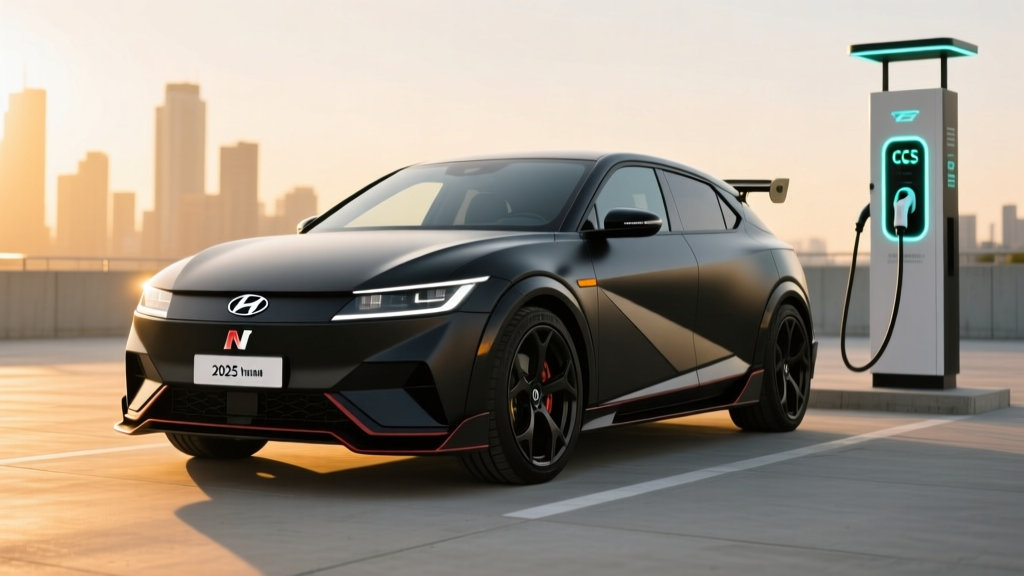
The Hyundai Ioniq 5 N isn't trying to be the most efficient electric crossover on the market. It's trying to be the most engaging — and the spec sheet backs it up. With dual motors producing up to 641 horsepower in N Grin Boost mode and a 0-60 mph time that embarrasses cars costing twice as much, Hyundai's N performance division has built something that challenges every assumption about what a hot EV can be. But performance comes at a cost — to range, to efficiency, and to your wallet. Here's everything you need to know before signing on the dotted line.
| Spec | Value |
|---|---|
| EPA Range | 221 miles |
| Battery (usable) | 84.0 kWh, NMC lithium-ion |
| Drivetrain | Dual-motor AWD |
| Horsepower (N Grin Boost) | 641 hp / 568 lb-ft torque |
| 0-60 mph | 3.25 seconds (manufacturer) |
| Top Speed | 161 mph |
| Max DC Fast Charge | 235 kW (800V architecture) |
| 10-80% DC Charge Time | ~18 minutes |
| Level 2 Home Charge Rate | 10.9 kW |
| EPA Efficiency | 79 MPGe combined (2.36 kWh/mile) |
| Cargo (rear seats up) | 27.2 cu ft |
| Cargo (rear seats folded) | 59.3 cu ft |
| Base MSRP | $67,695 (incl. $1,495 destination) |
| Battery/Powertrain Warranty | 10 years / 100,000 miles |
Real-World Range: What 221 EPA Miles Actually Means
The Ioniq 5 N carries an 84.0 kWh usable battery pack using NMC (nickel-manganese-cobalt) chemistry — chosen here for its higher energy density and power delivery over the LFP cells found in some standard-range Ioniq 5 trims. The EPA rates it at 221 miles of combined range. For context, that's roughly 80 miles fewer than the standard Ioniq 5 SEL AWD, which achieves 290 miles from a similar pack thanks to less aggressive tuning, stickier-but-narrower tires, and a lower curb weight.
- Mild weather, mixed driving: ~200–215 miles achievable with normal driving and regen use
- Highway cruising (70–80 mph): ~170–190 miles — the boxy aero profile and 275-width Pirelli P Zeros create significant drag
- Cold weather (below 32°F): ~145–170 miles — NMC chemistry loses roughly 20–30% range in freezing temps, compounded by cabin heating demands
- Track/l spirited driving: As little as 100–130 miles — N Grin Boost and sustained high-power output drain the pack rapidly
The Ioniq 5 N's thermal management system is among the best in the business — Hyundai added enhanced battery preconditioning and a dedicated N cooling mode to handle track abuse without severe derating. But physics is physics: 641 hp and 4,861 lbs of curb weight demand energy. If your daily commute is under 80 miles round-trip with home charging, the range is perfectly livable. If you're planning regular 300-mile road trips, you'll be stopping to charge at least once — and that's the trade-off you accept for this level of performance.
Charging: 800V Architecture Still Sets the Pace
The Ioniq 5 N uses Hyundai Motor Group's E-GMP platform with its native 800-volt electrical architecture. This is still one of the fastest-charging setups available in any production EV at this price point, and it's a genuine advantage over 400V competitors that bottleneck at lower charge rates.
| Charge Level | Power / Rate | Time / Speed |
|---|---|---|
| Level 1 (120V household) | ~1.4 kW | ~3–4 miles per hour of charging |
| Level 2 (240V home/public) | 10.9 kW | ~30 miles per hour; full charge in ~8.5 hours |
| DC Fast Charge (CCS/NACS*) | Peak 235 kW | 10–80% in ~18 minutes on a 350 kW charger |
*2025 Ioniq 5 N ships with CCS1 in the US. Hyundai offers a NACS adapter, and future builds may transition to native NACS. Verify with your dealer.
Charging curve reality check: The 235 kW figure is a peak, not a sustained rate. In real-world DC fast charging, the Ioniq 5 N pulls maximum power between roughly 10% and 45% state of charge, then tapers progressively. You'll see 200+ kW early in the session, dropping to ~150 kW by 60% SoC and further to ~80 kW by 75%. The 10–80% time of 18 minutes assumes a charger capable of delivering 350 kW (like Electrify America's latest stalls or Tesla Supercharger V4 with CCS adapter). On a 150 kW charger, expect 10–80% in roughly 28–32 minutes.
For home charging, the onboard 10.9 kW AC charger is generous — most competitors in this segment offer 7.7 to 11.5 kW. On a dedicated 48-amp Level 2 home charger (like a ChargePoint Home Flex or Emporia Level 2), you'll add roughly 30 miles of range per hour and fully replenish the 84 kWh pack overnight. Budget roughly $500–$1,200 for a quality Level 2 home installation, depending on whether your electrical panel needs a 60-amp circuit upgrade.
Performance: The 0-60 That Started the Conversation
Let's address the keyword directly: the Ioniq 5 N 0-60 mph time is 3.25 seconds with N Grin Boost engaged, per Hyundai's official figures. Independent testing by outlets including Car and Driver and Motor Trend has confirmed times in the 3.2–3.4 second range, depending on surface conditions and launch technique. That places the Ioniq 5 N in the company of the Porsche Taycan 4S, Tesla Model Y Performance, and BMW i4 M50 — cars that cost significantly more or offer far less practicality.
The powertrain is a dual-motor AWD setup: a front motor producing up to 223 hp and a rear motor producing up to 223 hp in standard mode, with N Grin Boost temporarily unlocking a combined 641 hp and 568 lb-ft for 10-second bursts. The system uses an 84 kWh NMC battery optimized for high C-rate discharge — meaning it can dump power to the motors aggressively without excessive voltage sag or thermal throttling.
But the Ioniq 5 N's performance story isn't just straight-line speed. Hyundai's N division engineered features that address the classic "fast EV" criticisms:
- N e-Shift: Simulates an 8-speed dual-clutch transmission with simulated shift shocks, rev matching, and even a "redline" — controversial among purists, but genuinely useful for modulating power on track
- N Active Sound+:: Internal and external speakers generate synthetic engine and turbo sounds. You can turn it off entirely
- Torque distribution: N Torque Kissing allows adjustable front/rear torque split from 100% rear to 100% front
- N Drift Optimizer: Yes, really. Adjusts torque distribution, damping, and stability control to facilitate controlled slides
- Brake regen: N-specific regen braking can deliver up to 0.6g of deceleration, reducing wear on the mechanical brakes during track sessions
On road, the adaptive dampers (electronically controlled) offer a genuinely compliant Normal mode and a spine-compressing N mode. The 275/35R-21 Pirelli P Zero tires provide exceptional grip but transmit road imperfections firmly. This is a performance car first, a comfort cruiser second.
Pricing, Trims & Federal Tax Credit Eligibility
The 2025 Ioniq 5 N is offered as a single, fully-loaded trim — there are no sub-trims or option packages beyond color choices and a few dealer-installed accessories.
| Item | Amount |
|---|---|
| Base MSRP (incl. $1,495 destination) | $67,695 |
| Performance Blue Matte paint | +$1,000 |
| Typical as-tested price | $67,695 – $69,500 |
| Federal §30D Tax Credit (potential max) | Up to $7,500 |
| Effective price after max credit | ~$60,195 |
Does the Ioniq 5 N qualify for the federal EV tax credit? This is where it gets complicated, and you should verify current eligibility on IRS.gov's clean vehicle credit page before purchasing. Under current §30D rules:
- MSRP cap: The Ioniq 5 N is classified as an SUV/crossover for tax credit purposes, which has an $80,000 MSRP cap. At $67,695, it clears this threshold easily.
- Buyer income limits: Modified AGI must not exceed $150,000 (single), $225,000 (head of household), or $300,000 (joint filers).
- Battery sourcing requirements: The $7,500 credit is split into two halves — $3,750 for critical minerals sourcing and $3,750 for battery component manufacturing. Hyundai's supply chain has evolved, but specific model-year sourcing compliance changes. As of the 2025 model year, the Ioniq 5 (standard trims built in Georgia at Hyundai's Metaplant) qualifies for the full $7,500. However, the Ioniq 5 N is built in Ulsan, South Korea — and its battery sourcing may limit the credit to $3,750 or potentially $0 depending on current-year FEOC (Foreign Entity of Concern) rules. Confirm with your dealer and a tax professional before relying on the credit.
- Point-of-sale transfer: If eligible, you can transfer the credit to the dealer at purchase for an immediate price reduction rather than waiting to claim it on your tax return.
Interior, Cargo & Daily Livability
The Ioniq 5 N shares its cabin architecture with the standard Ioniq 5, which means a flat floor (thanks to the E-GMP skateboard platform), generous rear legroom, and a dual-screen setup with dual 12.3-inch displays. Where the N diverges:
- N-specific sport seats: Heavily bolstered front buckets with integrated headrests and N badging. They hold you firmly in corners but may feel confining on long highway drives compared to the standard Ioniq 5's more relaxed chairs
- N steering wheel: Thicker rim with dedicated N1 and N2 shortcut buttons for custom drive mode presets, plus a red N Grin Boost button
- Aluminum pedals, N shift knob: Track-oriented details that signal intent
- Rear seat: 37.9 inches of legroom — adequate for adults, though the sloping roofline cuts into headroom for anyone over 6'0"
Cargo capacity is 27.2 cubic feet behind the rear seats and 59.3 cubic feet with them folded — competitive with the Tesla Model Y (30.2 / 76.2 cu ft) on the low side, owing partly to the N model's more aggressive rear suspension tuning eating into under-floor storage. There is no frunk (front trunk) — the space is occupied by power electronics and the enhanced cooling system.
On the tech front, the Ioniq 5 N runs Hyundai's latest infotainment with wireless Apple CarPlay and Android Auto, Bluelink connected services, and a full suite of Hyundai SmartSense ADAS features including:
- Highway Driving Assist 2 (SAE Level 2 — requires driver supervision at all times)
- Navigation-based smart cruise control
- Blind-spot collision avoidance
- Rear cross-traffic collision avoidance
- Remote Smart Parking Assist (the car can park itself while you stand outside)
Efficiency, Ownership Costs & Warranty
The EPA rates the Ioniq 5 N at 79 MPGe combined, which translates to approximately 2.36 kWh per mile (or 42.4 kWh/100mi). That's thirsty by EV standards — the standard Ioniq 5 AWD achieves 110 MPGe — but expected given the N's weight (4,861 lbs), tire width, and performance tuning.
At a national average electricity cost of ~$0.17/kWh (per EIA data), charging the Ioniq 5 N costs roughly $0.40 per mile at home on Level 2. DC fast charging at public rates ($0.35–$0.55/kWh) pushes that to $0.80–$1.30 per mile. For comparison, a 25 MPG gas car at $3.40/gallon costs ~$0.14 per mile. The Ioniq 5 N is not the EV you buy to save money on fuel — it's the EV you buy to have 641 hp and still carry groceries.
Hyundai's warranty coverage remains a class leader:
- New vehicle: 5 years / 60,000 miles
- Powertrain: 10 years / 100,000 miles
- Battery: 10 years / 100,000 miles (capacity retention warranty covers degradation below 70% of original capacity)
- Corrosion: 7 years / unlimited miles
- Roadside assistance: 5 years / unlimited miles
The 10-year battery warranty with a 70% retention threshold is among the most generous in the industry, and Hyundai's track record with the E-GMP platform's thermal management suggests strong long-term durability. NMC chemistry typically sees 10–15% degradation over the first 100,000 miles in normal use, though high-performance driving and frequent DC fast charging can accelerate this slightly.
Ioniq 5 N vs. the Competition
The performance EV crossover segment has grown crowded. Here's how the Ioniq 5 N stacks up against its most direct rivals on the metrics that matter:
| Hyundai Ioniq 5 N | Tesla Model Y Performance | BMW i4 M50 | Porsche Macan 4 E-Perf | |
|---|---|---|---|---|
| 0-60 mph | 3.25 sec | 3.5 sec | 3.7 sec | 4.9 sec |
| Horsepower | 641 hp | 456 hp | 536 hp | 402 hp |
| EPA Range | 221 mi | 277 mi | 245 mi | 300+ mi (est.) |
| Max DC Charge | 235 kW | 250 kW | 205 kW | 270 kW |
| Base MSRP | $67,695 | ~$54,990 | ~$69,900 | ~$84,000 |
| Battery Warranty | 10yr/100k mi | 8yr/120k mi | 8yr/80k mi | 8yr/100k mi |
The Ioniq 5 N wins on peak horsepower and warranty length, ties or beats on charge speed, but trails on range and efficiency. The Model Y Performance is the value pick if you want speed on a budget; the i4 M50 offers a more premium interior but is a sedan (less cargo); the Macan is the luxury play at a steep premium.
- Sub-3.5 sec 0-60 with genuine track capability
- 800V architecture — 10-80% in ~18 min on 350 kW charger
- Class-leading 10-year/100,000-mile battery warranty
- N e-Shift and torque vectoring add real driving engagement
- Practical crossover cargo space (27.2 cu ft)
- Under $68k before potential tax credit
- 221-mile EPA range — shortest in the segment
- 79 MPGe efficiency means higher charging costs
- Firm ride in N mode; sport seats may fatigue on long drives
- No frunk — all electronics under the hood
- South Korea-built: federal tax credit eligibility uncertain vs. US-built trims
- Synthetic sounds and simulated shifts won't appeal to purists
Who Should Buy the Ioniq 5 N?
The Ioniq 5 N is built for a specific buyer: someone who wants supercar-rivaling acceleration, track-day credibility, and daily-driver practicality in a single package — and who has reliable home charging to offset the limited range. It's an excellent choice for:
- Enthusiasts with a commute: If your daily drive is under 80 miles and you have Level 2 at home, the range limitation is manageable, and you'll smile every time you merge onto the highway
- Track-day participants: The thermal management, N e-Shift, and torque vectoring make this a legitimate track car that can drive home afterward
- Performance EV skeptics: If you've dismissed EVs as "fast but boring," the N division's chassis tuning, steering feel, and e-Shift system make a compelling counter-argument
It's not ideal for:
- Long-distance commuters: 221 miles of range with real-world losses means frequent charging stops on 200+ mile days
- Efficiency-first buyers: At 79 MPGe, your electricity costs will be noticeably higher than a standard Ioniq 5 or Tesla Model Y
- Comfort-priority families: The firm suspension and aggressive seats are tuned for performance, not plushness
Frequently Asked Questions
What is the real-world range of the Hyundai Ioniq 5 N?
The EPA rates the Ioniq 5 N at 221 miles combined. In real-world mixed driving in moderate temperatures, expect 200–215 miles. Highway driving at 75+ mph drops this to roughly 170–190 miles, and cold weather (below freezing) can reduce range to 145–170 miles. Track use will deplete the battery far more quickly.
How fast does the Ioniq 5 N charge?
On a 350 kW DC fast charger, the Ioniq 5 N peaks at 235 kW and charges from 10–80% in approximately 18 minutes. On a 150 kW charger, expect 28–32 minutes for the same range. At home on a 240V Level 2 charger (10.9 kW), a full charge takes about 8.5 hours, adding roughly 30 miles per hour of charging.
What does the Ioniq 5 N cost after tax credits?
The base MSRP is $67,695 including destination. If you qualify for the full $7,500 federal §30D credit (subject to income caps, MSRP limits, and battery sourcing requirements), the effective price drops to roughly $60,195. However, because the Ioniq 5 N is built in South Korea, its battery sourcing compliance is less certain than US-built Ioniq 5 trims. Verify current eligibility on IRS.gov and with a tax professional before purchasing.
Is the Ioniq 5 N worth it vs. the Tesla Model Y Performance?
If your priority is maximum driving engagement, chassis dynamics, and track capability, the Ioniq 5 N justifies its $12,700+ premium over the Model Y Performance. If your priority is range (277 vs. 221 miles), Supercharger network access, and value, the Model Y Performance is the pragmatic pick. They serve different buyer profiles despite similar performance numbers.
Does the Ioniq 5 N qualify for the $7,500 federal EV tax credit?
Potentially, but it's not guaranteed. The MSRP ($67,695) is well under the $80,000 SUV cap, and qualifying buyers must meet income thresholds. The complicating factor is battery component and critical mineral sourcing — the Ioniq 5 N is imported from South Korea, and its supply chain may not meet all §30D requirements for the full $7,500. Check the fueleconomy.gov tax credit database for the most current eligibility status for your specific model year.
What's the 0-60 time of the Ioniq 5 N?
Hyundai quotes 3.25 seconds for the 0-60 mph sprint with N Grin Boost engaged (641 hp). Independent testing has confirmed times in the 3.2–3.4 second range. This makes the Ioniq 5 N one of the quickest production crossovers available at any price point.
How does the N e-Shift system work?
N e-Shift simulates an 8-speed dual-clutch transmission by modulating motor torque to create the sensation of gear shifts — complete with shift shock, rev matching, and a simulated redline at which power "drops" until you "upshift" via the steering wheel paddles. It's designed to give drivers more granular control over power delivery on track and to make the driving experience feel more analog. You can disable it entirely for seamless single-speed EV acceleration.
Sources: fueleconomy.gov (EPA range and efficiency data), IRS.gov (§30D clean vehicle credit rules), Hyundai Motor America official specifications.