The Chevrolet Bolt has long been the entry point for budget-conscious EV buyers, and the current-generation Bolt (often referred to as the Bolt EV and Bolt EUV) remains a compelling value proposition in 2026. But while range and pricing dominate headlines, the interior of the Chevy Bolt is where owners actually spend their time — and it tells a more nuanced story than the spec sheet alone suggests. This review breaks down everything from cabin materials and cargo dimensions to the full powertrain, charging, and ownership picture.
Chevy Bolt Interior: Space, Materials, and Daily Livability
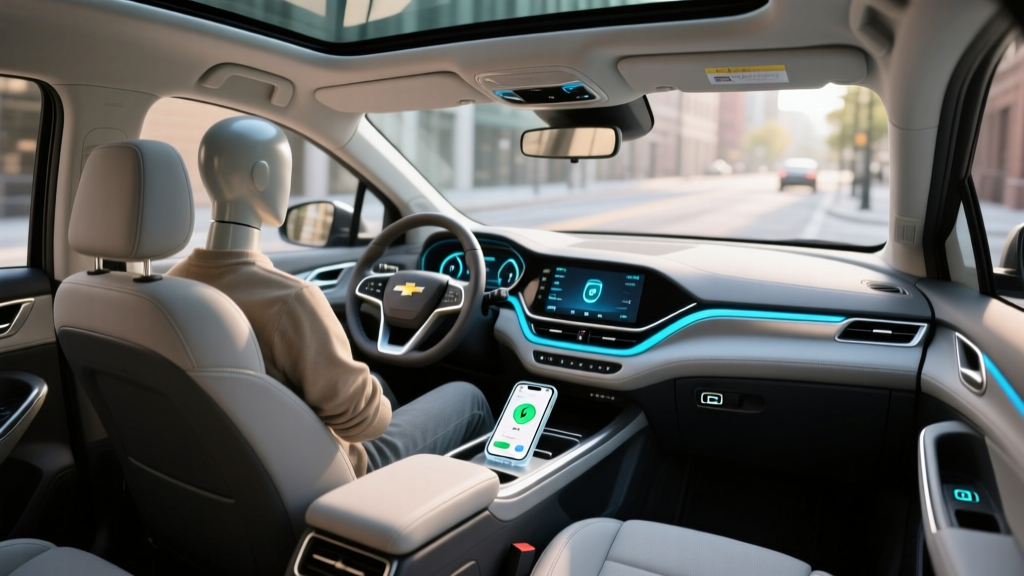
Step inside the Bolt and you'll find a cabin that prioritizes function over luxury. The dashboard layout is straightforward, dominated by an 11-inch diagonal infotainment touchscreen running Chevrolet's latest Infotainment 3 system with wireless Apple CarPlay and Android Auto. A 10.2-inch digital driver information cluster replaces traditional gauges, displaying range, energy flow, and regen settings.
Material quality reflects the Bolt's price point. Hard plastics dominate the lower dash, door panels, and center console — a deliberate cost-saving measure that keeps the MSRP low. The upper dash uses a softer-touch material, and the available leatherette-trimmed seats (Premier trim) add a layer of refinement over the base cloth. Panel gaps are consistent, and nothing rattles at highway speed, but comparison shoppers coming from a Hyundai Kona Electric or a Volvo EX30 will notice the difference immediately.
Passenger and Cargo Dimensions
The Bolt hatchback (sometimes called the Bolt EV) offers 94.4 cubic feet of total passenger volume and 16.3 cubic feet of cargo space behind the rear seats. Fold the 60/40 split rear bench flat, and that expands to approximately 54.6 cubic feet — enough for a week's worth of groceries, two large suitcases, or a full Costco run.
The Bolt EUV (Electric Utility Vehicle) variant stretches the wheelbase, yielding 97.6 cubic feet of passenger volume and 16.3 cubic feet of cargo, expanding to roughly 54.3 cubic feet with seats folded. The EUV's advantage is rear-seat legroom: approximately 39.1 inches versus 35.6 inches in the standard Bolt — a meaningful difference for families with rear-facing car seats or tall teenagers.
| Measurement | Bolt EV (Hatchback) | Bolt EUV |
|---|---|---|
| Front Headroom | 39.7 in | 40.0 in |
| Front Legroom | 42.1 in | 40.9 in |
| Rear Headroom | 37.9 in | 38.3 in |
| Rear Legroom | 35.6 in | 39.1 in |
| Cargo (seats up) | 16.3 cu ft | 16.3 cu ft |
| Cargo (seats folded) | 54.6 cu ft | 54.3 cu ft |
| Passenger Volume | 94.4 cu ft | 97.6 cu ft |
Notable interior drawbacks: the center armrest is narrow, rear-seat USB ports are limited (one port on lower trims), and the cargo floor sits slightly high due to the battery pack placement beneath the floor. There's no frunk (front trunk) — the space under the hood houses the motor and power electronics.
Range, Battery, and Real-World Efficiency
The current Chevy Bolt is equipped with a 65 kWh (usable capacity) lithium-ion battery pack using NMC (nickel manganese cobalt) chemistry. This is not an LFP pack — NMC offers higher energy density, which is how GM fits meaningful range into the Bolt's compact platform.
Real-World Expectation: In mixed city/highway driving at moderate temperatures, expect 230–250 miles. Sustained highway driving at 75+ mph drops this to roughly 210–225 miles. In freezing weather (below 30°F) with cabin heat, plan for 170–200 miles. The Bolt lacks a heat pump, which increases cold-weather energy consumption compared to competitors that use one.
Efficiency is rated at 120 MPGe combined (Bolt EV), translating to approximately 28 kWh per 100 miles — competitive for the segment. The Bolt's relatively light curb weight (around 3,563 lbs for the EV, 3,679 lbs for the EUV) helps efficiency in city driving where regenerative braking recaptures energy frequently.
Charging Speeds: DC Fast, Level 2, and Level 1
The Bolt's charging profile is where buyers need to set realistic expectations. GM equipped the Bolt with a DC fast-charging capability that peaks at approximately 55 kW — a figure that trails most modern competitors significantly.
| Charging Level | Power / Rate | Speed / Time |
|---|---|---|
| Level 1 (120V household) | ~1.4 kW | ~4 miles of range per hour |
| Level 2 (240V home/public) | 11.5 kW (max onboard charger) | ~39 miles of range per hour; 0–100% in ~7 hours |
| DC Fast Charge (CCS) | 55 kW peak | 10–80% in ~55 minutes; adds ~90 miles in 30 min |
The 11.5 kW onboard AC charger is genuinely excellent for this price class — it means a full overnight charge on a Level 2 home station in about seven hours. However, the 55 kW DC fast-charge ceiling is the Bolt's most significant limitation for road-trippers. On a 300-mile trip requiring a mid-route charge, you'll spend 50–60 minutes at the charger while competitors with 150–250 kW peak rates add the same range in 15–20 minutes.
The charge curve is relatively flat — the Bolt sustains close to its peak rate from low states of charge but tapers gradually above 80% SoC. There's no dramatic cliff, but there's also no exciting ramp-up. The Bolt uses a CCS1 connector; NACS (Tesla Supercharger) compatibility requires an adapter, and GM has been rolling out adapter access to the Supercharger network for Bolt owners.
Performance, Drivetrain, and Driving Impressions
The Bolt is powered by a single front-mounted permanent-magnet electric motor producing 200 horsepower and 266 lb-ft of torque, driving the front wheels. There is no AWD or dual-motor option.
| Spec | Value |
|---|---|
| Motor Output | 200 hp / 266 lb-ft torque |
| Drivetrain | FWD (single motor) |
| 0–60 mph | ~6.5 seconds (Bolt EV) |
| Battery Capacity | 65 kWh usable (NMC chemistry) |
| EPA Range | 259 mi (EV) / 247 mi (EUV) |
| MPGe Combined | 120 MPGe (EV) |
| Curb Weight | ~3,563 lbs (EV) / ~3,679 lbs (EUV) |
The 266 lb-ft of torque is available instantly, giving the Bolt confident city acceleration and easy merging. The 0–60 time of roughly 6.5 seconds is respectable — quicker than most compact gas crossovers. Ride quality is compliant, the turning radius is tight (ideal for urban parking), and the low center of gravity from the floor-mounted battery minimizes body roll.
Regenerative braking is adjustable via steering-wheel paddles and a one-pedal driving mode that can bring the car to a complete stop without touching the brake pedal. It's well-calibrated and one of the Bolt's most appreciated features among experienced EV drivers.
Tech, Safety, and Driver Assistance
The infotainment system is a bright spot. The 11-inch touchscreen is responsive, supports wireless Apple CarPlay and Android Auto, and includes built-in Google services on higher trims (navigation, Google Assistant). A Wi-Fi hotspot is available via OnStar.
Driver assistance is bundled under Chevrolet's Chevy Safety Assist suite, standard across all trims:
- Automatic Emergency Braking with Front Pedestrian Braking
- Forward Collision Alert
- Lane Keep Assist with Lane Departure Warning
- Following Distance Indicator
- IntelliBeam automatic high beams
- Rear Vision Camera (HD Surround Vision available on Premier)
Adaptive cruise control is available on 2LT and Premier trims. Blind-spot monitoring and rear cross-traffic alert are also available but not standard on the base trim — an important consideration for safety-minded buyers.
Pricing, Trims, and Federal Tax Credit Eligibility
The Bolt's pricing remains its strongest competitive weapon. For 2026, MSRP figures are as follows:
| Trim | Base MSRP | Est. After §30D Credit* |
|---|---|---|
| Bolt EV 1LT | ~$26,500 | ~$19,000 |
| Bolt EV 2LT | ~$29,400 | ~$21,900 |
| Bolt EUV LT | ~$28,200 | ~$20,700 |
| Bolt EUV Premier | ~$33,200 | ~$25,700 |
*Federal tax credit estimates shown assume full $7,500 eligibility under IRS §30D rules. Actual credit depends on multiple factors.
- MSRP Cap: The Bolt qualifies — its MSRP is well under the $55,000 cap for cars/SUVs per IRS §30D guidelines.
- Buyer Income Limits: Modified AGI must not exceed $150,000 (single), $225,000 (head of household), or $300,000 (joint filers).
- Battery Component & Critical Minerals Sourcing: The Bolt's battery sourcing must meet phased-in thresholds for North American assembly and critical-mineral procurement. These requirements tighten annually — verify current-year eligibility at fueleconomy.gov or consult a tax professional before purchase.
- Point-of-Sale Transfer: Eligible buyers can transfer the credit to the dealer at purchase, reducing the out-of-pocket price immediately rather than waiting for a tax refund.
Warranty and Long-Term Battery Outlook
Chevrolet backs the Bolt's battery pack and electric drive components with an 8-year / 100,000-mile warranty (whichever comes first), with a capacity-retention threshold typically set at 60% of original capacity. The limited vehicle warranty is 3 years / 36,000 miles bumper-to-bumper and 5 years / 60,000 miles powertrain.
For NMC battery packs of this generation, industry data suggests typical degradation of 8–12% over the first 100,000 miles under normal use — meaning most owners will retain 88–92% of original capacity well within the warranty period. Avoiding repeated DC fast-charging to 100% and minimizing prolonged storage at very high or very low states of charge can further extend pack life.
Who the Chevy Bolt Is Best For — and Who Should Look Elsewhere
- You primarily commute under 60 miles round-trip and charge at home overnight
- Budget is your top priority — you want the lowest-cost new EV available
- You value a tall hatchback cargo area over sporty driving dynamics
- You want strong Level 2 home charging (11.5 kW) without paying a premium
- You road-trip frequently and need 150+ kW DC fast charging to minimize stops
- You need AWD for snow-belt winters
- You want premium interior materials or a luxury-brand badge
- You need to tow (the Bolt is not rated for towing)
Pros
- Among the lowest MSRP of any new EV
- 259-mile EPA range is ample for commuting
- 11.5 kW Level 2 charger — best in class at this price
- Spacious cargo area for a compact hatchback
- One-pedal driving and strong regenerative braking
- Standard Chevy Safety Assist suite
Cons
- 55 kW DC fast-charge peak is slow for road trips
- No heat pump — significant cold-weather range loss
- Hard-plastic-heavy interior at this price point
- FWD only — no AWD option
- CCS connector; Supercharger access requires adapter
- Blind-spot monitoring not standard on base trim
Frequently Asked Questions
What is the real-world range of the Chevy Bolt?
The EPA rates the Bolt EV at 259 miles and the EUV at 247 miles. In real-world mixed driving at moderate temperatures, expect 230–250 miles. Highway-only driving at 75 mph reduces this to about 210–225 miles. In sub-freezing weather with the heater running, plan for 170–200 miles due to the lack of a heat pump.
How fast does the Chevy Bolt charge?
On a Level 2 (240V) home charger, the Bolt charges at up to 11.5 kW, adding roughly 39 miles per hour and reaching a full charge in about 7 hours. On a DC fast charger, it peaks at 55 kW, taking approximately 55 minutes for a 10–80% charge. This is significantly slower than competitors with 150–250 kW capability.
How much does the Chevy Bolt cost after tax credits?
With a base MSRP starting around $26,500 and potential eligibility for the full $7,500 federal tax credit under IRS §30D, the effective price can drop to roughly $19,000 for qualified buyers. Eligibility depends on buyer income, battery sourcing requirements, and MSRP caps — verify at irs.gov before purchasing.
Is the Chevy Bolt worth buying vs. competitors?
If your priority is lowest cost of entry with adequate range for commuting, the Bolt is hard to beat. However, if you road-trip often, the Hyundai Kona Electric (faster DC charging, available heat pump), the Nissan Leaf (though CHAdeMO is declining), or stepping up to a Tesla Model 3 or Hyundai Ioniq 5 will serve you better for highway use. The Bolt wins on price; it compromises on charging speed and interior refinement.
Does the Chevy Bolt qualify for the federal EV tax credit?
The Bolt's MSRP falls well under the §30D cap, making it price-eligible. However, full $7,500 credit eligibility depends on current-year battery component and critical-mineral sourcing thresholds, which tighten annually, plus buyer income limits. Check the latest eligibility list at fueleconomy.gov and consider consulting a tax professional for your specific situation.
Is the interior of the Chevy Bolt comfortable for long drives?
The front seats are supportive for drives up to 2–3 hours. Road-trip comfort is limited more by charging speed than seat quality — the 55-minute DC fast-charge stops mean more time out of the car. Rear-seat comfort is good in the EUV (with its longer wheelbase and extra legroom) but tighter in the standard Bolt hatchback for adults on longer journeys.