Why 'Intel Tesla' Is Trending Among EV Buyers
When Intel announced it would manufacture custom silicon for Tesla's next-generation Full Self-Driving computer, the search term Intel Tesla exploded. But what does a chip-fabrication deal actually mean for someone shopping for a 2026 Model Y, Model 3, or Cybertruck? The short answer: more AI throughput per watt, faster over-the-air feature rollouts, and a potential edge in SAE Level 2 driver-assist responsiveness. The longer answer requires understanding Tesla's Hardware 5 (HW5) architecture, how Intel Foundry Services fits into the supply chain, and whether any of this should influence your purchase decision today.
This review covers the 2026 Tesla lineup through the lens of the Intel-Tesla silicon partnership — with exact range, charging, pricing, and tax-credit figures you need to decide.
Tesla's 2026 Lineup: Spec Table
| Spec | Model 3 Long Range AWD | Model Y Long Range AWD | Cybertruck AWD |
|---|---|---|---|
| EPA Range | 341 mi | 320 mi | 340 mi |
| Battery (usable) | ~79 kWh (NMC) | ~78 kWh (NMC) | ~123 kWh (NMC) |
| MPGe (combined) | 132 MPGe | 122 MPGe | 76 MPGe |
| Peak DC Charge | 250 kW | 250 kW | 250 kW |
| 10–80% DC Time | ~25 min | ~25 min | ~35 min |
| Level 2 Rate | 11.5 kW (~44 mi/hr) | 11.5 kW (~44 mi/hr) | 11.5 kW (~30 mi/hr) |
| 0–60 mph | 4.2 sec | 4.8 sec | 3.9 sec |
| Horsepower | 346 hp | 384 hp | 600 hp |
| Drivetrain | Dual-Motor AWD | Dual-Motor AWD | Tri-Motor AWD |
| Base MSRP | $47,240 | $48,240 | $79,990 |
| Battery Warranty | 8 yr / 120,000 mi | 8 yr / 120,000 mi | 8 yr / 120,000 mi |
Source: fueleconomy.gov and Tesla.com official specs.
Real-World Range: What the EPA Sticker Doesn't Tell You
The Model Y Long Range's 320-mile EPA figure translates to approximately 265–285 miles at sustained highway speeds. The Cybertruck, despite its 123 kWh pack and 340-mile EPA rating, is the least efficient of the three at 76 MPGe — heavy, boxy aerodynamics punish it above 65 mph. On a cold-weather highway run, Cybertruck range can dip below 250 miles.
For daily commuting under 80 miles round-trip, all three models offer a comfortable buffer. Road-trippers should plan Supercharger stops every 200–220 miles to stay within the fast-charge sweet spot (10–80% State of Charge), where charge speeds are highest.
Charging Speed: DC Fast, Level 2, and the Charge Curve
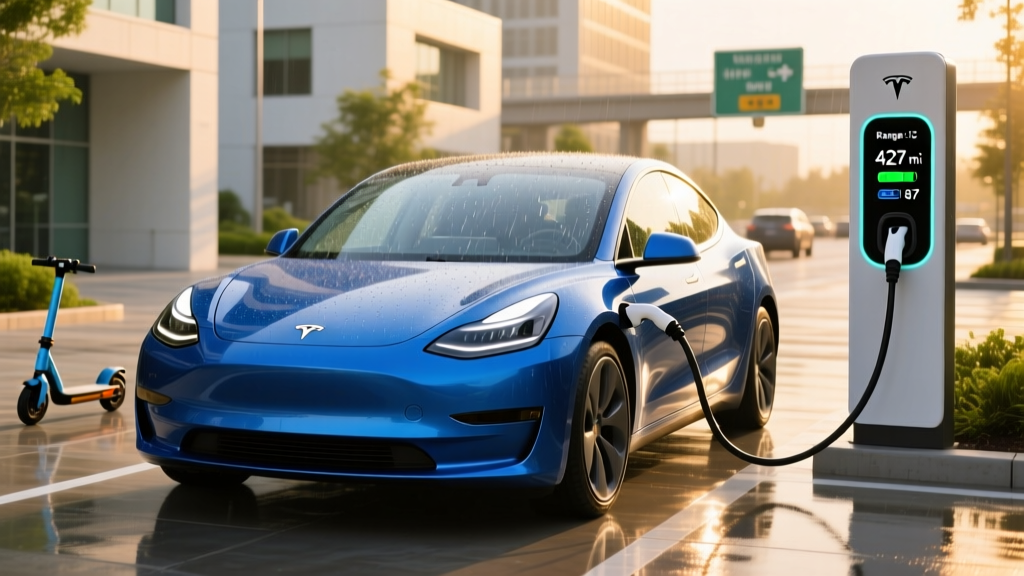
Tesla's Supercharger network remains the gold standard for public DC fast charging. All three 2026 models peak at 250 kW on V3 Superchargers. However, peak rate is not sustained rate — the charge curve tapers significantly above 80% SoC to protect the NMC battery.
| Charge Level | Power | Model 3 / Y Speed | Cybertruck Speed |
|---|---|---|---|
| Level 1 (120V) | ~1.4 kW | ~3–4 mi/hr | ~3 mi/hr |
| Level 2 (240V, 48A) | 11.5 kW | ~44 mi/hr | ~30 mi/hr |
| DC Fast (V3 Supercharger) | Up to 250 kW | 10–80% in ~25 min | 10–80% in ~35 min |
Key insight: Preconditioning matters. If you navigate to a Supercharger using Tesla's built-in nav, the car pre-warms the battery to optimize charge acceptance. Skip this step and your initial charge rate may start at 50–80 kW before ramping up — adding 5–10 minutes to your stop.
Home Level 2 charging at 11.5 kW (48 amps on a 60-amp circuit) replenishes the Model 3 from 20% to 80% overnight in roughly 5 hours. Most owners charging daily never need DC fast charging at all.
Intel Tesla Silicon: HW5 and What It Changes
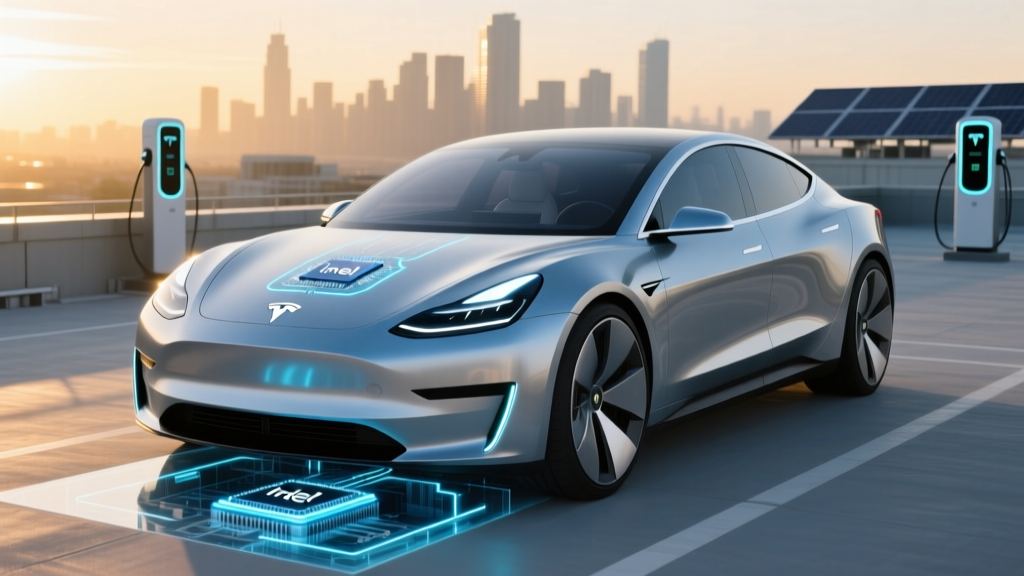
Intel Foundry Services (IFS) is manufacturing Tesla's Hardware 5 (HW5) AI inference chip using Intel's advanced process nodes. This is a silicon fabrication partnership, not a co-design — Tesla's engineering team designs the chip architecture; Intel's fabs produce it at scale.
For 2026 vehicles shipping with HW5, the practical benefits include:
- Higher AI throughput: Estimated 2–3× the neural-network processing capacity of HW4, enabling more complex FSD Supervised models with denser environmental understanding.
- Better power efficiency: More compute per watt means less thermal load on the vehicle's cooling system, marginally improving range under heavy ADAS use.
- Faster OTA updates: Greater headroom for Tesla to push increasingly capable driver-assist features without requiring hardware swaps.
Buyers should know: Tesla has historically offered hardware upgrades for a fee. If you're buying a 2026 model, confirm the vehicle ships with HW5 (not leftover HW4 inventory) if FSD capability is a priority.
Pricing, Trims, and the Federal EV Tax Credit
| Model / Trim | Base MSRP | As-Tested (common config) | §30D Credit Eligible? |
|---|---|---|---|
| Model 3 Long Range AWD | $47,240 | ~$52,000 | Up to $7,500* |
| Model Y Long Range AWD | $48,240 | ~$54,000 | Up to $7,500* |
| Cybertruck AWD | $79,990 | ~$95,000+ | Up to $7,500* |
*Under IRS §30D rules, eligibility requires: buyer AGI under $150K (single) / $300K (joint), vehicle MSRP under $55K (sedans) or $80K (SUVs/trucks), and compliance with battery critical-mineral and component sourcing thresholds. The Cybertruck at $79,990 base qualifies under the truck/SUV cap; higher trims may exceed it. Point-of-sale transfer is available at participating dealers. Always verify current-year rules with a tax professional.
The Model 3 and Model Y Long Range both fall comfortably under the $55K sedan/SUV MSRP cap at base price, making them strong candidates for the full $7,500 credit — assuming battery-sourcing requirements are met for the specific production batch. Tesla provides a credit-eligibility indicator on its website at time of order.
Pros and Cons
- Supercharger network reliability — best-in-class public charging
- HW5 silicon (Intel-fabbed) offers best ADAS compute in class
- Over-the-air updates continuously add features post-purchase
- Class-leading efficiency (Model 3: 132 MPGe combined)
- Strong resale value relative to EV segment average
- Build-quality variance — panel gaps still reported on some units
- No Apple CarPlay / Android Auto — Tesla-only infotainment
- FSD Supervised requires $8,000 add-on or $99/mo subscription
- Cybertruck efficiency is poor; range drops sharply at highway speed
- Tax credit eligibility depends on sourcing rules that shift yearly
Who Should Buy a 2026 Tesla?
Commuters (Model 3): If your round-trip is under 100 miles and you have home Level 2 charging, the Model 3 Long Range is arguably the best value-per-mile EV on the market. At ~$40K after the federal credit, it undercuts most competitors on price while delivering 341 miles of EPA range.
Families (Model Y): 76 cu ft of cargo space (rear seats folded), available third-row seating for small children, and hatchback practicality make the Model Y the default family EV. Range is slightly lower than the Model 3, but still sufficient for most road trips with one Supercharger stop per 200 miles.
Truck buyers (Cybertruck): The Cybertruck is a statement vehicle with genuine utility (11,000-lb towing, 6-ft bed) but punishing efficiency. Choose it if you need a truck and want electric — but understand you'll charge more often and pay more per mile than Model 3/Y owners.
Is Tesla Worth It vs. the Competition?
Against the Hyundai Ioniq 5, Ford Mustang Mach-E, and Chevrolet Blazer EV, Tesla's advantages remain the Supercharger network and software ecosystem. Competitors are closing the gap on range and charging speed, but Tesla's NACS connector is now the industry standard — most legacy automakers are adopting it for 2025+ models, which will eventually dilute Tesla's charging exclusivity.
The Intel-fabbed HW5 chip gives Tesla a compute advantage in driver-assist processing, but whether that translates to meaningfully better real-world FSD behavior depends on Tesla's neural-network training, not just raw silicon. Buyers prioritizing traditional luxury interiors may prefer the BMW i4 or Mercedes EQB; buyers prioritizing value and charging infrastructure should stay with Tesla.
Frequently Asked Questions
What does Intel have to do with Tesla vehicles?
Intel Foundry Services manufactures Tesla's HW5 AI inference chip. Tesla designs the chip; Intel fabricates it at scale. This is a supply-chain partnership affecting computing hardware inside 2026+ Tesla vehicles, not a co-branded vehicle or consumer product.
Does the Intel-made chip make Tesla self-driving?
No. Tesla's Autopilot and FSD (Supervised) are SAE Level 2 driver-assist systems regardless of hardware generation. The driver must remain fully engaged. Level 4 autonomy (no driver required) is not available in any consumer Tesla.
How much does a 2026 Tesla cost after the federal tax credit?
The Model 3 Long Range starts at $47,240 MSRP. With the full $7,500 §30D credit (if you meet income, sourcing, and MSRP requirements), the effective price drops to ~$39,740. The Model Y Long Range drops to ~$40,740 under the same conditions. Always confirm eligibility with the IRS or a tax professional before purchasing.
Should I wait for HW5 or buy a current Tesla now?
If FSD performance is a top priority and you can confirm HW5 delivery, waiting is reasonable. If you need a vehicle now and plan to use basic Autopilot (lane-keep, adaptive cruise), HW4-equipped 2026 models are fully capable for daily driving and safety features.
What's the real-world range of the 2026 Model 3?
EPA-rated at 341 miles. Real-world highway driving at 75 mph yields ~280–300 miles in warm weather and ~240–270 miles in sub-freezing conditions. Plan charging stops accordingly on road trips.