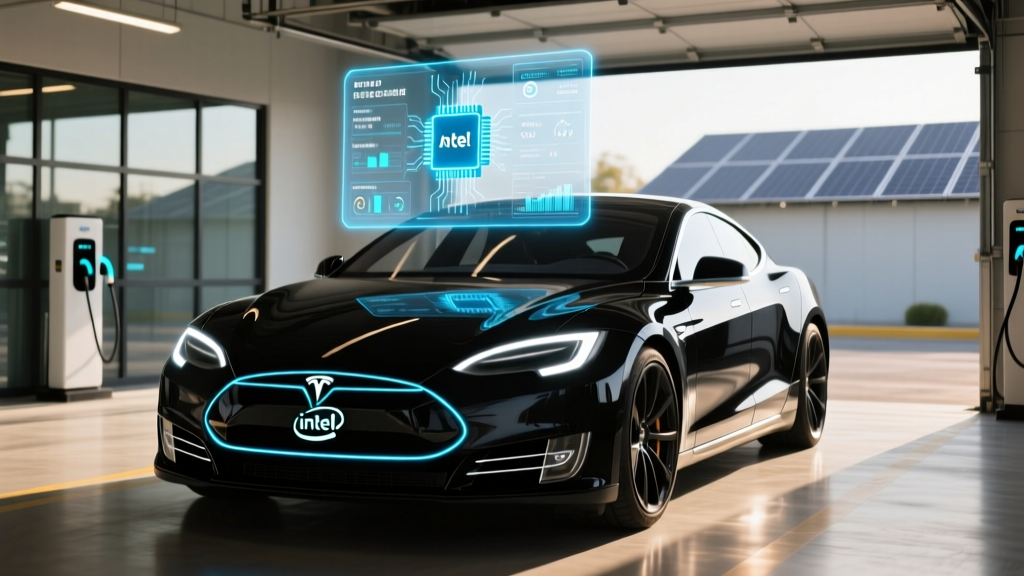
When EV shoppers search for "Intel and Tesla," they're usually trying to untangle a web of overlapping stories: Intel's Mobileye division once supplied Tesla's earliest Autopilot chips, Intel foundries now compete to manufacture Tesla's custom silicon, and Tesla's in-house Dojo supercomputer relies on a complex semiconductor supply chain where Intel plays a role. This guide cuts through the noise to explain exactly where Intel and Tesla intersect in 2026 — and what that means for the cars you can actually buy today.
The Intel-Tesla Relationship: A Quick History
Tesla's first Autopilot hardware (Hardware 1, or HW1, introduced in 2014) ran on an Intel-based Mobileye EyeQ3 system-on-chip. Mobileye, then an Intel subsidiary (acquired in 2017 for $15.3 billion), provided the vision-processing silicon that enabled Tesla's earliest lane-keeping and adaptive cruise features. That partnership ended abruptly in 2016 when Tesla pivoted to its own custom Full Self-Driving (FSD) chip, designed in-house and fabricated by Samsung.
Since then, the Intel-Tesla relationship has evolved from a direct supplier arrangement into something more indirect but strategically important:
- Intel Foundry Services (IFS) competes for contracts to manufacture Tesla's next-generation AI inference chips
- Intel's x86 architecture previously powered Tesla's MCU1 and MCU2 infotainment systems before Tesla shifted to AMD Ryzen for MCU3 (2021+)
- Intel Mobileye remains a major ADAS supplier to rival automakers (Volkswagen, Porsche, BMW), making it a competitive benchmark against Tesla's vision-only Autopilot/FSD stack
- Intel CPUs and accelerators are used in data-center training clusters that Tesla and other AI labs use for neural-network development
The bottom line: Intel no longer supplies chips that ship inside a new 2026 Tesla vehicle's drivetrain or autonomy stack, but Intel's foundry and data-center businesses remain entangled with Tesla's broader AI ambitions.
Where Intel Silicon Meets Tesla Vehicles in 2026
If you're buying a new Tesla today — whether a refreshed Model 3 Highland, Model Y Juniper, Cybertruck, or the new-generation platform — here's where Intel does and doesn't appear in the silicon stack:
| Subsystem | 2026 Silicon Supplier | Intel Role |
|---|---|---|
| Autonomy (FSD/Autopilot) | Tesla HW4 (custom, Samsung fab) | None — former Mobileye supplier |
| Infotainment (MCU) | AMD Ryzen Embedded | None — Intel Atom powered MCU1/MCU2 (pre-2021) |
| Battery Management | Tesla custom + TI/NXP | None |
| Dojo Training Tiles | Tesla D1 chip (TSMC 7nm) | Potential future IFS fab partner |
| Cellular/Connectivity | Quectel modems (Qualcomm-based) | None |
| Data-Center Training | NVIDIA H100 + Tesla Dojo | Intel Gaudi accelerators (competitive) |
The key takeaway for buyers: the chips that determine your Tesla's range, charging speed, Autopilot behavior, and infotainment responsiveness are not Intel products in 2026. Intel's relevance to Tesla owners is primarily downstream — through the competitive pressure Mobileye places on Tesla's FSD development, and through Intel Foundry's potential to manufacture future Tesla silicon as TSMC capacity tightens.
Mobileye vs. Tesla FSD: The Autonomy Benchmark
Intel's most visible connection to the Tesla conversation is Mobileye, which Intel took public in 2022 while retaining majority ownership. Mobileye supplies ADAS and autonomous-driving silicon to over 50 automakers and represents the dominant alternative to Tesla's vision-only approach.
Here's how Mobileye's current stack compares to Tesla's FSD (Supervised) as of the 2026 model year:
| Attribute | Tesla FSD (Supervised) | Mobileye SuperVision |
|---|---|---|
| SAE Level | Level 2 | Level 2 |
| Sensor Approach | Vision-only (8 cameras) | Vision + optional lidar (11 cameras) |
| Chip | Tesla HW4 (dual SoC) | Mobileye EyeQ6H |
| Availability | All Tesla models | Porsche, Zeekr, Polestar, BMW |
| Hands-Free Highway | No (supervised) | Yes on approved roads (EyeQ6H) |
| City Street Navigation | Yes (supervised, US-wide) | Limited deployment (China, EU) |
| Consumer Cost | $8,000 one-time or $99/mo | Included in vehicle package |
For Tesla buyers, Mobileye matters because it sets the competitive bar. When Porsche's Macan EV or BMW's iX delivers smooth, hands-free highway driving using Mobileye silicon, it pressures Tesla to improve FSD's supervised experience. Intel, through Mobileye, effectively funds the R&D that keeps Tesla's autonomy team honest.
Tesla's Semiconductor Strategy: Why Intel Foundry Matters
Tesla designs its own chips but doesn't manufacture them. The company's HW4 autonomy chip is fabricated by Samsung, and its Dojo D1 training chip is built on TSMC's 7nm node. As global demand for AI silicon has strained TSMC's capacity, Tesla — like Apple, NVIDIA, and AMD — has explored diversifying its foundry partners.
Intel Foundry Services (IFS), Intel's contract-manufacturing division launched in 2021, positions itself as a geopolitical hedge: US-based fabs in Ohio and Arizona, backed by CHIPS Act funding, offer Tesla a domestic alternative to TSMC and Samsung. While Tesla has not publicly confirmed an IFS contract as of early 2026, industry analysts at Reuters have reported ongoing discussions between Tesla and Intel regarding next-generation inference chips for Tesla's Optimus robot and future vehicle platforms.
For current Tesla owners, this foundry dynamic has a practical implication: chip supply stability affects vehicle pricing and delivery timelines. The 2020-2022 semiconductor shortage delayed Tesla deliveries and forced the company to rewrite firmware for alternative chips. A diversified foundry strategy — potentially including Intel — reduces the risk of future production bottlenecks that could push out your delivery date or inflate pricing.
What This Means for Tesla Buyers in 2026
If you're evaluating a Tesla purchase and wondering whether Intel's involvement (or lack thereof) affects your decision, here's the practical framework:
The Intel-Tesla connection doesn't change what you buy — but the competitive dynamics it creates do.
- Choose Tesla if: You want the most widely deployed Level 2 autonomy system (FSD Supervised), access to the Supercharger network (now open to NACS-equipped competitors), and OTA updates that continuously improve vehicle software.
- Choose a Mobileye-equipped rival if: You prefer hands-free highway driving on approved roads (Porsche, BMW), lidar redundancy, or don't want to pay $8,000 for FSD.
- Watch Intel Foundry news if: You're timing a Tesla purchase and want to gauge supply-chain risk — IFS contracts could signal more stable production and pricing in 2027+.
Spec Snapshot: 2026 Tesla Model Y Long Range AWD
To ground the Intel-Tesla discussion in the vehicle you can actually buy, here are the key specs for Tesla's best-selling model, the refreshed 2026 Model Y Long Range AWD (Juniper):
| Attribute | Specification |
|---|---|
| EPA Range | 320 miles |
| Battery | ~78 kWh usable, NMC (2170 cells) |
| Drivetrain | Dual-motor AWD |
| 0-60 mph | 4.8 seconds |
| Horsepower | 384 hp combined |
| Peak DC Fast Charge | 250 kW (V3 Supercharger) |
| 10-80% DC Charge | ~27 minutes |
| Level 2 Home Charge | 11.5 kW (~44 mi/hr) |
| Efficiency | 122 MPGe / 27 kWh/100mi |
| Cargo Volume | 72 cu ft (rear seats folded) |
| Base MSRP | $48,990 (before incentives) |
| Battery Warranty | 8 years / 120,000 miles |
| Autonomy Hardware | HW4 (Tesla custom, Samsung fab) |
| Infotainment | 15.4" touchscreen, AMD Ryzen |
Federal Tax Credit: Does the 2026 Model Y Qualify?
The 2026 Tesla Model Y Long Range AWD is eligible for the full $7,500 federal EV tax credit under IRS §30D, provided the buyer meets income requirements and the vehicle meets battery-sourcing thresholds. Here's the current eligibility framework:
| Line Item | Amount |
|---|---|
| Base MSRP (Long Range AWD) | $48,990 |
| Federal Tax Credit (§30D) | -$7,500 |
| Effective Price (if eligible) | $41,490 |
| Destination Fee | +$1,390 |
| Estimated Out-the-Door | ~$42,880 (before state incentives) |
- MSRP Cap: SUVs/crossovers must be under $80,000 — Model Y qualifies at $48,990
- Income Cap: AGI ≤ $300,000 (married filing jointly), $225,000 (head of household), $150,000 (single)
- Battery Sourcing: Critical minerals and battery components must meet escalating percentages from US or FTA partners — Tesla's supply chain currently meets 2026 thresholds
- Point-of-Sale Transfer: Buyers can transfer the credit to the dealer at purchase, reducing the upfront price rather than waiting for a tax refund
- Assembly: Must be assembled in North America — Model Y is built in Fremont, CA and Austin, TX
Source: IRS §30D Clean Vehicle Credit. Eligibility rules are subject to change; consult a tax professional before purchasing.
Pros, Cons, and the Bottom Line
Pros
- Class-leading Supercharger network (17,000+ US stalls)
- OTA updates continuously improve features post-purchase
- Strong resale value relative to EV market average
- FSD (Supervised) offers widest city-street coverage of any Level 2 system
- $7,500 federal tax credit eligible at point of sale
- Excellent efficiency (27 kWh/100mi) reduces charging costs
Cons
- FSD costs $8,000 extra and remains Level 2 (not autonomous)
- Vision-only approach lacks lidar redundancy that Mobileye rivals offer
- Service center wait times remain long in many metro areas
- No Apple CarPlay or Android Auto integration
- Insurance premiums 20-35% higher than comparable gas crossovers
- Panel gaps and build-quality inconsistencies still reported
Frequently Asked Questions
Does Tesla use Intel chips in its 2026 vehicles?
No. Tesla's current autonomy hardware (HW4) is a custom chip fabricated by Samsung, and its infotainment system runs on AMD Ryzen processors. Intel's last direct involvement was the Mobileye EyeQ3 chip in 2014-2016 Model S vehicles and Intel Atom processors in pre-2021 infotainment units.
Is Intel Mobileye a competitor to Tesla Autopilot?
Yes, indirectly. Mobileye (majority-owned by Intel) supplies ADAS silicon and software to Porsche, BMW, Volkswagen, and others. Mobileye's SuperVision system offers hands-free highway driving on approved roads — a capability Tesla's supervised FSD does not yet provide without driver engagement.
Could Intel manufacture Tesla chips in the future?
It's possible. Intel Foundry Services is building US-based fabs in Ohio and Arizona with CHIPS Act funding. Industry reports suggest Tesla has explored IFS as a foundry partner for next-generation chips, but no public contract has been confirmed as of early 2026.
Does the Intel-Tesla relationship affect which EV I should buy?
Not directly. The chips inside your vehicle are one factor among many — range, charging speed, price, service access, and autonomy features matter more. However, the competition between Tesla's in-house approach and Intel Mobileye's supplier model drives innovation across the industry, benefiting all EV buyers.
Is Tesla FSD actually self-driving?
No. Tesla FSD (Supervised) is an SAE Level 2 driver-assist system. You must remain fully engaged — monitoring the road, ready to take over at any moment. Only Level 4 robotaxi services like Waymo operate without a human driver, and those are geofenced to specific cities.
For the latest EPA range and efficiency data, see fueleconomy.gov. For Tesla's official specifications, visit Tesla's Model Y configurator.