Quick Verdict: The 2026 Model Y Sets the Bar for Mass-Market EVs
The 2026 Tesla Model Y (the Juniper refresh) remains the benchmark compact electric SUV for buyers who prioritize efficiency, charging infrastructure, and software over traditional luxury finishes. With an EPA-estimated 320 miles of range on the Long Range AWD trim, access to the 20,000+ Supercharger network, and a cabin that's been meaningfully upgraded over the pre-2025 model, the Model Y continues to justify its sales dominance. But "inside of Tesla" isn't just about the minimalist dashboard — it's about a vertically integrated ecosystem of battery, software, and charging that competitors still struggle to match.
This review breaks down every number that matters: real-world range, charging curves, interior dimensions, and the tax-credit math that determines your actual out-of-pocket cost.
Range and Efficiency: EPA Sticker vs. Real-World Reality
- EPA Estimated: 320 miles
- Real-World Highway (70 mph, mild weather): ~270–290 miles
- Real-World Cold Weather (below 32°F, mixed driving): ~230–260 miles
- Efficiency: 122 MPGe combined / 27 kWh per 100 miles
Sources: EPA Fueleconomy.gov
The 320-mile EPA figure is competitive, but Tesla's efficiency advantage shows in the kWh-per-100-mile metric: 27 kWh/100mi is among the best in the segment, meaning you spend less per mile at the charger than in a Hyundai Ioniq 5 (30 kWh/100mi) or Ford Mustang Mach-E (34 kWh/100mi). This efficiency comes from Tesla's heat pump (standard on all trims), low rolling-resistance tires, and an aggressively slippery 0.23 Cd drag coefficient.
Highway range drops roughly 10–15% below the EPA figure because the test cycle includes substantial city/regen driving. In cold weather, expect a further 15–25% reduction due to cabin heating demand and battery resistance, even with the heat pump preconditioning the pack. For a 400-mile winter road trip, plan at least one charging stop.
Battery Chemistry and Capacity
| Specification | Long Range AWD | Performance AWD |
|---|---|---|
| Battery Chemistry | NMC (Nickel Manganese Cobalt) | NMC |
| Total Capacity | ~82 kWh | ~82 kWh |
| Usable Capacity | ~77 kWh | ~77 kWh |
| Battery Warranty | 8 years / 120,000 miles | 8 years / 120,000 miles |
| Warranty Threshold | ≥70% capacity retention | ≥70% capacity retention |
Tesla uses NMC chemistry in the Long Range and Performance trims to maximize energy density and range. This contrasts with the LFP (lithium iron phosphate) batteries used in the base Standard Range RWD trim. The trade-off: NMC offers roughly 15–20% more energy density than LFP, but LFP tolerates regular 100% charging better and has a longer cycle life. For daily commuters who can charge to 100% every night, the Standard Range LFP variant is arguably the smarter long-term play — but you sacrifice about 50 miles of EPA range and dual-motor AWD.
Tesla's battery degradation data, aggregated from fleet telemetry, shows roughly 12% capacity loss at 150,000 miles for NMC packs — well within the 70% retention warranty threshold. Replacement cost, if needed out of warranty, runs $12,000–$16,000 depending on labor and pack availability.
Charging Speeds: DC Fast, Level 2, and Level 1
| Charging Level | Max Rate | Speed (Approx.) |
|---|---|---|
| Level 1 (120V household) | 1.4 kW | ~3–4 miles per hour |
| Level 2 (240V home/public) | 11.5 kW (48A) | ~35–40 miles per hour |
| DC Fast Charge (CCS/NACS) | 250 kW peak | 10–80% in ~25 minutes |
| Tesla Supercharger V4 | 250 kW peak | 10–80% in ~25 minutes |
The Model Y's 250 kW peak DC fast-charge rate is no longer class-leading — the Hyundai Ioniq 5 and Kia EV6 hit 350 kW on 800V architectures, achieving 10–80% in roughly 18 minutes. However, Tesla's sustained charge curve is among the best in the industry. Where some competitors spike to peak kW and drop off sharply, the Model Y holds above 150 kW through approximately 60% State of Charge before tapering. The practical result: real-world Supercharger stops are only marginally longer than 800V rivals.
For home charging, the onboard 11.5 kW charger (48 amps) is a strong point. A full charge from 10% to 100% takes roughly 7 hours on a Level 2 wall connector — easily accomplished overnight. Tesla's Wall Connector costs ~$475, and a typical 240V/60A circuit installation runs $800–$2,000 depending on panel proximity and local permitting. Always have a licensed electrician confirm your panel has capacity before committing to a 60A circuit.
Preconditioning matters: Navigate to a Supercharger using the car's built-in navigation, and the battery thermal system will warm the pack en route, enabling peak charge rates upon arrival. Without preconditioning (e.g., pulling into a charger without navigation routing), peak rates may be limited to 100–150 kW until the pack warms up — a significant time penalty in cold weather.
Performance and Drivetrain
| Metric | Long Range AWD | Performance AWD |
|---|---|---|
| Drivetrain | Dual-Motor AWD | Dual-Motor AWD |
| Horsepower | 384 hp | 456 hp |
| 0–60 mph | 4.8 seconds | 3.5 seconds |
| Top Speed | 135 mph | 155 mph |
| Towing Capacity | 3,500 lbs | 3,500 lbs |
The Long Range's 4.8-second 0–60 time is brisk for a family SUV and more than adequate for highway merging and passing. The Performance trim's 3.5 seconds puts it in sports-car territory, though the firmer suspension tuning sacrifices some ride comfort on rough pavement. Both trims feature Tesla's dual-motor setup with independent front and rear motors — the rear is a permanent-magnet synchronous motor for efficiency, the front an induction motor that can decouple for reduced drag during cruising.
Regenerative braking is strong but no longer offers a true one-pedal-driving mode to a full stop (Tesla removed the low-speed regen setting in 2024). You'll still use the brake pedal at very low speeds, which some drivers prefer for smoothness.
Inside of Tesla: Interior, Tech, and Space
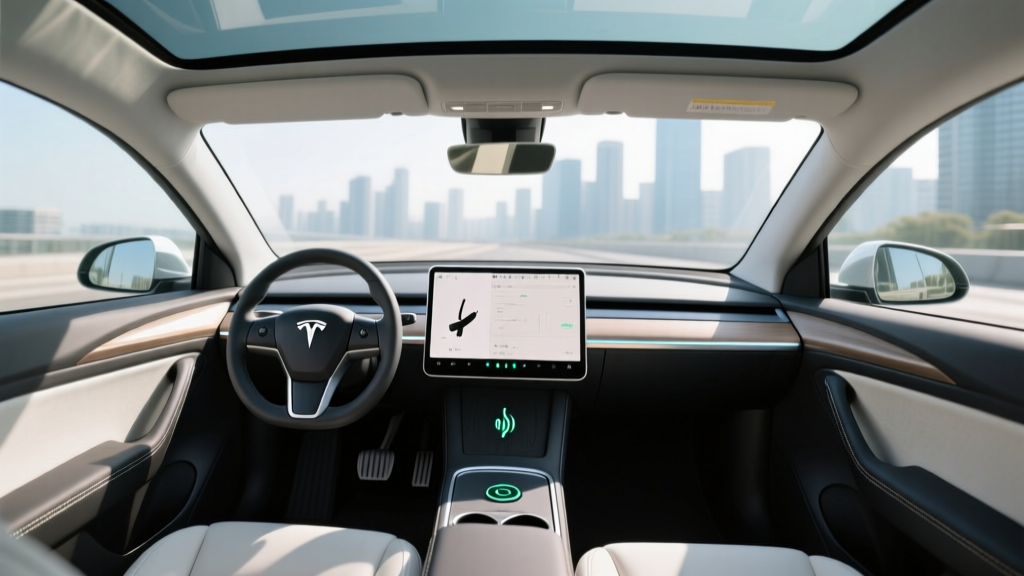
The Juniper refresh (introduced for the 2025 model year and carried into 2026) brought meaningful interior upgrades that address the most common criticism of the pre-refresh Model Y: cabin refinement.
What's changed:
- Ambient lighting strips across the dashboard and doors
- Ventilated front seats (finally standard on Long Range and above)
- Acoustic glass on all windows, reducing cabin noise by roughly 20% at highway speed
- Rear-seat touchscreen (8 inches) for climate and entertainment control
- Updated materials: softer-touch surfaces on armrests and door panels
- Power-folding second-row seats
What hasn't changed: The minimalist philosophy. There is still no instrument cluster behind the steering wheel — all information is on the central 15.4-inch touchscreen. Turn signals remain on the steering wheel (not stalkless as in the Cybertruck and refreshed Model 3 in some markets), and the gear selector is on the steering column. Whether this minimalism feels premium or spartan depends on your taste.
| Dimension | Measurement |
|---|---|
| Front Legroom | 41.8 inches |
| Rear Legroom | 37.3 inches |
| Cargo Volume (behind 2nd row) | 30.2 cu ft |
| Cargo Volume (2nd row folded) | 72.1 cu ft |
| Front Trunk (Frunk) | 4.1 cu ft |
Cargo space is generous for the class, beating the Ioniq 5 (27.2 cu ft behind the second row) and competitive with the Mach-E (29.7 cu ft). The low load floor and wide hatch opening make it practical for strollers, groceries, and camping gear. The frunk is small — useful for charging cables and a bag or two, but don't plan on fitting a carry-on.
Infotainment and Software: Tesla's software remains the industry benchmark for responsiveness and over-the-air update frequency. Features like Sentry Mode (dashcam-based security), Dog Mode (climate control for pets), and the built-in trip planner with Supercharger routing are deeply integrated in ways that Apple CarPlay/Android Auto (still not supported) can't replicate. The trade-off: you're fully within Tesla's ecosystem, and some users find the lack of smartphone projection frustrating.
Driver Assistance — Autopilot and FSD:
Tesla Autopilot and Full Self-Driving (Supervised) are Level 2 driver-assistance systems, not autonomous driving. The driver must remain engaged, hands on or near the wheel, and eyes on the road at all times. Tesla's cabin camera monitors driver attention.
Autopilot (standard) includes adaptive cruise control and lane-centering. FSD (Supervised), a $8,000 add-on or $99/month subscription, adds automatic lane changes, traffic-light recognition, and city-street navigation. As of early 2026, FSD has improved substantially but still requires active supervision — it is not a Level 4 robotaxi system like Waymo. NHTSA continues to monitor Tesla's Autopilot/FSD safety data, and buyers should review NHTSA's AV safety resources before purchasing.
Pricing, Trims, and Federal Tax Credit
| Trim | Base MSRP | Est. Federal Credit (§30D) | Effective Price* |
|---|---|---|---|
| Standard Range RWD | $44,990 | Up to $7,500 | ~$37,490 |
| Long Range AWD | $48,990 | Up to $7,500 | ~$41,490 |
| Performance AWD | $53,490 | Up to $7,500 | ~$45,990 |
*Effective price assumes full $7,500 §30D credit eligibility. Destination fee ($1,390) not included.
- MSRP Cap: SUVs/vans/pickups must have MSRP ≤ $80,000 (Model Y qualifies on all trims)
- Buyer Income Cap: Modified AGI ≤ $150,000 (single) / $300,000 (joint)
- Battery Sourcing: Critical minerals and battery components must meet escalating domestic/free-trade-partner thresholds — Tesla's U.S.-built packs with sourced materials currently qualify
- Point-of-Sale Transfer: You can transfer the credit to the dealer at purchase for an immediate price reduction (rather than waiting for tax filing)
- Verification: Always confirm current eligibility at IRS.gov before purchasing — rules change annually
The Model Y's pricing advantage is that all trims fall under the $80,000 SUV MSRP cap, making them eligible for the full credit if your income and the battery-sourcing requirements align. The Standard Range RWD at roughly $37,500 after credit is one of the most affordable ways into a new Tesla — though the 260-mile EPA range and RWD-only drivetrain may limit its appeal in colder climates.
Warranty and Ownership Costs
Tesla's warranty structure is straightforward:
- Basic Vehicle: 4 years / 50,000 miles
- Battery & Drive Units: 8 years / 120,000 miles (Long Range/Performance), 8 years / 100,000 miles (Standard Range)
- Capacity Retention Threshold: 70% during warranty period
The 8-year/120,000-mile battery warranty is competitive with the industry standard (Hyundai offers 10 years/100,000 miles; Ford matches at 8 years/100,000 miles). Insurance costs tend to run 15–25% higher than comparable gas SUVs due to repair costs and parts pricing — expect $1,800–$2,500 annually depending on your profile and state.
Total cost of ownership over 5 years and 75,000 miles, factoring in electricity at $0.14/kWh vs. gas at $3.50/gallon, typically favors the Model Y by $4,000–$7,000 over a comparably priced gas SUV like the Toyota RAV4 — primarily from fuel savings and lower maintenance (no oil changes, fewer brake replacements due to regen).
Pros and Cons
- Best-in-class Supercharger network access (20,000+ stalls, 99%+ uptime)
- Top-tier efficiency: 27 kWh/100mi means lower charging costs
- Strong software and OTA update cadence
- Juniper refresh meaningfully improves cabin quietness and comfort
- 3,500-lb towing capacity is practical for light trailers
- Competitive pricing after federal tax credit
- 250 kW peak DC charge rate trails 800V rivals (Ioniq 5, EV6)
- No Apple CarPlay or Android Auto support
- FSD remains Level 2 — expensive for what it delivers today
- Minimalist interior still polarizing (no instrument cluster)
- Insurance premiums above segment average
- Rear-seat headroom is tight for passengers over 6'2"
Who Should Buy the 2026 Model Y?
- You take regular road trips and want reliable Supercharger access
- You need AWD for snow or rain but don't want a massive SUV
- You value software features and OTA improvements over traditional luxury finishes
- Your household income qualifies for the §30D credit
- Maximum DC fast-charge speed is your top priority (look at Ioniq 5/EV6 at 350 kW)
- You want Apple CarPlay/Android Auto integration
- You prefer a more traditional interior with physical buttons and an instrument cluster
- You need three rows of seating (look at the Kia EV9 or Tesla Model X)
Frequently Asked Questions
What is the real-world range of the 2026 Tesla Model Y?
The Long Range AWD has a 320-mile EPA estimate. Expect roughly 270–290 miles on highway trips in mild weather and 230–260 miles in cold conditions (below freezing). The Standard Range RWD is EPA-rated at 260 miles with proportionally lower real-world figures.
How fast does the Model Y charge at home and on the road?
On a Level 2 home charger (240V, 48A), the Model Y adds about 35–40 miles of range per hour, charging fully overnight. On a DC fast charger or Supercharger, it peaks at 250 kW and charges from 10–80% in approximately 25 minutes — though preconditioning via navigation is essential for achieving peak rates.
Does the 2026 Model Y qualify for the $7,500 federal EV tax credit?
All Model Y trims fall under the $80,000 SUV MSRP cap and are currently eligible, provided your modified adjusted gross income is ≤ $150,000 (single) or ≤ $300,000 (joint) and battery-sourcing requirements are met. The credit can be transferred at point of sale for an immediate price reduction. Always verify current rules at IRS.gov.
Is the Model Y worth buying over the Hyundai Ioniq 5 or Ford Mustang Mach-E?
The Model Y wins on efficiency (27 kWh/100mi vs. 30+), Supercharger network reliability, and software integration. The Ioniq 5 wins on DC fast-charge speed (350 kW vs. 250 kW) and offers CarPlay. The Mach-E offers a more traditional interior. If Supercharger access and efficiency matter most, the Model Y holds the edge in 2026.
What's the biggest drawback of owning a Tesla Model Y?
The lack of Apple CarPlay/Android Auto is the most common frustration for new owners accustomed to smartphone projection. Insurance costs also run 15–25% higher than comparable gas SUVs, and the 250 kW peak charge rate, while adequate, is falling behind 800V competitors on public non-Tesla chargers.
Is Tesla's Full Self-Driving worth the $8,000 cost?
FSD (Supervised) is a Level 2 driver-assist system that requires your full attention. It handles many city and highway scenarios competently but is not autonomous driving. For most buyers, the standard Autopilot (included) provides sufficient adaptive cruise and lane-centering. Consider FSD only if you want to evaluate its ongoing improvement via OTA updates — and understand you are paying for a system that still requires active supervision.