Quick Verdict: The Premium Family EV That Still Sets the Bar
If you're searching inside Tesla Model X for whether it still justifies its premium price tag in 2026, the short answer is yes — but only for a specific buyer. The Model X remains the only three-row electric SUV with falcon-wing rear doors, a 5,000-lb towing rating, and access to the most reliable DC fast-charging network in North America. With up to 335 miles of EPA-estimated range in Long Range trim and a 2.5-second 0-60 time in Plaid guise, it straddles family hauler and performance machine in a way no competitor fully replicates.
But at a starting MSRP of $79,990, the Model X is no longer the only game in town. The Rivian R1S, Kia EV9, and Mercedes EQS SUV all make compelling arguments. This review breaks down the exact numbers — range, charging curves, real-world efficiency, tax credit eligibility, and total cost of ownership — so you can decide whether the Model X earns its place in your garage.
Range, Battery & Efficiency: What the EPA Says vs. the Real World
Real-World Expectation: 275–300 miles on highway road trips at 70–75 mph; 230–260 miles in sub-30°F winter conditions with cabin heat. Plaid trim drops to an EPA 326 miles, with similar real-world reductions.
The 2026 Tesla Model X Long Range uses a ~100 kWh (usable) battery pack built on NMC (nickel manganese cobalt) chemistry. Tesla has not transitioned the Model X to LFP (lithium iron phosphate) — the heavier vehicle benefits from NMC's superior energy density. The pack is paired with Tesla's heat pump thermal management system, which recovers waste heat from the drivetrain to warm the cabin, reducing winter range loss compared to resistive heaters.
| Spec | Long Range AWD | Plaid |
|---|---|---|
| EPA Range | 335 mi | 326 mi |
| Battery (usable) | ~100 kWh, NMC | ~100 kWh, NMC |
| MPGe (city/hwy/combined) | 104 / 96 / 100 | 100 / 93 / 97 |
| kWh per 100 mi | 34 | 35 |
| 0-60 mph | 3.8 sec | 2.5 sec |
| Horsepower | 670 hp | 1,020 hp |
| Drivetrain | Dual-Motor AWD | Tri-Motor AWD |
| Top Speed | 155 mph | 163 mph |
| Towing Capacity | 5,000 lbs | 5,000 lbs |
| Base MSRP | $79,990 | $94,990 |
Efficiency is competitive for a vehicle of this size. At roughly 34 kWh per 100 miles (Long Range), the Model X sips electrons more carefully than the Rivian R1S (38 kWh/100 mi) but less efficiently than the sleeker BMW iX. Per fueleconomy.gov, the combined MPGe of 100 translates to about $0.045–$0.055 per mile at the national average electricity rate of $0.17/kWh — roughly one-third the per-mile fuel cost of a comparable gas SUV.
Charging Speed: DC Fast, Level 2 & the Supercharger Advantage
Charging speed is where the Model X continues to shine, particularly on Tesla's Supercharger network. The 2026 Model X supports a peak DC fast-charge rate of 250 kW on V3 Superchargers and compatible CCS stations via its native NACS connector.
| Charging Level | Power / Rate | Speed | Notes |
|---|---|---|---|
| Level 1 (120V) | ~1.4 kW | ~3 mi/hr | Emergency/trickle only |
| Level 2 (240V, 48A) | 11.5 kW | ~34 mi/hr | Home Wall Connector; full charge in ~10 hr |
| Level 2 (240V, 32A) | 7.7 kW | ~23 mi/hr | Mobile Connector on NEMA 14-50 |
| DC Fast (V3 Supercharger) | 250 kW peak | 10–80% in ~30 min | Sustains ~170 kW avg to 50%; tapers above 80% |
| DC Fast (CCS adapter) | Up to 250 kW | Varies by station | Electrify America, EVgo; depends on station output |
Real-world charging curve reality: The Model X peaks at 250 kW only at a low state of charge (typically 5–15% SoC) and with battery preconditioning active. In practice, expect an average charge rate of roughly 150–170 kW during the 10–80% session, yielding a ~30-minute stop. Above 80%, the rate drops sharply to protect the NMC cells — charging from 80–100% can add another 25 minutes. For road trips, plan to charge to 80% and move on.
At home, the Tesla Wall Connector at 48 amps adds about 34 miles of range per hour — enough to fully replenish the pack overnight. Installation costs vary; budget $500–$2,000 depending on panel proximity and whether a 200-amp service upgrade is needed.
Performance & Driving Dynamics
The dual-motor Long Range Model X delivers 670 horsepower and a 3.8-second 0-60 time — quick by any measure, and genuinely startling in a three-row SUV. The tri-motor Plaid (1,020 hp, 2.5 seconds) enters supercar territory, though the 5,000+ lb curb weight is felt in corners. Air suspension is standard, providing a compliant ride and up to 8.3 inches of ground clearance for light off-pavement use.
The steering is precise but light, and the regenerative braking (one-pedal driving capable) is well-calibrated. Towing is rated at 5,000 lbs with the optional tow package, though expect range to drop 30–40% when pulling a loaded trailer at highway speeds.
Interior, Tech & Standout Features
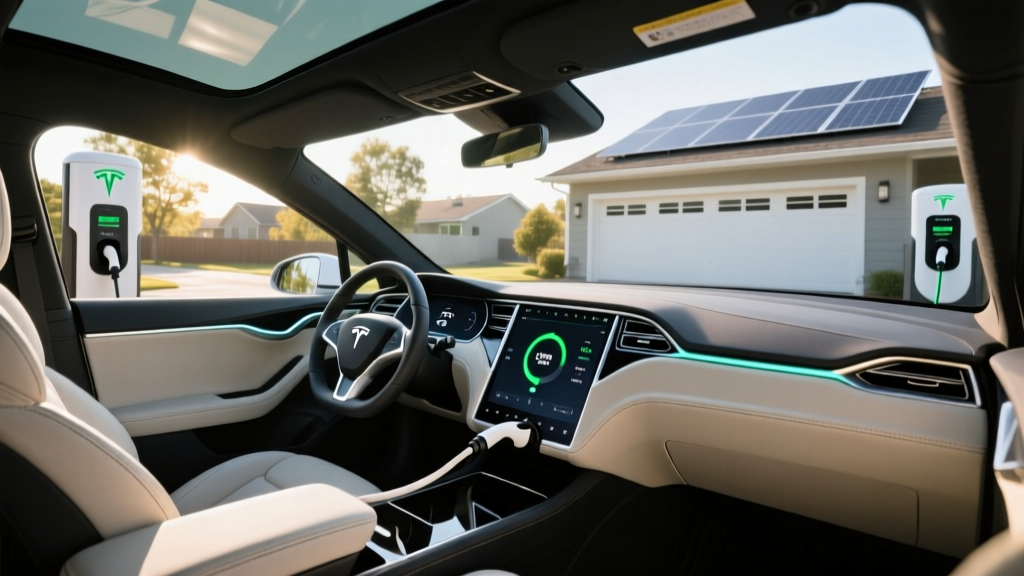
Step inside the Tesla Model X and the 17-inch center touchscreen dominates the dashboard, angled toward the driver in the refreshed interior. A second 8-inch screen serves rear-seat passengers for climate and entertainment controls. The yoke steering wheel remains standard (a conventional round wheel is available as a no-cost option), and a 22-speaker audio system delivers immersive sound.
Seating configurations: The Model X offers 5-seat (two-row bench), 6-seat (captain's chairs with center console), and 7-seat layouts. The 6-seat configuration is the sweet spot for comfort and third-row access via the iconic falcon-wing doors, which open upward with articulated hinges to clear tight parking spaces.
- Cargo volume: 88.1 cu ft (all rows folded) / 41.1 cu ft (behind second row) / 12.6 cu ft (behind third row)
- Front trunk (frunk): 6.6 cu ft — fits a carry-on or charging cables
- Second-row legroom: 40.9 inches
- Third-row legroom: 32.7 inches (best for children on longer trips)
Driver assistance: Tesla's Autopilot is standard, offering adaptive cruise control and lane-centering as an SAE Level 2 system. Full Self-Driving (Supervised), a $8,000 add-on (or $99/month subscription), adds automatic lane changes, traffic-light recognition, and Navigate on Autopilot. Per NHTSA guidelines, FSD remains a Level 2 system — the driver must remain fully engaged and is liable for all vehicle actions. It is not autonomous driving.
Pricing, Tax Credits & Ownership Cost
| Trim | Base MSRP | As-Tested (typical) | §30D Credit Eligible? |
|---|---|---|---|
| Long Range AWD | $79,990 | $85,000–$92,000 | Potentially — see rules below |
| Plaid | $94,990 | $100,000–$108,000 | No — exceeds MSRP cap |
Federal tax credit (§30D) eligibility for the Model X is nuanced. Under current IRS rules, the §30D New Clean Vehicle Credit offers up to $7,500, but only if the vehicle and buyer meet all of the following criteria:
- MSRP cap: SUVs/vans must have a base MSRP ≤ $80,000. The Long Range ($79,990) qualifies; the Plaid ($94,990) does not.
- Buyer income cap: AGI ≤ $300,000 (married filing jointly) / $225,000 (head of household) / $150,000 (single).
- Battery sourcing: Critical minerals and battery components must meet phased-in percentage thresholds from US/FTA countries. Tesla's supply chain has largely complied, but verify current-year status at irs.gov.
- Point-of-sale transfer: Eligible buyers can transfer the credit to the dealer at purchase for an immediate price reduction.
- Assembly: Must be assembled in North America (the Model X is built in Fremont, CA — qualifies).
Bottom line: A Long Range Model X buyer earning under the income cap could see the effective price drop to ~$72,490 after the full $7,500 credit. The Plaid is ineligible regardless of buyer income due to its MSRP. Always consult a tax professional and verify eligibility on the IRS website before purchasing.
Warranty & Long-Term Battery Outlook
Tesla covers the Model X with a 4-year/50,000-mile limited vehicle warranty and an 8-year/150,000-mile battery and drive unit warranty (whichever comes first). The battery warranty guarantees retention of at least 70% of original capacity during the coverage period. Industry data from Tesla's own impact reports and third-party fleet analyses suggest NMC packs in the Model X typically degrade 8–12% over the first 100,000 miles, with degradation slowing significantly thereafter.
Out-of-warranty battery replacement for a Model X currently ranges from $12,000 to $18,000 depending on pack configuration and service center. This is a real cost to factor if you plan to keep the vehicle beyond 150,000 miles.
Pros, Cons & Who Should Buy
✅ Pros
- 335-mi EPA range leads the three-row EV SUV segment
- 250 kW DC fast charging with Tesla Supercharger network reliability
- Falcon-wing doors ease third-row access in tight spaces
- 5,000-lb towing capacity with integrated trailer mode
- Class-leading 0-60 performance (2.5s Plaid)
- OTA software updates continuously add features
- Heat pump standard — better cold-weather efficiency
❌ Cons
- Starting at $79,990; Plaid ineligible for tax credit
- Third-row legroom (32.7 in) is tight for adults on long trips
- FSD ($8,000) remains Level 2 — not autonomous despite the name
- No Apple CarPlay or Android Auto integration
- Falcon-wing doors can be slow in heavy rain and may leak over time
- Panel gaps and interior build quality still trail Mercedes/BMW
- Insurance premiums run 15–25% higher than comparable gas SUVs
Who the Model X Suits Best
Choose the Model X if: You need three rows, want maximum Supercharger network reliability for road trips, tow occasionally, and value blistering performance in a family vehicle. The Long Range at ~$72,500 (after credit) is a compelling package.
Look elsewhere if: You prioritize build-quality refinement (BMW iX, Mercedes EQS SUV), need a usable adult-sized third row (Rivian R1S, Kia EV9), or your budget is under $60,000 (Kia EV9, used Model X).
Frequently Asked Questions
What is the real-world range of the 2026 Tesla Model X?
The EPA rates the Long Range at 335 miles and the Plaid at 326 miles. In real-world highway driving at 70–75 mph, expect 275–300 miles. In cold weather (below 30°F) with cabin heating, range can drop to 230–260 miles. Preconditioning the battery and using seat heaters instead of cabin heat can recover 10–15 miles.
How fast does the Model X charge at home and on the road?
At home on a Level 2 Tesla Wall Connector (48A/11.5 kW), the Model X gains about 34 miles of range per hour — a full charge takes roughly 10 hours. On a V3 Supercharger (250 kW peak), a 10–80% session takes approximately 30 minutes, adding about 200 miles of range.
Does the Tesla Model X qualify for the $7,500 federal tax credit?
The Long Range trim ($79,990 MSRP) can qualify if the buyer's AGI is under the income cap ($300,000 married filing jointly) and battery sourcing requirements are met. The Plaid ($94,990) exceeds the $80,000 SUV MSRP cap and is ineligible. Always verify current rules at irs.gov and consult a tax professional.
Is the Model X worth buying over the Rivian R1S or Kia EV9?
The Model X wins on range (335 vs. R1S's ~321 mi), Supercharger access, and performance. The Rivian R1S offers more rugged capability, a more usable third row, and a lower starting price (~$75,900). The Kia EV9 is far more affordable (~$54,900) with a 304-mi range but lacks AWD performance and towing parity. Your priority — luxury/performance vs. value vs. off-road — determines the winner.
What's the biggest drawback of owning a Model X?
Beyond the price, the most common owner complaints center on falcon-wing door reliability (sensor issues, slow operation in rain), panel-gap inconsistencies, and the lack of Apple CarPlay/Android Auto. Insurance costs are also notably higher than segment averages.
How long will the Model X battery last?
Tesla warranties the battery for 8 years or 150,000 miles with a 70% capacity retention guarantee. Real-world fleet data suggests 88–92% capacity retention at 100,000 miles for NMC packs. With proper care (avoiding frequent 100% charges, using preconditioning), the pack should deliver 200,000+ miles before significant degradation.