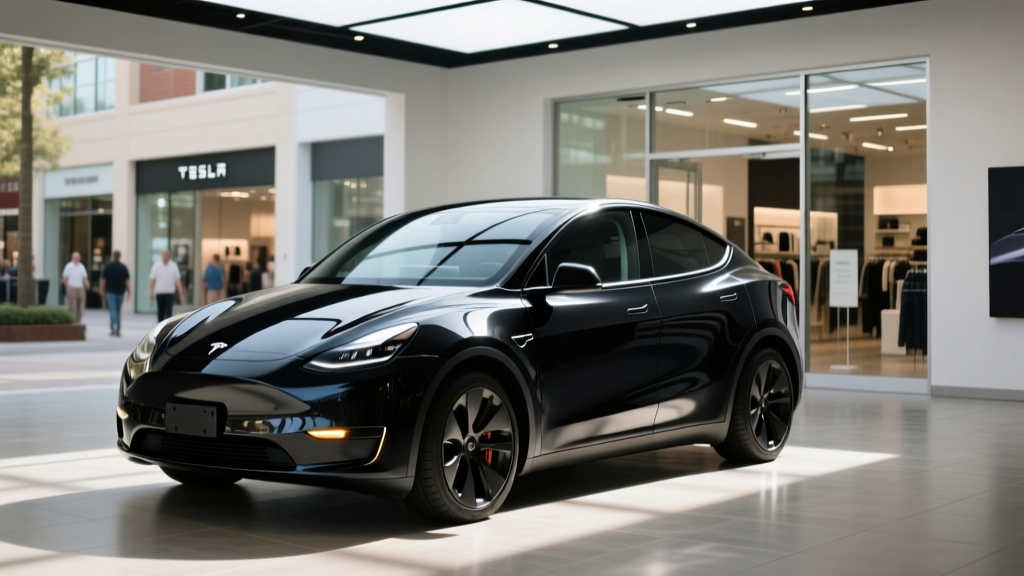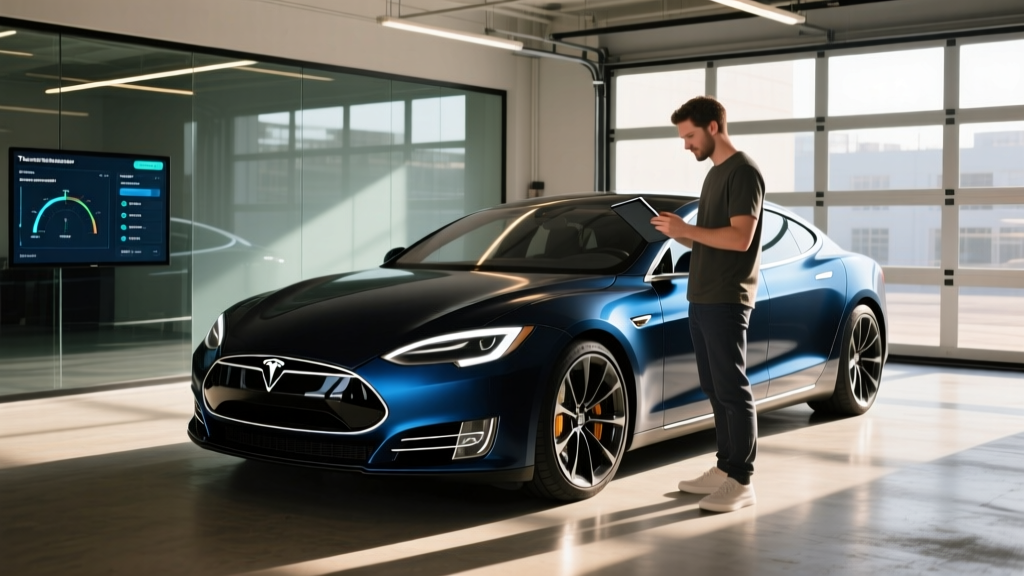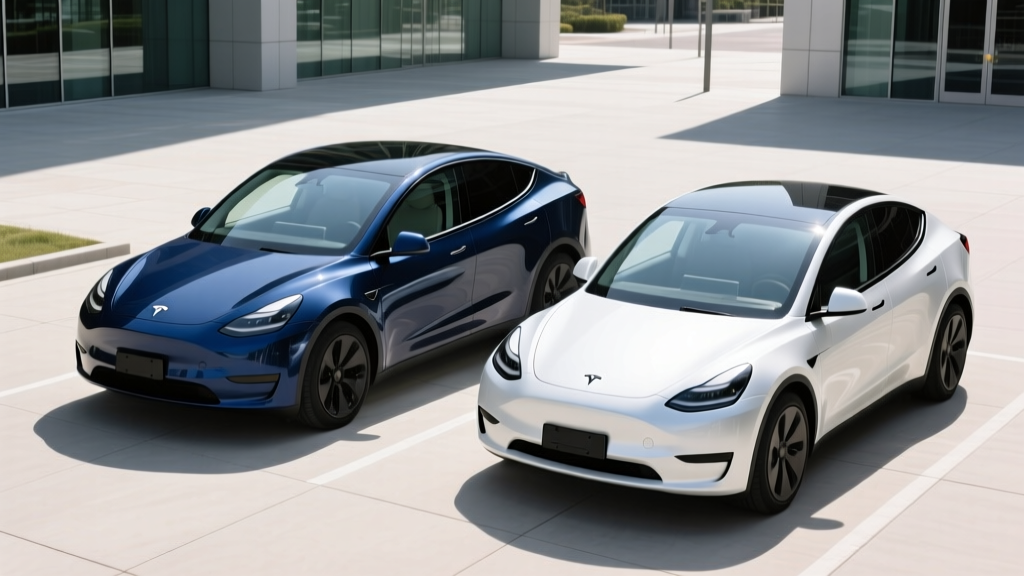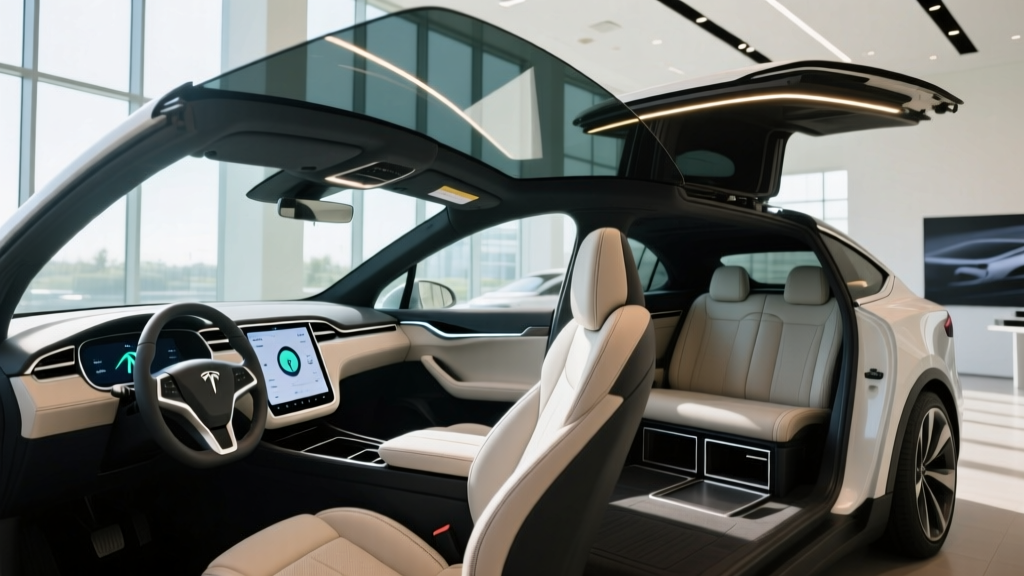
The Tesla Model X remains one of the most polarizing electric SUVs on the road. Its falcon-wing rear doors and yoke steering draw attention, but buyers spending six figures need more than a party trick. This review goes deep inside of the Tesla Model X — examining cabin materials, infotainment, passenger space, and third-row usability — while also covering the hard EV numbers that matter: EPA range, DC fast-charging speeds, real-world efficiency, and 2026 federal tax credit eligibility.
For 2026, the Model X continues in Long Range (dual-motor AWD) and Plaid (tri-motor AWD) trims. Tesla has quietly updated the interior with ventilated front seats, a rear touchscreen, and improved cabin insulation, but the fundamental architecture — introduced in 2015 and refreshed in 2021 — is showing its age against newer rivals like the Rivian R1S, BMW iX, and Mercedes EQS SUV. Here is what you need to know before configuring one.
Spec Snapshot: 2026 Tesla Model X at a Glance
| Specification | Long Range AWD | Plaid AWD |
|---|---|---|
| EPA Range | 335 miles | 326 miles |
| Battery (usable, est.) | ~100 kWh, NMC | ~100 kWh, NMC |
| MPGe (combined) | 102 MPGe | 98 MPGe |
| kWh / 100 mi | 33 kWh | 34 kWh |
| Peak DC Fast Charge | 250 kW (CCS via adapter or native NACS) | 250 kW |
| 10–80% DCFC Time | ~32 minutes | ~32 minutes |
| Level 2 Home Charge | 11.5 kW / ~34 mi/hr | 11.5 kW / ~34 mi/hr |
| 0–60 mph | 3.8 seconds | 2.5 seconds |
| Horsepower | 670 hp | 1,020 hp |
| Drivetrain | Dual-Motor AWD | Tri-Motor AWD |
| Base MSRP | $81,630 | $96,630 |
| Battery Warranty | 8 yr / 150,000 mi | 8 yr / 150,000 mi |
Sources: EPA / fueleconomy.gov, Tesla.com order page. Pricing excludes destination fee. Specs reflect 2026 model year.
Inside of the Tesla Model X: Cabin, Screens, and Materials
Settle into the driver's seat and the first thing you notice is the yoke. Tesla's rectangular steering yoke is standard on the Model X (a conventional round wheel is available as a no-cost delete). The yoke improves forward sightlines to the 12.3-inch digital instrument cluster but demands a learning curve for low-speed maneuvers and three-point turns where hand-over-hand input is natural. On highway cruises, it feels fine; in a parking garage, you will notice the compromise.
The 17-Inch Center Touchscreen
The centerpiece of the cabin is a 17-inch OLED center touchscreen that tilts left or right via a motorized hinge — a feature Tesla calls "cinematic display." Resolution is crisp (2200 x 1300), touch response is instant, and the AMD Ryzen-based infotainment processor handles navigation, media, and gaming without lag. The interface is entirely Tesla-native: there is no Apple CarPlay or Android Auto. You use Tesla's native apps for Spotify, Apple Music, Tidal, and podcasts, or pair a phone via Bluetooth for basic audio streaming.
Climate controls live exclusively on the screen (no physical knobs), which draws criticism from traditionalists but works adequately once muscle memory develops. Ventilated front seats are standard for 2026, a welcome addition for hot-climate buyers.
Second-Row and Third-Row Space
The Model X offers two second-row configurations: a three-seat bench (standard, seats six total) or two captain's chairs (seats five or six depending on front-row layout). The captain's chairs are individually mounted on aluminum pedestals and slide fore/aft, offering excellent legroom — up to 41.1 inches in the second row. However, the fixed pedestal design makes it impossible to fold the captain's chairs flat, limiting cargo flexibility.
The third row is best described as occasional-use. Legroom measures 32.7 inches — adequate for children or adults on short trips, but tight for anyone over 5'10" on longer drives. Headroom is compromised by the sloping roofline. Access is easier than in most three-row SUVs thanks to the falcon-wing doors, which open vertically and create a large opening. In practice, the doors are genuinely useful for loading car seats — you can stand nearly upright beside the second row.
- Behind 3rd row: 15.8 cu ft
- Behind 2nd row (3rd row folded): 40.2 cu ft
- Behind 1st row (all rear rows folded, bench config): 85.1 cu ft
- Front trunk (frunk): 6.5 cu ft
Build Quality and Cabin Noise
Tesla's panel gaps and interior material quality have improved since the early Fremont-built cars, but the Model X still doesn't match the fit-and-finish of a BMW iX or Mercedes EQS SUV at similar price points. Soft-touch materials cover the dash and door uppers, but some lower panels feel hard and hollow. Cabin insulation has improved for 2026 with acoustic glass all around — wind and road noise are well-managed at highway speed.
Range, Efficiency, and Real-World Expectations
The Model X Long Range achieves 102 MPGe combined (33 kWh/100 mi) per the EPA. That is respectable for a 5,185-lb SUV but trails lighter competitors like the BMW iX xDrive50 (87 MPGe but with a smaller battery and less range) and the Rivian R1S Dual-Motor (equivalent efficiency with a different vehicle class profile).
The ~100 kWh NMC (nickel-manganese-cobalt) battery pack provides the energy density needed for this vehicle's weight and performance. Tesla recommends daily charging to 80–90% for NMC chemistry and reserving 100% charges for road trips — a practice that helps preserve long-term battery health.
Charging Speed: DC Fast Charging and Home Level 2
| Charging Level | Power / Rate | Miles Added | Notes |
|---|---|---|---|
| Level 1 (120V outlet) | ~1.4 kW | ~3–4 mi/hr | Emergency / trickle only |
| Level 2 (240V home, 48A) | 11.5 kW | ~34 mi/hr | Full charge in ~9 hours |
| DC Fast Charge (V3 Supercharger) | Peak 250 kW | ~175 mi in 15 min | 10–80% in ~32 min |
| DC Fast Charge (V4 Supercharger) | Up to 250 kW (vehicle-limited) | Similar to V3 | Model X does not support >250 kW |
The Model X peaks at 250 kW on DC fast charging, which was class-leading in 2021 but is now outpaced by 800V-architecture rivals. The Hyundai Ioniq 9 and Kia EV9 can accept up to 350 kW thanks to their 800V platforms, enabling 10–80% charges in roughly 20 minutes versus the Model X's ~32 minutes.
Charging curve reality: The Model X sustains peak power only between roughly 10–30% state of charge. Above 50%, the rate tapers to ~150 kW, and above 80% it drops further to ~50 kW. This is standard NMC behavior, but it means the "15-minute" marketing figure applies only to partial fills. Plan road-trip stops around 10–80% top-ups for the fastest experience.
For home charging, the onboard charger accepts up to 11.5 kW (48 amps on a 60-amp circuit). A Tesla Wall Connector installed on a NEMA 14-60 or hardwired 60A circuit will fully replenish the battery overnight in roughly 9 hours. Most owners who plug in nightly never need DC fast charging for daily use.
Performance: Long Range vs. Plaid
The Long Range dual-motor setup produces 670 horsepower and rockets to 60 mph in 3.8 seconds — quicker than nearly every gasoline SUV ever built. The Plaid's tri-motor configuration (one front, two rear) delivers 1,020 hp and a 2.5-second 0–60 time, placing it in supercar territory. Both versions feature standard all-wheel drive with precise torque vectoring.
In everyday driving, the Long Range is the more rational choice. The Plaid's additional weight (roughly 200 lbs more from the third motor) slightly reduces range and efficiency, and the acceleration difference is irrelevant at legal speeds. The Plaid exists for buyers who want the statement and the track capability — it includes upgraded brakes and a Track Mode that most owners will never activate.
Ride quality is firm but controlled. The adaptive air suspension (standard) offers adjustable ride height — useful for clearing speed bumps or lowering for highway efficiency. Steering is quick but numb, a common Tesla trait. The Model X is not a corner-carver like the BMW iX M60, but it is composed and stable at speed.
Pricing, Trims, and Federal Tax Credit Eligibility
| Trim | Base MSRP | As-Tested (typical config) | §30D Federal Credit Eligibility |
|---|---|---|---|
| Long Range AWD | $81,630 | $86,000–$92,000 | Not eligible (exceeds MSRP cap) |
| Plaid AWD | $96,630 | $102,000–$115,000 | Not eligible (exceeds MSRP cap) |
Critical tax credit note: Under current IRS §30D rules, the federal EV tax credit has an MSRP cap of $80,000 for SUVs. The Model X Long Range starts at $81,630 — just over the threshold — and the Plaid is far above it. Neither trim qualifies for the up-to-$7,500 federal credit. Additionally, buyer income caps apply ($300,000 joint / $150,000 single modified AGI), and battery critical-mineral and component sourcing requirements must be met. Even if the MSRP were under the cap, buyers should verify current-year eligibility on the IRS clean vehicle credit page before assuming qualification.
Tesla does offer leasing, and in some prior years the lease has been structured to capture the commercial clean vehicle credit (§45W), passing savings to the lessee via reduced monthly payments. Check Tesla's current lease terms for availability — this pathway changes frequently.
Popular options that increase the as-tested price include:
- 22-inch Turbine wheels: $5,500 (reduces range by ~15 miles)
- Full Self-Driving (Supervised) capability: $8,000 one-time or $99/month
- Signature Paint (Ultra Red, Midnight Silver): $2,000–$3,000
- Five-seat interior (captain's chairs): no cost
- Six-seat interior (bench): standard
Driver Assistance: Autopilot and FSD (Supervised)
Standard Autopilot includes Traffic-Aware Cruise Control and Autosteer (lane centering) and works well on divided highways. The optional FSD (Supervised) package adds Navigate on Autopilot (automatic lane changes and highway on/off-ramp handling), traffic light and stop sign recognition, and Autopark. In practice, FSD is impressive in capability but still requires active supervision — it can make unexpected decisions in construction zones, unmapped areas, or complex intersections. Treat it as a fatigue-reducer on long highway drives, not a replacement for attention.
The Model X also includes standard automatic emergency braking, blind-spot monitoring, lane departure warning, and a 360-degree camera system. It has not been crash-tested by IIHS in recent years; NHTSA awarded it 5 stars overall in prior model-year testing.
Pros and Cons
- Class-leading Supercharger network access (17,000+ stalls in North America)
- Falcon-wing doors ease car-seat loading and third-row access
- Genuine 335-mile EPA range covers most road trips with one stop
- Tri-motor Plaid offers absurd performance (2.5s to 60)
- Over-the-air updates continually add features
- Spacious cargo area (85.1 cu ft max) with flat floor
- No federal tax credit — MSRP exceeds $80K SUV cap
- DC fast charging peaks at 250 kW (slower than 800V rivals)
- Third row is cramped for adults on longer trips
- Yoke steering is divisive and impractical for some drivers
- Build quality still inconsistent vs. legacy luxury brands
- Captain's chairs don't fold flat, limiting cargo versatility
- No Apple CarPlay or Android Auto support
Who Should Buy the Tesla Model X?
- You need three rows and prioritize Supercharger access for frequent road trips
- You regularly load car seats and value the falcon-wing door opening
- You want 300+ miles of range in a three-row electric SUV
- You are already in the Tesla ecosystem (Powerwall, Solar, other Tesla vehicles)
- You want federal tax credit eligibility — consider the Rivian R1S, BMW iX, or Hyundai Ioniq 9
- Third-row comfort for adults is a priority — the Rivian R1S or Kia EV9 offer more space
- You prefer traditional luxury build quality — test-drive the BMW iX or Mercedes EQS SUV
- You need the fastest possible DC charging — 800V platforms (Hyundai/Kia) charge ~30% faster
Frequently Asked Questions
What is the real-world range of the Tesla Model X?
The EPA rates the Long Range at 335 miles and the Plaid at 326 miles. In real-world mixed driving at moderate temperatures, expect 280–310 miles. Highway driving at 75+ mph yields roughly 260–280 miles, and cold weather (below freezing) can drop range to 230–260 miles. These figures assume standard 20-inch wheels; upgrading to 22-inch wheels costs approximately 10–15 miles of range.
How fast does the Model X charge at home and on the road?
On DC fast charging, the Model X peaks at 250 kW and charges from 10–80% in approximately 32 minutes on a V3 or V4 Tesla Supercharger. At home on a Level 2 Wall Connector (11.5 kW / 48A), it adds roughly 34 miles of range per hour, fully charging in about 9 hours. Level 1 (120V) adds only 3–4 miles per hour and is suitable only for emergency trickle charging.
Does the Tesla Model X qualify for the $7,500 federal EV tax credit?
No. Under current IRS §30D rules, the Model X exceeds the $80,000 MSRP cap for SUVs in both Long Range ($81,630) and Plaid ($96,630) trims. It does not qualify for the federal new clean vehicle credit. Some buyers have historically captured credit value through Tesla's leasing structure (commercial credit §45W), but this varies and should be verified directly with Tesla and a tax professional.
How does the Model X compare to the Rivian R1S and BMW iX?
The Rivian R1S offers better third-row space, more off-road capability, and qualifies for the federal tax credit on eligible trims — but has a smaller charging network. The BMW iX provides superior interior luxury and build quality but is a two-row SUV with less range (~309 miles EPA). The Model X's key advantages are Supercharger network access, falcon-wing doors, and the highest EPA range in the three-row EV SUV segment.
Is the yoke steering worth it?
For most buyers, no. The yoke improves forward visibility of the instrument cluster and feels fine on straight highways, but it makes low-speed maneuvers, U-turns, and parking more difficult because you cannot shuffle the wheel hand-over-hand. Tesla offers a conventional round wheel as a no-cost alternative at order time. Unless you are committed to the aesthetic and willing to adapt for several weeks, choose the round wheel.
What is the battery warranty on the Model X?
Tesla covers the Model X battery and drive unit for 8 years or 150,000 miles, whichever comes first, with a minimum 70% capacity retention threshold during the warranty period. This is one of the more generous mileage limits in the industry (many competitors offer 8yr/100,000mi). Out-of-warranty battery replacement costs are estimated at $15,000–$22,000 depending on pack configuration and labor, though most Model X batteries show minimal degradation within the warranty window based on fleet data.
Can the Model X tow?
Yes. When equipped with the optional tow hitch, the Model X is rated to tow up to 5,000 lbs. Note that towing significantly reduces range — expect a 40–50% reduction depending on trailer weight and aerodynamics. Plan charging stops accordingly when towing.