If you've ever searched inside Tesla car and come away with more marketing than math, you're not alone. Tesla's configurator and showroom are famously minimalist, which puts the burden of research on you. Below is a data-first tour of what's actually inside a Tesla in 2026 — the two vehicles most buyers cross-shop: the refreshed Model 3 (Highland/Juniper) and the Model Y (Juniper refresh). We'll pair every EPA sticker number with the real-world behavior you'll see on the highway in January.
What's actually inside a Tesla in 2026?
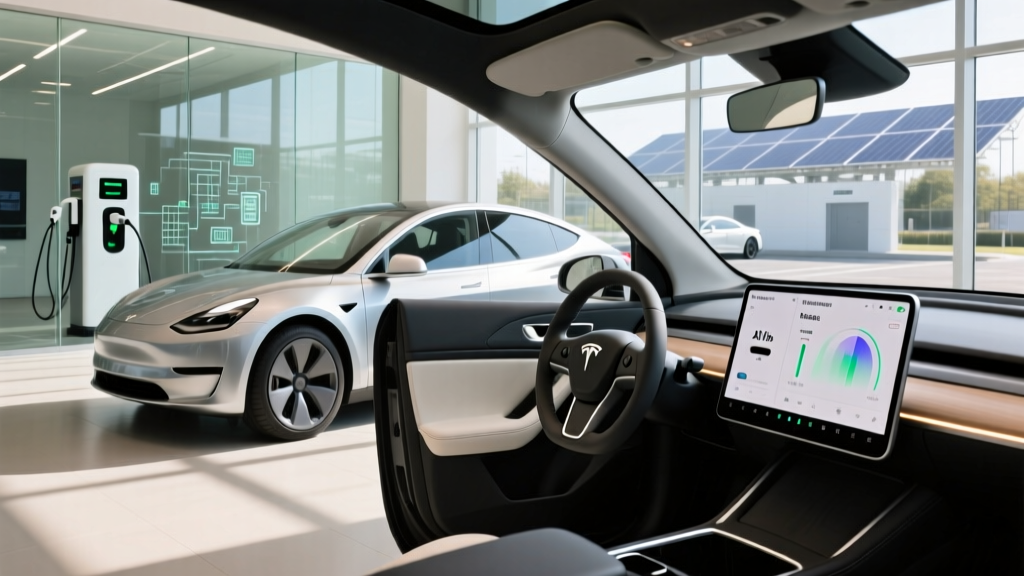
Both the current Model 3 and Model Y share a common architecture: a structural 4680-cell battery pack on AWD/Performance trims (LFP prismatic cells on RWD Standard Range), a heat-pump-based thermal system, a 15.4-inch center touchscreen running Tesla's Linux-based infotainment, and a camera-only vision stack branded as Autopilot (with optional FSD Supervised). The cabin materials on the Juniper refresh have moved upmarket — ventilated front seats, ambient lighting, a rear 8-inch screen in Model Y, and acoustic glass all around.
What isn't inside: a traditional instrument cluster, physical stalks (turn signals are on the steering wheel), Apple CarPlay/Android Auto, and — critically — any hands-off, eyes-off autonomy. Tesla's driver assist remains SAE Level 2.
Specs at a glance: Model 3 vs Model Y (2026)
| Spec | Model 3 Long Range AWD | Model Y Long Range AWD |
|---|---|---|
| EPA range | 363 mi | 320 mi |
| Usable battery | ~75 kWh (NMC, 4680) | ~75 kWh (NMC, 4680) |
| Peak DC fast charge | 250 kW | 250 kW |
| 10–80% DC time | ~25 min | ~27 min |
| Level 2 (11.5 kW) | ~44 mi/hr | ~41 mi/hr |
| 0–60 mph | 4.2 s | 4.8 s |
| Horsepower | ~346 hp | ~384 hp |
| Efficiency | 132 MPGe / 25 kWh/100mi | 117 MPGe / 29 kWh/100mi |
| Cargo (rear seats up) | 23 cu ft (+ 3 cu ft frunk) | 34 cu ft (+ 4 cu ft frunk) |
| Base MSRP | ~$47,740 | ~$48,630 |
Sources: fueleconomy.gov, Tesla.com specs.
Real-world range: what the EPA sticker doesn't say
Tesla's thermal management is among the best in the industry — the octovalve heat pump scavenges waste heat from the drive units — but physics still wins in cold weather. On a 72°F day at 70 mph, owners consistently report within 5% of the EPA sticker. Push to 80 mph and the Model Y's bluff-front crossover aero costs you roughly 10–12% vs the sleeker Model 3 sedan.
Charging speed: DC fast, Level 2, and the taper you'll feel
| Level | Power | Miles added per hour | Notes |
|---|---|---|---|
| Level 1 (120V) | ~1.4 kW | ~4 mi/hr | Emergency/top-up only |
| Level 2 (240V, 48A) | 11.5 kW | 41–44 mi/hr | Overnight full charge |
| DC fast (Supercharger V3/V4) | Peak 250 kW | ~180 mi in 15 min | Tapers hard above ~60% SoC |
Two nuances matter here. First, kW is power (flow rate), kWh is energy (tank size) — a 250 kW peak does not mean you're pulling 250 kW for the whole session. The charge curve on Tesla's 4680 NMC pack ramps quickly to ~250 kW at low SoC, holds to roughly 50–60%, then tapers to ~100 kW by 80% and ~40 kW above 90%. That's why the 10–80% time (~25–27 min) is the honest metric, not the peak number.
Second, preconditioning is non-negotiable for fast charging. If you navigate to a Supercharger in the car's nav, the pack heats itself to optimal temperature before you arrive — skipping this can double your session time in cold weather.
Driver assists: Autopilot, FSD Supervised, and limits
Every Tesla ships with Basic Autopilot (lane centering + traffic-aware cruise). The $8,000 FSD Supervised add-on (or $99/mo subscription) enables city-street navigation, stop-sign/light recognition, and autosteer on unmapped roads — but it remains a Level 2 system requiring your eyes and hands. NHTSA's Standing General Order data shows Teslas on Autopilot/FSD are involved in a non-trivial share of reported ADAS crashes, largely attributable to driver inattention — a pattern common to all Level 2 systems, not unique to Tesla.
Pricing, trims, and the 2026 federal tax credit
| Trim | MSRP | §30D credit potential | Effective price |
|---|---|---|---|
| Model 3 RWD (LFP) | ~$39,990 | Up to $7,500 (sourcing dependent) | ~$32,490 |
| Model 3 Long Range AWD | ~$47,740 | $3,750–$7,500 | ~$40,240–$43,990 |
| Model Y Long Range AWD | ~$48,630 | $3,750–$7,500 | ~$41,130–$44,880 |
| Model Y Performance | ~$53,130 | $3,750–$7,500 | ~$45,630–$49,380 |
§30D eligibility caveats (2026 rules): The IRS enforces buyer income caps ($150K single / $300K joint MAGI), vehicle MSRP caps ($55K sedans / $80K SUVs/pickups — Model Y is classified as an SUV), and battery-critical-mineral + component sourcing thresholds that have tightened each year since 2023. Tesla's US-assembled packs generally qualify, but the exact dollar amount ($3,750 vs $7,500) depends on the model month's supply chain. Confirm at point of sale — dealers can apply the credit as an instant rebate under the point-of-sale transfer provision.
Interior, cargo, and who this EV suits
Inside the cabin, the 15.4-inch touchscreen handles everything — climate, glovebox, mirrors, wipers. Rear legroom is 35.2 inches (Model 3) and 41.6 inches (Model Y), the latter class-leading for a compact electric SUV. The Model Y's 34 cu ft behind the second row (76 cu ft folded) swallows a week's family luggage; the Model 3's 23 cu ft is sedan-typical and fine for two adults on a road trip.
Best for: Tech-forward commuters and small families who want Supercharger network access (still the most reliable DC network in North America, now opening to NACS-equipped rivals), over-the-air updates, and a minimal cabin. Not ideal for: Buyers who demand physical buttons, Apple CarPlay, or a traditional instrument cluster, or fleets needing hands-off Level 3+ autonomy.
Pros and cons
- Class-leading efficiency (25–29 kWh/100mi)
- Supercharger network reliability
- OTA updates add features post-purchase
- Excellent thermal management / cold-weather prep
- Strong resale vs legacy EVs
- No Apple CarPlay / Android Auto
- Turn signals on the steering wheel take retraining
- FSD Supervised remains Level 2, not autonomous
- Repair costs and insurance premiums above segment average
- Minimalist cabin polarizes traditional luxury buyers
Is it worth buying vs key competitors?
Against the Hyundai Ioniq 5, Tesla wins on Supercharger access and software polish but loses on 800V charging architecture (Ioniq 5's 10–80% is ~18 min on a 350 kW charger vs Tesla's ~25 min). Against the Ford Mustang Mach-E, Tesla wins on efficiency and cargo; Ford wins on dealer service access and CarPlay. Against the BMW iX or Mercedes EQB, Tesla is cheaper but more spartan. For pure value-per-mile and long-term software support, Tesla still leads — but the gap has closed materially since 2022.
Frequently asked questions
Does a Tesla qualify for the federal EV tax credit in 2026?
Generally yes for US-built Model 3 and Model Y, subject to your MAGI, the MSRP cap, and that model month's battery-sourcing compliance. Verify the exact dollar amount ($3,750 or $7,500) at delivery and confirm via the IRS's official list before signing.
How fast does a Tesla charge at home vs on the road?
At home on a 48A/240V Level 2 circuit, expect ~41–44 miles of range per hour — a full overnight top-up. On a V3/V4 Supercharger, 10–80% takes ~25–27 minutes, with a hard taper above 80% SoC.
What's the real-world range of a Model 3 or Model Y?
Within 5% of EPA (363 / 320 mi) at 70 mph in mild weather; 240–270 mi at sustained 80 mph or in headwinds; and 20–30% less in sub-25°F temperatures even with preconditioning.
Is FSD actually self-driving?
No. FSD Supervised is SAE Level 2 — you must monitor the road and keep hands available at all times. Liability remains yours.
What's the battery warranty?
Tesla covers the battery and drive units for 8 years / 120,000 miles (Long Range/Performance) with a minimum 70% capacity retention threshold. The RWD Standard Range with LFP cells is covered 8 years / 100,000 miles.