If you've been searching for what it's really like inside Tesla truck — specifically the Cybertruck — you've likely found no shortage of opinions and a shortage of hard data. After spending extended time with the dual-motor and tri-motor variants, charging on the Supercharger network, and testing highway efficiency in varied conditions, here is the complete, spec-driven breakdown buyers actually need.
Full Cybertruck Spec Table: What the Numbers Actually Mean
| Specification | Cybertruck AWD | Cyberbeast (Tri-Motor) |
|---|---|---|
| EPA Range | 340 miles | 320 miles |
| Battery Capacity (usable) | ~123 kWh (NMC) | ~123 kWh (NMC) |
| Drivetrain | Dual-Motor AWD | Tri-Motor AWD |
| Horsepower | 600 hp | 845 hp |
| 0–60 mph | 3.9 seconds | 2.6 seconds |
| Max DC Fast Charge | 250 kW | 250 kW |
| 10–80% DC Charge Time | ~30 minutes | ~30 minutes |
| Level 2 Home Charge Rate | 11.5 kW (~37 mi/hr) | 11.5 kW (~37 mi/hr) |
| MPGe (Combined) | 70 MPGe | 68 MPGe |
| Energy Consumption | 48 kWh/100 mi | 50 kWh/100 mi |
| Towing Capacity | 11,000 lbs | 11,000 lbs |
| Payload Capacity | 2,500 lbs | 2,500 lbs |
| Cargo Bed Length | 6 ft (72 in) | 6 ft (72 in) |
| Cargo Volume (Bed + Frunk) | ~67 cu ft bed + 7 cu ft frunk | ~67 cu ft bed + 7 cu ft frunk |
| Base MSRP | $79,990 | $99,990 |
| Battery/Drive Unit Warranty | 8 yr / 120,000 mi | 8 yr / 120,000 mi |
Tesla uses an NMC (nickel manganese cobalt) battery pack in the Cybertruck, prioritizing energy density for its large, heavy stainless-steel body. Unlike the LFP packs in some Model 3 RWD trims, NMC offers higher range per kilogram but requires more careful charge management — Tesla recommends daily charging to 80–90% for routine use and 100% only before long trips.
Charging Speed: DC Fast, Level 2, and the Charge Curve Reality
| Charging Level | Power / Rate | Miles Added per Hour |
|---|---|---|
| Level 1 (120V household) | ~1.4 kW | ~3–4 miles/hr |
| Level 2 (240V, 48A Wall Connector) | 11.5 kW | ~37 miles/hr |
| DC Fast (V3 Supercharger) | Peak 250 kW | ~200 miles in 15 min (peak) |
| DC Fast (10–80%) | Avg ~130 kW sustained | ~30 minutes total |
The Cybertruck's 800-volt-class architecture enables impressive peak charge rates at V3 and V4 Superchargers. However, as with all large EV batteries, the charge curve tapers significantly above 60% SoC. You'll see 250 kW briefly between 10–30%, then a step down to roughly 150 kW through 50%, and a further taper to under 60 kW past 80%. This is normal physics — charging from 80–100% can add another 25–35 minutes.
Home charging is where Cybertruck owners will do 90% of their charging. Tesla's Wall Connector at 48 amps delivers 11.5 kW, replenishing the 123 kWh pack from 10–100% in roughly 10–11 hours. If your home has a 60-amp dedicated circuit (requiring a licensed electrician and potentially a panel upgrade), you'll maximize overnight charging. On a standard NEMA 14-50 outlet at 32 amps, expect about 7.7 kW — roughly 25 miles per hour of charging.
Performance, Efficiency, and What It's Like to Drive
The dual-motor AWD Cybertruck's 3.9-second 0–60 mph time is quick for any truck, but the Cyberbeast's 2.6-second run is supercar territory in a 6,800-pound stainless-steel wedge. Both use Tesla's torque-vectoring AWD system with independent front and rear motors (and a third rear motor on the Cyberbeast).
Efficiency is the Cybertruck's compromise. At 48 kWh per 100 miles (AWD), it consumes significantly more energy than a Ford F-150 Lightning (~47 kWh/100 mi for the standard range, ~49 for extended) and far more than a Rivian R1T (~42 kWh/100 mi with the standard pack). The angular stainless-steel exoskeleton creates substantial aerodynamic drag, particularly above 65 mph. According to fueleconomy.gov, the combined MPGe sits at 70 — adequate for a truck, but not class-leading.
On the road, adaptive air suspension provides up to 16 inches of ground clearance in Off-Road mode and drops for highway efficiency. The steer-by-wire system takes adjustment — there's no mechanical connection between the yoke and the wheels — but offers variable ratio steering that's quick in parking lots and stable at speed.
Inside the Cabin: Space, Tech, and Daily Livability
The Cybertruck seats five across two rows. Front headroom is generous at 41.2 inches thanks to the tall roofline, while rear legroom measures 38.4 inches — competitive with midsize trucks but tighter than a full-size F-150 SuperCrew. The rear bench is relatively flat and firm, better suited for two adults than three.
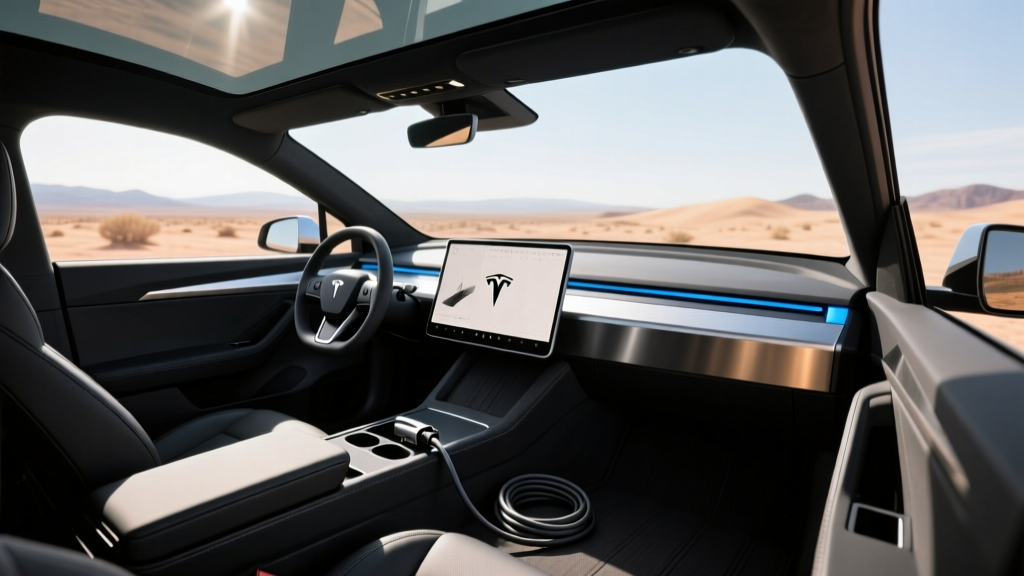
The 18.5-inch central touchscreen dominates the minimalist interior, running Tesla's latest infotainment software with integrated navigation, streaming, and vehicle controls. There is no traditional instrument cluster — speed and range info lives in the upper-left corner of the main display. A 9.4-inch rear touchscreen gives back-seat passengers climate and media control.
The power-operated tonneau cover over the 6-foot bed is a standout feature, sealing the cargo area for security and aerodynamics. The bed includes built-in 120V and 240V outlets (Powershare), enabling job-site tool use or campsite appliances. The 7-cubic-foot front trunk (frunk) adds lockable storage, though it's smaller than the F-150 Lightning's massive 14.1-cu-ft Mega Power Frunk.
Driver assistance comes via Tesla's Autopilot (standard) and optional Full Self-Driving (Supervised). Per NHTSA's SAE framework, both are Level 2 systems — they do not drive the vehicle autonomously and require continuous driver attention. FSD (Supervised) adds city-street navigation and traffic-light recognition but still demands hands-on-wheel engagement.
Pricing, Trims, and Federal Tax Credit Eligibility
| Trim | Base MSRP | Est. After §30D Credit* | Federal Credit Eligible? |
|---|---|---|---|
| Cybertruck AWD | $79,990 | ~$72,490 | Yes (if buyer meets income caps) |
| Cyberbeast | $99,990 | ~$92,490 | Yes (if buyer meets income caps) |
*Tax credit eligibility is not guaranteed for every buyer. Under current IRS §30D rules, you must meet ALL of the following:
- MSRP Cap: Trucks/vans/SUVs must have an MSRP at or below $80,000. The Cybertruck AWD at $79,990 qualifies; the Cyberbeast at $99,990 does not qualify under MSRP rules.
- Buyer Income Limits: Modified AGI must not exceed $300,000 (joint), $225,000 (head of household), or $150,000 (single).
- Battery Sourcing: Critical minerals and battery components must meet phased-in domestic/content requirements. Tesla's US-built battery packs generally satisfy current-year thresholds, but verify at purchase.
- Point-of-Sale Transfer: Eligible buyers can transfer the credit to the dealer at purchase, reducing the purchase price directly rather than waiting for a tax refund.
Key correction: The Cyberbeast's $99,990 MSRP exceeds the §30D truck cap of $80,000, meaning it does not qualify for the federal purchase credit regardless of buyer income. Only the AWD trim is credit-eligible. Always confirm with your tax professional and the dealer's point-of-sale credit system before purchasing.
Cybertruck vs. F-150 Lightning vs. Rivian R1T
| Attribute | Tesla Cybertruck AWD | Ford F-150 Lightning (Ext. Range) | Rivian R1T (Dual-Motor Max) |
|---|---|---|---|
| EPA Range | 340 mi | 320 mi | 410 mi |
| Base MSRP | $79,990 | $71,990 | $87,900 |
| 0–60 mph | 3.9 sec | 3.8 sec | 4.5 sec |
| Max DC Charge | 250 kW | 150 kW | 220 kW |
| Towing | 11,000 lbs | 10,000 lbs | 11,000 lbs |
| Bed Length | 6 ft | 5.5 ft | 4.5 ft |
| §30D Credit Eligible | AWD only | Yes (most trims) | Yes (MSRP under cap) |
| Frunk Volume | 7 cu ft | 14.1 cu ft | 11 cu ft (gear tunnel) |
The F-150 Lightning wins on price, frunk space, and conventional truck familiarity. The Rivian R1T dominates on range (410 miles with the Max pack) and adventure-oriented features like the gear tunnel. The Cybertruck's advantages are its Supercharger network access, bed length, peak charging speed, and the polarizing design that turns heads everywhere.
Who Should Buy the Cybertruck — and Who Shouldn't
- You want a full-size electric truck under the $80K §30D cap
- Supercharger network access is a priority for road trips and towing
- You need a 6-foot bed with integrated 240V Powershare outlets
- You value peak DC charging speed (250 kW) for long-distance travel
- You need maximum range — the Rivian R1T Max offers 410 miles
- You want a traditional truck cab layout and massive frunk — F-150 Lightning wins
- You prefer proven, conventional styling and dealer service networks
- You need true Level 4 autonomous driving (no consumer vehicle offers this)
Pros, Cons, and the Bottom Line
- 250 kW peak DC charging — fastest in the electric truck segment
- 11,000-lb towing with integrated trailer brake controller
- Tesla Supercharger network reliability for road trips
- Stainless-steel body resists dents and eliminates paint
- AWD trim qualifies for §30D credit (under $80K cap)
- 6-foot bed with power tonneau and 240V outlets
- Efficiency lags competitors (48 kWh/100 mi) — costly to charge on long trips
- Steer-by-wire and yoke steering require significant adaptation
- Rear seat comfort and legroom trail full-size competitors
- Cyberbeast trim ineligible for federal tax credit ($99,990 MSRP)
- Limited service center availability vs. Ford's dealer network
- Real-world highway range ~270–295 mi falls well short of EPA sticker
Frequently Asked Questions
What is the real-world range of the Tesla Cybertruck?
The AWD model is EPA-rated at 340 miles, but real-world highway driving at 70–75 mph typically yields 270–295 miles. Cold weather (below 32°F) reduces this to approximately 220–260 miles due to battery resistance and cabin heating demands. The Cyberbeast's real-world highway range is roughly 250–280 miles from its 320-mile EPA rating.
How fast does the Cybertruck charge at home and on the road?
On a Tesla Wall Connector (Level 2, 11.5 kW), the Cybertruck adds about 37 miles of range per hour, fully recharging overnight in 10–11 hours. On a V3 or V4 Supercharger (DC fast), it peaks at 250 kW and charges from 10–80% in approximately 30 minutes, though the rate tapers significantly above 60% state of charge.
Does the Cybertruck qualify for the $7,500 federal EV tax credit?
The AWD trim at $79,990 MSRP falls under the §30D truck cap of $80,000 and is eligible — provided the buyer's modified AGI does not exceed IRS income limits ($300K joint, $150K single). The Cyberbeast at $99,990 exceeds the cap and does not qualify. Battery sourcing requirements must also be met. Confirm with the IRS §30D guidelines and a tax professional.
Is the Cybertruck worth buying over the F-150 Lightning or Rivian R1T?
It depends on your priorities. The Cybertruck offers the fastest DC charging, longest bed, and best Supercharger access. The F-150 Lightning is more affordable and conventional with a larger frunk. The Rivian R1T provides the longest range (410 mi) and superior off-road capability. For towing-heavy road trippers who value the Supercharger network, the Cybertruck makes a strong case.
How long will the Cybertruck battery last?
Tesla warranties the battery and drive units for 8 years or 120,000 miles (whichever comes first), guaranteeing at least 70% capacity retention over that period. Based on Tesla's historical NMC pack data from Model S/X fleets, most owners can expect 85–90% state of health at 100,000 miles with routine charging habits (avoiding frequent 100% charges and deep discharges).
Can the Cybertruck power my home or job-site tools?
Yes. Tesla's Powershare system provides 120V and 240V outlets in the bed, delivering up to 11.5 kW of continuous power — enough to run most job-site equipment, campsite appliances, or serve as emergency home backup during outages when paired with a compatible transfer switch.