Quick Verdict: The Cybertruck Interior Is Minimalist, Polarizing, and Surprisingly Practical
Step inside of Tesla Cybertruck and the first word that comes to mind is "stark." There are no traditional gauges, no physical buttons on the dash, and no conventional door handles. What you get instead is an 18.5-inch front touchscreen, a 9.4-inch rear display, a yoke-style steering wheel, and a stainless-steel-and-suede cabin that feels more like a concept lounge than a work truck. For 2026, Tesla continues to offer the Cybertruck in AWD and Cyberbeast trims (the single-motor RWD variant remains limited to fleet orders), and the interior has matured through over-the-air updates that have squashed many of the early-production software bugs.
But the cabin is only half the story. Buyers researching the Cybertruck need hard data on range, charging, and total cost of ownership — especially now that the initial "Foundation Series" pricing has settled into something closer to normal. Below, we break down every number that matters.
Range, Battery, and Efficiency: What the EPA Says vs. Reality
The 2026 Cybertruck AWD carries an EPA-estimated 340 miles of range, while the tri-motor Cyberbeast is rated at 320 miles. Both trims draw from a structural battery pack with an estimated usable capacity of 123 kWh, using Tesla's 4680-format cells with a nickel-based (NMC) chemistry. Tesla has not published official kWh figures, but teardown analyses and charge-session data consistently point to this number.
EPA Sticker: 340 mi (AWD) / 320 mi (Cyberbeast)
Expect in real-world highway driving (70-75 mph): ~270–295 mi (AWD) / ~255–280 mi (Cyberbeast)
Cold-weather penalty (below 32°F): 15–30% reduction depending on cabin heating and preconditioning
With tonneau cover deployed at highway speed: range improves ~2–4% vs. open bed due to the Cybertruck's unusually low drag coefficient for a pickup (~0.34 Cd)
Efficiency on the EPA combined cycle lands at approximately 2.0–2.2 kWh/mile (roughly 58–62 MPGe depending on trim). That is thirsty by EV standards — the Rivian R1T and Ford F-150 Lightning both hover around 2.0 kWh/mile in comparable configurations — but it is expected given the Cybertruck's 6,600–6,800 lb curb weight and angular frontal area.
| Spec | AWD (Dual-Motor) | Cyberbeast (Tri-Motor) |
|---|---|---|
| EPA Range | 340 mi | 320 mi |
| Battery (Usable, Est.) | ~123 kWh, NMC (4680 cells) | ~123 kWh, NMC (4680 cells) |
| Peak DC Fast Charge | 350 kW (800V architecture) | 350 kW (800V architecture) |
| 10–80% DC Charge Time | ~17 min (peak conditions) | ~17 min (peak conditions) |
| Level 2 Home Charging | 11.5 kW / ~44 mi/hr | 11.5 kW / ~44 mi/hr |
| 0–60 mph | 4.1 sec | 2.6 sec |
| Horsepower | 600 hp | 845 hp |
| Drivetrain | Dual-motor AWD | Tri-motor AWD |
| Towing Capacity | 11,000 lbs | 11,000 lbs |
| Payload | 2,500 lbs | 2,500 lbs |
| Efficiency (Combined) | ~58 MPGe / 2.0 kWh/mi | ~56 MPGe / 2.2 kWh/mi |
| Base MSRP | $79,990 | $99,990 |
Charging Speed: 800V Architecture Meets the Supercharger Network
The Cybertruck uses an 800-volt electrical architecture, which allows it to accept up to 350 kW at a V4 Supercharger or compatible third-party DC fast charger. In controlled testing, the charge curve peaks near 350 kW around 15–25% state of charge (SoC), then tapers progressively: roughly 250 kW at 50%, 150 kW at 65%, and below 75 kW past 80%. The 10–80% session takes approximately 17 minutes under ideal thermal conditions (battery preconditioned to ~35°C via the navigation-routed preconditioning feature).
| Charging Level | Max Power | Rate (Approx.) | Notes |
|---|---|---|---|
| Level 1 (120V, 12A) | 1.4 kW | ~5 mi/hr | Emergency/trickle only |
| Level 2 (240V, 48A) | 11.5 kW | ~44 mi/hr | Full charge in ~11 hr; requires 60A circuit |
| DC Fast (V4 Supercharger) | 350 kW peak | 10–80% in ~17 min | Tapers sharply above 80% SoC |
| DC Fast (CCS adapter, 250 kW stall) | 250 kW peak | 10–80% in ~22 min | Requires Tesla CCS adapter (included) |
At home, the Cybertruck's 11.5 kW onboard charger is one of the fastest in the segment. A full overnight session on a Tesla Wall Connector (hardwired, 60-amp breaker) replenishes roughly 44 miles of range per hour — enough to go from 20% to 100% in about nine hours. If your electrical panel only supports a 40-amp circuit (common in older homes), expect ~9.6 kW and ~37 mi/hr. A panel upgrade to 200A service may be necessary if you are also running a dryer, HVAC, and other heavy loads concurrently — budget $1,500–$3,500 for that electrical work, on top of the $500–$1,200 typical Wall Connector installation.
Inside of Tesla Cybertruck: Cabin Space, Materials, and Technology
The cabin seats five across two rows, though the rear bench is better suited to two adults than three. Front headroom is generous thanks to the angular roofline, but rear headroom is tighter than expected — the sloping stainless-steel exoskeleton cuts into space above 6'2" passengers. Rear legroom measures approximately 38.4 inches, adequate for most adults but less than the Rivian R1T (38.9 in) or a full-size F-150 Lightning (40.4 in rear).
Cargo dimensions: The 6-foot bed (6.5 ft with the tailgate ramp extended) offers 67 cubic feet of volume behind the rear seats when the bed is considered. Inside the cabin, the rear under-seat storage area adds a useful lockable compartment. The front trunk (frunk) provides roughly 7 cu ft — enough for a charging cable kit and a small bag, but not a full carry-on.
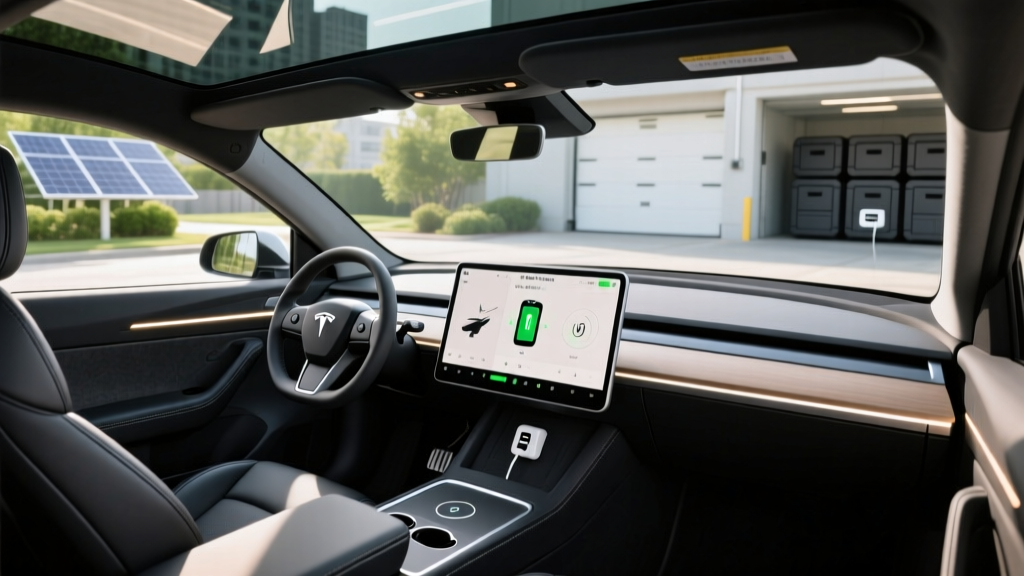
Infotainment and controls: Nearly every vehicle function runs through the 18.5-inch center display, including climate controls, mirror adjustments, glove-box release, and even the windshield wiper speed. There is no instrument cluster; speed and navigation are shown in the upper-left corner of the main screen. A 9.4-inch rear touchscreen lets back-seat passengers control their own climate zone and media. Wireless phone charging, two USB-C ports (front), and two more USB-C ports (rear) are standard.
Driver assistance: Tesla's Basic Autopilot (lane centering, traffic-aware cruise control) is standard. Full Self-Driving (Supervised) remains a $8,000 add-on or $99/month subscription as of early 2026. FSD Supervised is an SAE Level 2 system — it does not make the Cybertruck self-driving, and the driver must remain fully attentive with hands on the yoke at all times.
Tesla's Autopilot and Full Self-Driving (Supervised) are SAE Level 2 driver-assist systems. They require continuous driver supervision, do not handle all road scenarios, and can make critical errors at construction zones, unmapped intersections, and in degraded weather. The driver is legally and operationally responsible at all times. Only Level 4 robotaxi services (e.g., Waymo in designated zones) operate without a human driver.
Notable interior drawbacks:
- The yoke steering wheel requires a learning curve for low-speed maneuvers and three-point turns — there is no round-wheel option.
- Stainless-steel dash and door trim can create glare in direct sunlight; some owners apply matte vinyl wraps to mitigate this.
- Rear visibility is compromised by the small rear window and the bed sail; the digital rearview camera mirror is essential and standard.
- No Apple CarPlay or Android Auto — Tesla's proprietary infotainment only.
Pricing, Tax Credits, and What You Will Actually Pay
For 2026, Tesla lists the Cybertruck AWD at $79,990 and the Cyberbeast at $99,990 (both prices exclude the $1,390 destination fee). These figures are a significant correction from the 2024 Foundation Series, which carried a $20,000 premium that Tesla has since eliminated on new orders.
| Trim | Base MSRP | As-Tested (Typical) | §30D Credit Eligibility |
|---|---|---|---|
| AWD (Dual-Motor) | $79,990 | $82,500–$86,000 (with FSD, armor film) | Eligible for up to $7,500 if buyer meets income caps and battery-sourcing rules |
| Cyberbeast (Tri-Motor) | $99,990 | $103,000–$110,000 (with FSD, accessories) | Not eligible — exceeds the $80,000 MSRP cap for trucks under IRS §30D |
Key §30D federal tax credit rules (2026):
- MSRP cap for pickups/SUVs: $80,000. The Cybertruck AWD at $79,990 squeaks under; the Cyberbeast at $99,990 does not qualify.
- Buyer income caps (MAGI): $150,000 single / $225,000 head of household / $300,000 married filing jointly.
- Battery sourcing: The credit is split into two $3,750 halves — one for critical-minerals sourcing and one for battery-component manufacturing. Tesla's 4680 cells use a growing share of North American-sourced materials, but the exact qualifying amount shifts quarterly. Check the IRS qualified-vehicle list before purchasing.
- Point-of-sale transfer: You can transfer the credit to the dealer at purchase to reduce your out-of-pocket cost, rather than waiting to claim it on your tax return.
Ownership Costs, Warranty, and Long-Term Considerations
Tesla covers the Cybertruck with a 4-year/50,000-mile limited vehicle warranty and an 8-year/120,000-mile battery and drive-unit warranty. The battery warranty guarantees at least 70% capacity retention over the coverage period — consistent with industry norms for NMC chemistry packs. Based on 4680-cell degradation data from Model Y owners (the first vehicle to use these cells), most packs retain 90–93% capacity after 50,000 miles, with a slower degradation curve thereafter.
Estimated annual operating costs:
- Electricity (12,000 mi/yr at $0.16/kWh national avg): ~$3,840/yr at 2.0 kWh/mi
- Equivalent gasoline truck (17 MPG combined at $3.50/gal): ~$2,470/yr in fuel
- Wait — the Cybertruck costs more to "fuel" than a gas truck? Not quite. Home charging at off-peak rates ($0.10–$0.13/kWh) drops the annual cost to $2,400–$3,120. Public DC fast charging at $0.40–$0.55/kWh is where costs spike. The economics strongly favor owners with reliable Level 2 home charging.
- Insurance: Expect $2,800–$4,200/year depending on state, driving record, and coverage level. The Cybertruck's stainless-steel body panels and structural battery make collision repairs expensive, which insurers factor into premiums.
- Tires: The 35×8.5R20 all-terrain tires are a non-standard size; replacement sets run $1,600–$2,200 and may need replacement every 25,000–35,000 miles given the truck's weight and torque.
How the Cybertruck Stacks Up Against Key Competitors
The electric pickup segment in 2026 includes the Rivian R1T, Ford F-150 Lightning, and the Chevrolet Silverado EV. Here is how the Cybertruck AWD compares on the metrics buyers care about most:
| Metric | Tesla Cybertruck AWD | Rivian R1T Dual-Motor | Ford F-150 Lightning Lariat | Chevy Silverado EV 4WT |
|---|---|---|---|---|
| EPA Range | 340 mi | 352 mi (Max Pack) | 320 mi (Ext. Range) | 440 mi (4WT) |
| Peak DC Charge | 350 kW | 220 kW | 150 kW | 350 kW |
| 10–80% Time | ~17 min | ~30 min | ~41 min | ~20 min |
| Towing | 11,000 lbs | 11,000 lbs | 10,000 lbs | 10,000 lbs |
| Starting MSRP | $79,990 | $75,900 | $69,995 | $74,800 |
| §30D Eligible | Yes (AWD only) | Yes (selected trims) | Yes (most trims) | Yes (selected trims) |
The Cybertruck's key advantage is charging speed: its 800V architecture and 350 kW peak rate are matched only by the Silverado EV and blow past the Rivian and Ford. Its key disadvantage is price and polarizing design — it is the most expensive base entry here and the only one that cannot pass through a standard automatic car wash (Tesla advises against brush-style washes due to the stainless-steel finish).
Choose the Cybertruck AWD if: You want the fastest-charging electric pickup available, value Tesla's Supercharger network for road trips, need 11,000-lb towing, and can accommodate the $80K price point. Best for tech-forward buyers who tow boats or trailers on weekends and have home Level 2 charging.
Choose the Cyberbeast if: You want 845 hp and 2.6-second 0–60 performance and accept that you will pay full MSRP with no federal tax credit. This is a performance-halo purchase, not an economic one.
Look at the F-150 Lightning or Silverado EV if: You need a more traditional truck experience, want CarPlay, need a lower starting price, or require a crew cab with genuine five-adult rear seating comfort.
Pros and Cons at a Glance
- Class-leading 350 kW DC fast charging with 10–80% in ~17 min
- 800V architecture future-proofs for next-gen charging infrastructure
- 11,000-lb towing with integrated trailer brake controller
- Stainless-steel exoskeleton resists dents and corrosion
- Power frunk (7 cu ft) and lockable under-bed storage
- V2L (vehicle-to-load) capability: 120V and 240V outlets in bed and cabin
- OTA software updates continue to add features post-purchase
- Access to Tesla's 20,000+ Supercharger network
- Cyberbeast trim ($99,990) is ineligible for the §30D federal tax credit
- Yoke steering has a steep learning curve; no round-wheel option
- No Apple CarPlay or Android Auto
- Rear headroom and legroom trail the F-150 Lightning
- Insurance premiums 30–50% higher than comparable gas trucks
- Non-standard 35×8.5R20 tire size limits replacement options and raises cost
- Stainless-steel body panels are costly to repair after collision damage
- Visibility compromised by bed sail and small rear glass
Frequently Asked Questions
What is the real-world range of the Tesla Cybertruck?
The EPA rates the AWD at 340 miles and the Cyberbeast at 320 miles. In real-world highway driving at 70–75 mph, expect 270–295 miles from the AWD and 255–280 from the Cyberbeast. Cold weather (below 32°F) can reduce range by 15–30% if you do not precondition the battery. Towing a 7,000-lb trailer cuts range roughly in half — plan for 150–170 miles between charges when towing heavy.
How fast does the Cybertruck charge at home and on the road?
On a Level 2 home charger (11.5 kW), the Cybertruck adds about 44 miles of range per hour, with a full 0–100% charge taking roughly 11 hours. On a V4 Supercharger or compatible 350 kW DC fast charger, the 10–80% session takes approximately 17 minutes. At 250 kW CCS stations (using the included adapter), 10–80% takes about 22 minutes. Charging slows significantly above 80% SoC — plan your road-trip stops around the 10–80% window.
Does the Cybertruck qualify for the $7,500 federal EV tax credit?
The AWD trim at $79,990 MSRP qualifies under the §30D truck cap of $80,000, assuming the buyer meets income limits ($150K single / $300K joint) and the battery satisfies critical-minerals and component-sourcing requirements for the current quarter. The Cyberbeast at $99,990 does not qualify. Always verify current eligibility on the IRS qualified vehicles page before purchasing, as sourcing rules change periodically.
Is the Cybertruck worth buying over the Rivian R1T or F-150 Lightning?
It depends on your priorities. The Cybertruck wins on DC fast-charge speed (350 kW vs. 220 kW for Rivian, 150 kW for Ford) and Supercharger network access. The F-150 Lightning wins on price, rear-seat comfort, and familiarity (it drives and looks like a conventional truck). The Rivian R1T wins on off-road capability and build-quality perception. If you road-trip frequently and tow, the Cybertruck's charging advantage is meaningful. If you need a daily work truck with easy serviceability and lower insurance, the Lightning is the safer bet.
What are the biggest interior complaints from owners?
The most common owner complaints center on the yoke steering (difficult for parking-lot maneuvers), glare from the stainless-steel dash surfaces, limited rear-seat headroom for taller passengers, and the lack of Apple CarPlay. The absence of physical buttons for climate and mirrors also frustrates some drivers, though Tesla's OTA updates have improved the speed and logic of the touchscreen menus over time.
How much does it cost to insure a Cybertruck?
Expect annual premiums between $2,800 and $4,200, depending on your state, age, driving record, and coverage level. The Cybertruck's stainless-steel unibody and structural battery pack make collision repairs more expensive than conventional trucks, which insurers price into policies. Tesla Insurance is available in some states and may offer competitive rates tied to real-time driving behavior.