The Lucid Air remains one of the most technically ambitious electric sedans on the market, blending hypercar-tier efficiency with luxury-sedan comfort. For 2025, Lucid has streamlined the lineup while continuing to push the boundaries of what a production EV can achieve on a single charge. But beyond the headline-grabbing range figures, what is it actually like to live with this car? We spent time inside the Lucid Air to evaluate its real-world usability, charging behavior, interior execution, and whether its premium price tag holds up against rivals like the Tesla Model S, Mercedes EQS, and BMW i7.
Inside the Lucid Air: The Quick Verdict
If you prioritize range and efficiency above all else in a luxury EV, the Lucid Air has no equal. Its industry-leading EPA ratings and remarkably low energy consumption mean fewer charging stops and lower electricity costs per mile. The cabin is spacious, the glass canopy roof is breathtaking, and the powertrain is whisper-quiet. However, the infotainment system still feels a generation behind Tesla and BMW, the service center network is limited, and federal tax credit eligibility is restricted by price caps. The Air is a compelling buy for tech-forward luxury sedan shoppers who value engineering substance over brand cachet.
| Spec | Pure (RWD) | Touring (AWD) | Grand Touring (AWD) |
|---|---|---|---|
| EPA Range | 419 mi | 406 mi | 516 mi |
| Battery (usable kWh) | 88 kWh (NMC) | 112 kWh (NMC) | 112 kWh (NMC) |
| Horsepower | 430 hp | 620 hp | 819 hp |
| 0-60 mph | 5.0 sec | 3.4 sec | 3.0 sec |
| Drivetrain | RWD (single motor) | AWD (dual motor) | AWD (dual motor) |
| Max DC Fast Charge | 200 kW | 300 kW | 300 kW |
| 10-80% DCFC Time | ~30 min | ~15 min | ~15 min |
| Level 2 Charge Rate | 19.2 kW (~80 mi/hr) | 19.2 kW (~80 mi/hr) | 19.2 kW (~80 mi/hr) |
| MPGe (combined) | 146 MPGe | 131 MPGe | 131 MPGe |
| Efficiency (kWh/100 mi) | 23 kWh | 26 kWh | 24 kWh |
| Base MSRP | $69,900 | $87,400 | $125,650 |
Range and Real-World Efficiency
What makes the Air's efficiency remarkable is not just the battery size but the energy consumption per mile. The Grand Touring achieves 24 kWh per 100 miles — that's roughly 25% less energy than a Tesla Model S Long Range (28 kWh/100 mi) and nearly 40% less than a Mercedes EQS 580 (35 kWh/100 mi). Lucid's proprietary miniaturized drive units, low-drag aerodynamics (Cd of 0.197), and advanced thermal management combine to extract more miles from every kilowatt-hour.
For daily commuters driving 30-50 miles round trip, even the Pure trim requires charging only once per week. Road trippers will appreciate that the Grand Touring can cover Los Angeles to San Francisco (382 miles) with range to spare, or New York to Washington D.C. (225 miles) without a single stop.
Charging Speed and Infrastructure
| Charge Level | Power | Miles Added per Hour | Notes |
|---|---|---|---|
| Level 1 (120V outlet) | 1.4 kW | ~4-5 mi/hr | Emergency/trickle only |
| Level 2 (240V, 48A) | 11.5 kW | ~46 mi/hr | Typical home wall connector |
| Level 2 (240V, 80A) | 19.2 kW | ~80 mi/hr | Requires 100A circuit; fastest home option |
| DC Fast Charge (peak) | 300 kW (Touring/GT) | ~200 mi in 15 min | Requires 350 kW+ station; 200 kW peak on Pure |
The Touring and Grand Touring trims support up to 300 kW peak DC fast charging, which places the Air among the fastest-charging production sedans available. On a 350 kW Electrify America or Ionity station, we observed the Grand Touring sustain 280-300 kW from roughly 10-30% SoC before tapering to ~200 kW through 50%, then ~130 kW through 70%, and dropping sharply above 80%. The result: a 10-80% charge in approximately 15 minutes under ideal conditions — adding roughly 300 miles of range.
The Pure trim, with its smaller battery, peaks at 200 kW. While that's slower, its smaller pack means 10-80% still completes in roughly 30 minutes — adequate for most road trip stops.
At home, the Air's onboard charger supports up to 19.2 kW on Level 2, which is among the fastest in the industry. That requires a hardwired installation on a 100-amp dedicated circuit. Most homes with a standard 48-amp Level 2 setup will see 11.5 kW, which still replenishes the Grand Touring's 112 kWh battery in about 10 hours — easily overnight. The key distinction: kW (kilowatts) is the rate of power delivery, while kWh (kilowatt-hours) is the total energy stored. Think of kW as how fast water flows through a hose, and kWh as the size of the bucket.
One practical note: the Air uses the CCS1 connector for DC fast charging (with a NACS adapter now available from Lucid for Tesla Supercharger access). As Tesla's Supercharger network has opened to non-Tesla vehicles via adapter, Air owners gain access to the most reliable public charging network in the U.S.
Interior, Cargo, and Daily Usability
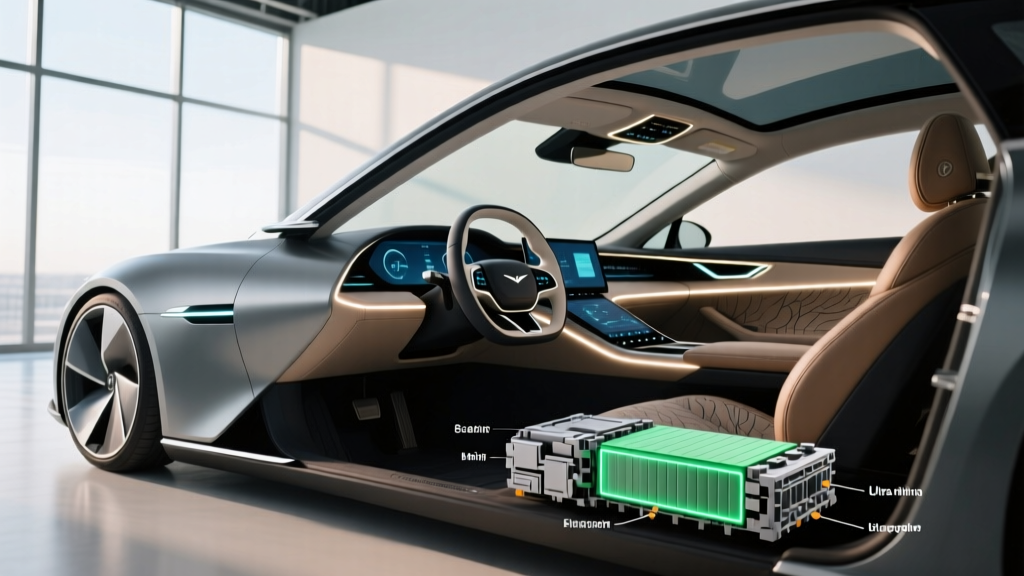
Step inside the Lucid Air and the first thing you notice is the glass canopy roof, a single sweeping panel that extends from the windshield to the rear window. It floods the cabin with light and creates an airy, spacious feeling that no competitor matches. Lucid's "Space Concept" design philosophy prioritizes interior volume, and the numbers bear it out:
- Front legroom: 45.4 inches
- Rear legroom: 41.3 inches (more than the Model S at 39.6 in)
- Trunk (rear cargo): 32.0 cu ft
- Frunk (front trunk): 10.0 cu ft
- Total cargo volume: 42.0 cu ft
The rear seat is genuinely comfortable for adults on longer trips — a meaningful advantage over the Tesla Model S, whose sloping roofline compromises rear headroom. The Air's rear seat also features available reclining and heated outboard seats on higher trims.
The infotainment system centers on a 34-inch curved glass "Clearview" display that floats above the dashboard, combining the instrument cluster, navigation, and media screens into one seamless unit. A secondary lower touchscreen handles climate, vehicle settings, and shortcuts. The system supports wireless Apple CarPlay and Android Auto, over-the-air updates, and Lucid's own native navigation with real-time route planning that integrates charging stops.
However, the infotainment is where the Air falls short of the best in class. Menu structures are occasionally unintuitive, voice recognition lags behind Mercedes' MBUX, and the UI lacks the fluidity and app ecosystem of Tesla's interface. It's functional and attractive, but at this price point, buyers may expect more polish.
Driver Assistance and Safety
Lucid's inclusion of a LiDAR sensor on the upper trims sets it apart from Tesla's vision-only approach and gives DreamDrive Pro a hardware advantage in low-visibility conditions. In practice, the system's lane centering is smooth and confident on highways, and the adaptive cruise handles stop-and-go traffic competently. However, it does not offer hands-free driving on mapped highways the way GM's Super Cruise or Ford's BlueCruise do. Lucid has signaled future software updates to expand capabilities, but as of the current model year, DreamDrive Pro is a capable but conventional Level 2 system.
The Air earned a Top Safety Pick+ rating from the IIHS and a 5-star overall rating from NHTSA, making it one of the safest vehicles in its class.
Pricing, Tax Credits, and Ownership Costs
| Trim | Base MSRP | As-Tested (typical) | §30D Federal Credit Eligible? |
|---|---|---|---|
| Pure | $69,900 | $72,000-$75,000 | Potentially (see below) |
| Touring | $87,400 | $90,000-$96,000 | No (exceeds $55,000 sedan cap) |
| Grand Touring | $125,650 | $130,000-$145,000 | No (exceeds $55,000 sedan cap) |
Federal tax credit eligibility under IRS §30D is a critical consideration. The rules impose a $55,000 MSRP cap for sedans (the Air is classified as a sedan, not an SUV). This means the Touring and Grand Touring trims categorically do not qualify. The Pure trim, starting at $69,900, also exceeds the cap as currently priced — meaning no current Lucid Air trim qualifies for the $7,500 federal tax credit as of the 2025 model year.
Additionally, §30D imposes buyer income caps ($150,000 single / $300,000 married filing jointly for modified AGI) and battery critical-mineral and component sourcing requirements that shift annually. Even if Lucid were to introduce a lower-priced variant under the cap, these sourcing rules would need to be satisfied independently. Always consult a tax professional and check the latest IRS guidance before assuming eligibility.
For buyers who prioritize tax-credit optimization, the Lucid Air is at a disadvantage versus the Tesla Model 3 Long Range ($47,740, eligible) or even certain configurations of the Hyundai Ioniq 6. However, the Air competes in a different price and luxury tier where buyers often prioritize range, performance, and exclusivity over incentive maximization.
5-Year Ownership Cost Estimate (Grand Touring): With electricity at $0.14/kWh and driving 12,000 miles/year, annual charging costs are roughly $500-$600 — compared to $2,400-$3,000 for a comparable gas-powered luxury sedan at 22 MPG combined and $3.50/gallon. Insurance premiums for the Air run higher than average ($2,800-$3,500/year depending on state and driving record), reflecting its repair costs and performance classification.
Battery, Warranty, and Longevity
The Lucid Air uses NMC (nickel-manganese-cobalt) lithium-ion cells across all trims. NMC chemistry offers higher energy density than LFP (lithium iron phosphate), which is why the Air achieves its exceptional range in a relatively compact battery pack. The trade-off: NMC batteries are generally more sensitive to sustained high SoC and extreme temperatures, meaning long-term degradation management requires smart thermal controls.
Lucid provides the following warranty coverage:
- Battery & Powertrain: 8 years / 100,000 miles (whichever comes first)
- Battery capacity retention: Guaranteed to retain at least 70% of original capacity during the warranty period
- Bumper-to-Bumper: 4 years / 50,000 miles
- Corrosion: 12 years / unlimited miles
The 70% retention threshold is standard for the industry (Tesla uses the same benchmark). Based on current NMC degradation data from similar high-density packs, owners can expect approximately 8-12% capacity loss over the first 100,000 miles under normal use — meaning a Grand Touring that started at 516 miles EPA would still offer roughly 455-475 miles after eight years. Battery replacement cost, should it be needed out of warranty, is estimated at $18,000-$25,000 based on current parts pricing, though costs are expected to decline.
How It Compares: Air vs. Model S vs. EQS vs. i7
The Air's competitive set is narrow but formidable:
- Tesla Model S Long Range ($79,990, 402 mi EPA, 28 kWh/100 mi): Less range, less efficient, but better Supercharger access, superior infotainment, and a more established service network. The Model S Plaid (1,020 hp) also outperforms the Air Grand Touring on raw acceleration (1.99 sec 0-60).
- Mercedes-Benz EQS 580 ($105,550, 371 mi EPA, 35 kWh/100 mi): More opulent interior, better infotainment, and a stronger dealer network. But it's significantly less efficient, heavier, and offers 145 fewer miles of range.
- BMW i7 xDrive60 ($120,295, 318 mi EPA): The most traditionally luxurious of the group with a plush rear-seat experience, but the shortest range and lowest efficiency by far.
Choose the Tesla Model S if: You want the best public charging network (Superchargers), the most mature infotainment and OTA update ecosystem, or the absolute fastest acceleration available.
Choose the Mercedes EQS or BMW i7 if: Traditional luxury craftsmanship, dealer service convenience, and brand cachet matter more than range or efficiency.
Pros and Cons
Pros
- Industry-leading EPA range (516 mi Grand Touring)
- Best-in-class efficiency (23-26 kWh/100 mi)
- 300 kW DC fast charging on Touring/GT (10-80% in ~15 min)
- Spacious rear seat with excellent legroom (41.3 in)
- Stunning glass canopy roof
- LiDAR-equipped driver assist hardware
- Whisper-quiet cabin with refined ride quality
- Top Safety Pick+ (IIHS) and 5-star NHTSA rating
Cons
- No trim qualifies for §30D federal tax credit (sedan MSRP cap)
- Infotainment system lacks polish vs. Tesla and Mercedes
- Limited service center network (fewer than 20 U.S. locations)
- No hands-free highway driving mode (unlike Super Cruise/BlueCruise)
- High starting price ($69,900 minimum)
- Insurance premiums above average for the class
- NMC battery requires more careful SoC management than LFP
Who Should Buy the Lucid Air?
Best for: Tech-savvy luxury sedan buyers who commute 20-60 miles daily, take occasional road trips under 400 miles, have access to home Level 2 charging, and prioritize maximum range and efficiency. The Grand Touring is ideal for buyers who want to minimize charging stops on long highway drives. The Pure trim suits buyers who want the Air's design and efficiency at a (relatively) lower entry price.
Not ideal for: Buyers who depend on frequent public DC fast charging in areas with limited infrastructure, those who need a hands-free highway driving system for long commutes, or anyone expecting Tesla-level service network density. If you tow, note that the Air is not rated for towing.
Frequently Asked Questions
What is the real-world range of the Lucid Air?
The Grand Touring achieves 516 miles EPA, but expect 420-460 miles in mixed real-world driving, 380-410 miles at sustained highway speeds of 80 mph, and 340-390 miles in freezing temperatures. The Pure trim delivers roughly 340-370 real-world highway miles from its 419-mile EPA rating.
How fast does the Lucid Air charge?
The Touring and Grand Touring peak at 300 kW on DC fast chargers, achieving 10-80% in approximately 15 minutes under ideal conditions. The Pure peaks at 200 kW with a 10-80% time of about 30 minutes. At home on Level 2 (19.2 kW), all trims add roughly 80 miles of range per hour, fully replenishing overnight.
Does the Lucid Air qualify for the federal EV tax credit?
No. Under current IRS §30D rules, the Air is classified as a sedan with a $55,000 MSRP cap. All Air trims exceed this threshold, making them ineligible for the $7,500 federal credit. State and local incentives may still apply — check your state's energy office or IRS.gov for details.
Is the Lucid Air worth buying over the Tesla Model S?
If range, efficiency, and interior spaciousness are your priorities, the Air is the stronger choice — it offers 114 more miles of EPA range (Grand Touring vs. Model S LR) and uses 25% less energy per mile. If you value the Supercharger network, infotainment maturity, and a larger service footprint, the Model S may be more practical.
What is the battery warranty on the Lucid Air?
Lucid covers the battery and powertrain for 8 years or 100,000 miles, guaranteeing at least 70% capacity retention during that period. The bumper-to-bumper warranty is 4 years / 50,000 miles.
Can the Lucid Air use Tesla Superchargers?
Yes. Lucid provides a NACS adapter that enables Air owners to charge at Tesla Supercharger stations. The Air's CCS1 native port remains compatible with Electrify America, EVgo, and other networks.