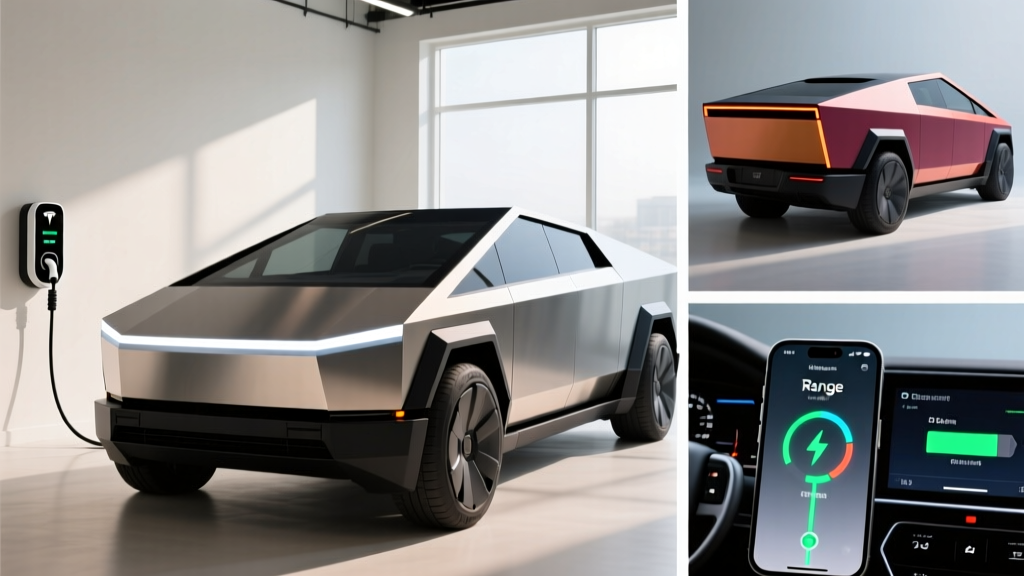
The Tesla Cybertruck defies easy categorization. It is simultaneously the most talked-about vehicle on the road and one of the least understood by prospective buyers. If you've been searching for a detailed look at what it's actually like inside a Cybertruck — beyond the polarizing angular exterior — this review covers the numbers that matter: real-world range, charging speed, cabin practicality, and the total cost of ownership in 2026.
After spending time with all three current trims — the Rear-Wheel Drive, the Dual Motor All-Wheel Drive, and the tri-motor Cyberbeast — here is what the spec sheets don't tell you.
At a Glance: 2026 Cybertruck Specifications
| Spec | RWD (Base) | AWD Dual Motor | Cyberbeast (Tri-Motor) |
|---|---|---|---|
| EPA Range | ~250 mi (est.) | 340 mi | 320 mi |
| Battery (usable) | ~100 kWh (NMC est.) | 123 kWh (NMC) | 123 kWh (NMC) |
| 0–60 mph | ~6.5 s | 4.1 s | 2.6 s |
| Horsepower | ~315 hp | 600 hp | 845 hp |
| Drivetrain | RWD (single motor) | AWD (dual motor) | AWD (tri-motor) |
| Max DC Fast Charge | ~250 kW | 350 kW (800V) | 350 kW (800V) |
| 10–80% DCFC Time | ~32 min | ~18 min | ~18 min |
| Level 2 Home Charge | 11.5 kW (~30 mi/hr) | 11.5 kW (~30 mi/hr) | 11.5 kW (~30 mi/hr) |
| MPGe (combined) | ~67 MPGe | 67 MPGe | 62 MPGe |
| Towing Capacity | 7,500 lb | 11,000 lb | 11,000 lb |
| Base MSRP | $60,990 | $79,990 | $99,990 |
Note: RWD trim specs are estimated based on Tesla's announced figures for the base model entering production in 2026. AWD and Cyberbeast figures reflect EPA-published data via fueleconomy.gov.
Real-World Range: What the EPA Sticker Doesn't Tell You
The AWD Cybertruck carries an EPA-estimated 340 miles of range. In mixed real-world driving — 70 mph highway cruising with moderate climate control — expect closer to 270–290 miles. In cold weather (below 32°F), that figure can drop to 220–250 miles due to battery resistance and cabin heating demands. The Cyberbeast, at 320 miles EPA, typically delivers 250–270 miles in real-world highway conditions.
The Cybertruck's stainless-steel exoskeleton is heavy — the AWD model tips the scales at roughly 6,600 pounds — and that mass works against highway efficiency. The AWD trim achieves roughly 2.0–2.2 kWh per mile at highway speeds, which is thirstier than a Model X and far less efficient than a Rivian R1T (roughly 2.0 kWh/mi) or an F-150 Lightning Extended Range (~2.1 kWh/mi). Around town, regenerative braking helps recover energy, and you'll see closer to EPA figures if most of your driving is suburban at 35–50 mph.
If you tow, plan aggressively: towing a 5,000-pound trailer can cut range by 40–50%, leaving you with roughly 150–170 miles before needing a charge.
Charging Speed: The 800-Volt Advantage
This is where the Cybertruck distinguishes itself from most of the electric truck segment. The AWD and Cyberbeast trims use an 800-volt battery architecture, enabling peak DC fast-charge rates of up to 350 kW at compatible V4 Tesla Superchargers.
| Charging Level | Power (kW) | Miles of Range Added per Hour | Notes |
|---|---|---|---|
| Level 1 (120V household) | ~1.4 kW | ~4–5 mi/hr | Emergency/trickle only |
| Level 2 (240V home, 48A) | 11.5 kW | ~30 mi/hr | Full overnight charge in ~11 hrs |
| DC Fast Charge (V4 Supercharger) | Up to 350 kW | ~750+ mi/hr (peak) | 10–80% in ~18 min (AWD/Beast) |
| DC Fast Charge (CCS adapter, non-Tesla) | Up to 250 kW | ~550 mi/hr (peak) | Requires Tesla CCS adapter |
A critical reality about charge curves: the Cybertruck does not sustain 350 kW for the entire session. Peak rate holds roughly between 10% and 35% State of Charge (SoC), then tapers progressively. From 50% to 80%, you'll see rates closer to 120–150 kW. The advertised 10–80% time of ~18 minutes assumes optimal battery preconditioning — meaning you've navigated to a Supercharger using the truck's built-in routing, which warms the battery to ideal charging temperature before you arrive.
If you arrive at a charger cold (without preconditioning), expect 10–80% to take 25–30 minutes instead. Always precondition.
For home charging, a Level 2 wall connector on a 60-amp circuit (48 amps continuous) delivers 11.5 kW, adding roughly 30 miles of range per hour. A full 0–100% charge takes about 11 hours, making overnight charging straightforward for most daily commutes. Home installation of a 240V/60A circuit typically runs $800–$2,500 depending on your panel capacity and conduit run — factor in a possible panel upgrade ($1,500–$3,000) if your home has a 100-amp service.
Inside the Cybertruck: Cabin, Cargo, and Tech
Stepping inside a Cybertruck is where the "concept car in production clothing" impression intensifies — for better and worse.
Front and Rear Seating
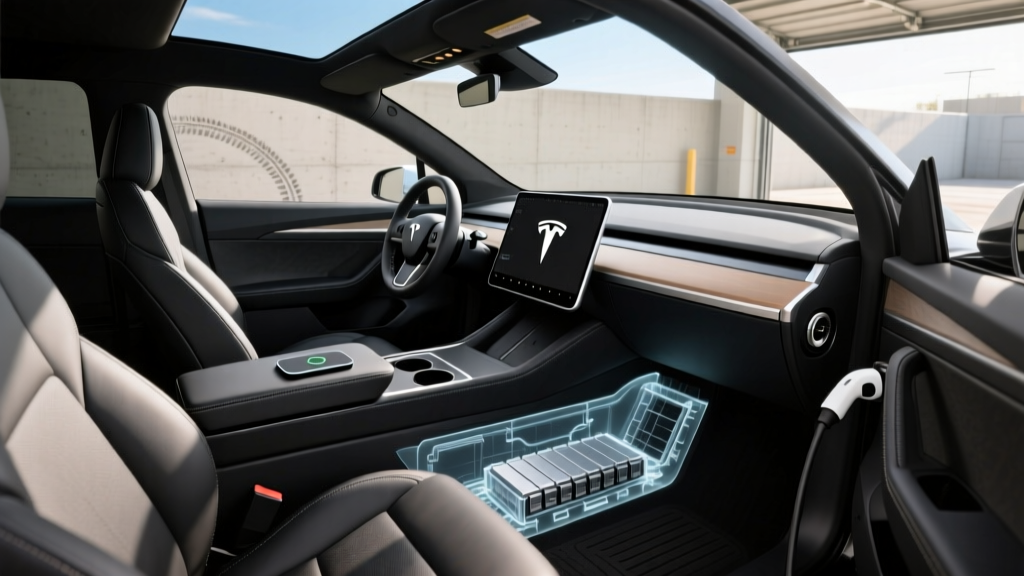
The cabin seats five on a vegan-leather bench-style front row (with a center fold-down armrest/console). Front headroom is generous at roughly 41.0 inches, and legroom measures approximately 41.7 inches. The rear bench offers about 38.4 inches of legroom — adequate for adults on shorter trips but tight for six-foot passengers on long hauls. The rear seatback angle is relatively upright, and the roofline slopes aggressively, cutting into rear headroom. Taller passengers will notice.
Cargo Capacity
The 6-foot composite bed offers ~67 cubic feet of volume with the tonneau cover closed. The powered retractable bed cover (standard on all trims) is one of the truck's best practical features — it seals weather-tight and supports the roof rack system rated for 300 pounds dynamic / 600 pounds static load.
There is no traditional frunk (front trunk) in the Cybertruck; that space is occupied by HVAC components and the 12V lithium-ion auxiliary battery. Interior storage behind the rear seats (the "sail" pillars) provides enclosed, lockable space for gear — Tesla quotes roughly ~12 cu ft of interior cargo behind/under the rear bench.
Infotainment and Driver Assistance
The centerpiece is an 18.5-inch touchscreen with no physical buttons or stalks — turn signals are integrated into the yoke-style steering wheel (a conventional round wheel is now available as a no-cost option). The interface runs Tesla's latest software, including navigation, media, and vehicle controls. A rear 9.4-inch touchscreen serves second-row passengers for climate and media.
Driver assistance comes via Tesla Autopilot (standard), which includes adaptive cruise control and lane-keeping. Full Self-Driving (Supervised) is an optional $8,000 add-on (or $99/month subscription) that enables automatic lane changes, intersection handling, and parking maneuvers. To be clear: FSD is an SAE Level 2 system. The driver must remain fully attentive, hands on or near the yoke, and eyes on the road at all times. It is not autonomous driving.
Tesla Autopilot and FSD (Supervised) are SAE Level 2 driver-assistance systems. You are the driver. The system can steer, accelerate, and brake within its lane, but you must monitor the road, keep your hands available, and be ready to take over instantly. Only Level 4+ robotaxi services (e.g., Waymo in designated zones) operate without a human driver.
Unique Features and Notable Drawbacks
The Cybertruck's steer-by-wire system eliminates the mechanical connection between yoke and wheels, enabling a variable steering ratio: roughly 340° of lock-to-lock at low speeds (tight parking maneuvers) and less sensitive response at highway speed. It takes genuine adaptation — expect a week or two before it feels natural.
The 48-volt electrical architecture (an industry first for a production vehicle at this scale) reduces wiring harness weight and enables higher-power accessories. It also means conventional 12V aftermarket accessories won't work without adapters.
Notable drawbacks: the stainless-steel body panels show fingerprints relentlessly, panel gap consistency has improved since early 2024 deliveries but still draws scrutiny, rear visibility is compromised by the thick sail pillars and small rear window (a digital camera-based rearview mirror helps), and the sheer width of the vehicle (~80 inches without mirrors) makes tight urban parking garages stressful.
Performance: From Commuter to Cyberbeast
The tri-motor Cyberbeast's 2.6-second 0–60 mph time makes it one of the quickest production vehicles ever sold, regardless of powertrain. But the more relevant performance metric for most buyers is the AWD Dual Motor's 4.1-second sprint — which is quicker than nearly every gas-powered truck on the market and more than adequate for highway merging and passing.
All trims feature adaptive air suspension with up to 16 inches of ground clearance in Off-Road mode (roughly 13 inches at Normal height). The Cybertruck's approach and departure angles (35° and 30° respectively) are competitive with a well-equipped midsize off-roader. The stainless-steel underbody armor is standard, providing genuine protection on rocky trails.
Ride quality has been a surprise: the air suspension, combined with the steer-by-wire tuning, delivers a composed and surprisingly comfortable highway ride. The 20-inch all-terrain tires (standard on AWD) generate noticeable road noise above 65 mph — a tradeoff for off-road capability.
Pricing, Trims, and Federal Tax Credit Eligibility
| Trim | Base MSRP | Est. As-Tested* | §30D Federal Credit Eligibility |
|---|---|---|---|
| RWD | $60,990 | $63,000–$66,000 | Eligible (up to $7,500) if income/MSRP caps met |
| AWD Dual Motor | $79,990 | $83,000–$90,000 | Eligible — MSRP under $80,000 truck cap |
| Cyberbeast | $99,990 | $105,000–$112,000 | NOT eligible — MSRP exceeds $80,000 truck cap |
*As-tested prices reflect common add-ons: FSD ($8,000), premium connectivity, and accessories. Destination charges included in MSRP.
Under current IRS §30D rules, the Cybertruck qualifies as a light-duty truck, which carries an $80,000 MSRP cap (compared to $55,000 for sedans). This means:
- RWD ($60,990): Potentially eligible for the full $7,500 credit.
- AWD Dual Motor ($79,990): Just under the truck cap — eligible, but adding enough options to push the total vehicle MSRP above $80,000 could disqualify it. Confirm the window-sticker MSRP before purchase.
- Cyberbeast ($99,990): Exceeds the $80,000 truck MSRP cap. No federal credit.
Additional §30D requirements apply to all trims:
- Buyer income caps: Modified AGI must not exceed $300,000 (joint filers), $225,000 (head of household), or $150,000 (single).
- Battery sourcing: A percentage of critical minerals and battery components must be sourced from the U.S. or free-trade-agreement countries. Tesla has progressively increased domestic sourcing, but exact eligibility can shift — always verify current-year requirements on the IRS Clean Vehicle Credit portal before purchasing.
- Point-of-sale transfer: As of 2024, the credit can be transferred to the dealer at purchase, reducing your out-of-pocket cost immediately rather than waiting for a tax refund. Confirm your dealer participates.
Ownership Costs: Warranty, Efficiency, and Long-Term Value
Tesla provides a 4-year/50,000-mile basic vehicle warranty and an 8-year/120,000-mile battery and drive unit warranty, guaranteeing a minimum of 70% battery capacity retention over that period. The Cybertruck's NMC (nickel manganese cobalt) battery chemistry offers higher energy density than LFP but is more sensitive to sustained high-State-of-Charge storage. Best practice: charge to 80–90% for daily use and only charge to 100% before long trips.
Efficiency-wise, the AWD model's 67 MPGe combined translates to roughly 50 kWh per 100 miles — or about $0.065–$0.09 per mile on a national-average residential electricity rate of $0.16/kWh. That compares favorably to a gas truck getting 18 MPG combined at $3.50/gallon ($0.194/mile). Over 15,000 miles per year, the AWD Cybertruck saves roughly $1,900–$2,200 annually on energy versus a comparable gas truck.
Insurance is a different story. Cybertruck premiums run 30–50% higher than a comparable F-150 Lightning, driven by stainless-steel body repair complexity, high parts costs, and Tesla's direct repair network limitations. Expect annual premiums of $3,200–$4,800 depending on your state and driving record. Get quotes before purchasing.
Pros, Cons, and Who Should Buy One
- Best-in-class DC fast charging (350 kW, ~18 min 10–80%)
- 11,000-lb towing capacity (AWD/Cyberbeast)
- Genuine off-road capability with air suspension and armor
- Powered tonneau cover and integrated bed power (120V/240V)
- Over-the-air updates continuously add features
- Supercharger network access (most reliable public DC network)
- Real-world highway range well below EPA (270–290 mi vs. 340 mi)
- Steep learning curve: steer-by-wire, yoke, no stalks
- Rear visibility and rear-seat comfort are compromised
- High insurance premiums ($3,200–$4,800/yr)
- No frunk; limited interior cargo flexibility
- Stainless-steel panels show fingerprints and are costly to repair
- Cyberbeast exceeds $80K MSRP cap — no federal tax credit
Buy it if: You want a full-size electric truck with best-in-class charging speed, genuine towing/off-road capability, and you have reliable home charging. The AWD Dual Motor is the value sweet spot — fast, capable, and still eligible for the federal credit.
Look elsewhere if: Your priority is maximum range (Rivian R1T Max Pack: 410 mi), traditional truck ergonomics (F-150 Lightning), or you need a comfortable 5-adult family hauler (the rear seat isn't ideal for long trips with taller passengers).
Frequently Asked Questions
What is the real-world range of the Cybertruck?
The AWD Dual Motor is EPA-rated at 340 miles, but expect 270–290 miles in real-world highway driving at 70 mph, and 220–250 miles in sub-freezing temperatures. The Cyberbeast (320 mi EPA) typically returns 250–270 miles. Towing cuts range by 40–50%.
How fast does the Cybertruck charge at home and on the road?
At home on a Level 2 (240V/48A) charger, it adds ~30 miles per hour, with a full charge taking about 11 hours. On a V4 Tesla Supercharger, the AWD and Cyberbeast peak at 350 kW and charge 10–80% in roughly 18 minutes with preconditioning. Without preconditioning, add 7–12 minutes.
Does the Cybertruck qualify for the $7,500 federal EV tax credit?
The RWD ($60,990) and AWD ($79,990) trims fall under the $80,000 MSRP cap for trucks and may qualify, subject to buyer income limits ($150K–$300K MAGI depending on filing status) and battery-sourcing requirements. The Cyberbeast ($99,990) exceeds the cap and does not qualify. Always verify current rules at irs.gov before purchasing.
Is the Cybertruck worth buying vs. the F-150 Lightning or Rivian R1T?
If charging speed and off-road capability are top priorities, the Cybertruck's 800V architecture and air suspension give it an edge. If you need maximum range, the Rivian R1T Max Pack (410 mi EPA) wins. If you want traditional truck ergonomics, a roomier cabin, and a frunk, the F-150 Lightning Extended Range (320 mi, more conventional layout) may suit you better. The AWD Cybertruck's tax-credit-eligible pricing is competitive at ~$72,500 after a potential $7,500 credit.
How reliable is the Cybertruck's build quality?
Early 2024 deliveries drew criticism for panel gaps, trim rattles, and software bugs. Tesla has made iterative improvements through 2025–2026, and current build quality is noticeably better — though it still doesn't match the consistency of legacy automakers like Ford or Toyota. The stainless-steel body, while dent-resistant, is expensive to repair if damaged, contributing to high insurance costs.
Can the Cybertruck power my home or tools?
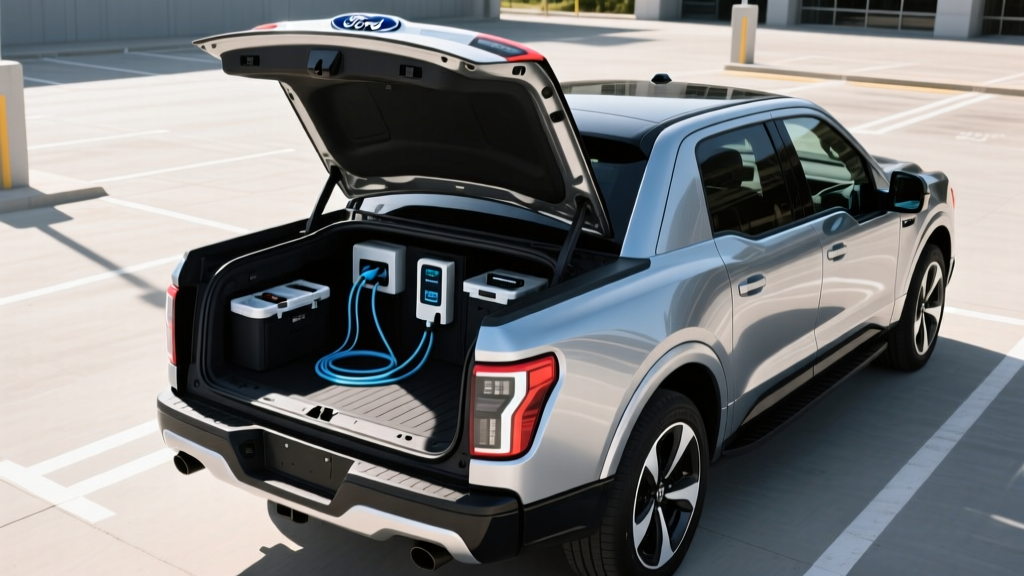
Yes. The Cybertruck offers integrated Powershare capability with up to 11.5 kW of bidirectional power (V2H/V2L). You can run 120V and 240V outlets directly from the bed and cabin, and with Tesla's Powerwall integration or a compatible home transfer switch, the truck can serve as a backup generator during outages — running essential circuits for multiple days on a full charge.