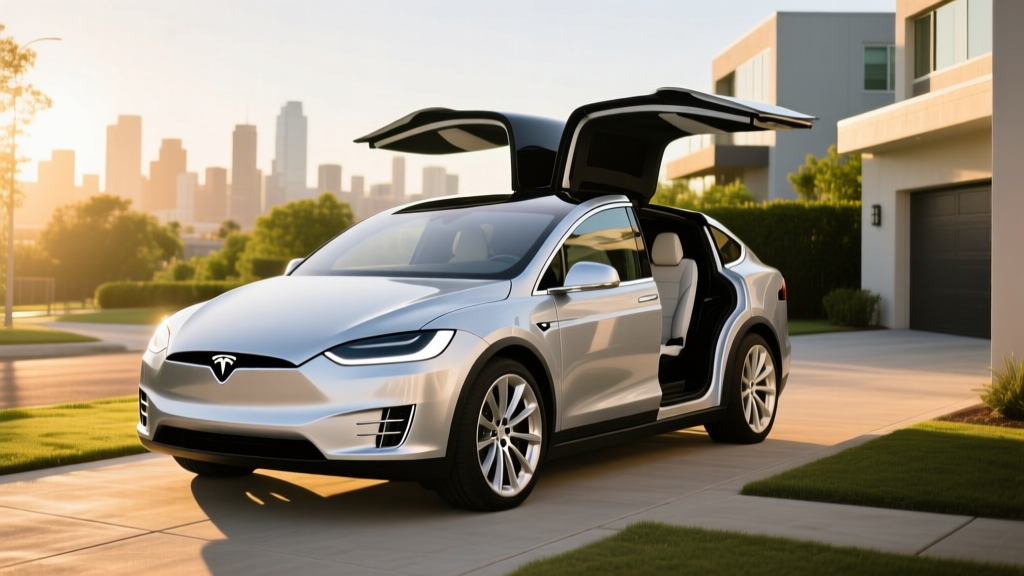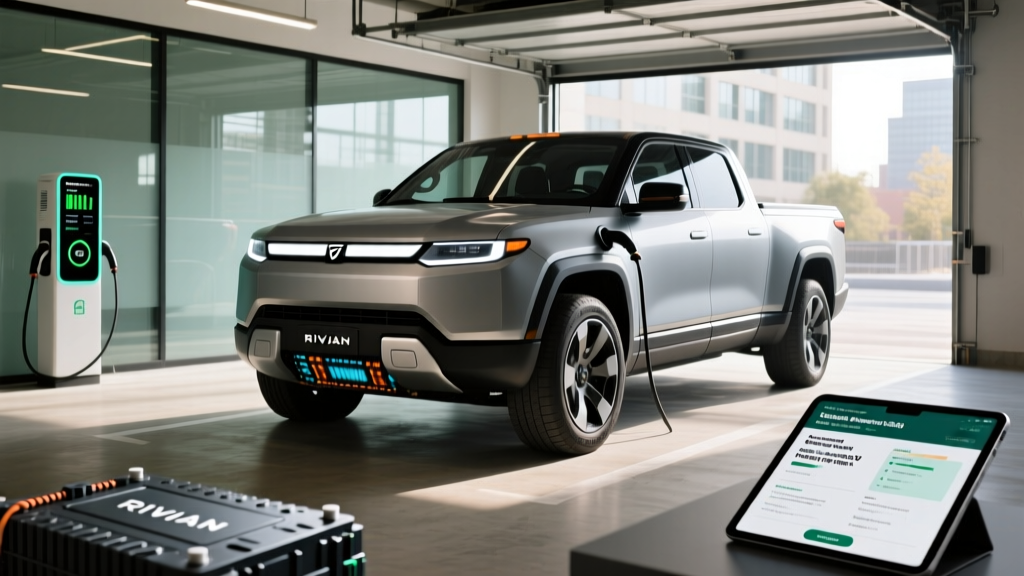
The Tesla Cybertruck is arguably the most polarizing vehicle on the road. Its angular stainless-steel exoskeleton and steer-by-wire architecture divide opinion like nothing else in the EV market. But once you step past the futuristic skin, the question that matters to buyers is practical: How does it perform as a daily driver, a tow rig, and a road-trip companion? This review goes inside Cybertruck to examine real-world range, charging behavior, cabin tech, ownership economics, and whether it holds up against the Ford F-150 Lightning and Rivian R1T in 2026.
Quick Verdict: What You Need to Know Before Buying
The 2026 Cybertruck is available in three configurations: the single-motor Rear-Wheel Drive (RWD), the Dual Motor All-Wheel Drive (AWD), and the tri-motor Cyberbeast. It rides on a 48-volt electrical architecture — a first for a production vehicle at this scale — and uses steer-by-wire with no mechanical connection between the yoke and the wheels. Build quality has improved markedly since the chaotic 2024 launch ramp, though panel gaps and early software gremlins remain part of the ownership narrative. It qualifies for partial or full federal tax credit eligibility depending on the trim and the buyer's income, though the MSRP cap for trucks ($80,000) creates a razor-thin margin on the AWD trim.
| Spec | RWD (Base) | AWD | Cyberbeast |
|---|---|---|---|
| EPA Range | ~325 mi (est.) | 340 mi | 320 mi |
| Battery (usable) | ~100 kWh (NMC) | ~123 kWh (NMC) | ~123 kWh (NMC) |
| 0-60 mph | ~6.5 sec | 4.1 sec | 2.6 sec |
| Horsepower | ~350 hp | 600 hp | 845 hp |
| Drivetrain | RWD | Dual-Motor AWD | Tri-Motor AWD |
| Max Tow Capacity | 7,500 lb | 11,000 lb | 11,000 lb |
| Base MSRP | $61,635 | $81,635 | $101,635 |
| MPGe (combined) | TBD | 69 MPGe | 68 MPGe |
| Battery Warranty | 8 yr / 120,000 mi | 8 yr / 120,000 mi | 8 yr / 120,000 mi |
Range & Efficiency: EPA Sticker vs. the Real World
EPA Estimate: 340 miles (AWD) / 320 miles (Cyberbeast)
Real-World Expectation: 270–300 mi on highway road trips at 70+ mph; 220–250 mi in sub-freezing temperatures; up to 310 mi in mixed city/suburban driving where regenerative braking recovers energy.
The Cybertruck AWD's 340-mile EPA figure is competitive for a full-size electric truck, but the stainless-steel body and wide 35-inch tires create real aerodynamic drag that punishes highway efficiency. On a flat, 75-mph cruise in 65°F weather, expect roughly 2.0–2.2 kWh per mile — translating to around 280–300 miles before you need to find a charger. Cold weather (below 32°F) compounds this: battery preconditioning draws energy, cabin heating adds load, and the pack's internal resistance rises. Plan for 20–30% range loss in winter conditions.
Efficiency on the AWD model lands at roughly 69 MPGe combined per fueleconomy.gov, or about 48 kWh per 100 miles. That trails the F-150 Lightning Extended Range (70 MPGe) by a hair and significantly lags the Rivian R1T Dual-Motor (73 MPGe with the Standard battery). The Cyberbeast's extra motor and heavier curb weight drop it to 68 MPGe.
If you plan to tow, reset your expectations entirely. Trailering a 7,000-pound camper at highway speeds can cut effective range to 130–160 miles between charges. The Cybertruck's integrated trailer brake controller and tow/haul mode manage the load well, but physics is unforgiving: you will stop to charge every two hours on a towing day.
Charging Speed: DC Fast, Home Level 2, and the 48V Advantage
| Charging Level | Power | Speed / Time |
|---|---|---|
| DC Fast Charge (peak) | 250 kW (V3 Supercharger) / up to 325 kW (V4) | 10–80% in ~28 min (AWD) |
| DC Sustained (real-world) | ~170–200 kW average to 80% | Charge curve tapers sharply above 85% |
| Level 2 Home (Wall Connector) | 11.5 kW (48A) | ~34 mi/hr added; full charge in ~11 hrs |
| Level 1 (120V outlet) | ~1.4 kW | ~4 mi/hr — emergency/trickle only |
The Cybertruck supports up to 250 kW on Tesla's widespread V3 Superchargers and can accept higher rates on newer V4 cabinets where available. In real-world testing, the large ~123 kWh pack (AWD/Cyberbeast) sustains strong charging rates through the 30–60% state-of-charge window, then tapers progressively. A 10–80% session takes approximately 28 minutes at a V3 stall — adequate for road trips but not class-leading. The Ford F-150 Lightning, with its smaller pack and comparable peak rate, can match or slightly beat this time.
One engineering advantage of the 48-volt architecture: lower current for the same power means thinner wiring harnesses and less resistive heat loss. This matters for sustained high-rate charging and overall electrical efficiency, even if the end-user experience is measured in minutes rather than volts.
For home charging, the Tesla Wall Connector at 11.5 kW (48 amps on a 60-amp circuit) adds roughly 34 miles of range per hour. A full overnight charge from 10% to 100% takes about 11 hours. Most owners charging nightly from 30% back to 80% will top off in 4–5 hours. Home installation costs typically run $800–$2,000 depending on panel capacity and conduit distance; a 200-amp panel upgrade (if needed) can add $1,500–$3,000.
Performance & Driving Dynamics
The Cyberbeast's 2.6-second 0–60 mph time makes it one of the quickest production trucks ever built, eclipsing the Rivian R1T Quad-Motor (2.7 sec) and the F-150 Lightning (3.8 sec). The AWD model's 4.1 seconds is more than sufficient for any real-world merge or overtake, and the base RWD's ~6.5 seconds is respectable for a single-motor truck.
The steer-by-wire system is the Cybertruck's most talked-about engineering feature. With no mechanical column, the yoke requires less than one full turn lock-to-lock, giving it go-kart-like responsiveness at low speeds and variable ratios at highway speed. Most drivers adapt within a day, though the lack of physical feedback takes longer to internalize. At parking-lot speeds, the rear-wheel steering (standard on all trims) shrinks the turning circle to roughly 40 feet — tighter than many midsize sedans despite the truck's 223.5-inch overall length.
Ride quality is firm but controlled. The adaptive air suspension (standard on AWD and Cyberbeast, optional on RWD) offers up to 12 inches of ground clearance in Off-Road mode and drops 2 inches at highway speed for aerodynamic efficiency. Body roll is minimal for a 6,800-pound vehicle, thanks to the low-slung battery pack and stiff structural exoskeleton.
Inside the Cabin: Tech, Space, and Daily Livability
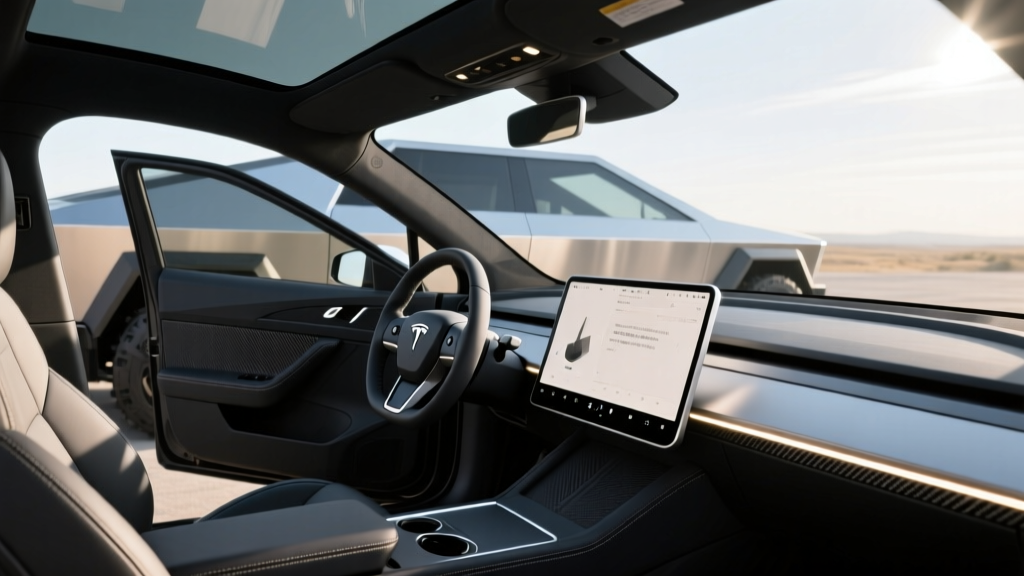
Step inside Cybertruck and you find a cabin that prioritizes minimalism and screen real estate over traditional truck utility. The centerpiece is an 18.5-inch center touchscreen running Tesla's latest infotainment OS, which controls virtually every vehicle function — climate, mirrors, glovebox, suspension height, and drive modes. There are no physical buttons on the dash. A secondary 9.4-inch rear touchscreen gives back-seat passengers their own climate and entertainment controls.
Passenger Space:
- Front legroom: 41.5 inches
- Rear legroom: 38.2 inches
- Front headroom: 40.8 inches
- Rear headroom: 38.5 inches
- Seating: 6-passenger (3-across front bench + 3-across rear)
Cargo Capacity:
- Bed volume: 74 cu ft (with tonneau closed)
- Bed length: 72 inches (6 ft)
- Front trunk (frunk): ~7.1 cu ft — fits a large backpack or charging cables, not a full suitcase
- Max payload: ~2,500 lb (AWD)
- Towing: 11,000 lb max (AWD/Cyberbeast); 7,500 lb (RWD)
The motorized tonneau cover is a standout feature: it's rated to support 300 pounds (useful as a step or work surface) and seals the bed for security and weather protection. The 120V and 240V bed outlets (up to 9.6 kW output) enable job-site power tools, campsite appliances, or even emergency home backup via a transfer switch — a genuine differentiator for working truck owners.
The drawbacks are real. The yoke-style steering wheel is controversial for daily driving — round-wheel advocates note its inconvenience during three-point turns and parking maneuvers. Visibility is compromised by the thick A-pillars, small rear window, and angular roofline; the rearview camera becomes essential for reversing. Interior materials are hard-wearing but not premium — expect hard plastics on the lower dash and door panels that wouldn't pass muster in a comparably priced Rivian or Ford Platinum.
Driver Assistance & Autonomy: What Autopilot Actually Does
SAE Automation Level: Level 2 — Tesla's Autopilot and Full Self-Driving (Supervised) require continuous driver attention. Hands must remain on the yoke, and the driver is legally responsible for all vehicle operation. This is not autonomous driving. Level 4 driverless operation (like Waymo) is not available in any consumer Tesla vehicle.
All Cybertrucks ship with Tesla's Basic Autopilot (traffic-aware cruise control and lane-centering). Full Self-Driving (Supervised) is an $8,000 add-on or $99/month subscription as of 2026, adding automated lane changes, traffic light and stop sign recognition, and city-street navigation. FSD (Supervised) has improved substantially through its neural-network-based "end-to-end" architecture, but it still makes unpredictable decisions in construction zones, complex intersections, and adverse weather. According to NHTSA reporting data, Tesla vehicles operating on Autopilot/FSD have been involved in a notable share of reported Level 2 incidents — a reminder that supervision is non-negotiable.
The Cybertruck's 360-degree camera suite and ultrasonic-replacement vision system (Tesla Vision) provide excellent situational awareness on the screen, but the lack of traditional proximity sensors means the system relies entirely on camera interpretation, which can struggle in heavy rain, fog, or direct sun glare.
What Autopilot/FSD Does NOT Do: Navigate unmapped roads, handle all construction zones, respond to hand signals from flaggers, operate safely in heavy snow/fog, or replace an attentive driver. You must be prepared to take over at any moment.
Pricing, Tax Credits, and Total Cost of Ownership
| Trim | Base MSRP | As-Tested (typical) | §30D Credit Eligibility | Effective Price |
|---|---|---|---|---|
| RWD | $61,635 | $64,635 | Eligible (under $80K cap) | ~$54,135–$61,635 |
| AWD | $81,635 | $86,635 | MSRP exceeds $80K truck cap — NOT eligible | $81,635+ |
| Cyberbeast | $101,635 | $109,635 | MSRP exceeds $80K truck cap — NOT eligible | $101,635+ |
The Cybertruck's pricing structure creates a frustrating tax-credit trap. Under IRS §30D rules, the federal clean vehicle credit for trucks, SUVs, and vans caps eligible MSRP at $80,000. Only the base RWD model at $61,635 clears this threshold — and only if the buyer also meets income limits ($150,000 single / $300,000 joint AGI) and the vehicle's battery satisfies critical-mineral and component-sourcing requirements, which Tesla has been actively reshoring but which remain subject to annual IRS guidance updates.
The point-of-sale transfer option (available since 2024) lets eligible buyers apply the credit as an instant rebate at delivery rather than waiting for a tax refund. However, the AWD and Cyberbeast trims — the ones most buyers actually want — exceed the $80,000 MSRP cap by $1,635 and $21,635 respectively, making them ineligible regardless of income. This is a key differentiator vs. the F-150 Lightning, whose Lariat and XLT trims often fall under the cap.
5-Year Ownership Cost Snapshot (AWD, 15K mi/yr):
- Electricity (home + Supercharger mix): ~$4,800
- Maintenance (no oil changes, minimal brake wear with regen): ~$1,200
- Insurance (estimated, varies by state/driver): ~$14,000–$18,000
- Estimated depreciation: ~$32,000–$38,000
- Tires (heavy EV truck, expect 25K–35K mi life): ~$2,400
Insurance is a notable pain point. The Cybertruck's stainless-steel body panels, specialized glass, and low-volume production mean repair costs are high, and insurers price accordingly. Expect premiums 20–40% above a comparable F-150 Lightning.
Warranty Coverage
Tesla provides the following warranty structure for the 2026 Cybertruck:
- Basic Vehicle: 4 years / 50,000 miles
- Battery & Drive Units: 8 years / 120,000 miles (minimum 70% capacity retention)
- Rust-through (exoskeleton): 5 years / unlimited miles
The 70% capacity retention threshold over 8 years is standard for the industry. Tesla's NMC chemistry has demonstrated strong long-term degradation curves in Model 3/Y fleets — typically losing 10–12% capacity over the first 100,000 miles before leveling off. The Cybertruck's large ~123 kWh pack provides a buffer: even at 70% health, you'd still have ~240 miles of range (AWD).
How It Compares: Cybertruck vs. F-150 Lightning vs. Rivian R1T
Best for Raw Performance: Cybertruck Cyberbeast — 2.6 sec 0-60, 845 hp, tri-motor torque vectoring.
Best for Tax Credit Eligibility: F-150 Lightning XLT/Lariat — multiple trims under the $80K MSRP cap.
Best for Interior Quality & Refinement: Rivian R1T — premium materials, conventional steering, quad-motor option.
Best for Supercharger Network Access: Cybertruck — native NACS, no adapter needed for Tesla's 20,000+ stall network.
Best for Towing Range: F-150 Lightning Extended Range — slightly better towing efficiency and available Max Tow package.
Best for Off-Road Capability: Rivian R1T — quad-motor tank turns, 14.9" ground clearance, dedicated off-road modes.
Who Should Buy the Cybertruck — and Who Shouldn't
Choose the Cybertruck if:
- You want a full-size electric truck with native Supercharger access and don't want to rely on adapters.
- You value the 9.6 kW onboard power output for job-site tools or campsite use.
- Acceleration and tech-forward driving dynamics (steer-by-wire, yoke) appeal to you.
- You can charge at home and your daily commute is under 200 miles round-trip.
Look elsewhere if:
- You need the $7,500 federal tax credit on an AWD or performance trim — the MSRP cap disqualifies both.
- You prefer a conventional steering wheel and traditional truck ergonomics.
- Premium interior materials and quiet cabin refinement are priorities (consider Rivian R1T).
- You regularly tow long distances and need maximum between-charge range (F-150 Lightning Extended Range or a diesel remains more practical).
Pros:
- Native NACS / Supercharger access — no adapter needed
- 9.6 kW bed power output — best in class for work-site use
- Stainless-steel exoskeleton is dent-resistant and distinctive
- Cyberbeast performance (2.6s 0-60) is unmatched in trucks
- Rear-wheel steering gives a surprisingly tight turning radius
- Over-the-air updates continuously add features
Cons:
- AWD and Cyberbeast exceed $80K MSRP cap — no federal tax credit
- Real-world highway range ~280 mi; towing range ~140 mi
- Yoke steering and buttonless cabin polarize and frustrate some drivers
- Insurance premiums run 20–40% above comparable electric trucks
- Panel gaps and build consistency still lag legacy automakers
- Frunk is small (7.1 cu ft) for a truck this size
Frequently Asked Questions
What is the real-world range of the Cybertruck?
The EPA rates the AWD at 340 miles and the Cyberbeast at 320 miles. In real-world highway driving at 70–80 mph, expect 270–300 miles. In cold weather (below freezing), plan for 220–250 miles. Towing a heavy trailer cuts range to roughly 130–160 miles.
How fast does the Cybertruck charge at home and on the road?
At a Tesla V3 Supercharger (250 kW), a 10–80% charge takes approximately 28 minutes. At home on a Level 2 Wall Connector (11.5 kW), you add about 34 miles of range per hour, with a full charge taking roughly 11 hours.
Does the Cybertruck qualify for the $7,500 federal EV tax credit?
Only the base RWD trim (MSRP $61,635) qualifies, and only if you meet IRS income limits ($150K single / $300K joint) and the battery meets critical-mineral sourcing requirements for the current tax year. The AWD ($81,635) and Cyberbeast ($101,635) exceed the $80,000 MSRP cap for trucks and are ineligible. Always verify current rules at irs.gov.
Is the Cybertruck worth buying over the F-150 Lightning or Rivian R1T?
It depends on your priorities. The Cybertruck wins on Supercharger network access, bed power output, and raw acceleration. The F-150 Lightning wins on tax credit eligibility, conventional ergonomics, and dealer service network. The Rivian R1T wins on interior quality, off-road capability, and available quad-motor configuration.
What are the biggest complaints from Cybertruck owners?
Common owner-reported issues include higher-than-expected insurance costs, panel-gap inconsistencies, the learning curve of yoke steering for low-speed maneuvers, limited rear visibility, and the absence of a physical button for basic functions like wipers and mirror adjustment. Early-production units (2024) had more software and hardware issues; 2025–2026 build quality has improved.
What battery chemistry does the Cybertruck use?
The Cybertruck uses NMC (nickel manganese cobalt) lithium-ion cells in a structural battery pack. NMC offers higher energy density than LFP (lithium iron phosphate), which is important given the truck's size and weight. Tesla recommends daily charging to 80–90% for NMC longevity, with periodic 100% charges before long trips.
Can the Cybertruck power my home during an outage?
The Cybertruck supports up to 9.6 kW of bidirectional power output through its bed outlets, and Tesla's Powershare system can integrate with a home transfer switch (sold separately) for emergency backup. At 9.6 kW, it can run essential circuits (refrigerator, lights, HVAC fan, well pump) for multiple days depending on the pack's state of charge.