The Short Answer on Infiniti EVs
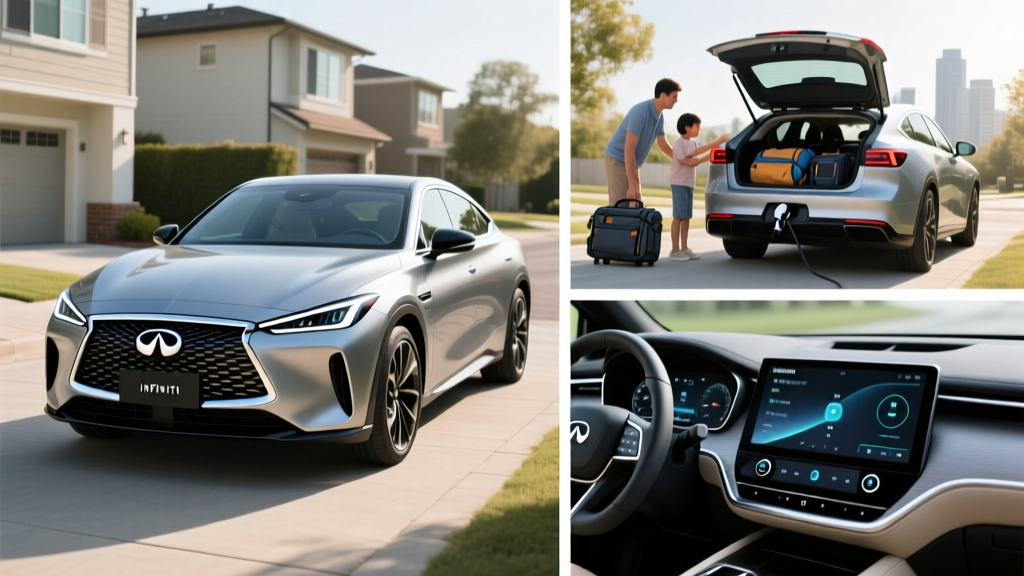
As of early 2026, Infiniti does not sell a fully electric vehicle in the United States. The brand has previewed the QX60 EV concept (shown in 2024) and signaled plans for its first dedicated EV platform by the late 2020s, but no production Infiniti BEV is currently available to order. Buyers considering an Infiniti today must choose between the brand's existing hybrid and gasoline models or look to luxury EV competitors such as Genesis, BMW, Cadillac, or Tesla. If you specifically want an Infiniti-badged electrified vehicle, the 2026 QX60 with its available hybrid powertrain is the closest option.
Where Infiniti Stands on Electrification in 2026
Infiniti, Nissan's luxury division, has been notably slower to bring a production EV to market compared to rivals. While parent company Nissan pioneered mass-market EVs with the Leaf (launched in 2010), Infiniti's electrification strategy has remained largely in the concept and planning stages.
The brand's most concrete EV signal came with the QX60 EV concept, unveiled at Monterey Car Week in August 2024. Infiniti described it as a "vision for the brand's electrified future" but has not confirmed a production timeline, pricing, or final specifications. Industry analysts expect a production version no earlier than the 2027–2028 model year, likely riding on the Renault-Nissan-Mitsubishi Alliance's next-generation EV platform.
For now, Infiniti's U.S. lineup consists of:
- Q50 — gasoline sport sedan (aging platform, minimal updates)
- QX50 / QX55 — gasoline compact crossovers with variable-compression turbo engine
- QX60 — three-row SUV, available with a mild-hybrid powertrain
- QX80 — full-size luxury SUV (redesigned for 2025, gasoline only)
None of these are plug-in hybrids (PHEVs) or battery-electric vehicles (BEVs). The QX60's hybrid system is a mild-hybrid assist that improves fuel economy slightly but cannot drive on electric power alone.
Infiniti's Hybrid Option vs. a Luxury EV: The Numbers
Since a true Infiniti EV isn't available, the practical comparison is between the closest Infiniti electrified model (the QX60 hybrid) and a comparable luxury electric SUV from a competing brand. Here's how they stack up:
| Attribute | 2026 Infiniti QX60 (Mild Hybrid) | 2026 Genesis GV60 (AWD, BEV) | 2026 BMW iX xDrive50 (BEV) |
|---|---|---|---|
| Powertrain | 2.0L VC-Turbo + mild hybrid | Dual-motor BEV | Dual-motor BEV |
| Horsepower | 268 hp | 314 hp | 516 hp |
| EPA Range / MPG | ~23 MPG combined | 248 mi (EPA) | 324 mi (EPA) |
| Energy Cost per Mile | ~$0.17/mi (gas at $3.50/gal) | ~$0.05/mi (home charging, $0.14/kWh) | ~$0.05/mi (home charging, $0.14/kWh) |
| Base MSRP | ~$53,000 | ~$53,500 | ~$87,000 |
| Federal Tax Credit (§30D) | Not eligible | Check IRS eligibility — varies by battery sourcing | Not eligible (MSRP exceeds $80K cap for SUVs) |
| Battery Warranty | N/A (no traction battery) | 10 yr / 100,000 mi | 8 yr / 80,000 mi |
| DC Fast Charge (peak kW) | N/A | ~240 kW (10–80% in ~18 min) | ~150 kW (10–80% in ~31 min) |
Sources: fueleconomy.gov, manufacturer specifications. Tax credit eligibility per IRS §30D rules — verify current sourcing and income requirements at irs.gov.
Real Costs: Infiniti Hybrid Ownership vs. Going Electric Elsewhere
The financial case for waiting on an Infiniti EV versus buying a competitor's electric SUV today hinges on five-year total cost of ownership (TCO). Let's model a realistic scenario: 15,000 miles/year, 5 years, national average electricity at $0.14/kWh and gasoline at $3.50/gallon.
| Cost Category (5-Year) | Infiniti QX60 Hybrid | Genesis GV60 AWD |
|---|---|---|
| Purchase Price (base MSRP) | $53,000 | $53,500 |
| Federal Tax Credit | $0 | Up to $7,500 (if eligible) |
| Net Purchase Cost | $53,000 | ~$46,000 |
| Fuel/Energy (75,000 mi total) | ~$12,750 (gasoline) | ~$3,675 (home charging) |
| Maintenance (est.) | ~$3,500 (oil, filters, brakes) | ~$1,200 (cabin filter, tires, fluid top-offs) |
| Insurance (est. avg) | ~$9,500 | ~$10,500 (EV premium ~10%) |
| Estimated 5-Year Total | ~$78,750 | ~$61,375 |
The GV60's advantage comes primarily from the potential §30D tax credit and dramatically lower energy and maintenance costs. However, this assumes home Level 2 charging access — a critical variable we'll address next.
What a First-Time EV Buyer Must Know Before Committing
If you're considering abandoning the Infiniti showroom for a luxury EV from another brand, several practical realities shape the ownership experience:
Home Charging Is Non-Negotiable for Most Owners
Over 80% of EV charging happens at home. Without a dedicated Level 2 (240V) home charger, daily EV ownership becomes significantly more inconvenient. A Level 2 installation typically costs:
- Charger hardware: $400–$800 (e.g., ChargePoint Home Flex, Emporia Level 2)
- Electrician labor + permit: $800–$2,500 (varies by panel distance and local code)
- Electrical panel upgrade (if needed): $1,500–$4,000 for a 200-amp service upgrade
If you live in an apartment, condo, or street-parking-only situation, public charging becomes your primary fuel source — and DC fast charging at $0.35–$0.55/kWh erases much of the per-mile cost advantage over gasoline.
Cold Weather Cuts Range 20–35%
EPA range estimates are generated in controlled conditions. In sustained freezing temperatures (below 32°F), expect 20–35% range reduction due to battery chemistry limitations and cabin heating demands. A 248-mile GV60 might deliver only 160–195 miles of real winter range on highway trips. Vehicles equipped with a heat pump (standard on many 2026 luxury EVs) mitigate this loss to roughly 15–20%.
DC Fast Charging Is Not Uniform
Peak charge rates (e.g., "up to 240 kW") apply only in a narrow State of Charge (SoC) window, typically 10–40%. Above 80%, charging slows dramatically to protect the battery. A "10–80% in 18 minutes" spec means a full 10–100% session could take 35–45 minutes. Plan road trips around 80% charge stops, not 100%.
Common Misconceptions About Waiting for an Infiniti EV
| Myth | Fact |
|---|---|
| "Infiniti will release an EV soon, so I should wait." | No production Infiniti BEV has been confirmed for sale before 2027–2028. The QX60 EV concept lacks confirmed specs, pricing, or a firm timeline. |
| "Infiniti's hybrid is basically the same as a plug-in hybrid." | The QX60's mild hybrid cannot plug in and cannot drive on electric-only power. A PHEV (like the BMW X5 xDrive50e) offers 30+ miles of electric range and qualifies for partial EV benefits. |
| "Luxury EVs are all over $80,000." | The Genesis GV60 starts at ~$53,500, the Cadillac Lyriq at ~$58,000, and the Tesla Model Y at ~$44,000. Several luxury-brand EVs fall well under the §30D SUV MSRP cap of $80,000. |
| "EV batteries need replacing every few years." | Modern NMC and LFP batteries are warrantied for 8–10 years / 100,000+ miles at 70% capacity retention. Real-world degradation data shows most packs retain 85–90% capacity at 100,000 miles (Recurrent Auto data). |
| "I'll save money no matter what with an EV." | Without home charging, EV energy costs at public DC fast chargers ($0.35–$0.55/kWh) can approach or exceed gasoline per-mile costs. Higher insurance premiums ($500–$1,500/year more) also offset some savings. |
Decision Framework: Should You Wait, Switch Brands, or Stay Gas?
If-Then Guide for the Infiniti-Minded Buyer
- If brand loyalty to Infiniti is your top priority → Stay with the QX60 hybrid or QX80 for now. Accept higher fuel costs and no EV tax credit. Re-evaluate in 2027–2028 if a production Infiniti EV is announced.
- If you want a luxury EV today with comparable size and comfort → Test-drive the Genesis GV60, Cadillac Lyriq, or BMW iX. All offer premium interiors, strong range, and available federal tax credits (verify eligibility at irs.gov).
- If you can't charge at home → An EV is likely not ideal yet. Consider a plug-in hybrid from another brand (e.g., BMW X5 xDrive50e, Volvo XC90 Recharge) for partial electric commuting with gas flexibility, or wait for infrastructure to improve.
- If you drive more than 300 miles regularly in cold climates → Choose an EV with 300+ miles EPA range and a heat pump (e.g., BMW iX, Rivian R1S) to account for winter range loss. Alternatively, a hybrid avoids range uncertainty entirely.
- If total cost of ownership is your primary concern → A luxury EV with home charging and tax-credit eligibility will almost certainly beat the Infiniti QX60 hybrid over 5 years, saving $10,000–$17,000 in the model above.
The Bottom Line for Infiniti EV Shoppers
Infiniti remains one of the few luxury brands without a production electric vehicle in 2026. The QX60 EV concept signals intent, but intent doesn't put electrons in a battery pack on your driveway. Buyers who want an electrified Infiniti experience today are limited to the brand's mild-hybrid models — functional, comfortable, but offering none of the cost, performance, or environmental advantages of a true BEV or PHEV.
The competitive luxury EV market has matured substantially. Vehicles like the Genesis GV60, Cadillac Lyriq, and BMW iX deliver 240–324 miles of EPA range, DC fast charging in 18–31 minutes (10–80%), and premium interiors that match or exceed Infiniti's current offerings — often at a lower net cost after federal incentives.
Waiting for Infiniti to deliver its first EV is a valid choice if brand loyalty is paramount. But the opportunity cost of waiting 2–3 more years includes continued gasoline expense, missed tax credits, and deferred access to a rapidly improving charging infrastructure.
Frequently Asked Questions
Does Infiniti make any electric cars in 2026?
No. As of early 2026, Infiniti does not sell a fully electric or plug-in hybrid vehicle in the United States. The QX60 EV concept was shown in 2024, but no production date has been confirmed.
When will the Infiniti QX60 EV be available?
Infiniti has not announced a firm production date. Industry estimates place a production model no earlier than the 2027–2028 model year. All specifications remain preliminary and unconfirmed.
Is the Infiniti QX60 hybrid a plug-in?
No. The QX60 uses a mild-hybrid system that assists the gasoline engine but cannot be plugged in and cannot drive on electric power alone. It does not qualify for any federal EV tax credit.
What luxury EVs are closest to an Infiniti in price and size?
The Genesis GV60 (~$53,500), Cadillac Lyriq (~$58,000), and Tesla Model Y (~$44,000) offer similar luxury crossover positioning with full electric powertrains. The BMW iX (~$87,000) competes at a higher price point but offers more range and power.
Do I qualify for the $7,500 federal EV tax credit?
Eligibility under IRS §30D depends on your adjusted gross income (caps: $300K joint / $225K head of household / $150K single), the vehicle's MSRP (under $80K for SUVs), and battery component/critical mineral sourcing requirements. Rules are subject to change — verify current eligibility at irs.gov and consult a tax professional.
Can I charge an EV if I don't have a garage?
It's possible but significantly less convenient. Options include workplace charging, public Level 2 stations, and DC fast chargers. However, relying exclusively on public charging increases per-mile energy costs by 3–5x compared to home charging and adds time to your routine. Evaluate your local charging infrastructure via apps like PlugShare or ChargePoint before purchasing.