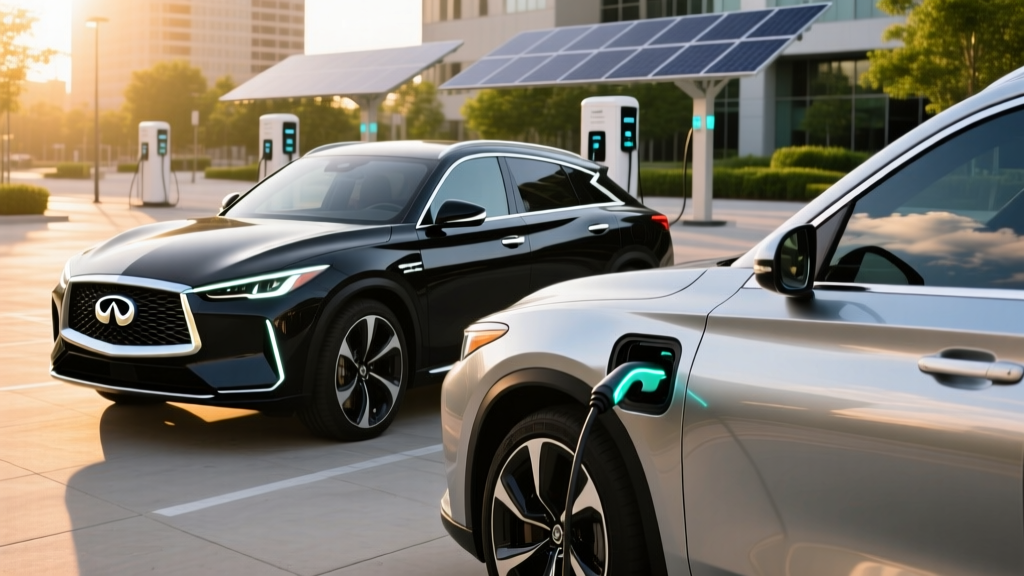
If you're searching for Infiniti electric cars you can buy today, here's the honest answer: as of early 2026, Infiniti does not sell a dedicated battery-electric vehicle (BEV) in the United States. The brand's first ground-up EV, a production version of the QX Inspiration concept, has been announced for the mid-to-late 2020s but remains unreleased with no confirmed U.S. MSRP, EPA range, or on-sale date. Current Infiniti buyers who want electrification are limited to the brand's mild-hybrid and older hybrid offerings, not plug-ins or BEVs. If an Infiniti EV is a must-have, you're in a waiting game; if you need an electrified luxury SUV now, competitors like Genesis, BMW, and Cadillac already have models on dealer lots with verified range, charging, and federal tax-credit data.
The Quick Take on Infiniti EVs
- Available BEVs today: 0
- Announced: Production EV based on QX Inspiration (mid-to-late 2020s, preliminary)
- Expected platform: Nissan e-4ORCE-derived, dual-motor AWD likely
- Current Infiniti electrified option: Mild-hybrid QX60 (not a plug-in, no EV mode)
- Best move now: Test-drive Genesis GV60/GV70 Electrified, BMW iX, or Cadillac Lyriq while you wait
Why Infiniti Is Late to the EV Party
Infiniti's parent company, Nissan, is hardly an EV novice — the Leaf launched in 2010 and the Ariya arrived for the 2023 model year with up to 304 miles of EPA range. But the luxury division has moved far more slowly. The QX Inspiration concept debuted at the 2019 Detroit auto show and the QX50-e concept followed, yet neither translated to a U.S. production model by 2026. The delay traces to three factors: Nissan's own financial restructuring through its "Nissan Next" and subsequent "Re:Nissan" plans, the prioritization of mainstream EVs (Ariya, next-gen Leaf) for volume, and the complexity of giving Infiniti a distinct luxury EV identity rather than simply rebadging a Nissan.
For buyers, this means the Infiniti showroom in 2026 is still dominated by turbocharged four-cylinders and V6 engines, with only a 48-volt mild-hybrid system on the QX60 providing any electrification — and that system cannot propel the vehicle on electric power alone, nor does it plug in.
What the Upcoming Infiniti EV Might Look Like
Based on Nissan's confirmed roadmap and the QX Inspiration concept, the first production Infiniti EV will likely be a midsize luxury SUV. Here's what we can reasonably project from the concept and the e-4ORCE platform shared with the Ariya, with the critical caveat that all figures below are preliminary and not confirmed for the production model:
| Attribute | Concept / Platform Estimate | Comparable: Nissan Ariya (2025) |
|---|---|---|
| Body style | Midsize luxury SUV | Midsize crossover SUV |
| Drivetrain | e-4ORCE dual-motor AWD (expected) | e-4ORCE AWD available |
| Battery (usable, est.) | ~87–91 kWh, NMC chemistry | 87 kWh usable, NMC |
| EPA range (est.) | 280–320 mi (target) | 289–304 mi EPA |
| Peak DC fast charge | ~130 kW (platform limit) | 130 kW peak |
| 10–80% DCFC time | ~35–40 min (est.) | ~35 min (EPA-rated test) |
| Level 2 AC charge | 7.2 kW (est.) | 7.2 kW |
| Horsepower | ~389 hp (if Ariya e-4ORCE tune) | 389 hp |
| 0–60 mph | ~5.0 sec (est.) | 5.0 sec |
A few things jump out. The Ariya platform's 130 kW peak DC charge rate is modest for 2026 — rivals like the Hyundai Ioniq 5 and Genesis GV60 accept 235–350 kW on 800-volt architecture, cutting 10–80% times to 18 minutes or less. If Infiniti carries over the 400-volt architecture without upgrades, road-trip charging will be noticeably slower than segment benchmarks. That's worth watching when official specs drop.
Infiniti EV vs. The Luxury EVs You Can Buy Today
Waiting for Infiniti means passing on some strong alternatives. Here's how the projected Infiniti EV stacks up against three luxury electric SUVs already in showrooms, with real EPA data from fueleconomy.gov:
| Spec | Infiniti EV (Projected) | Genesis GV60 (AWD) | BMW iX xDrive50 | Cadillac Lyriq (AWD) |
|---|---|---|---|---|
| Status | Announced / unreleased | On sale | On sale | On sale |
| Base MSRP | TBA | ~$53,350 | ~$87,250 | ~$62,690 |
| EPA range | 280–320 mi (est.) | 280 mi | 324 mi | 307 mi |
| Battery (usable) | ~87–91 kWh | 74 kWh | 105.2 kWh | 100.4 kWh |
| Peak DC charge | ~130 kW (est.) | 235 kW (800V) | 150 kW | 190 kW |
| 10–80% DCFC | ~35–40 min (est.) | ~18 min | ~31 min | ~28 min |
| 0–60 mph | ~5.0 sec (est.) | 4.5 sec | 4.6 sec | 4.8 sec |
| HP | ~389 | 429 (Boost) | 516 | 500 |
| Federal §30D credit | Unknown | Not eligible (Korea-built) | Not eligible (Germany-built) | Up to $7,500 (U.S.-built) |
The Lyriq stands out as the only model here potentially eligible for the full §30D federal clean-vehicle credit of up to $7,500, thanks to U.S. assembly and ongoing battery-sourcing compliance — though buyers must still clear MSRP caps ($80,000 for SUVs), adjusted gross income limits ($300K joint / $150K single), and critical-mineral requirements. Always verify current-year eligibility on irs.gov before purchase, as sourcing rules tighten annually.
Real-World Ownership Costs: EV vs. Gas Luxury SUV
Whether you wait for an Infiniti EV or cross-shop a Lyriq or GV60 today, the financial case for going electric hinges on your driving volume, local electricity rates, and access to home charging. Below is a 5-year cost snapshot comparing a projected Infiniti-class EV against a typical turbocharged V6 luxury SUV (think current QX60) driven 12,000 miles/year.
| Cost Category | Luxury EV (est.) | Luxury Gas SUV (QX60-class) |
|---|---|---|
| Purchase price (base, before credit) | $60,000 | $52,000 |
| Federal §30D credit (if eligible) | –$7,500 | $0 |
| Net purchase | $52,500 | $52,000 |
| Fuel/energy (5 yrs, 60K mi) | $4,800 ($0.14/kWh, 3 mi/kWh) | $12,000 ($4.00/gal, 20 mpg) |
| Maintenance (5 yrs) | $1,800 | $4,200 |
| Insurance (5 yrs, avg.) | $11,500 | $9,500 |
| 5-year total (purchase + fuel + maint. + ins.) | $70,600 | $77,700 |
The EV wins on operating costs by roughly $9,900 over five years, primarily from fuel and maintenance savings (no oil changes, fewer brake jobs thanks to regen). But insurance runs ~15–25% higher on EVs per current industry data, and the upfront price gap only fully closes with the federal credit. If you don't qualify for §30D — due to income, MSRP, or sourcing — the payback stretches considerably.
For a tighter comparison, consider that a mild-hybrid QX60 (the only electrified Infiniti today) returns 21/26/23 mpg city/highway/combined per the EPA. That's a meaningful improvement over a non-hybrid V6 but nowhere near the per-mile energy cost of a BEV at national-average electricity rates.
What First-Time EV Buyers Need to Know Before Waiting (or Switching Brands)
If you've never owned an EV, a few realities shape whether any luxury electric SUV — Infiniti's future model included — will actually work for your life.
Home charging is the make-or-break
Over 80% of EV charging happens at home. A Level 2 home charger (240V, typically 32–48 amps / 7.7–11.5 kW) adds 25–40 miles of range per hour of charging and costs $800–$2,500 installed depending on panel capacity and run length. If you live in an apartment, condo, or street-parking situation without charger access, daily EV ownership becomes a planning exercise — and one that Infiniti's projected 130 kW DC charge rate won't solve quickly on road trips.
Cold weather cuts range 20–35%
Lithium-ion batteries lose efficiency below freezing, and cabin heating draws heavily from the pack. A projected 300-mile Infiniti EV could realistically deliver 200–240 miles in sustained sub-30°F driving. A heat pump (standard on the Ariya and likely on Infiniti's EV) mitigates this but doesn't eliminate it.
Charging curves taper above 80%
The "130 kW peak" spec applies only at low state-of-charge. Above 80% SoC, charge rates drop sharply to protect battery health — often to 30–50 kW. This is why 10–80% times are the meaningful metric, not 0–100%.
Common Infiniti EV Misconceptions, Answered
| Myth | Fact |
|---|---|
| "Infiniti already sells an electric car." | False. No Infiniti BEV or PHEV is on sale in the U.S. as of 2026. The QX60 has a mild-hybrid system that cannot drive on electric power alone and does not plug in. |
| "The QX Inspiration is available to order." | It remains a concept/preview. No U.S. pricing, EPA range, or delivery date has been published. |
| "An Infiniti EV will get the $7,500 tax credit automatically." | Unknown. §30D eligibility depends on final assembly location, battery sourcing, MSRP caps, and buyer income — all of which must be confirmed at launch. Check irs.gov for current-year rules. |
| "I can just charge at public stations." | Public DCFC costs $0.35–$0.60/kWh in many markets — often more per mile than gasoline. Home charging at $0.12–$0.16/kWh is what makes EVs cheaper to run. |
| "Infiniti's EV will charge as fast as a Hyundai or Porsche." | Unlikely if it inherits the Ariya's 400V / 130 kW architecture. 800V rivals charge nearly twice as fast. |
Decision Framework: Should You Wait for Infiniti, or Buy Now?
If / Then Guide
- If you're loyal to Infiniti and can wait 1–3 more years → Monitor Nissan's official press channels for the production reveal; do not put down a deposit until EPA range and §30D eligibility are confirmed.
- If you need a luxury EV within 6 months → Test the Cadillac Lyriq (best credit eligibility, strong range), Genesis GV60 (fastest charging, distinctive design), or BMW iX (longest range, highest price).
- If you want an electrified Infiniti today, any kind → The QX60 mild-hybrid saves ~2–3 mpg over a non-hybrid V6 but is not a plug-in and offers no EV-mode driving.
- If you don't have home charging → Reconsider any BEV purchase until you secure reliable Level 2 access; a PHEV from another luxury brand (BMW X5 xDrive50e, Volvo XC90 Recharge) may fit better.
- If federal tax credit eligibility is a dealbreaker → Prioritize U.S.-assembled models (Lyriq, Tesla Model Y, Rivian R1S) and verify current-year sourcing compliance on irs.gov before signing.
Frequently Asked Questions
Does Infiniti make any electric cars in 2026?
No. Infiniti does not currently sell a BEV or PHEV in the U.S. market. The brand's first production EV, previewed by the QX Inspiration concept, is announced for the mid-to-late 2020s but has no confirmed on-sale date, MSRP, or EPA range.
Is the Infiniti QX60 a hybrid or electric?
The current QX60 uses a 48-volt mild-hybrid system paired with a turbocharged V6. It is not a plug-in hybrid, has no electric-only driving mode, and cannot be charged from an outlet. Expect combined fuel economy around 23 mpg per the EPA.
Will the Infiniti EV qualify for the $7,500 federal tax credit?
It's too early to say. §30D eligibility requires U.S. final assembly, compliance with critical-mineral and battery-component sourcing thresholds, MSRP under $80,000 (SUVs), and buyer income below $300K joint / $150K single. Infiniti has not confirmed where its EV will be built. Verify at purchase on irs.gov.
How will the Infiniti EV compare to the Nissan Ariya?
Infiniti's EV is expected to share the e-4ORCE dual-motor platform with the Ariya but with more power, a more luxurious interior, and a higher price. The key question is whether Infiniti upgrades to 800-volt architecture for faster charging — something the Ariya does not offer.
What luxury EV should I buy instead of waiting for Infiniti?
For the best combination of range, charging speed, and potential tax-credit eligibility, the Cadillac Lyriq (307 mi EPA, up to $7,500 credit) is the pragmatic pick. For fastest charging, the Genesis GV60 (235 kW, 10–80% in ~18 min) leads. For maximum range and performance regardless of price, the BMW iX xDrive50 (324 mi, 516 hp) is the benchmark.
What should I know about home charging before buying any EV?
You'll want a Level 2 (240V) home charger rated for 32–48 amps, professionally installed on a dedicated circuit. Budget $800–$2,500 for equipment and labor; add $1,500–$4,000 if your home needs a 200-amp panel upgrade. A licensed electrician should evaluate your panel capacity before purchase.