Quick Answer: Should Your Fleet Go Electric?
An industrial electric vehicle — ranging from electric box trucks and cargo vans to yard tractors and forklifts — typically costs 30-50% more upfront than its diesel or gas equivalent but delivers 40-60% lower per-mile operating costs through cheaper energy and reduced maintenance. For fleet operators running predictable routes under 200 miles daily with access to depot charging, a 2026 electric commercial vehicle can break even within 3-5 years and save $8,000-$15,000 annually per vehicle in fuel and maintenance. Federal incentives under the IRC §45W Commercial Clean Vehicle Credit can offset up to $40,000 on heavy-duty models. The key constraint: you must have depot charging infrastructure or reliable access to DC fast-charging corridors.
What Qualifies as an Industrial Electric Vehicle?
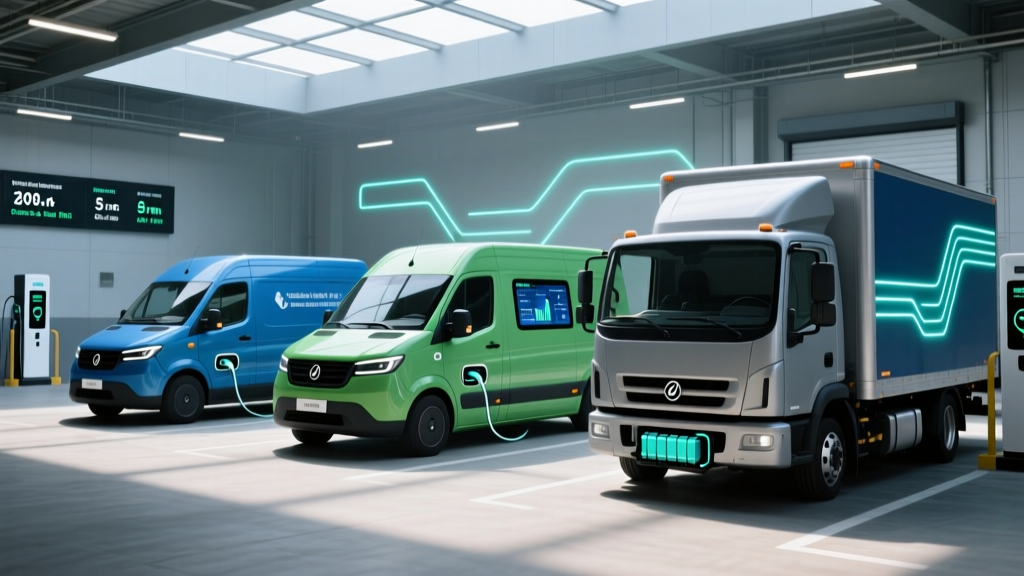
The term "industrial electric vehicle" spans a wide category of electrified commercial equipment. For fleet buyers in 2026, the most relevant segments include:
- Class 2b-3 Electric Cargo Vans: Ford E-Transit, BrightDrop Zevo 600, Mercedes-Benz eSprinter — last-mile delivery workhorses with 150-200 miles of EPA range.
- Class 4-6 Medium-Duty Box Trucks: Ford E-Transit Cutaway, Lightning Electric Class 4, SEA Electric conversions — walk-in delivery and utility trucks, 150-250 mile range.
- Class 7-8 Heavy-Duty Tractors: Tesla Semi, Freightliner eCascadia, Volvo VNR Electric — regional haul and drayage, 150-500 mile range depending on configuration.
- Yard Tractors & Forklifts: Orange EV, Kalmar electric yard dogs, and lithium-ion forklifts — indoor/outdoor material handling, typically opportunity-charged during shifts.
This guide focuses on the on-road commercial vehicles (Classes 2b through 8) that fleet managers most commonly evaluate against diesel alternatives.
2026 Industrial Electric Vehicle Spec Comparison
| Vehicle | Class | Battery (kWh) | EPA Range | Peak DC Charge | 10-80% Time | Base MSRP (est.) |
|---|---|---|---|---|---|---|
| Ford E-Transit (Cargo Van) | 2b | 68 kWh (NMC) | 126 mi | 115 kW | ~45 min | $51,000 |
| BrightDrop Zevo 600 | 3 | 165 kWh (NMC) | 272 mi | 120 kW | ~75 min | $95,000 |
| Mercedes-Benz eSprinter (2025+) | 2b | 113 kWh (NMC) | 203 mi | 115 kW | ~42 min | $72,000 |
| Freightliner eCascadia | 8 | 291-438 kWh (NMC) | 155-230 mi | 250 kW | ~60 min | $300,000+ |
| Tesla Semi (600 kWh config) | 8 | ~600 kWh (est.) | ~500 mi (claimed) | ~750 kW (Megacharger) | ~30 min (est.) | $250,000+ |
| Volvo VNR Electric | 8 | 150-375 kWh (NMC) | 150-275 mi | 250 kW | ~60-90 min | $270,000+ |
Source: Manufacturer specifications and fueleconomy.gov. Tesla Semi specs remain preliminary based on announced configurations; verify with Tesla before purchase decisions. Range varies significantly with payload, terrain, and ambient temperature.
EV vs Diesel: The Real Cost Breakdown
Fleet electrification decisions live and die on total cost of ownership (TCO). Let's compare a Class 3 electric delivery truck (similar to a BrightDrop Zevo 600) against a comparable diesel cab-chassis over a 5-year, 100,000-mile ownership cycle.
| Cost Category | Electric (Class 3) | Diesel (Class 3) | 5-Year Difference |
|---|---|---|---|
| Vehicle Purchase | $95,000 | $58,000 | +$37,000 (EV) |
| Federal Tax Credit (§45W) | -$40,000 | $0 | -$40,000 (EV savings) |
| Depot Charger Install (Level 2, shared) | $8,000 (allocated) | $0 | +$8,000 (EV) |
| Fuel/Energy (100k mi) | $6,200 (avg $0.13/kWh) | $28,500 (avg $3.80/gal, 7 mpg) | -$22,300 (EV savings) |
| Maintenance (5 years) | $4,500 | $14,000 | -$9,500 (EV savings) |
| Insurance (5 years) | $18,000 | $15,000 | +$3,000 (EV) |
| Net 5-Year Cost | $91,700 | $115,500 | -$23,800 (EV savings) |
Key takeaways from this comparison:
- The federal §45W credit is the single biggest lever. For vehicles over 16,000 lbs GVWR, the credit reaches $40,000 — and it applies at the point of sale. However, battery component and critical mineral sourcing requirements apply, similar to the consumer §30D credit. Verify current-year eligibility on irs.gov.
- Fuel savings dominate operating costs. At commercial electricity rates of $0.10-$0.16/kWh, an electric truck uses the energy equivalent of roughly $1.50-$2.50 per diesel-gallon-equivalent. Diesel at $3.80/gal makes the gap enormous.
- Maintenance savings are real but often overstated. Electric drivetrains eliminate oil changes, DEF fluid, DPF filters, and turbo maintenance. But tire wear on heavy EVs is higher due to instant torque and vehicle weight — budget for more frequent rotations and replacements.
- Insurance runs 15-25% higher on commercial EVs due to higher repair costs, specialized technician requirements, and limited actuarial data. Get quotes before committing.
Charging Infrastructure: The Make-or-Break Factor
The single largest barrier to industrial electric vehicle adoption isn't the vehicle — it's the charging infrastructure. Fleet operators need to plan charging as carefully as they plan routes.
Depot Charging Costs (2026 Estimates)
| Component | Single Vehicle | 5-Vehicle Fleet | Notes |
|---|---|---|---|
| Level 2 Charger Hardware (40-80 kW) | $3,500-$8,000 | $15,000-$35,000 | Networked chargers with fleet management software |
| DC Fast Charger (150-350 kW) | $40,000-$85,000 | $150,000-$350,000 | Only needed for rapid turnaround or high-utilization fleets |
| Electrical Panel Upgrade | $5,000-$25,000 | $15,000-$80,000 | Varies wildly by existing service capacity |
| Trenching & Conduit | $3,000-$12,000 | $10,000-$40,000 | Distance from panel to parking stalls |
| Permits & Utility Interconnection | $2,000-$8,000 | $5,000-$20,000 | Utility demand charges may apply |
| Total Per Site | $13,500-$53,000 | $195,000-$475,000 | Depot-only Level 2; add $40k-$85k per DCFC stall |
Critical insight: Utility demand charges can wreck your electricity economics. Many commercial utilities charge peak-demand fees based on your highest 15-minute consumption window. Simultaneously charging five trucks at 80 kW each (400 kW total) can trigger demand charges of $10-$25/kW/month — adding $4,000-$10,000/month to your bill. Solution: invest in smart charging software that staggers charge sessions, or install on-site battery storage to buffer peak draws.
Charging Speed Reality Check
Unlike passenger EVs that can rely on public DC fast-charging networks, industrial electric vehicles depend overwhelmingly on depot charging. Here's what different charging levels deliver:
- Level 2 (40-80 kW AC or DC): Adds 30-80 miles of range per hour. Ideal for overnight depot charging — an 8-10 hour shift covers 200-500 miles of replenishment, sufficient for most last-mile and regional routes.
- DC Fast Charging (150-350 kW): Adds 100-200+ miles per hour. Necessary for mid-day top-ups on longer routes or high-utilization vehicles running double shifts. Expect a 10-80% charge in 45-90 minutes for Class 8 trucks.
- Megawatt Charging System (MCS): The emerging standard for heavy-duty trucks, delivering up to 1.2 MW (1,200 kW). Tesla's Megacharger is a proprietary precursor. MCS infrastructure is in pilot phases at select fleet depots and highway corridors as of 2026.
Real-World Range: What the EPA Sticker Doesn't Tell You
Published range figures for industrial electric vehicles are measured under specific test cycles. In actual fleet operations, expect significant variation based on these factors:
Range Degradation Factors for Commercial EVs
- Payload weight: A fully loaded Class 8 truck (80,000 lbs GCW) can lose 25-40% of its empty-weight range. A Class 3 van at max payload typically sees a 15-20% reduction.
- Cold weather (below 32°F): Battery chemistry slows, cabin heating draws energy, and regenerative braking is limited on a cold pack. Expect 20-35% range loss in sub-freezing conditions. Fleets in northern climates should spec 25-30% more battery than warm-climate counterparts.
- Highway speeds: Electric trucks are most efficient at 25-45 mph stop-and-go (maximum regen benefit). Sustained 65-70 mph highway running increases consumption by 15-25% versus mixed urban duty cycles.
- Auxiliary loads: Liftgates, refrigeration units (e-trucks), PTO equipment, and HVAC all draw from the traction battery. A refrigerated electric box truck may sacrifice 20-30% of range to the reefer unit alone.
- Battery degradation over time: NMC batteries in commercial service typically retain 80-85% capacity after 8 years / 200,000 miles under normal cycling. Heavy daily deep-cycling (running to 10% SoC regularly) accelerates degradation. Most manufacturers warrant 70-80% capacity retention at 8 years.
Practical rule of thumb: Spec your battery for 1.5x your longest expected daily route. A 150-mile daily route with occasional detours and cold-weather operation needs at least 225 miles of rated range — which means a larger battery pack or mid-day charging opportunity.
Federal Incentives and Tax Credits (2026)
The commercial EV incentive landscape differs from consumer credits. Fleet buyers should understand two key programs:
IRC §45W — Commercial Clean Vehicle Credit
- Credit amount: Up to $7,500 for vehicles under 16,000 lbs GVWR; up to $40,000 for vehicles at or above 16,000 lbs GVWR.
- Eligibility: Vehicle must be acquired for business use, meet battery component and critical mineral sourcing requirements (phased annually), and be placed in service in the United States.
- Point-of-sale transfer: As of 2024, the credit can be transferred to the dealer at purchase, effectively reducing the upfront invoice price — similar to the consumer §30D credit mechanism.
- No MSRP cap (unlike the consumer credit), but income and sourcing rules still apply. Verify current-year requirements at irs.gov.
Additional Incentive Layers
- EPA Clean Heavy-Duty Vehicles Program: Funded through the Inflation Reduction Act, this program provides direct grants to states and municipalities for replacing diesel heavy-duty vehicles with zero-emission alternatives. Check your state's allocation status.
- State and utility incentives: California's HVIP (Hybrid and Zero-Emission Truck and Bus Voucher Incentive Project), New York's Truck Voucher Incentive Program, and various utility make-ready programs can stack with federal credits. These vary by jurisdiction — consult your state energy office and local utility.
- Depot charging infrastructure credits: The §30C Alternative Fuel Vehicle Refueling Property Credit covers up to 30% of charging equipment and installation costs (up to $100,000 per item for commercial property), subject to prevailing wage and census-tract requirements.
Decision Framework: Is an Industrial Electric Vehicle Right for Your Fleet?
Choose an Electric Commercial Vehicle If:
- Your daily routes are predictable and under 200 miles (covers most last-mile, urban delivery, and drayage operations).
- You have depot parking with access to electrical infrastructure or the ability to upgrade.
- Your vehicles return to base nightly for 8+ hours of charging time.
- You operate in a state with strong incentive stacking (CA, NY, NJ, MA, WA, OR, CO).
- Your fuel spend per vehicle exceeds $5,000/year (the savings math works faster).
- You face emissions compliance requirements (CARB Advanced Clean Trucks rule, corporate ESG mandates, or municipal zero-emission zones).
Stick With Diesel or Consider Hybrid If:
- Your routes regularly exceed 300+ miles without reliable en-route DC fast charging.
- You operate in extreme cold climates (below 0°F) without heated depot parking.
- Your fleet has no fixed depot — owner-operators and hotshot truckers who park on the street face severe charging access barriers.
- Your duty cycle involves sustained heavy PTO use (concrete pumpers, bucket trucks with extended boom operations) that would rapidly deplete the traction battery.
- You need maximum payload capacity — battery weight in Class 8 trucks can reduce cargo allowance by 2,000-5,000 lbs, directly impacting revenue per load.
- Your fleet turns over vehicles in under 3 years — the TCO advantage requires longer ownership horizons to recoup the upfront premium.
Common Misconceptions About Industrial Electric Vehicles
| Myth | Fact |
|---|---|
| "Electric trucks can't handle heavy payloads." | Electric motors produce peak torque from zero RPM. The challenge isn't capability — it's range reduction. A fully loaded eCascadia can pull 80,000 lbs GCW, but range drops 25-40%. Route planning must account for payload. |
| "Charging takes too long for commercial operations." | Overnight depot charging on Level 2 (8-10 hours) fully replenishes most Class 2b-6 vehicles. For double-shift operations, mid-day DC fast charging adds 100-150 miles in 30-45 minutes. Operations scheduling, not charging speed, is the real constraint. |
| "Battery replacement will bankrupt the fleet." | Commercial EV battery warranties typically cover 8 years/200,000+ miles at 70-80% capacity retention. NMC packs in fleet service are showing 2-3% annual degradation under normal cycling. Full replacement costs $30,000-$80,000+ depending on size, but most fleets will retire or repurpose the vehicle before needing one. |
| "The grid can't support fleet electrification." | Most depot charging can be managed with smart scheduling and load balancing. The real bottleneck is utility interconnection timelines — getting a new transformer and service upgrade can take 12-24 months. Start the utility conversation 18+ months before your first EV arrives. |
| "EVs are maintenance-free." | They eliminate powertrain maintenance (no oil, filters, DEF, DPF, turbo). But tire wear increases 15-30% due to weight and torque, suspension components face higher loads, and the thermal management system (coolant loops, heat pumps) requires periodic service. Budget 50-60% less maintenance than diesel — not zero. |
First-Time Fleet EV Buyer Checklist
If you're evaluating your first industrial electric vehicle, work through these steps before signing a purchase order:
- Audit your routes. Pull GPS telematics data for the past 6 months. Identify daily mileage, peak mileage days, dwell times, and return-to-base patterns. This determines battery size and charging strategy.
- Survey your electrical infrastructure. Have a licensed electrician assess your depot's panel capacity, service size (amps/voltage), and available conduit paths. This determines charging feasibility and upgrade costs.
- Contact your utility early. Ask about commercial EV rates, demand charges, make-ready programs, and interconnection timelines. Some utilities offer managed-charging rates that cut energy costs 30-50% versus standard commercial tariffs.
- Model your TCO honestly. Include charger installation, utility demand charges, insurance premiums, tire costs, and realistic electricity rates (not just the cheapest overnight rate). Compare against your actual diesel spend, not national averages.
- Check incentive eligibility. Confirm §45W credit eligibility for your specific vehicle configuration with the manufacturer. Research state vouchers, utility rebates, and §30C charging infrastructure credits. These can cut effective purchase cost by 40-60%.
- Pilot before scaling. Order 1-2 vehicles first. Run them on your actual routes for 3-6 months. Measure real energy consumption, charging times, range in your climate, and driver acceptance. Then scale based on data, not projections.
- Train your drivers. Electric trucks drive differently — aggressive acceleration wastes energy, while smooth regenerative braking extends range. Driver behavior can swing energy consumption by 20-30%. Invest in eco-driving training.
Frequently Asked Questions
What is the typical range of an industrial electric vehicle in 2026?
Class 2b-3 electric vans (Ford E-Transit, eSprinter) deliver 126-272 miles EPA rated. Class 8 electric semis (eCascadia, Volvo VNR Electric) range from 150-275 miles depending on battery configuration. Real-world range drops 15-40% under full payload, highway speeds, or cold weather. Tesla Semi claims ~500 miles in its largest configuration, but independent fleet testing data remains limited.
How long does it take to charge a commercial electric truck?
On a depot Level 2 charger (40-80 kW), expect 6-10 hours for a full charge on a Class 3-6 truck — ideal for overnight operations. On a DC fast charger (150-250 kW), a 10-80% charge takes 45-90 minutes depending on battery size. Megawatt-class charging (MCS, 1 MW+) is in early deployment and can cut Class 8 charge times to under 30 minutes.
Do industrial electric vehicles qualify for tax credits?
Yes. The IRC §45W Commercial Clean Vehicle Credit offers up to $7,500 for vehicles under 16,000 lbs GVWR and up to $40,000 for heavier vehicles. Battery sourcing requirements apply and phase in annually. The credit can be transferred to the dealer at point of sale. Charging infrastructure may qualify for the §30C credit (30% up to $100,000 per item). Always verify current-year rules at irs.gov and consult a tax professional.
What is the biggest risk in fleet electrification?
The biggest risk is underestimating charging infrastructure lead times and costs. Utility interconnection upgrades can take 12-24 months and cost $50,000-$500,000+ for larger fleet depots. Ordering vehicles before securing charging infrastructure is the most common mistake. Additionally, utility demand charges can erase expected energy savings if charging isn't managed with smart software or battery buffering.
How does cold weather affect electric truck range?
In temperatures below 32°F, expect 20-35% range reduction from a combination of slower battery chemistry, cabin/defrost heating loads, and limited regenerative braking on a cold pack. Below 0°F, losses can exceed 40%. Northern-climate fleets should spec larger battery packs, install heated depot parking where possible, and use battery preconditioning features to mitigate losses.
Is an electric truck cheaper than diesel over its lifetime?
For fleets running under 200 miles daily with depot charging, yes — typically $20,000-$50,000 cheaper over 5-7 years after incentives. The savings come primarily from fuel ($0.10-$0.16/kWh vs. $3.50-$4.50/gal diesel) and reduced maintenance. For long-haul operations exceeding 400 miles daily without reliable en-route charging, diesel remains the practical choice in 2026. Run your own numbers with actual route data and local electricity rates before deciding.