Federal EV Tax Credit: Income Caps, MSRP Limits, and Battery Sourcing Rules for 2026
The federal Clean Vehicle Credit under IRS §30D can knock up to $7,500 off the price of a qualifying new electric vehicle — or up to $4,000 for a used EV. But eligibility isn't automatic. Your modified adjusted gross income (MAGI), the vehicle's MSRP, where its battery minerals come from, and even the assembly location all determine whether you see that credit at the point of sale or on your tax return.
This guide breaks down every eligibility gate, then pairs it with a realistic 5-year total cost of ownership (TCO) analysis so you can answer the only question that matters: does going electric actually save me money?
§30D New Clean Vehicle Credit — Eligibility Checklist (2026)
- Income caps (MAGI): $150,000 single filers / $225,000 head of household / $300,000 joint filers. You must fall under the cap in either the year of delivery or the prior year.
- MSRP caps: Vans, SUVs, and pickups ≤ $80,000. Sedans and other body styles ≤ $55,000. The MSRP includes factory-installed options but excludes destination charges.
- Battery sourcing: $3,750 of the credit depends on critical-mineral sourcing (from the US or a free-trade-agreement partner); the other $3,750 depends on battery-component manufacturing/assembly in North America. Failing either test halves the credit.
- Final assembly: Vehicle must undergo final assembly in North America (US, Canada, or Mexico). Check your VIN at NHTSA's VIN decoder.
- Point-of-sale transfer: As of 2024, you can transfer the credit to the dealer at purchase, reducing your out-of-pocket cost immediately — regardless of whether you owe enough in taxes to claim it on your return. This is a major change from the old non-refundable structure.
- Vehicle type: Must be a new BEV or PHEV with ≥ 7 kWh battery capacity. HEVs and mild hybrids do not qualify.
Source: IRS §30D guidance. Rules evolve — verify current-year requirements before purchasing.
Which Popular 2026 EVs Actually Qualify?
The battery-sourcing and component-manufacturing requirements have disqualified many models that previously received the full $7,500. Here's where several mainstream EVs stand for the 2026 model year:
| Vehicle | MSRP (base) | Credit Amount | Notes |
|---|---|---|---|
| Tesla Model Y Long Range AWD | $44,990 | $7,500 | Full credit — meets both mineral and component tests |
| Ford Mustang Mach-E Select | $42,995 | $3,750 | Meets component test; mineral sourcing partial |
| Chevrolet Equinox EV 2LT | $34,995 | $7,500 | Full credit — North American battery supply chain |
| Hyundai Ioniq 5 SE | $43,975 | $3,750 | Meets one of two sourcing requirements |
| Volkswagen ID.4 Pro | $40,790 | $7,500 | US-assembled with qualifying battery chain |
| BMW i4 eDrive40 | $57,900 | $0 | Exceeds $55,000 sedan MSRP cap |
The BMW i4 example illustrates the MSRP trap: even though it's a compelling EV, the sedan cap of $55,000 eliminates it entirely. SUVs and trucks get a more generous $80,000 ceiling, which is why the Ford F-150 Lightning and Rivian R1S still qualify at higher price points.
5-Year Total Cost of Ownership: EV vs. Gas Baseline
Tax credits aside, the real ownership math plays out across five categories: purchase price, energy/fuel, maintenance, insurance, and depreciation. Below is a side-by-side comparison using a representative 2026 BEV (Chevrolet Equinox EV 2LT AWD, 319 mi EPA range, 85 kWh battery) versus a comparable gasoline compact SUV (28 MPG combined, $30,500 MSRP). Assumptions: 15,000 miles/year, $0.14/kWh home charging, $3.50/gallon gasoline, 5-year hold period.
| Category | EV (Equinox EV 2LT AWD) | Gas (Comparable Compact SUV) | 5-Year Difference |
|---|---|---|---|
| Purchase price (after credit) | $27,495 ($34,995 − $7,500) | $30,500 | EV saves $3,005 |
| Energy/fuel (75,000 mi) | $3,675 (2,550 kWh × $0.14) | $9,375 (2,679 gal × $3.50) | EV saves $5,700 |
| Maintenance | $1,800 | $3,750 | EV saves $1,950 |
| Insurance | $9,500 | $7,500 | EV costs $2,000 more |
| Depreciation (5-year) | $14,000 (~40% residual) | $13,500 (~56% residual) | EV costs $500 more |
| Total 5-Year Cost | $56,470 | $64,625 | EV saves ~$8,155 |
That ~$8,000 savings over five years is real but conditional. It assumes you qualify for the full credit, charge primarily at home at residential electricity rates, and don't live in a state with aggressive EV registration fees. Shift any of those variables and the gap narrows — or reverses.
Charging vs. Gasoline: The Per-Mile Cost Math
The single largest operational advantage of an EV is energy cost — but only if you control where and when you charge.
| Scenario | Cost per Mile | Annual Cost (15k mi) |
|---|---|---|
| Home Level 2 at $0.14/kWh (EV averaging 3.4 mi/kWh) | $0.041 | $615 |
| Home with time-of-use off-peak at $0.09/kWh | $0.026 | $390 |
| Public DC fast charging at $0.40/kWh (30% of charging) | $0.118 | $1,770 |
| Gas vehicle at 28 MPG, $3.50/gal | $0.125 | $1,875 |
Home-charged EVs run at roughly one-third the per-mile cost of gasoline. But if you rely predominantly on public DC fast chargers — at $0.35–$0.48/kWh on networks like Electrify America or EVgo — the advantage shrinks to pennies. Some public-charging-only EV owners in high-rate states (California, Massachusetts) report per-mile costs that rival or exceed a 30-MPG gas car.
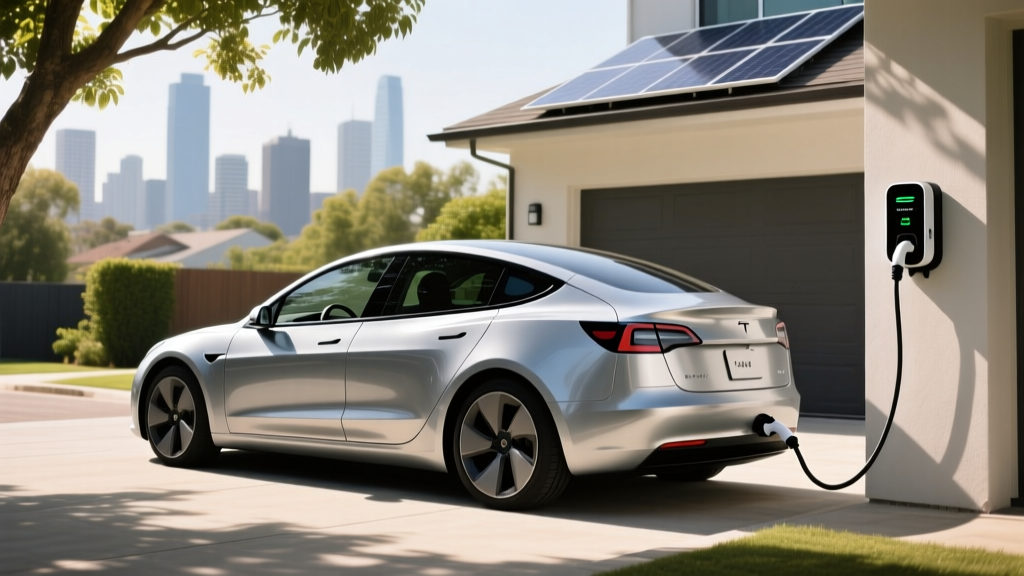
The practical takeaway: home charging access is the single biggest determinant of EV operating-cost savings. If you can install a Level 2 charger and charge overnight, the economics are overwhelming. If you're entirely dependent on public infrastructure, the fuel savings may not justify the higher purchase price.
Maintenance Savings: Where EVs Win Decisively
| Maintenance Item | EV | Gas Vehicle |
|---|---|---|
| Oil changes | None — $0 | 2×/year, ~$50–$80 each ($500–$800 over 5 years) |
| Brake pads | 100,000+ mi life (regen braking) | 30,000–50,000 mi replacement ($300–$500 per axle) |
| Transmission fluid | Typically sealed, no service interval | 30,000–60,000 mi flush ($150–$300) |
| Spark plugs | N/A | 30,000–100,000 mi ($200–$600) |
| Coolant | Battery thermal management loop, ~100,000 mi | 30,000–50,000 mi ($100–$200) |
| Cabin air filter | Every 15,000–20,000 mi ($30–$60) | Same interval and cost |
| Tire rotation | Every 5,000–7,500 mi (EVs are heavier — tires wear faster) | Every 5,000–7,500 mi |
EVs eliminate the most frequent and costly routine maintenance items. The regenerative braking system alone can save $600–$1,000 over five years by extending brake pad life well past 100,000 miles. The one maintenance area where EVs can cost more: tires. Heavier curb weights (the Equinox EV tips the scales at ~4,600 lbs vs. ~3,500 lbs for a gas equivalent) and instant torque accelerate tire wear. Budget for a tire replacement around 30,000–40,000 miles rather than the 50,000+ miles typical of lighter gas vehicles.
Insurance Reality: The Hidden EV Cost Premium
Here's where the EV narrative gets less flattering. Insurance premiums for electric vehicles run 15–30% higher than comparable gas cars, according to industry data. The reasons are structural, not arbitrary:
- Higher repair costs: EV battery packs and power electronics are expensive to diagnose and replace after collision damage. A minor rear-end impact that would cost $2,000 to repair on a gas car can total an EV if the battery enclosure is compromised.
- Specialized labor: High-voltage system repairs require certified technicians, and fewer shops have that certification — driving up labor rates.
- Higher vehicle values: Even after tax credits, many EVs carry higher insured values than their gas counterparts, raising comprehensive and collision premiums.
- Parts availability: OEM EV parts (battery modules, inverters, charge ports) often have longer lead times, increasing rental-car and storage costs for insurers.
In our 5-year model, the EV insurance premium runs ~$1,900/year vs. ~$1,500/year for the gas baseline — a $2,000 cumulative difference. Some insurers now offer EV-specific policies with bundling discounts, and states with competitive insurance markets may show smaller gaps. Always get quotes from at least three carriers before purchase, and ask specifically about EV discounts.
Depreciation and Resale Value: The Moving Target
EV depreciation has been volatile. In 2023–2024, aggressive price cuts by Tesla and a flood of off-lease EVs cratered resale values for many models — some losing 50–60% of value in three years. The market has stabilized somewhat in 2025–2026, but EVs still generally depreciate faster than Toyota or Honda gas vehicles.
Key depreciation factors:
- Battery health anxiety: Used-EV buyers discount vehicles with uncertain battery state-of-health (SoH). Models with strong warranty transferability (8 years/100,000 miles federally mandated on battery) hold value better.
- Tech obsolescence: A 2022 EV with 230 miles of range and 50 kW DC charging looks dated next to a 2026 model offering 350+ miles and 200+ kW charging. The pace of improvement punishes older models.
- Tax credit effect: When a new Equinox EV costs $27,495 after the credit, the used market must price below that — compressing resale values for 1–3-year-old examples.
- Brand matters: Tesla, Porsche, and Hyundai/Kia EVs have shown better residual retention than some luxury marques (Mercedes EQ series, Jaguar I-PACE) that suffered steep depreciation.
For the 5-year ownership model above, we estimate the Equinox EV retains ~40% of its post-credit purchase price ($11,000 residual on a $27,495 net cost), while the gas SUV retains ~56% of its $30,500 MSRP ($17,000 residual). That $500 gap in depreciation cost is modest but real — and it widens if you buy a luxury EV at full MSRP without a tax credit.
State, Local, and Utility Incentives: The Stacked Savings
Beyond the federal credit, incentives vary enormously by jurisdiction. Always verify current availability with your state energy office and local utility before relying on them in your purchase math.
- California: Clean Fuel Reward (up to $1,000 at point of sale) plus potential CVRP rebate of up to $7,000 for income-qualified buyers.
- Colorado: State tax credit of up to $5,000 for new EVs (MSRP ≤ $80,000), stackable with federal credit.
- New York: Drive Clean Rebate up to $2,000, plus utility-specific charging rebates (e.g., ConEdison $500 Level 2 rebate).
- Utility rebates (nationwide): Many utilities offer $250–$1,000 rebates for home Level 2 charger installation, and time-of-use rate plans that cut charging costs 30–50%. Check with your provider.
- HOV lane access: Several states (CA, CO, FL, GA, MD, VA) grant single-occupant HOV lane access to EVs — a non-monetary perk worth hundreds of hours annually in congested metros.
State incentives change frequently. Verify at your state's energy office website and the Alternative Fuels Data Center before purchasing.
Putting It All Together: Does an EV Save You Money?
The honest answer depends on four variables:
- Do you qualify for the full $7,500 federal credit? If yes, the purchase-price gap collapses or reverses for many mainstream models. If no (income too high, vehicle doesn't meet sourcing tests), you're paying $3,000–$7,500 more upfront.
- Can you charge at home? Home Level 2 charging at residential rates is where 70%+ of the fuel savings live. Public-only charging erodes the advantage significantly.
- What's your insurance delta? Get real quotes before committing. In some states, the EV insurance premium can eat $400–$600/year of your fuel savings.
- How long will you keep the car? The 5-year math favors EVs. At 3 years, depreciation and higher insurance may offset the fuel and maintenance savings. At 8–10 years, the EV advantage compounds as maintenance savings grow and the battery proves durable.
For a buyer who qualifies for the full credit, charges at home, and holds the vehicle 5+ years, the total savings of $7,000–$10,000 over a gas equivalent is well-supported by the data. For a buyer who doesn't qualify, relies on public charging, and trades in at 3 years, the EV may cost $3,000–$5,000 more than a fuel-efficient gas car.
Frequently Asked Questions
Can I claim the EV tax credit if I owe no federal income tax?
Under the point-of-sale transfer option (available since January 2024), yes. You can transfer the credit to the dealer as a down-payment reduction at purchase. The credit functions as an upfront discount regardless of your tax liability. However, if your MAGI exceeds the income caps when you file, you may have to repay the credit to the IRS — so verify your projected income carefully.
Do leased EVs qualify for the tax credit?
Leased vehicles fall under a different section of the tax code (§45W commercial clean vehicle credit), which is claimed by the leasing company (the legal owner). Many lessors pass the $7,500 through as a capitalized-cost reduction, effectively lowering your monthly payment. Crucially, the §45W credit has no MSRP caps, no income limits, and no battery-sourcing requirements — making leasing a workaround for buyers who are priced out of the §30D new-vehicle credit. Always confirm the lessor is passing the credit through before signing.
What's the used EV tax credit, and who qualifies?
The §25E Previously-Owned Clean Vehicle Credit offers up to $4,000 (or 30% of the sale price, whichever is lower) for used EVs and PHEVs. Income caps are lower: $75,000 single / $112,500 head of household / $150,000 joint. The vehicle must be at least 2 model years old, sold for $25,000 or less, purchased from a dealer, and the credit can only be claimed once per VIN. Point-of-sale transfer is available for this credit as well.
How do I check if a specific vehicle qualifies before buying?
Use the VIN decoder at NHTSA.gov to confirm North American final assembly. Then check the IRS's list of qualifying vehicles (updated periodically) for battery-sourcing compliance. Your dealer should provide a seller's report at the time of sale certifying the vehicle meets all requirements — this is mandatory for the point-of-sale transfer.
Are EV registration fees higher than gas cars?
In many states, yes. Because EVs don't pay gas taxes, 30+ states impose supplemental annual EV registration fees ranging from $50 (Colorado) to $225 (Washington). These fees partially offset the fuel-tax revenue loss and should be factored into your TCO calculation — typically adding $500–$1,100 over 5 years depending on your state.