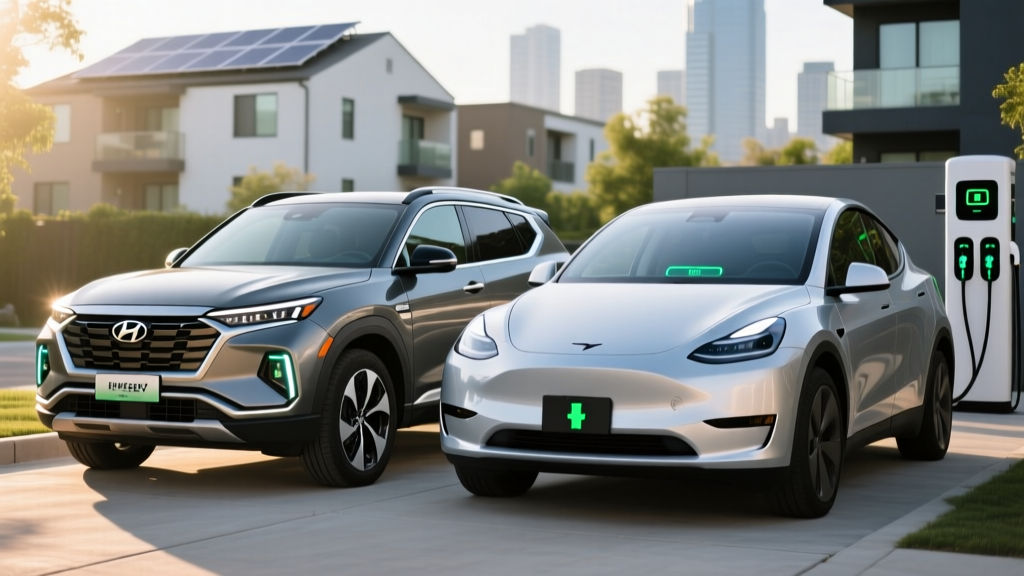
The Tucson Tesla Cross-Shop: Why Buyers Are Comparing These Two
Search forums and EV subreddit threads for "tucson tesla" and you'll find a recurring debate: should you go plug-in hybrid with the Hyundai Tucson PHEV or full battery-electric with the Tesla Model Y? It's an unconventional comparison on paper — one is a compact PHEV with 33 miles of electric range, the other a dedicated BEV with over 300 miles. But for buyers weighing electrified SUVs around $35,000–$45,000, the decision hinges on daily driving habits, home charging access, and how often you take road trips.
This guide breaks down the 2026 Hyundai Tucson PHEV and 2026 Tesla Model Y across every metric that matters: real-world range, charging speed, interior space, tax credit eligibility, and five-year ownership cost. We'll tell you exactly which one earns your money — and why.
Side-by-Side Spec Table: Tucson PHEV vs Model Y
| Specification | 2026 Hyundai Tucson PHEV SEL | 2026 Tesla Model Y Long Range AWD |
|---|---|---|
| Powertrain Type | Plug-in Hybrid (PHEV) | Battery Electric (BEV) |
| EPA Electric-Only Range | 33 miles | 320 miles |
| Total Range (gas + electric) | ~400 miles | 320 miles |
| Battery Capacity | 13.8 kWh (NMC) | 78.1 kWh usable (NMC) |
| Combined Horsepower | 261 hp | 384 hp |
| 0-60 mph | 7.1 sec | 4.8 sec |
| Drivetrain | AWD (HTRAC) | Dual-Motor AWD |
| MPGe (electric mode) | 80 MPGe | 119 MPGe |
| MPG (gas-only combined) | 35 MPG | N/A |
| Max DC Fast Charge | N/A (AC only) | 250 kW peak |
| Level 2 Charge Rate | 7.2 kW (3.5 hrs full) | 11.5 kW (~44 mi/hr) |
| Cargo Volume (rear seats up) | 38.7 cu ft | 30.2 cu ft (+ 4.1 cu ft frunk) |
| Cargo Volume (rear seats down) | 72.3 cu ft | 76.2 cu ft |
| Base MSRP | $38,975 | $44,990 |
| Federal Tax Credit (§30D) | Up to $7,500 | $7,500 (point-of-sale) |
| Battery Warranty | 10 yr / 100,000 mi | 8 yr / 120,000 mi |
Real-World Range: What the EPA Numbers Don't Tell You
Hyundai Tucson PHEV: EPA-rated 33 miles electric-only. Real-world expectation: 28–31 miles in mixed driving with climate control on; drops to 22–25 miles in sustained cold (below 30°F) due to cabin heating load and reduced battery efficiency. Once the battery depletes, the 1.6L turbo hybrid delivers a genuine 35 MPG combined.
Tesla Model Y Long Range AWD: EPA-rated 320 miles. Real-world highway expectation: 270–290 miles at 75 mph in moderate temperatures. In cold weather (20°F or below), expect 230–255 miles due to cabin heating and battery resistance. The heat pump helps, but physics is physics — cold lithium-ion cells and winter HVAC loads exact a 15–25% toll.
For commuters with a sub-30-mile round trip and home charging, the Tucson PHEV covers most daily driving on electricity alone — you'd visit a gas station perhaps once a month. The Model Y eliminates gas entirely but demands you plan around charging on road trips exceeding ~250 miles (accounting for a realistic buffer and DC fast-charger spacing).
If your daily commute is 40+ miles each way, the Tucson's electric range won't cover it, and you'll burn gas daily — at which point the Model Y's efficiency advantage (119 MPGe vs 80 MPGe) becomes significant.
Charging Speed: Where the Gap Widens
This is where comparing a PHEV to a BEV reveals a fundamental architectural difference. The Tucson PHEV charges exclusively on AC power — it has no DC fast-charging port. The Model Y charges on both AC (home) and DC (road trips).
| Charging Level | Hyundai Tucson PHEV | Tesla Model Y LR AWD |
|---|---|---|
| Level 1 (120V household) | ~1.4 kW / ~4 mi/hr | ~1.3 kW / ~4 mi/hr |
| Level 2 (240V home) | 7.2 kW / full charge in ~3.5 hrs | 11.5 kW / ~44 mi/hr |
| DC Fast Charge | Not supported | 250 kW peak / 10-80% in ~22 min |
| Connector | J1772 (AC) | NACS (AC + DC) |
What this means practically: The Tucson's 13.8 kWh battery is small enough that even a standard 120V outlet adds roughly 4 miles of range per hour — plug in overnight and you'll wake up with a full battery. A 240V Level 2 home charger (typically $500–$1,200 installed) fills it completely in about 3.5 hours. Since you're only replenishing 33 miles of range, home charging is trivial.
The Model Y's 78.1 kWh pack demands a proper Level 2 home charger for practical daily use — a 240V/48A circuit adds roughly 44 miles per hour, enough to replenish a day's driving in a few hours. On road trips, Tesla's Supercharger network (now open to NACS-equipped vehicles from other brands as well) delivers 10–80% in about 22 minutes at a 250 kW V3/V4 stall. Expect the charge curve to taper significantly above 80% — filling from 80–100% can take as long as 10–80%.
Source: fueleconomy.gov — 2026 Hyundai Tucson PHEV
Pricing, Tax Credits, and What You Actually Pay
| Cost Factor | 2026 Tucson PHEV SEL | 2026 Tesla Model Y LR AWD |
|---|---|---|
| Base MSRP | $38,975 | $44,990 |
| As-Tested (typical config) | $41,500 | $47,500 |
| Federal Tax Credit (§30D) | Up to $7,500 | $7,500 |
| Effective Price (after credit) | ~$31,475 | ~$37,490 |
| Destination Fee | $1,395 | $1,995 |
Both vehicles can qualify for the full $7,500 federal EV tax credit under IRS §30D, but eligibility is not automatic. Here's what you must verify:
- MSRP Cap: SUVs must have an MSRP at or below $80,000 — both vehicles clear this easily.
- Buyer Income Cap: Modified AGI must not exceed $150,000 (single), $225,000 (head of household), or $300,000 (joint). Check your prior-year or current-year tax return.
- Battery Sourcing: The $7,500 credit splits into two halves — $3,750 for critical minerals and $3,750 for battery component sourcing. Both Hyundai and Tesla have worked to meet North American sourcing requirements, but verify current-year compliance on the IRS qualified vehicles list before purchasing.
- Point-of-Sale Transfer: As of 2024+, you can transfer the credit to the dealer at purchase, reducing your out-of-pocket cost immediately rather than waiting for tax filing. Both brands support this.
Key caveat: Tax credit rules change frequently based on Treasury guidance and battery sourcing compliance. Always confirm eligibility on irs.gov in the month you purchase — a model that qualifies in January may not in June if sourcing requirements shift.
Interior Space, Tech, and Daily Livability
The Tucson PHEV wins on traditional cargo versatility: 38.7 cubic feet behind the rear seats expands to 72.3 cu ft with seats folded — more than enough for Costco runs, strollers, or camping gear. The rear seat offers 41.3 inches of legroom, which is generous for adults on longer trips.
The Model Y's 30.2 cu ft of rear cargo (plus a 4.1 cu ft frunk) is tighter with seats up, but folding the rear row opens 76.2 cu ft — slightly more than the Tucson. Rear legroom is 41.6 inches. The Model Y's minimalist interior is polarizing: a single 15.4-inch touchscreen controls nearly everything, including climate vents and mirror adjustments. Some buyers love it; others find it distracting.
Infotainment and driver assists:
- Tucson PHEV: 12.3-inch dual displays, wireless Apple CarPlay/Android Auto, Hyundai SmartSense (adaptive cruise, lane-keeping, blind-spot, rear cross-traffic). Highway Driving Assist is competent SAE Level 2 — it keeps you centered and manages speed but requires hands on the wheel at all times.
- Model Y: Tesla's 15.4-inch touchscreen runs a proprietary OS with integrated navigation, streaming, and over-the-air updates. Autopilot (included) is SAE Level 2 adaptive cruise + lane centering. Full Self-Driving (Supervised) is an $8,000 add-on — despite the name, it remains Level 2 and requires constant driver supervision. No Apple CarPlay or Android Auto; Tesla's native system is the only option.
ADAS Reality Check: Neither Hyundai's Highway Driving Assist nor Tesla's Autopilot/FSD is "self-driving." Both are SAE Level 2 systems requiring full driver attention, hands on or near the wheel, and readiness to intervene at any moment. Only Level 4 services like Waymo operate without a human driver — those are robotaxis, not consumer vehicles.
Performance and Efficiency Compared
The Model Y Long Range AWD delivers 384 horsepower from its dual-motor setup and hits 60 mph in 4.8 seconds — genuinely quick for a family SUV. The Tucson PHEV's combined 261 hp (1.6L turbo + electric motor) reaches 60 mph in 7.1 seconds, which is adequate for merging and passing but not thrilling.
Efficiency is where the BEV advantage shows clearly. The Model Y achieves 119 MPGe (28 kWh/100mi), meaning it converts electricity to motion with minimal waste. The Tucson PHEV manages 80 MPGe in electric mode — respectable for a PHEV, but the smaller battery and heavier hybrid powertrain create more losses. In gas-only mode, the Tucson returns 35 MPG combined, which is excellent for a compact SUV.
Source: fueleconomy.gov — 2026 Tesla Model Y
Five-Year Ownership Cost: Where the Math Decides
Let's model a realistic five-year / 75,000-mile ownership scenario for a driver averaging 15,000 miles/year with home charging access:
| Cost Category | Tucson PHEV | Model Y LR AWD |
|---|---|---|
| Purchase (after $7,500 credit) | $31,475 | $37,490 |
| Fuel/Energy (5 yrs, 75K mi) | ~$3,800 (gas + electricity) | ~$2,900 (electricity only) |
| Maintenance (5 yrs) | ~$2,200 | ~$1,100 |
| Insurance (5 yrs avg) | ~$7,500 | ~$9,800 |
| Estimated Depreciation | ~$12,000 | ~$15,500 |
| 5-Year Total | ~$56,975 | ~$66,790 |
The Tucson PHEV's lower purchase price, cheaper insurance, and slower depreciation give it a ~$10,000 five-year advantage in this scenario. However, this assumes you drive fewer than 33 miles daily and charge at home — if you exceed electric range regularly, gas costs climb and the gap narrows. The Model Y's higher insurance premiums (typical for Tesla) and steeper depreciation are the main cost drivers, offset partially by near-zero maintenance (no oil changes, fewer brake replacements due to regen).
Pros and Cons: The Honest Scorecard
Tucson PHEV Pros
- 33-mile electric range covers most commutes gas-free
- No range anxiety — gas engine for road trips
- Lower purchase price and insurance cost
- 10-year/100,000-mile battery warranty
- Wireless CarPlay/Android Auto
- Easy home charging — even 120V works overnight
Tucson PHEV Cons
- No DC fast charging — EV range limited to 33 mi
- Less power (261 hp) and slower acceleration
- Still requires oil changes and gas-engine maintenance
- Lower MPGe (80) in electric mode vs a BEV
- Electric range drops to ~22 mi in cold weather
Model Y Pros
- 320-mile EPA range — genuine road-trip capability
- 250 kW DC fast charging, 10-80% in ~22 min
- Superior performance (384 hp, 4.8s 0-60)
- Tesla Supercharger network access
- Over-the-air updates improve the car over time
- Near-zero routine maintenance
Model Y Cons
- $6,000+ higher base price
- Higher insurance premiums (~30% more)
- No Apple CarPlay or Android Auto
- Minimalist interior isn't for everyone
- Cold-weather range loss (~20%) is significant
- Home Level 2 charger installation is near-mandatory
Which One Should You Buy?
Choose the Hyundai Tucson PHEV if:
- Your daily round-trip commute is under 30 miles and you can charge at home
- You take frequent road trips to areas with sparse charging infrastructure
- You want a lower upfront cost and cheaper insurance
- You prefer traditional controls, wireless CarPlay, and a conventional dealership experience
- You live in an apartment or area where installing a 240V charger is impractical (120V is sufficient)
Choose the Tesla Model Y if:
- Your commute exceeds 35 miles or you want to eliminate gas entirely
- You have reliable home Level 2 charging access
- You value performance, tech-forward features, and OTA updates
- You road-trip frequently along corridors with Supercharger coverage
- You want maximum cargo space with seats folded (76.2 cu ft)
Frequently Asked Questions
Does the Hyundai Tucson PHEV qualify for the $7,500 federal tax credit?
The 2026 Tucson PHEV can qualify for up to $7,500 under IRS §30D, provided you meet income caps ($150K single / $300K joint), the vehicle's MSRP is under $80,000 (it is), and the battery meets current-year critical mineral and component sourcing requirements. Always verify on the IRS qualified vehicles list before purchasing, as eligibility can change with Treasury guidance.
Can I road-trip the Tucson PHEV without planning charging stops?
Yes — that's the PHEV advantage. Once the 33-mile electric range depletes, the Tucson operates as a conventional hybrid delivering 35 MPG combined. You refuel at any gas station in under five minutes. The trade-off is that you're burning gas for the entire trip rather than running on cheaper electricity.
Is the Tesla Model Y cheaper to own long-term than the Tucson PHEV?
Not necessarily. The Model Y saves on fuel and maintenance but costs more upfront, carries higher insurance premiums (~$400–$600/year more), and depreciates faster. Over five years, the Tucson PHEV typically costs $8,000–$12,000 less in total ownership for a driver who stays within electric range most days.
How does cold weather affect each vehicle?
The Tucson PHEV's electric range drops from 33 to roughly 22–25 miles in sustained sub-30°F weather, but the gas engine provides cabin heat with no range penalty once the battery depletes. The Model Y loses 15–25% of its 320-mile range in similar conditions (down to ~230–255 miles) because battery efficiency drops and the heat pump draws energy. Tesla's battery preconditioning helps mitigate this when navigating to a Supercharger.
Do I need a home charger for either vehicle?
For the Tucson PHEV, a standard 120V outlet is sufficient — it adds ~4 miles per hour, fully replenishing the 33-mile range overnight. For the Model Y, a 240V Level 2 home charger is practically mandatory; relying on 120V adds only ~4 miles per hour, meaning a depleted battery could take 80+ hours to fill. Budget $800–$2,000 for Level 2 installation depending on your electrical panel.