The Short Answer on the Hyundai Santa Fe Electric
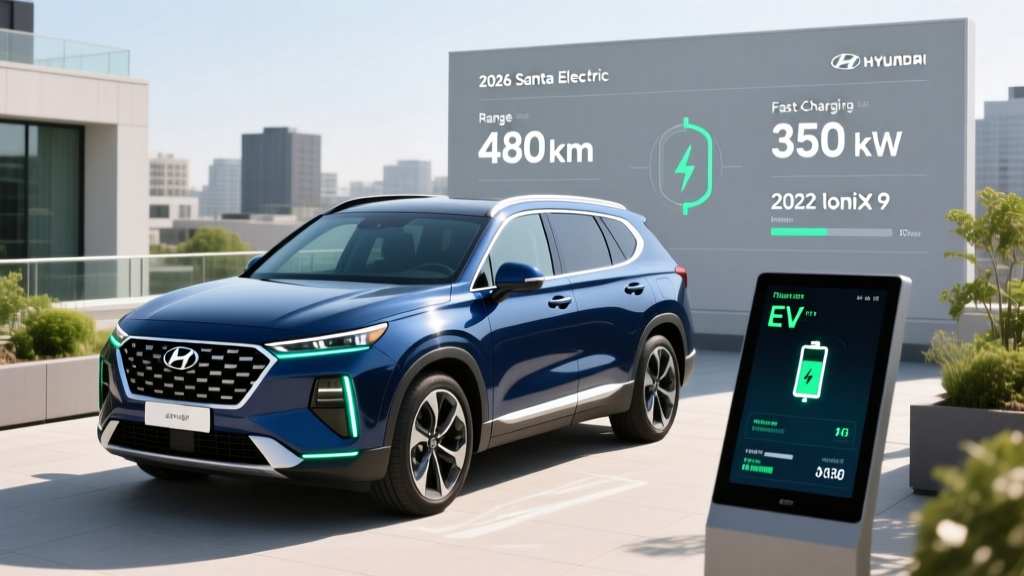
The Hyundai Santa Fe electric is officially called the Hyundai Ioniq 9 — a three-row electric SUV that went on sale in the U.S. for the 2025 model year and carries into 2026 with minor updates. It rides on Hyundai's E-GMP platform and offers up to 311 miles of EPA-estimated range (RWD Long Range), a 110.3 kWh NMC battery, and peak DC fast charging at ~240 kW (10–80% in approximately 24 minutes). Base pricing starts around $56,000 before incentives. It replaces the gas Santa Fe as Hyundai's flagship family hauler for buyers ready to go fully electric, while the gas Santa Fe continues in parallel for those who aren't.
What Is the Hyundai Santa Fe Electric, Exactly?
Search for "Hyundai Santa Fe electric" and you'll land on the Ioniq 9. Hyundai consolidated its electrified naming under the Ioniq sub-brand, so the three-row electric SUV that sits above the Ioniq 5 wears the Ioniq 9 badge rather than "Santa Fe EV." It shares its platform and much of its powertrain architecture with the Kia EV9, but with distinct styling, tuning, and interior execution.
The Ioniq 9 is available in three main configurations for 2026:
- Standard Range RWD — 76.1 kWh battery, ~230 miles EPA
- Long Range RWD — 110.3 kWh battery, up to 311 miles EPA
- Long Range AWD — 110.3 kWh battery, ~280 miles EPA
All trims use an 800-volt electrical architecture, which is the key enabler of its fast DC charging speeds — a meaningful advantage over 400-volt rivals like the Volkswagen ID.4 or the gas-platform-based electric SUVs from legacy competitors.
Range, Battery, and Charging: The Numbers That Matter
Here's the full spec breakdown for the 2026 Ioniq 9 lineup:
| Spec | Std Range RWD | Long Range RWD | Long Range AWD |
|---|---|---|---|
| EPA Range | ~230 mi | 311 mi | ~280 mi |
| Battery (usable) | 76.1 kWh | 110.3 kWh | 110.3 kWh |
| Chemistry | NMC | NMC | NMC |
| Horsepower | 215 hp | 215 hp | 379 hp |
| 0–60 mph | ~8.0 sec | ~8.2 sec | ~5.7 sec |
| Max DC Charge Rate | ~200 kW | ~240 kW | ~240 kW |
| 10–80% DC Fast Charge | ~22 min | ~24 min | ~24 min |
| Level 2 (11 kW AC) | ~7 hrs | ~10.5 hrs | ~10.5 hrs |
| Towing Capacity | — | 2,000 lb | 4,400 lb |
Real-World Range vs. EPA Sticker
The 311-mile EPA figure for the Long Range RWD is achievable in mild conditions around town. Expect ~250–270 miles on sustained highway driving at 70+ mph. In cold weather (below 32°F), plan for a 20–30% reduction, bringing real range to roughly 215–250 miles. The AWD model's 280-mile EPA rating translates to about 230–245 miles highway, ~195–215 miles in winter. These figures assume you're using the heat pump (standard on Long Range trims) and not aggressively accelerating.
On charging: the 800V architecture means the Ioniq 9 can sustain high charge rates longer than 400V competitors. At a 350 kW Electrify America or Tesla Supercharger (with NACS adapter), you'll see peak rates near 240 kW that taper gradually — not a sharp cliff at 60% SoC like some rivals. From 10–80%, expect roughly 24 minutes at a capable station. Above 80%, charging slows significantly to protect the battery; a full 10–100% session takes closer to 40–45 minutes. Plan your road trips around 10–80% charges for the best time efficiency.
Ioniq 9 vs. Gas Santa Fe: Cost and Efficiency Comparison
Many shoppers cross-shop the Ioniq 9 with the gas-powered 2026 Santa Fe. Here's how the economics stack up over 5 years, assuming 15,000 miles/year, $3.50/gallon gas, and $0.14/kWh home electricity:
| Factor | Ioniq 9 Long Range AWD | Santa Fe Hybrid (AWD) | Santa Fe Gas (AWD) |
|---|---|---|---|
| Base MSRP | ~$60,500 | ~$40,500 | ~$38,000 |
| Federal Tax Credit (§30D) | Up to $7,500* | None | None |
| Effective Price | ~$53,000 | ~$40,500 | ~$38,000 |
| MPGe / MPG (combined) | ~85 MPGe | ~36 MPG | ~24 MPG |
| Annual Fuel/Energy Cost | ~$735 | ~$1,458 | ~$2,188 |
| 5-Year Fuel/Energy Cost | ~$3,675 | ~$7,290 | ~$10,940 |
| 5-Year Maintenance Est. | ~$1,200 | ~$2,800 | ~$3,500 |
| 5-Year Total (vehicle + energy + maint.) | ~$57,875 | ~$50,590 | ~$52,440 |
*The §30D federal tax credit of up to $7,500 depends on battery sourcing, critical minerals requirements, buyer income caps, and MSRP limits. The Ioniq 9's MSRP falls under the $80,000 SUV cap, but eligibility varies — check the IRS qualified vehicles list and consult a tax professional. The credit can now be transferred to the dealer at point of sale, reducing your out-of-pocket cost at purchase.
The Ioniq 9 doesn't beat the gas Santa Fe on total 5-year cost in every scenario — its higher base price is a real factor. But the gap narrows considerably when you factor in the tax credit, and the Ioniq 9 wins decisively on running costs. If you drive more than 15,000 miles/year or have access to cheap electricity (under $0.10/kWh), the math swings further in the EV's favor.
Real-World Ownership: What First-Time EV Buyers Must Know
Owning the Ioniq 9 — or any large EV — involves practicalities that spec sheets don't cover. Here's what actually matters once you bring it home:
Home Charging Is the Make-or-Break Factor
With a 110.3 kWh battery, Level 1 charging (120V household outlet at ~1.4 kW) adds roughly 3–4 miles per hour — that's 40+ hours for a full charge. It's only viable as a top-up strategy if you drive under 30 miles/day. For practical ownership, you need a Level 2 home charger (240V, 48A/11.5 kW). This adds about 30 miles per hour and fully replenishes the Long Range battery overnight in roughly 10.5 hours.
Level 2 installation typically costs $800–$2,500 depending on panel proximity and whether your electrical panel needs an upgrade (200A service is recommended for simultaneous EV charging and household load). Factor this into your purchase budget.
Public Charging Reality Check
Hyundai includes complimentary charging through Electrify America for a limited period on new Ioniq 9 purchases. The 800V architecture means you'll get more from each charging stop than competitors on 400V systems. Hyundai has also begun offering NACS (Tesla connector) compatibility, giving Ioniq 9 owners access to the Tesla Supercharger network — the most reliable public charging infrastructure in the U.S. Verify connector type at purchase, as transition-year vehicles may ship with CCS or NACS depending on build date.
Cold Weather and Driving Patterns
The Ioniq 9's standard heat pump helps mitigate winter range loss, but physics is physics. Battery chemistry (NMC) loses efficiency below freezing. If you live in northern climates and regularly drive 200+ miles in winter, the AWD Long Range's ~280-mile EPA range may shrink to ~200 miles on a cold highway run. Plan charging stops accordingly, and use the vehicle's battery preconditioning feature before arriving at DC fast chargers to maintain charge speed.
Common Misconceptions About the Santa Fe Electric (Ioniq 9)
| Myth | Fact |
|---|---|
| "It's just a Santa Fe with a battery." | The Ioniq 9 is built on a dedicated EV platform (E-GMP) with a flat floor, frunk, and optimized weight distribution — not a converted gas car. |
| "The battery will need replacing in 5 years." | Hyundai warranties the battery for 10 years/100,000 miles against capacity loss below 70%. Real-world data from E-GMP vehicles shows ~5–8% degradation over 100k miles. |
| "You can't tow with an electric SUV." | The Ioniq 9 AWD Long Range is rated for 4,400 lbs — sufficient for most boat trailers, small campers, and utility trailers. Range will drop 30–50% while towing at highway speeds. |
| "Everyone gets the $7,500 tax credit." | Eligibility depends on your income (AGI caps: $150k single / $300k joint), the vehicle's battery sourcing compliance, and MSRP under $80k. Check the IRS qualified vehicle list before assuming. |
| "Fast charging damages the battery." | Occasional DC fast charging is fine. Hyundai's thermal management system actively cools the battery during high-power sessions. Daily Level 2 home charging is gentler, but road-trip fast charging won't meaningfully degrade your pack. |
Decision Framework: Is the Ioniq 9 Right for You?
Choose the Hyundai Ioniq 9 (Santa Fe Electric) If:
- You need three rows and want a dedicated EV — the Ioniq 9 and Kia EV9 are the only mainstream options under $70k
- You have access to Level 2 home charging (or can install it)
- You regularly drive 200+ miles and want 800V fast-charging capability for road trips
- You value Hyundai's 10-year/100,000-mile battery and powertrain warranty
- You qualify for the §30D tax credit, narrowing the price gap with gas alternatives
Look Elsewhere If:
- You lack reliable access to home or workplace charging — public-only charging with a 110 kWh battery is expensive and time-consuming
- You regularly tow heavy loads over long distances — towing slashes EV range dramatically
- Your budget is firmly under $45,000 — consider the Hyundai Tucson PHEV or Santa Fe Hybrid instead
- You live in a region with minimal DC fast-charging infrastructure and frequently take 300+ mile trips
Pricing and Trim Breakdown (2026 Model Year)
Based on Hyundai's announced pricing structure, here's where the Ioniq 9 trims land:
- SE Standard Range — ~$56,000 (76.1 kWh, RWD, 230 mi)
- SEL Long Range — ~$60,500 (110.3 kWh, RWD or AWD, 280–311 mi)
- Limited Long Range AWD — ~$68,000 (110.3 kWh, AWD, premium features)
- Calligraphy Long Range AWD — ~$73,000 (top trim, 280 mi)
All trims fall under the §30D SUV MSRP cap of $80,000. For the most current pricing and credit eligibility, check fueleconomy.gov and Hyundai's official configurator.
Frequently Asked Questions
Is the Hyundai Santa Fe electric the same as the Ioniq 9?
Yes. Hyundai markets its three-row electric SUV as the Ioniq 9, not the "Santa Fe EV." They share a family resemblance in design language and target the same buyer, but the Ioniq 9 is a dedicated EV on the E-GMP platform, while the Santa Fe remains a gas/hybrid nameplate.
How long does it take to charge the Ioniq 9 at home?
On a Level 2 (240V, 48A) home charger, the Long Range 110.3 kWh battery takes approximately 10.5 hours from empty to full. Most owners charge overnight and wake up to a full battery. Level 1 (120V) is impractical for full recharges — expect 3–4 days from near-empty.
Does the Ioniq 9 qualify for the $7,500 federal tax credit?
It may. The Ioniq 9 meets the MSRP cap for SUVs ($80,000), but eligibility also depends on your adjusted gross income, the battery's critical-mineral and component sourcing compliance, and current IRS rules. The credit can be applied at point of sale. Verify on the IRS qualified clean vehicles page before purchasing.
What's the real highway range of the Ioniq 9 AWD?
The EPA rates the Long Range AWD at approximately 280 miles. On real-world highway drives at 70–75 mph in moderate temperatures, expect 230–245 miles. In cold weather (below freezing), plan for 195–215 miles before needing a charge. Use the battery preconditioning feature and the heat pump to maximize range.
Can the Ioniq 9 use Tesla Superchargers?
Hyundai has been transitioning to the NACS (Tesla) connector. Depending on your Ioniq 9's build date, it may ship with NACS or CCS. Vehicles with CCS can access Superchargers using a Hyundai-approved NACS adapter. Confirm your vehicle's connector type and adapter compatibility at purchase.