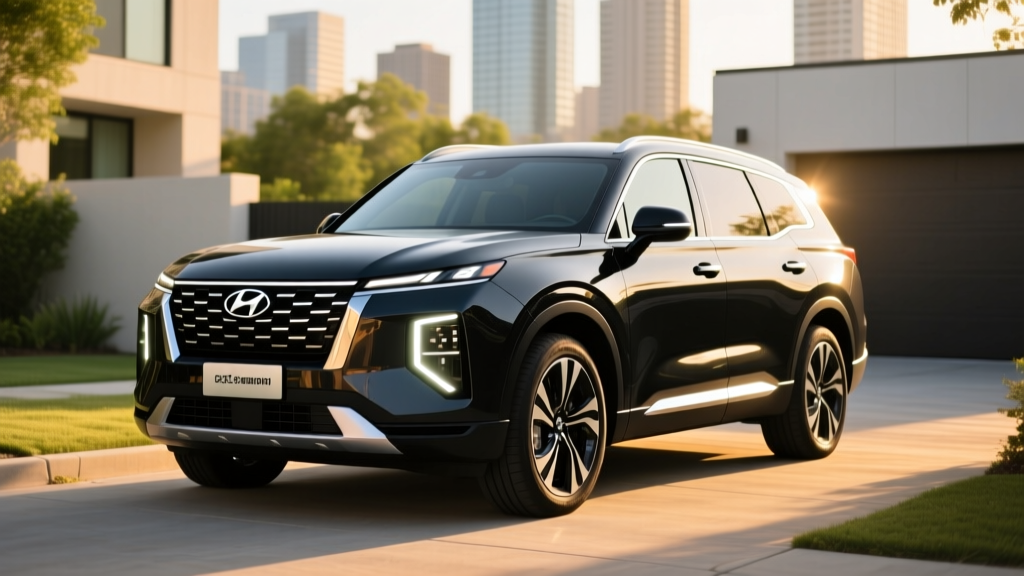
Quick Answer: Is the 2026 Hyundai Palisade EV Right for You?
The Hyundai Palisade EV is an announced (not yet on sale) three-row electric SUV expected to offer roughly 280–310 miles of EPA range, an ~84–100 kWh battery, and a starting MSRP near $55,000–$62,000 depending on trim. If you need three rows, want home Level 2 charging convenience, and qualify for a partial or full §30D federal tax credit (up to $7,500, subject to income caps, MSRP limits, and battery-sourcing rules), it could be a compelling family hauler. If you lack reliable home or workplace charging, frequently tow, or live in extreme cold without a heat-pump-equipped trim, weigh a Palisade Hybrid or a plug-in hybrid alternative until DC fast-charging infrastructure matures near your routes.
What We Know About the 2026 Hyundai Palisade EV So Far
Hyundai confirmed an all-electric Palisade variant as part of its expanded EV roadmap, built on the group's next-generation eM platform (or a heavily adapted E-GMP architecture for larger vehicles). As of early 2026, the Palisade EV has been announced but is not yet available for purchase in the United States. Final EPA certification figures have not been published on fueleconomy.gov, so all range, efficiency, and charging figures below are preliminary estimates based on Hyundai's disclosures, platform siblings like the Ioniq 9, and industry analysis. We will update this guide once official EPA numbers and MSRP are confirmed.
| Attribute | Estimated / Announced |
|---|---|
| EPA Range | ~280–310 mi (est., varies by trim/drivetrain) |
| Battery Capacity | ~84–100 kWh usable (NMC chemistry likely) |
| Peak DC Fast Charge | ~210–250 kW (est.) |
| 10–80% DC Charge Time | ~20–26 minutes (est.) |
| Level 2 AC Charge Rate | 10.9–11 kW onboard charger |
| Drivetrain | RWD standard, AWD available |
| Horsepower | ~215 hp (RWD) / ~350–380 hp (AWD) est. |
| 0–60 mph | ~7.5 sec (RWD) / ~5.0 sec (AWD) est. |
| Seating | 7 or 8 passengers (3 rows) |
| Starting MSRP (est.) | $55,000–$62,000 |
| Battery / Powertrain Warranty | 10 years / 100,000 miles (Hyundai standard) |
Real-world range note: EPA estimates are measured under controlled conditions. Expect ~10–15% range reduction at sustained highway speeds (70–80 mph) and 20–35% loss in sub-freezing temperatures without consistent battery preconditioning. An EPA-estimated 300-mile Palisade EV may deliver 250–270 miles on a highway road trip in mild weather and as little as 195–220 miles in cold winter conditions.
How the Palisade EV Compares to Gas and Hybrid Alternatives
For three-row family SUV buyers, the Palisade EV competes against its own gas and hybrid siblings, plus rivals like the Kia EV9, Rivian R1S, and Tesla Model X. Here's how the math works across powertrains when comparing estimated annual fueling costs.
| Powertrain | Efficiency | Energy/Fuel Cost | Annual Cost (est.) |
|---|---|---|---|
| Palisade EV (home L2, $0.14/kWh avg) | ~2.0–2.2 kWh/mi | $0.28–$0.31/mi | $4,200–$4,650 |
| Palisade EV (public DC, $0.40/kWh avg) | ~2.0–2.2 kWh/mi | $0.80–$0.88/mi | $12,000–$13,200 |
| Palisade Gas (21 MPG combined, $3.40/gal) | 21 MPG | $0.16/mi | ~$2,430 |
| Palisade Hybrid (27 MPG combined, $3.40/gal) | 27 MPG | $0.13/mi | ~$1,890 |
Key insight: The Palisade EV only saves money on fueling if you charge primarily at home on a residential electricity rate. If you rely exclusively on public DC fast chargers at $0.35–$0.50/kWh, the gas or hybrid Palisade is actually cheaper to fuel annually. This is the single most misunderstood aspect of EV ownership economics — the savings depend entirely on where you charge.
Total Cost of Ownership: 5-Year Breakdown
| Cost Category | Palisade EV (est.) | Palisade Gas (est.) |
|---|---|---|
| Purchase Price (base MSRP) | $58,000 | $40,500 |
| Federal Tax Credit (§30D, if eligible) | −$3,750 to −$7,500* | $0 |
| Home Charger Install (Level 2, 240V) | $1,200–$2,500 | $0 |
| Fuel/Energy (5 yrs, 75% home / 25% DC) | $24,000–$28,000 | $12,150 |
| Maintenance (oil, filters, brakes, etc.) | $1,500–$2,000 | $3,500–$4,500 |
| Insurance (5 yrs, EV premium ~15–20%) | $9,500–$11,500 | $7,500–$9,000 |
| Estimated Depreciation (5 yrs) | $22,000–$27,000 | $16,000–$20,000 |
| Total 5-Year Cost (est.) | $83,000–$94,000 | $79,000–$86,000 |
*§30D credit eligibility depends on MSRP caps ($80,000 for SUVs), buyer income limits ($150K single / $300K joint AGI), and battery critical-mineral and component sourcing requirements. Verify current-year rules at IRS.gov before purchasing. Point-of-sale transfer is available through registered dealers.
Charging Reality: What First-Time EV Buyers Must Know
The Palisade EV's ownership experience hinges on your charging setup. Here's what each level delivers:
| Level | Power (kW) | Miles Added per Hour | Best Use Case |
|---|---|---|---|
| Level 1 (120V household outlet) | ~1.4 kW | ~3–4 mi/hr | Emergency / overnight trickle only |
| Level 2 (240V home, 48A circuit) | ~11 kW | ~30–35 mi/hr | Daily home charging (full overnight) |
| DC Fast Charging | ~210–250 kW peak | ~180–250 mi in 20 min | Road trips, rapid top-ups |
Charging curve reality: The Palisade EV will not sustain its peak kW rate for the entire session. Like all EVs, charging speed tapers significantly above ~80% state of charge (SoC) to protect battery health. A 10–80% session may take 20–26 minutes, but pushing from 80–100% can add another 20–30 minutes. On road trips, plan to charge to 80% and go — the time penalty for the last 20% is rarely worth it.
kW vs. kWh: Kilowatts (kW) measure power — the rate at which energy flows into the battery. Kilowatt-hours (kWh) measure energy — the total capacity of the battery. Think of kW as the flow rate of a hose and kWh as the size of the bucket. A 250 kW charger fills an ~90 kWh battery quickly, but only while conditions (temperature, SoC) allow peak flow.
Cold Weather, Towing, and Other Real-World Limitations
EVs lose range in cold weather — this is physics, not a defect. Lithium-ion batteries operate less efficiently below freezing, and cabin heating draws substantial energy. For the Palisade EV:
- Cold-weather range loss: Expect 20–35% reduction at 20°F or below. A 300-mile EPA rating could deliver 195–240 miles in winter. A heat pump (expected on higher trims) can mitigate this by ~5–10 percentage points.
- Towing impact: Towing a 3,500–5,000 lb trailer can cut range by 30–50%. If you tow frequently over long distances, the gas Palisade or a diesel SUV remains more practical until charging infrastructure thickens along towing corridors.
- Charging deserts: Rural areas and some highway corridors still have sparse DC fast-charger coverage. Use apps like PlugShare or the Hyundai Bluelink navigation to map routes before committing to long EV road trips.
- Battery preconditioning: Use the Palisade EV's navigation-based preconditioning to warm the battery before arriving at a DC charger — this can cut 10–80% charge time by 5–10 minutes in cold weather.
Common Misconceptions About the Palisade EV
| Myth | Fact |
|---|---|
| "The battery will need replacing in 5 years." | Hyundai warrants the battery for 10 years / 100,000 miles. Modern NMC batteries typically retain 85–90% capacity after 100K miles based on data from comparable Hyundai/Kia EVs. |
| "I'll save thousands on fuel every year." | Only if you charge primarily at home ($0.10–$0.18/kWh). Exclusive public DC charging at $0.35–$0.50/kWh can cost more than gasoline per mile. |
| "It qualifies for the full $7,500 tax credit automatically." | §30D eligibility requires meeting battery sourcing, MSRP, and buyer income thresholds. Many EVs qualify for $3,750 or $0 depending on the model year's critical-mineral rules. Always verify at IRS.gov. |
| "Level 1 charging is enough for daily use." | At ~3–4 miles of range per hour, Level 1 adds only ~36–48 miles over 12 hours. If your daily commute exceeds 40 miles, Level 2 (240V) installation is effectively mandatory. |
| "EVs need no maintenance." | No oil changes, but tires wear 15–25% faster due to vehicle weight and instant torque. Cabin air filters, brake fluid, coolant, wiper fluid, and suspension components still require service. |
Decision Framework: Should You Buy the Palisade EV, Gas, or Hybrid?
Choose the Palisade EV if:
- You have (or can install) Level 2 home charging — a 240V/48A circuit on a dedicated 60A breaker.
- Your daily driving is under 80 miles and you take road trips fewer than 6 times per year.
- You qualify for a meaningful §30D credit that narrows the upfront price gap with the gas model.
- You want minimal routine maintenance and quiet, instant-torque acceleration.
Choose the Palisade Gas or Hybrid if:
- You live in an apartment or lack access to home/workplace charging.
- You tow regularly over distances exceeding 150 miles.
- You frequently drive in extreme cold (below 10°F) where range loss compounds.
- The upfront cost gap (even after tax credits) stretches your budget beyond comfort.
Wait and watch if:
- The Palisade EV's final EPA range comes in below 270 miles — competitive pressure from the Kia EV9 (EPA up to 304 mi) may push Hyundai to revise.
- You need confirmed §30D eligibility before committing — sourcing rules shift annually.
Frequently Asked Questions
When will the Hyundai Palisade EV be available in the US?
Hyundai has announced the Palisade EV as part of its electrified lineup expansion, but a firm on-sale date for the US market has not been confirmed as of early 2026. Expect availability in late 2026 or as a 2027 model year vehicle. We will update this article once Hyundai confirms pricing and delivery timelines.
Will the Palisade EV have NACS (Tesla-style) or CCS charging?
Hyundai has committed to adopting the NACS connector on new EVs sold in North America. If the Palisade EV launches with NACS, it will gain native access to Tesla Supercharger stations (now open to NACS-equipped non-Tesla EVs). If early units ship with CCS1, a NACS adapter will be needed for Supercharger access. Confirm the connector with your dealer before purchase.
How much does home Level 2 charger installation cost?
A typical Level 2 installation (240V, 48A hardwired charger on a 60A dedicated circuit) costs $1,200–$2,500 including equipment, electrician labor, and permits. If your home's electrical panel needs an upgrade from 100A to 200A service, add $2,000–$4,000. Always get a quote from a licensed electrician before committing to an EV purchase.
Does the Palisade EV qualify for the $7,500 federal tax credit?
Possibly, but it depends on the model year's battery sourcing compliance, the vehicle's MSRP (must be ≤$80,000 for SUVs), and your adjusted gross income (≤$150,000 single / $225,000 head of household / $300,000 joint). The credit can be transferred at the point of sale as an instant discount through a registered dealer. Check current eligibility at fueleconomy.gov and IRS.gov before purchasing.
What happens if the battery degrades significantly?
Hyundai's battery warranty covers 10 years / 100,000 miles and typically guarantees retention above ~70% of original capacity. Based on data from the Ioniq 5 and Kia EV6 (which share platform DNA), most Hyundai/Kia EV batteries lose only 8–15% capacity over the first 100,000 miles under normal use. Full battery replacement, if ever needed out of warranty, currently costs $12,000–$20,000 depending on pack size — but this is rare within the first decade.
Can I charge the Palisade EV on a regular 120V outlet?
Yes, but only as a supplemental or emergency option. Level 1 charging at 120V delivers roughly 1.4 kW, adding about 3–4 miles of range per hour. A full charge from empty would take 60–70+ hours. For daily use, a Level 2 (240V) home charger is strongly recommended.