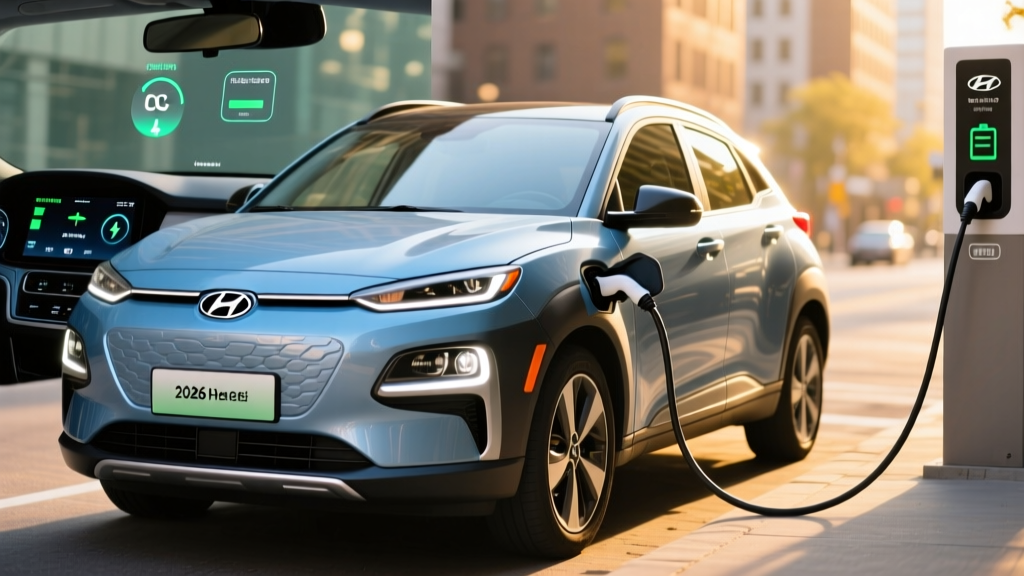
Quick Verdict: Is the 2026 Hyundai Kona Electric Worth It?
The 2026 Hyundai Kona Electric delivers an EPA-estimated 261 miles of range, 10-80% DC fast charging in approximately 43 minutes at a peak rate of 100 kW, and starts at $32,975 MSRP. It is a practical daily-driver EV for buyers who want compact-crossover utility, affordable home charging, and a 10-year/100,000-mile battery warranty — but its 100 kW peak charge rate and lack of all-wheel drive mean road-trippers and cold-climate buyers should weigh alternatives. Real-world highway range drops to roughly 220-235 miles, and cold weather can shave another 15-25% off that figure.
Range and Efficiency: EPA Sticker vs. Real-World Driving
The 2026 Kona Electric carries a 64.8 kWh usable battery pack using NMC (nickel manganese cobalt) chemistry. The EPA rates the SEL trim at 261 miles of combined range, with an efficiency of 118 MPGe combined (29 kWh/100 miles). That is competitive for the subcompact EV crossover segment.
Real-World Range Expectations
EPA Combined: 261 miles
Highway (70-75 mph, mild weather): ~220-235 miles
Cold weather (below 32°F, highway): ~175-200 miles
City/regenerative driving (mild weather): ~260-275 miles
The Kona Electric's efficiency shines in stop-and-go traffic where regenerative braking recovers energy. Highway driving at sustained speeds above 70 mph is where all EVs lose range, and the Kona's relatively compact battery means that loss is felt more acutely than in larger-pack vehicles. In winter, battery thermal management and cabin heating draw additional power — expect a 15-25% range reduction depending on severity.
The Kona Electric does not offer a heat pump as standard equipment on all trims, which is a notable omission for buyers in northern climates. A heat pump uses ambient air and waste heat to warm the cabin far more efficiently than resistive heating, preserving range in cold weather. If you live where winters regularly dip below freezing, prioritize a trim with the heat pump option or consider an EV that includes it standard.
Charging Speed and Infrastructure: What You Need to Know
Understanding the difference between kW (power — how fast energy flows) and kWh (energy — the battery's total capacity) is essential. The Kona Electric's 64.8 kWh battery stores energy; its charging hardware determines how quickly you can replenish it.
| Charging Level | Power (kW) | Time (Empty to Full / 10-80%) | Miles Added per Hour |
|---|---|---|---|
| Level 1 (120V household) | ~1.2 kW | ~54 hours (full) | ~4-5 mi/hr |
| Level 2 (240V home/public) | Up to 10.9 kW | ~6.5 hours (full) | ~37-40 mi/hr |
| DC Fast Charging | Peak 100 kW | ~43 min (10-80%) | ~150+ mi/hr (peak) |
The 100 kW peak DC fast-charge rate is the Kona Electric's most debated specification. Competitors like the Kia Niro EV (which shares a platform) and the Chevrolet Equinox EV offer higher peak rates. In practice, 100 kW means you will spend roughly 43 minutes going from 10% to 80% at a compatible DC fast charger — adequate for planned road trips with a meal or rest stop, but noticeably slower than vehicles peaking at 150-250 kW.
The charge curve also matters. Like all EVs, the Kona Electric's charge rate tapers significantly above 80% State of Charge to protect battery longevity. Charging from 80-100% on DC fast charge can take nearly as long as 10-80%. For road trips, plan to charge to 80% and move on — it is faster overall than waiting for a full charge.
The Kona Electric uses the CCS1 connector for DC fast charging. As Hyundai transitions its lineup to the NACS (Tesla-style) connector, verify the connector type on the specific model year and trim you purchase. A CCS-to-NACS adapter may be required for Tesla Supercharger access depending on the production date.
EV vs. Gas: Kona Electric Compared to the Gas Kona
Hyundai continues to sell the gas-powered Kona alongside the Electric variant. Here is how they compare on the metrics that matter for your wallet and daily driving.
| Specification | 2026 Kona Electric (SEL) | 2026 Kona Gas (SEL AWD) |
|---|---|---|
| Base MSRP | $32,975 | $27,400 |
| EPA Range / Tank Range | 261 miles | ~380 miles (13.2 gal × 29 mpg) |
| Fuel/Energy Cost per Mile | ~$0.04-$0.06 (home charging) | ~$0.11-$0.14 (gas at $3.30/gal) |
| Combined Efficiency | 118 MPGe (29 kWh/100 mi) | 29 MPG combined |
| Horsepower | 201 hp | 147 hp |
| 0-60 mph | ~7.4 seconds | ~9.2 seconds |
| Drivetrain | FWD only | FWD or AWD |
| Estimated 5-Year Fuel/Energy Cost | ~$2,700 (home charging) | ~$6,200 (gas) |
| Maintenance (5-year estimate) | ~$1,200 | ~$2,800 |
| Federal Tax Credit Potential | Up to $7,500 (§30D) | None |
The gas Kona wins on upfront price and total driving range per fill-up. The Kona Electric wins decisively on per-mile energy cost, acceleration, and long-term maintenance savings. Over five years and 75,000 miles, the EV's fuel and maintenance savings can total $4,000-$5,500, partially offsetting the higher purchase price — and that is before factoring in any federal or state tax incentives.
Total Ownership Cost Breakdown
Buying an EV is not just about the sticker price. Here is a realistic five-year cost projection for the Kona Electric assuming 15,000 miles per year, home Level 2 charging at $0.14/kWh national average, and no major battery issues.
| Cost Category | Kona Electric (5-Year) | Kona Gas (5-Year) |
|---|---|---|
| Purchase Price (MSRP) | $32,975 | $27,400 |
| Federal Tax Credit (§30D) | -$3,750 to -$7,500* | $0 |
| Net Purchase Price | $25,475 - $29,225 | $27,400 |
| Fuel / Electricity (75,000 mi) | $2,700 | $6,200 |
| Maintenance | $1,200 | $2,800 |
| Insurance (avg.) | $7,500 | $6,200 |
| Home Charger Install (Level 2) | $500 - $2,000 | $0 |
| Estimated 5-Year Total | $36,875 - $42,125 | $42,600 |
*Federal tax credit eligibility under IRS §30D depends on battery critical-mineral sourcing, buyer income caps ($150K single / $300K joint), and the $55,000 MSRP cap for SUVs. The Kona Electric qualifies as an SUV for the MSRP cap. Credit amounts and sourcing requirements change annually — verify current-year eligibility with a tax professional before purchasing.
Insurance tends to run 10-20% higher for EVs due to higher repair costs and battery replacement risk. Get quotes before committing. The home charger investment ($500-$2,000 for a Level 2 unit plus electrician labor, potentially more if your panel needs upgrading) pays for itself within 1-2 years of fuel savings versus public charging or gas.
What First-Time EV Buyers Should Know About the Kona Electric
Home Charging Is the Foundation
Over 80% of EV charging happens at home. If you can install a Level 2 (240V) charger in your garage or driveway, the Kona Electric will replenish roughly 37-40 miles of range per hour of charging — meaning an overnight charge easily covers any daily commute. Without home charging access, EV ownership becomes significantly less convenient and more expensive, as public DC fast charging costs $0.25-$0.45/kWh versus $0.10-$0.16/kWh at home.
Renters and condo dwellers without dedicated parking should honestly evaluate whether public charging infrastructure in their area is sufficient for daily needs. The Kona Electric's 100 kW charge rate means longer waits at public chargers compared to faster-charging EVs.
Battery Longevity and Warranty
Hyundai backs the Kona Electric's battery with a 10-year/100,000-mile warranty covering defects and capacity loss below 70% of original capacity. Based on data from Hyundai's NMC battery packs, owners can expect roughly 85-90% capacity retention after 100,000 miles under normal use. That means a battery that originally delivered 261 miles of range would still deliver approximately 220-235 miles at 100,000 miles — a gradual, manageable decline rather than a sudden failure.
Best practices for longevity include keeping the battery between 20-80% State of Charge for daily use, using the 100% charge setting only for road trips, and avoiding repeated DC fast charging in extreme heat without preconditioning.
Driving Patterns That Favor the Kona Electric
This EV excels for:
- Daily commutes under 80 miles round-trip
- City and suburban driving with frequent regenerative braking opportunities
- Two-car households where a gas vehicle handles long road trips
- Mild-to-moderate climates (or garaged vehicles in cold regions)
It is less ideal for:
- Frequent 300+ mile road trips (the 100 kW charge rate adds time)
- Buyers who need AWD for snow or mountain driving
- Extreme cold-climate residents without a garage and heat pump
- Towing (the Kona Electric is not rated for towing)
Common Misconceptions About the Kona Electric
| Myth | Fact |
|---|---|
| "261 miles of range means I can drive 261 miles no matter what." | EPA range assumes mixed driving in mild conditions. Sustained highway speeds, cold weather, and mountain grades all reduce range. Plan for 220-235 miles on a highway trip. |
| "DC fast charging at 100 kW is too slow to be useful." | 100 kW adds roughly 150+ miles in 30 minutes at peak rate — enough for most road-trip stops. The 43-minute 10-80% time is manageable with a meal break. |
| "The battery will need expensive replacement within a few years." | Modern NMC batteries degrade slowly. Hyundai's 10-year/100,000-mile warranty and real-world data suggest 85-90% capacity retention at high mileage. Out-of-warranty replacement costs $8,000-$14,000, but most batteries outlast the vehicle. |
| "I need to charge every night." | With a 261-mile range, most drivers charging at home only need to plug in every 2-3 days for a typical 30-40 mile daily commute. |
| "The $7,500 tax credit applies to everyone." | §30D has income caps, MSRP caps, and battery-sourcing requirements that change annually. Some buyers qualify for the full amount, some for partial, and some for none. Verify on IRS.gov before relying on it. |
Decision Framework: Should You Buy the 2026 Kona Electric?
Choose the Kona Electric If:
- You have home Level 2 charging access (or can install it)
- Your daily driving is under 100 miles round-trip
- You want a compact crossover with quick acceleration and low running costs
- You live in a mild or moderate climate, or have garage parking in cold regions
- You value the 10-year/100,000-mile battery warranty for long-term peace of mind
- You qualify for at least a partial federal tax credit, bringing the net price below $30,000
Look at Alternatives If:
- You take frequent road trips exceeding 250 miles and want faster DC charging (consider the Hyundai Ioniq 5 at 240 kW peak)
- You need AWD for snow or mountain driving (consider the Kia EV6 AWD or Subaru Solterra)
- You cannot install home charging and rely entirely on public infrastructure
- You regularly drive in sub-zero temperatures and need maximum cold-weather range preservation
- You need towing capability (the Kona Electric is not rated for towing)
Frequently Asked Questions
Does the 2026 Hyundai Kona Electric qualify for the $7,500 federal tax credit?
The Kona Electric may qualify for up to $7,500 under IRS §30D, but eligibility depends on the buyer's adjusted gross income (capped at $150K single / $300K joint), the vehicle's MSRP (capped at $55K for SUVs, which the Kona qualifies as), and battery critical-mineral and component sourcing requirements that tighten each year. The credit can now be transferred to the dealer at point of sale as a discount. Always verify current-year rules with a tax professional.
How much does it cost to charge the Kona Electric at home?
At the national average electricity rate of $0.14/kWh, a full charge of the 64.8 kWh battery costs approximately $9.07, yielding 261 miles of range — roughly $0.035 per mile. Compare that to $0.11-$0.14 per mile for a gas car averaging 29 MPG at $3.30/gallon. Over 15,000 miles per year, home charging saves $1,100-$1,600 annually versus gasoline.
Is the Kona Electric good in snow and cold weather?
The Kona Electric is front-wheel drive only, which limits traction in deep snow compared to AWD competitors. Range drops 15-25% in freezing temperatures due to battery chemistry and cabin heating demands. A heat pump (available on higher trims) mitigates some of this loss. If you live in heavy-snow regions, winter tires and AWD alternatives may be better choices.
What is the battery replacement cost if the warranty expires?
Out-of-warranty battery replacement for the Kona Electric runs approximately $8,000-$14,000 including labor, based on current Hyundai parts pricing. However, NMC battery data shows most packs retain 85-90% capacity at 100,000 miles and remain functional well beyond that. Complete battery failure is rare — gradual capacity loss is the norm.
How does the Kona Electric compare to the Kia Niro EV?
Both share Hyundai Motor Group's EV platform. The Kona Electric offers slightly more horsepower (201 hp vs. 201 hp — identical in 2026), similar range, and a more car-like crossover stance. The Niro EV offers marginally more cargo space. Both share the ~100 kW peak DC charge rate limitation. The choice often comes down to styling preference and dealer proximity. See fueleconomy.gov for side-by-side EPA data.
Can I tow with the Kona Electric?
No. The 2026 Kona Electric is not rated for towing. If you need even light trailer capability, consider a gas Kona (rated up to 1,200 lbs) or a larger EV like the Hyundai Ioniq 5.