Why Lease Deals Deserve a Hard Math Check
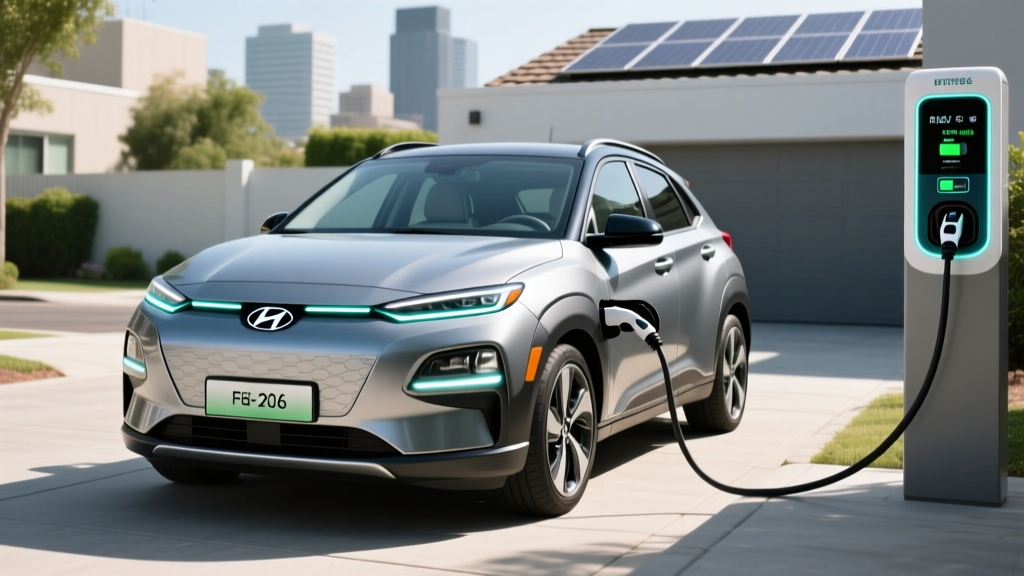
A $199/month Hyundai Kona Electric lease ad looks irresistible until you total the real cost of ownership. The 2026 Kona Electric — with its 261-mile EPA range, 65.4 kWh NMC battery, and 201-hp front motor — is one of the most affordable compact electric crossovers on the market, starting at $32,975 before incentives. But lease economics and outright purchase economics diverge sharply, and most shoppers never see the full picture.
This guide runs the actual numbers: federal tax credit eligibility under current IRS §30D rules, per-mile charging versus gas costs, insurance premiums, maintenance savings, and depreciation curves. By the end, you'll know whether a Kona Electric lease or purchase makes financial sense for your specific situation.
2026 Kona Electric: The Spec Sheet That Drives the Math
| Spec | 2026 Kona Electric SEL | 2026 Kona Electric Limited |
|---|---|---|
| Base MSRP | $32,975 | $38,475 |
| EPA Range | 261 mi | 242 mi (19" wheels) |
| Battery (usable) | 65.4 kWh, NMC | 65.4 kWh, NMC |
| Combined MPGe | 129 MPGe | 120 MPGe |
| Peak DC Fast Charge | ~100 kW (10-80% in ~43 min) | ~100 kW (10-80% in ~43 min) |
| Level 2 Charge Rate | 10.9 kW | 10.9 kW |
| 0-60 mph | 7.4 sec | 7.4 sec |
| Horsepower | 201 hp | 201 hp |
| Battery Warranty | 10 yr / 100,000 mi | 10 yr / 100,000 mi |
Federal Tax Credit: What You Actually Qualify For
The §30D federal EV tax credit offers up to $7,500, but the 2026 Kona Electric's eligibility is nuanced and depends on battery-sourcing compliance, your income, and the vehicle's MSRP classification. Under current IRS rules, the credit splits into two $3,750 halves: one for critical-mineral sourcing and one for battery-component manufacturing.
§30D Eligibility Checklist for the 2026 Kona Electric:
- MSRP Cap: The Kona Electric qualifies as a "passenger vehicle" (not SUV), so the MSRP cap is $55,000. All trims clear this threshold.
- Income Caps: Adjusted gross income must not exceed $150,000 (single), $225,000 (head of household), or $300,000 (joint filers).
- Battery Sourcing: As of 2026, strict critical-mineral and battery-component sourcing rules apply. Hyundai's battery supply chain has been evolving — confirm current-year eligibility with your dealer before signing, as compliance can shift mid-year.
- Point-of-Sale Transfer: If eligible, you can transfer the credit to the dealer at purchase, reducing your out-of-pocket cost by up to $7,500 at the time of sale. For leases, the credit technically goes to the lessor (Hyundai Capital), who may or may not pass the savings through to your monthly payment.
- Non-Refundable: If purchasing and claiming on your tax return, the credit is non-refundable — it can only reduce your tax liability to zero, not generate a refund.
Lease vs. Purchase Credit Difference: When you lease, the §30D credit goes to Hyundai as the vehicle owner. Many manufacturers pass this through as a "lease cash" incentive that lowers your monthly payment, but this is not guaranteed. Ask the dealer to show you the lease cash amount in writing before committing.
5-Year Total Cost of Ownership Breakdown
Here's what owning a 2026 Kona Electric SEL actually costs over 60 months, assuming 12,000 miles per year (60,000 miles total) and home Level 2 charging for 85% of your driving.
| Cost Category | Kona Electric SEL | Comparable Gas Crossover (e.g., Kia Seltos) |
|---|---|---|
| Purchase Price (after $7,500 credit*) | $25,475 | $28,500 |
| Charging / Fuel (5 years) | $3,150 | $7,800 |
| Insurance (5 years) | $9,750 | $7,500 |
| Maintenance (5 years) | $900 | $2,800 |
| Depreciation (5-year loss) | $14,200 | $12,100 |
| Total 5-Year Cost | $53,475 | $58,700 |
| Cost Per Mile | $0.89 | $0.98 |
*Assumes full §30D eligibility with point-of-sale transfer. Actual credit varies by battery-sourcing compliance in your purchase quarter. Gas comparison assumes 28 MPG combined at $3.50/gal.
Charging Cost vs. Gas: The Per-Mile Math
Charging the Kona Electric (home Level 2):
- Battery capacity: 65.4 kWh
- Average electricity cost: $0.16/kWh (national residential average)
- Efficiency: ~3.4 miles per kWh (129 MPGe combined)
- Cost per mile: $0.047
- Annual cost (12,000 mi): $564
Public DC Fast Charging (road trips, ~15% of miles):
- Average DCFC cost: $0.40/kWh
- Blended annual cost with 15% DCFC mix: $630
Gasoline equivalent (28 MPG combined):
- Fuel economy: 28 MPG
- Gas price: $3.50/gallon
- Cost per mile: $0.125
- Annual cost (12,000 mi): $1,500
Annual fuel savings with the Kona Electric: ~$870-$936
Over five years, that's roughly $4,500-$4,700 in fuel savings alone — a meaningful offset against higher insurance premiums. However, if you live in a region with high electricity rates (California at $0.30+/kWh, for example), the savings shrink to about $400/year. Always calculate with your local utility rate.
Maintenance Savings: Where EVs Quietly Win
| Maintenance Item | Kona Electric (5 yr) | Gas Crossover (5 yr) |
|---|---|---|
| Oil Changes | $0 (no engine oil) | $450 (9 changes @ $50) |
| Transmission Fluid | $0 (single-speed reducer) | $150 |
| Brake Pads/Rotors | $100 (regen extends life 2-3x) | $600 |
| Air Filters (engine) | $0 | $150 |
| Cabin Air Filter | $150 | $150 |
| Coolant Flush | $100 | $200 |
| Tire Rotation/Replacement | $400 (EVs wear tires ~15% faster due to torque + weight) | $350 |
| Wiper Fluid/Misc | $100 | $100 |
| Total | $850 | $2,150 |
Regenerative braking is the unsung cost saver. The Kona Electric's multi-level regen system (adjustable via steering-wheel paddles) can recapture enough kinetic energy to reduce friction-brake usage by 60-70%. Many EV owners report original brake pads lasting 80,000+ miles.
The one maintenance cost that's slightly higher: tires. The Kona Electric's instant torque and ~3,800-lb curb weight accelerate tread wear compared to a lighter gas crossover. Budget for a tire replacement around year 4.
Insurance Cost Reality: The Uncomfortable Truth
EV insurance premiums run 15-30% higher than comparable gas vehicles. For the Kona Electric, expect annual premiums of $1,800-$2,100 depending on your state, driving record, and coverage level — versus $1,400-$1,600 for a gas equivalent.
Why EVs cost more to insure:
- Higher repair costs: Battery packs, power electronics, and specialized high-voltage components require certified technicians and OEM parts.
- Total-loss thresholds: Even minor battery damage can trigger a total-loss declaration due to safety protocols around compromised lithium-ion cells.
- Limited aftermarket parts: Fewer third-party repair shops and parts suppliers mean insurers rely on dealer networks at higher rates.
- Purchase price: Higher MSRP translates to higher collision/comprehensive payouts.
Some insurers now offer EV-specific policies with battery-coverage riders. Shop quotes from at least three carriers — GEICO, Progressive, and State Farm all price EVs differently, and the spread can be $400+/year.
Depreciation: How Well Does the Kona Electric Hold Value?
EV depreciation has been steeper than gas vehicles over the past several years, driven by rapid technology advancement, price wars (particularly Tesla's), and consumer uncertainty about long-term battery health. The Kona Electric typically retains 40-48% of its value after five years, compared to 52-58% for a mainstream gas compact crossover.
Depreciation factors specific to the Kona Electric:
- Strong warranty transfer: Hyundai's 10-year/100,000-mile battery warranty is transferable to the second owner, which supports resale value.
- Battery degradation: NMC chemistry in the Kona typically loses 8-12% capacity over 5 years/60,000 miles based on fleet data. That leaves 230-240 miles of range — still highly usable.
- Charging speed liability: The Kona's ~100 kW peak DC fast charge rate is below the 200-350 kW rates of newer competitors. As fast-charger infrastructure expands, slower-charging EVs may depreciate faster.
- Market position: As one of the lowest-priced new EVs, the Kona Electric has a floor — budget-conscious used buyers will always find it attractive at the right price.
Lease vs. Buy: Which Path Fits Your Situation?
Choose a Kona Electric lease if:
- You drive under 12,000 miles/year (most leases cap at 10K-12K miles).
- You want to upgrade to newer battery/charging tech in 3 years without resale hassle.
- The dealer passes through the §30D credit as lease cash, lowering your monthly payment below $300.
- You don't want to worry about long-term depreciation or battery health.
Choose to purchase if:
- You qualify for the full $7,500 §30D credit via point-of-sale transfer and have the tax liability to use it.
- You drive 15,000+ miles/year (lease overage fees of $0.20-$0.25/mile add up fast).
- You plan to keep the vehicle 7+ years, spreading the depreciation hit over a longer horizon.
- You want to modify the vehicle (wraps, wheels, accessories) without lease-return penalties.
Frequently Asked Questions
How much does it really cost to own a Hyundai Kona Electric over 5 years?
Approximately $53,000-$55,000 all-in for a SEL trim, assuming full federal tax credit eligibility, home charging, and 12,000 miles/year. That breaks down to roughly $0.87-$0.92 per mile including depreciation. Without the federal credit, add $7,500, bringing the total closer to $60,500-$62,500.
Do I qualify for the $7,500 federal EV tax credit on the Kona Electric?
Possibly. You must meet income caps ($150K single / $300K joint), the vehicle must be under the $55K MSRP cap (all Kona trims qualify), and the battery must meet current-year critical-mineral and component-sourcing requirements. Battery sourcing compliance can change quarterly — verify with your dealer and consult a tax professional before relying on the credit. Full rules are at IRS.gov.
How much do I save on fuel and maintenance versus a gas car?
Combined fuel and maintenance savings run approximately $1,200-$1,500 per year for a typical driver (12,000 miles, national-average electricity rates). Over five years, that's $6,000-$7,500 in total savings. Savings are higher if you have access to cheap overnight electricity rates and lower if you rely heavily on expensive public DC fast chargers.
Are EVs more expensive to insure than gas cars?
Yes, typically 15-30% more. For the Kona Electric, budget $1,800-$2,100/year versus $1,400-$1,600 for a comparable gas crossover. Higher repair costs, specialized parts, and battery-replacement risk drive the premium difference. Shop multiple insurers — the spread between carriers can be significant for EVs.
How well does the Kona Electric hold its resale value?
The Kona Electric retains approximately 40-48% of its value after five years, which is below the 52-58% typical for gas compact crossovers. Hyundai's transferable 10-year battery warranty helps support used values, but rapid EV technology advancement and competitive pricing pressure continue to weigh on EV depreciation broadly.
What's the best Hyundai Kona Electric lease deal right now?
Lease deals vary by region, dealer, and current manufacturer incentives. As of early 2026, competitive Kona Electric leases run $279-$349/month for 36 months with $2,500-$3,500 due at signing on the SEL trim. The key question is whether Hyundai Capital is passing through the §30D credit as lease cash — always ask the dealer to itemize this. Compare the total lease cost (monthly × term + due at signing + disposition fee) against the purchase total-cost-of-ownership before deciding.
Does the Kona Electric qualify for HOV lane access?
In many states, yes. California, Colorado, Virginia, and several others offer HOV lane stickers or decals for qualifying EVs. California's Clean Air Vehicle deceleration program has limited availability and specific income requirements for new applications. Check your state's DMV or afdc.energy.gov for current rules.
Sources: fueleconomy.gov, IRS §30D Clean Vehicle Credits, Alternative Fuels Data Center. Pricing and incentive data reflect 2026 model year and current-year rules; always verify with your dealer and tax professional before purchasing.