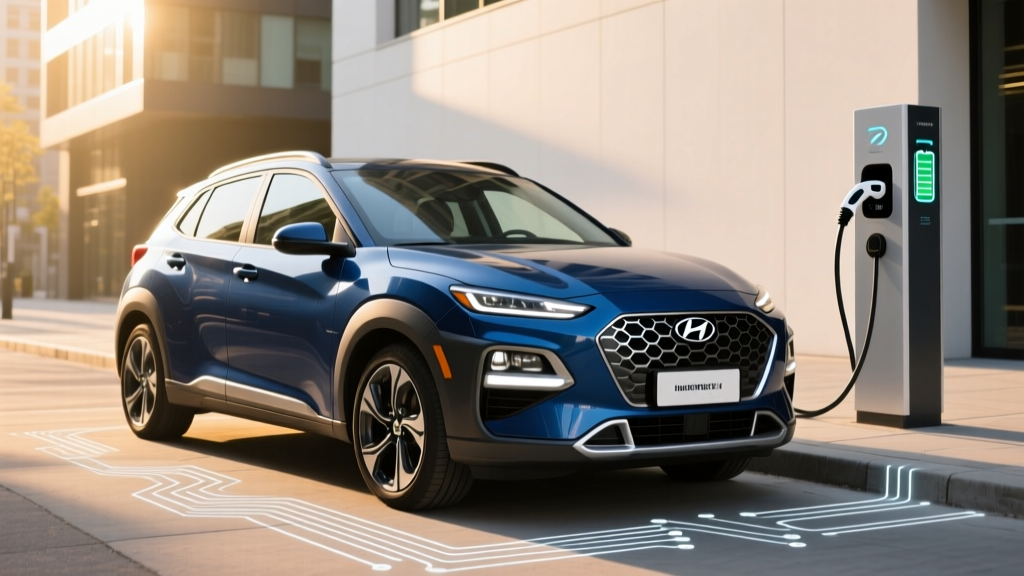
The second-generation Hyundai Kona Electric arrived for the 2024 model year on an all-new platform (internal body code 56111-BE200-SSS), growing substantially in size, range, and tech over its predecessor. Now heading into the 2025 model year with minor updates, this subcompact crossover targets urban commuters and small families who want a practical EV without stepping up to the Ioniq 5's footprint or price. We've compiled EPA data, real-world range observations, charging benchmarks, and ownership economics to help you decide if this Kona Electric variant deserves a spot in your driveway.
Quick Verdict: Who the Kona Electric (56111-BE200-SSS) Is For
The 56111-BE200-SSS body code designates the long-range, front-wheel-drive Kona Electric sold in North America. It's best suited for daily commuters and two-person households who charge at home, drive under 200 miles a day, and value Hyundai's 10-year powertrain warranty. It is not a road-trip champion—its ~100 kW peak DC charging speed means longer highway stops than rivals like the Chevrolet Bolt EV (now discontinued) or the Kia Niro EV. If you need AWD, towing capability, or ultra-fast charging, look to the Ioniq 5 instead.
EPA-estimated range: 261 miles (SEL trim, 18-inch wheels). The Limited trim with 19-inch alloys drops to 240 miles.
In real-world highway driving at 70 mph, expect 210–230 miles before needing a charge. In cold weather (below 30°F), range can fall to 170–200 miles due to cabin heating demand and battery chemistry limitations. City driving with regenerative braking recovers energy efficiently, often matching or slightly exceeding the EPA sticker.
Spec Table: 2024-2025 Hyundai Kona Electric at a Glance
| Specification | Value |
|---|---|
| EPA Range (SEL / Limited) | 261 mi / 240 mi |
| Battery Capacity (usable) | 65.5 kWh (NMC chemistry) |
| Drivetrain | Front-wheel drive (single motor) |
| Horsepower / Torque | 201 hp / 188 lb-ft |
| 0–60 mph | ~7.4 seconds |
| EPA Efficiency (combined) | 116 MPGe (29 kWh/100 mi) |
| Max DC Fast Charge Rate | ~100 kW (peak) |
| 10–80% DC Fast Charge Time | ~43 minutes |
| Level 2 AC Charge Rate | 11 kW (onboard charger) |
| Cargo Volume (rear seats up / down) | 25.5 cu ft / 54.4 cu ft |
| Rear Legroom | 38.2 inches |
| Battery/Powertrain Warranty | 10 years / 100,000 miles |
| Base MSRP (SE / SEL / Limited) | $32,975 / $34,475 / $39,475 |
Sources: fueleconomy.gov, Hyundai USA
Battery, Chemistry, and What 65.5 kWh Means in Practice
The Kona Electric (56111-BE200-SSS) uses a nickel-manganese-cobalt (NMC) lithium-ion pack with 65.5 kWh of usable capacity. NMC chemistry offers higher energy density than LFP (lithium iron phosphate), which is why Hyundai can fit over 260 miles of range into a compact crossover footprint. The trade-off: NMC batteries are more sensitive to sustained high state-of-charge (SoC) and extreme temperatures.
For daily driving, Hyundai recommends charging to 80% for routine use and saving 100% charges for road trips. The battery management system includes a buffer (roughly 2–3 kWh below the gross capacity) to protect against over-discharge, but you'll still want to avoid routinely draining below 10%.
Hyundai's battery thermal management uses an active liquid-cooling system, which helps maintain charge speed and longevity in both hot and cold climates. However, unlike the Ioniq 5's heat pump system (standard on many trims), the Kona Electric's cold-weather efficiency takes a more noticeable hit—plan on 25–35% range reduction in sustained sub-freezing temperatures.
Charging Speeds: DC Fast, Level 2, and Level 1
Charging is where the Kona Electric's positioning as a commuter-first EV becomes most apparent. Its ~100 kW peak DC rate is adequate but not class-leading. Here's what to expect at each level:
| Charging Level | Power | Miles Added per Hour | Notes |
|---|---|---|---|
| Level 1 (120V household) | ~1.4 kW | ~4–5 mi/hr | Full charge: ~48 hours. Emergency use only. |
| Level 2 (240V home) | Up to 11 kW | ~35–38 mi/hr | Full charge: ~7 hours. Ideal overnight setup. |
| DC Fast Charge | Peak ~100 kW | ~150+ mi in 30 min | 10–80% in ~43 min. Tapers heavily above 80%. |
Charging curve reality: The Kona Electric hits its ~100 kW peak only between roughly 10–40% SoC when the battery is preconditioned. From 40–70%, the rate drops to approximately 60–70 kW, and above 80%, it slows to under 30 kW. This is why Hyundai quotes 10–80% in ~43 minutes rather than a full charge. On a road trip, plan your stops around 20–80% swings to minimize time at the charger.
At home, an 11 kW Level 2 charger (such as a 48-amp hardwired unit on a 60-amp circuit) will replenish the battery fully overnight. If your home has a standard 40-amp circuit, a 32-amp charger delivers about 7.7 kW—still enough for a full overnight charge in roughly 9 hours. Expect home charger installation to cost $500–$1,500 depending on panel proximity and local permitting, or significantly more if a panel upgrade is needed.
Performance, Drivetrain, and Daily Driving Impressions
The single front-mounted motor produces 201 horsepower and 188 lb-ft of torque, sending power exclusively to the front wheels. The 0–60 mph time of approximately 7.4 seconds is brisk enough for confident highway merging and passing, though it won't pin you to your seat like a dual-motor Ioniq 5 or Tesla Model Y.
The Kona Electric's driving dynamics are tuned for comfort over sportiness. Ride quality is compliant over rough pavement, and the cabin stays quiet at highway speeds—a benefit of the absence of an internal combustion engine and Hyundai's improved sound insulation in this generation. The regenerative braking system offers multiple levels (selectable via steering-wheel paddles), with the strongest setting enabling near one-pedal driving in city traffic.
Limitations to know: There is no AWD option, which matters for buyers in heavy snow regions. Towing capacity is essentially zero—Hyundai does not rate the Kona Electric for towing. Ground clearance is modest at 6.3 inches, so this is strictly a pavement-oriented crossover.
Pricing, Trims, and Federal Tax Credit Eligibility
The 2024-2025 Kona Electric comes in three trims. Pricing has remained relatively stable between model years:
| Trim | Base MSRP | Key Features |
|---|---|---|
| SE | $32,975 | 18" alloys, 12.3" infotainment, wireless CarPlay/Android Auto, heated front seats |
| SEL | $34,475 | Adds roof rails, proximity key, power driver seat, Highway Driving Assist |
| Limited | $39,475 | 19" wheels, leather, HUD, ventilated front seats, sunroof (range drops to 240 mi) |
All trims include a $1,295 destination charge. A fully loaded Limited with premium paint and accessories can reach approximately $41,500–$42,000 out the door before incentives.
Federal Tax Credit (§30D) Eligibility
As of current IRS rules, the Hyundai Kona Electric may qualify for up to $7,500 in federal tax credits under Internal Revenue Code §30D, but eligibility depends on several factors that change periodically:
- MSRP cap: The Kona Electric (classified as an SUV/crossover by the IRS) must have an MSRP under $80,000—all trims qualify easily.
- Buyer income cap: Modified adjusted gross income must not exceed $150,000 (single), $225,000 (head of household), or $300,000 (joint filers).
- Battery sourcing: The critical minerals and battery component requirements have tightened annually since 2023. Hyundai's battery supply chain for the Kona Electric has been in flux—verify current-year eligibility on the official fueleconomy.gov tax credit page before purchasing, as the qualifying credit amount ($0, $3,750, or $7,500) depends on the exact build date and sourcing compliance.
- Point-of-sale transfer: If eligible, you can transfer the credit to the dealer at purchase, reducing your out-of-pocket cost immediately rather than waiting for a tax refund.
Always confirm with a tax professional and check IRS.gov for the latest rules before making a purchase decision.
SEL trim at $34,475 MSRP + $1,295 destination = $35,770.
If the full $7,500 §30D credit applies: effective price drops to ~$28,270—a compelling value for a 261-mile EV with Hyundai's warranty. Without the credit, you're paying ~$35,770 before state incentives and dealer fees.
Tech, Interior, and Standout Features
Hyundai loaded the second-gen Kona Electric with meaningful tech upgrades over the original:
- Dual 12.3-inch displays: A digital instrument cluster and infotainment touchscreen sit behind a single curved glass panel. The system supports wireless Apple CarPlay and Android Auto on all trims.
- Hyundai Digital Key 2: Use your smartphone (NFC/UWB) to unlock and start the car—available on SEL and Limited.
- Highway Driving Assist (HDA): A Level 2 SAE driver-assistance system combining adaptive cruise control with lane centering. It works well on divided highways but requires hands on the wheel and full driver attention at all times—this is not autonomous driving.
- Vehicle-to-Load (V2L): An available V2L adapter lets you power small electronics or appliances from the car's battery—handy for camping or emergency backup.
- Over-the-air (OTA) updates: Hyundai supports remote software updates for infotainment, navigation, and certain vehicle systems.
Highway Driving Assist is an SAE Level 2 driver-assistance feature. It does NOT make the Kona Electric self-driving. You must keep your hands on the steering wheel and eyes on the road. The system will issue escalating warnings and eventually bring the car to a stop if it detects driver disengagement. Compare this to GM's Super Cruise or Ford's BlueCruise, which allow hands-off driving on pre-mapped highways—the Kona Electric does not offer this capability.
Notable drawbacks: The Kona Electric lacks a front trunk (frunk)—the space under the hood houses power electronics instead. Rear visibility is somewhat compromised by thick C-pillars, making the standard rearview camera essential. The infotainment system, while functional, uses a mix of touch-capacitive buttons that can be finicky compared to physical knobs.
Space, Cargo, and Practicality
The second-generation Kona grew significantly—riding on a wheelbase 2.4 inches longer than its predecessor. The result is meaningful interior gains:
- Cargo (behind rear seats): 25.5 cu ft — enough for a week's groceries or two large suitcases
- Cargo (rear seats folded): 54.4 cu ft — competitive with small crossovers like the Subaru Crosstrek
- Rear legroom: 38.2 inches — adults up to about 6'2" will be comfortable
- Front headroom: 39.9 inches — generous even with the available sunroof on the Limited
For a two-person household, the Kona Electric is practical for daily life and weekend trips. Families with older children may find the rear seat and cargo area tight for long road trips with gear. There's no towing rating, so forget about trailers or boat hauling.
Pros and Cons
✓ Pros
- 261-mile EPA range covers most commutes with margin
- Industry-leading 10-year/100,000-mile battery warranty
- Strong value, especially with $7,500 tax credit eligibility
- Comfortable ride quality and quiet cabin
- Generous tech: dual 12.3" screens, wireless CarPlay/Android Auto
- V2L capability for off-grid power
- Physical buttons still supplement touchscreen controls
✗ Cons
- DC fast charging limited to ~100 kW (43 min 10–80%)
- No AWD option; FWD only limits snow-belt appeal
- No frunk (front trunk) for additional storage
- Cold-weather range loss is significant (~25–35%)
- Not rated for towing
- Limited trim with 19" wheels sacrifices 21 miles of range
- ADAS is capable but not hands-free like BlueCruise/Super Cruise
How It Stacks Up Against Key Competitors
The Kona Electric competes in a tight subcompact EV crossover segment. Here's how it compares on the metrics that matter most:
- vs. Kia Niro EV: The Niro EV shares a corporate platform and similar powertrain but offers slightly more cargo room and a comparable 239-mile range. The Kona's advantage is its longer warranty and slightly more modern interior design.
- vs. Chevrolet Bolt EUV (discontinued 2024): The Bolt EUV offered 247 miles of range at a lower price point, but its CCS charging was similarly slow (~55 kW peak on older models). With the Bolt gone, the Kona fills a similar value niche.
- vs. Volvo EX30: The EX30 is newer, more premium, and offers faster charging (~153 kW), but starts at a higher price and has less cargo room. The Kona wins on value and warranty.
- vs. Hyundai Ioniq 5: The Ioniq 5 is a class above—faster charging (up to 240 kW with 800V architecture), more space, AWD available, and available hands-free driving assist. But it starts ~$10,000 higher. If budget allows, the Ioniq 5 is the stronger all-around EV.
Ownership Costs and Long-Term Value
Hyundai's warranty coverage is a major ownership advantage:
- Battery warranty: 10 years / 100,000 miles (covers capacity loss below 70% of original)
- Powertrain warranty: 10 years / 100,000 miles
- New-vehicle limited warranty: 5 years / 60,000 miles
- Complimentary maintenance: 3 years / 36,000 miles
Charging at home at the US average electricity rate of ~$0.16/kWh, a full 65.5 kWh charge costs approximately $10.48—equivalent to roughly $0.04 per mile. Compare that to a 28 MPG gas crossover at $3.50/gallon ($0.125/mile), and you're saving about $0.085 per mile driving electric. Over 15,000 miles per year, that's roughly $1,275 in annual fuel savings.
Insurance premiums for the Kona Electric tend to run 10–20% higher than equivalent gas-powered Kona trims, so factor that into your total cost of ownership calculation. Depreciation data for the second-generation model is still limited, but first-gen Kona Electrics held value reasonably well given their niche positioning.
Frequently Asked Questions
What is the real-world range of the 2024-2025 Hyundai Kona Electric?
The EPA rates the Kona Electric SEL at 261 miles and the Limited at 240 miles. In real-world mixed driving, most owners report 220–250 miles in mild weather. Highway-only driving at 70+ mph drops this to approximately 210–230 miles, and sustained sub-freezing temperatures can reduce range to 170–200 miles depending on cabin heating use and driving style.
How fast does the Kona Electric charge at home and on the road?
On a DC fast charger, the Kona Electric peaks at approximately 100 kW and charges from 10–80% in about 43 minutes. At home on a Level 2 (240V) charger at 11 kW, a full charge takes roughly 7 hours. On a standard 120V outlet (Level 1), expect about 4–5 miles of range per hour of charging.
Does the Hyundai Kona Electric qualify for the $7,500 federal tax credit?
It may, depending on current IRS §30D battery sourcing rules, your income, and the vehicle's build date. The Kona Electric's MSRP is well under the $80,000 SUV cap. However, battery component and critical mineral requirements have been tightening—check fueleconomy.gov for the specific model year and build date you're considering, and consult a tax professional for personalized guidance.
Is the Kona Electric worth buying over the Ioniq 5?
If budget is the primary concern, yes—the Kona Electric starts roughly $10,000 lower than the Ioniq 5 and still delivers 261 miles of range with Hyundai's excellent warranty. If you need faster DC charging, AWD, more cargo space, or a more premium cabin, the Ioniq 5 is the better vehicle. Think of the Kona as the value commuter pick and the Ioniq 5 as the versatile all-rounder.
What's the biggest drawback of the Kona Electric?
Charging speed. At ~100 kW peak DC fast charging, the Kona Electric takes about 43 minutes to go from 10–80%—roughly double the time of 800V-architecture vehicles like the Ioniq 5 or Kia EV6. For daily commuters who charge at home, this rarely matters. For road trippers, it means longer stops and more careful route planning.
Does the Kona Electric have a heat pump?
The second-generation Kona Electric does not include a dedicated heat pump as standard equipment in the US market (unlike some international variants and the Ioniq 5). This contributes to its more pronounced range loss in cold weather. If you live in a cold climate and cold-weather range is a top priority, this is worth factoring into your decision.