Quick Verdict: A Practical Subcompact EV With Honest Range
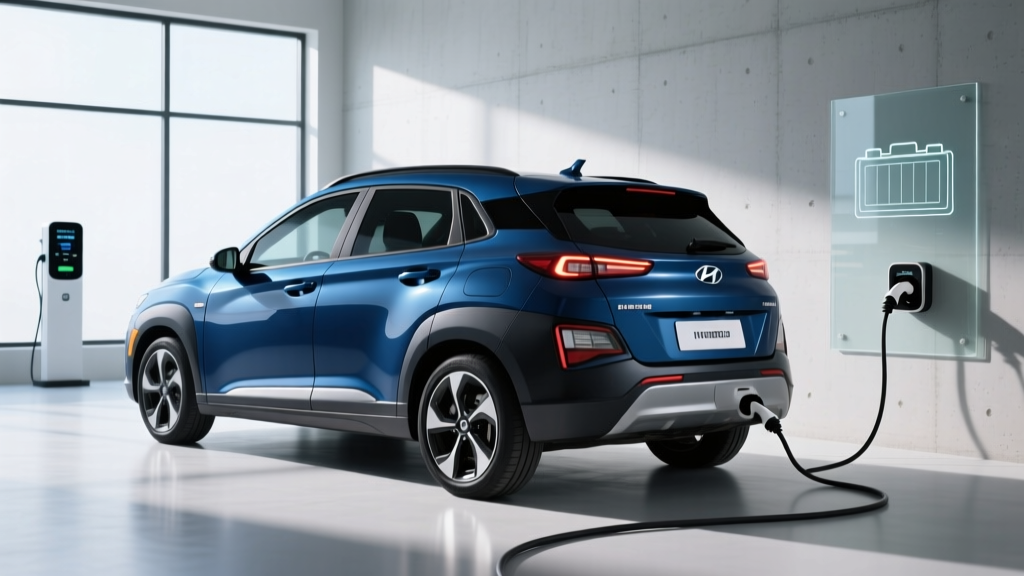
The redesigned Hyundai Kona Electric (chassis code SX2, often referenced by its body assembly part number 56111-BE100-T9Y in parts catalogs) is one of the most practical subcompact EVs on the market for the 2024 and 2025 model years. Larger than its predecessor in every dimension, it trades the previous generation's 150-kW DC fast-charging peak for a more modest but widely compatible 100-kW ceiling, while gaining meaningful interior space and a refined ride. If you're a commuter or small household seeking a sub-$35,000 BEV with real-world usability north of 240 miles, the Kona Electric belongs on your short list — but charging-speed seekers should look elsewhere.
| Spec | Value |
|---|---|
| EPA Range (SEL/Limited) | 261 miles |
| EPA Range (SE, 17" wheels) | 261 miles (2025 est.) |
| Battery Capacity (usable) | 64.8 kWh |
| Battery Chemistry | NMC (Nickel Manganese Cobalt) |
| Motor Output | 201 hp / 188 lb-ft torque |
| Drivetrain | FWD (single front motor) |
| 0-60 mph | ~7.8 seconds |
| Max DC Fast Charge | ~100 kW peak |
| 10-80% DCFC Time | ~43 minutes |
| Level 2 Charge Rate | 10.9 kW (onboard charger) |
| EPA Efficiency (combined) | 116 MPGe (29 kWh/100 mi) |
| Cargo Volume (rear seats up) | 25.8 cu ft |
| Cargo Volume (rear seats folded) | 63.7 cu ft |
| Rear Legroom | 38.2 inches |
| Battery Warranty | 8 years / 100,000 miles |
| Base MSRP (2025 SE) | $32,975 |
Range & Efficiency: What the EPA Sticker Actually Means on the Road
Hyundai equips the Kona Electric with a 64.8 kWh usable NMC lithium-ion battery pack across all trims. The EPA rates the Kona Electric at 261 miles of combined range for the SEL and Limited trims on 18-inch alloy wheels, with an efficiency of 116 MPGe (29 kWh per 100 miles). That's competitive with the Chevrolet Equinox EV and slightly ahead of the base Nissan Ariya, though the Kia Niro EV posts a marginally higher 265-mile figure.
The 261-mile EPA figure assumes a mix of city and highway driving at moderate temperatures. Expect the following in practice:
- City/commuter driving (55°F–75°F): 260–280 miles — regenerative braking in stop-and-go traffic maximizes efficiency, sometimes exceeding EPA.
- Highway cruising (70 mph, 70°F): 220–240 miles — aerodynamic drag at sustained speed reduces range ~10–15%.
- Cold weather (20°F–30°F, highway): 170–200 miles — NMC chemistry loses 20–30% range in freezing temps; the Kona's heat pump (standard on Limited, optional elsewhere) mitigates but doesn't eliminate this.
On a 250-mile road trip at 70 mph in summer conditions, you'll arrive with roughly 10–15% battery remaining. In winter, plan a mid-trip charge stop for the same distance.
One ownership nuance: Hyundai's battery management system (BMS) maintains a top and bottom buffer, so the 64.8 kWh figure represents usable capacity — not total cell capacity. This buffer strategy is a key reason Hyundai's long-term degradation data remains strong across the Kona and Ioniq lineups.
Charging Speed: Adequate for Daily Use, Modest on Road Trips
The Kona Electric's charging profile is where pragmatic buyers need to calibrate expectations. Hyundai rates the DC fast-charging peak at approximately 100 kW using a CCS1 connector. That's notably lower than the 150 kW the previous-generation Kona Electric could achieve, and far below the 200+ kW peaks of the Ioniq 5 or Hyundai's E-GMP platform vehicles.
| Charging Level | Power / Voltage | Speed (approx.) | Time |
|---|---|---|---|
| Level 1 (120V household) | 1.4 kW | ~5 miles per hour | ~46 hours (0–100%) |
| Level 2 (240V home/public) | 10.9 kW | ~36 miles per hour | ~6.5 hours (0–100%) |
| DC Fast Charge (CCS) | ~100 kW peak | ~130 mi in 30 min | ~43 min (10–80%) |
Understanding the charge curve: The 100 kW peak only holds from roughly 10% to 40% State of Charge (SoC). Above 50%, the rate tapers to 70–80 kW, and past 80% it drops to under 30 kW to protect battery health. This taper is why the 10–80% time is 43 minutes rather than the ~30 minutes you might calculate from peak kW alone.
For home charging, the 10.9 kW onboard charger is a strength. On a 48-amp Level 2 circuit (the most common home installation), you'll recover the full battery overnight in about 6.5 hours — faster than some competitors limited to 7.2 kW onboard chargers. This means a typical overnight session from 30% to 80% takes roughly 3.5 hours on a Level 2 home unit.
Performance & Driving Dynamics
The Kona Electric's single front-mounted permanent-magnet synchronous motor produces 201 horsepower and 188 lb-ft of torque, routing power exclusively to the front wheels. The 0–60 mph sprint clocks in around 7.8 seconds — brisk enough for confident highway merging but not in the same league as dual-motor competitors like the Tesla Model Y or Ford Mustang Mach-E.
Where the Kona shines is low-speed responsiveness. Electric torque delivery from 0 rpm makes it feel punchier than its 7.8-second time suggests around town. The steering is light and precise, the turning radius is tight (well-suited to urban parking), and the suspension tuning favors comfort over sportiness. Road noise is well-managed at city speeds but becomes noticeable above 65 mph on coarse pavement.
Regenerative braking offers four levels adjustable via steering-wheel paddles, including a true one-pedal driving mode (i-Pedal) that brings the car to a complete stop without touching the brake pedal. The transition between regen and friction braking is smooth — a calibration area where Hyundai has improved over earlier generations.
Interior, Cargo & Technology
The second-generation Kona Electric is substantially larger than its predecessor, and the interior reflects that growth. Front passengers get generous headroom and width, while the rear seat now accommodates adults comfortably with 38.2 inches of legroom — a meaningful improvement over the previous generation's cramped back row.
Cargo capacity is a standout: 25.8 cubic feet behind the rear seats and 63.7 cubic feet with the 60/40 split rear seats folded. That eclipses most subcompact crossovers and rivals some compact SUVs. Notably, Hyundai does not include a front trunk (frunk) in the Kona Electric — the space under the hood houses power electronics, and the absence of a frunk is a missed opportunity for charging-cable storage.
The infotainment system centers on dual 12.3-inch displays (a digital instrument cluster and touchscreen) running Hyundai's latest software. Wireless Apple CarPlay and Android Auto are standard on all trims. The Limited trim adds a head-up display, Bose premium audio, and Hyundai's Digital Key 2 (NFC/BLE-based phone-as-key). Over-the-air (OTA) updates are supported.
Driver assistance (Hyundai SmartSense): Standard across all trims are forward collision-avoidance assist (with pedestrian and cyclist detection), lane keeping assist, blind-spot collision warning, rear cross-traffic collision-avoidance assist, and highway driving assist. This is SAE Level 2 driver assistance — meaning the driver must remain fully engaged with hands on the wheel and eyes on the road at all times. It is not autonomous driving.
Pricing, Trims & Federal Tax Credit Eligibility
For the 2025 model year, Hyundai offers the Kona Electric in three trims:
| Trim | Base MSRP | Est. w/ $7,500 Credit | Destination |
|---|---|---|---|
| SE | $32,975 | ~$25,475* | $1,395 |
| SEL | $34,475 | ~$26,975* | $1,395 |
| Limited | $39,075 | ~$31,575* | $$1,395 |
*Credit-adjusted prices assume full §30D eligibility. Actual credit varies. See eligibility checklist below.
The IRS §30D federal tax credit provides up to $7,500 for qualifying new EVs, but eligibility is not guaranteed. The Kona Electric must satisfy multiple concurrent requirements, and Hyundai's battery-sourcing compliance has shifted across model years. As of early 2025, buyers should verify current eligibility directly with their dealer and a tax professional before relying on the credit.
- MSRP cap: Vehicle base MSRP must be ≤ $80,000 for SUVs (Kona qualifies at all trims).
- Buyer income cap: Modified AGI ≤ $150,000 (single) or ≤ $300,000 (joint filers).
- Battery sourcing: Critical minerals and battery components must meet phased-in percentage thresholds that tighten annually. Confirm with your dealer which sourcing rules apply to your specific VIN.
- Assembly: Final assembly must occur in North America. The Kona Electric is assembled in Ulsan, South Korea — this may disqualify it from §30D depending on current-year rules. Verify with the DOE's qualifying vehicle list.
- Point-of-sale transfer: If eligible, the credit can be transferred to the dealer at purchase, reducing your out-of-pocket cost immediately rather than waiting until tax filing.
Critical caveat: Because the Kona Electric is manufactured in South Korea, it has historically not qualified for the full §30D credit under the North American final assembly requirement. Some buyers have accessed partial credits or state-level incentives instead. Always confirm with your tax advisor before purchase.
Ownership Costs & Warranty
Hyundai backs the Kona Electric with one of the strongest warranty packages in the segment:
- Battery: 8 years / 100,000 miles (capacity retention above 70% threshold)
- Powertrain (motor, reducer): 10 years / 100,000 miles
- New vehicle limited: 5 years / 60,000 miles
- Roadside assistance: 5 years / unlimited miles
On the cost side, electricity for the Kona Electric averages roughly $0.04–$0.06 per mile at the national residential rate of ~$0.16/kWh and the vehicle's 29 kWh/100 mi efficiency. Compare that to a gasoline equivalent getting 28 MPG at $3.40/gallon (~$0.12/mi) — you're cutting fuel costs roughly in half with home charging. Public DC fast charging at $0.35–$0.50/kWh narrows that advantage on road trips.
Insurance premiums for the Kona Electric run 10–20% higher than comparable gas-powered subcompact crossovers, per industry averages. Shop quotes before purchase.
Pros, Cons & Who Should Buy
- Strong 261-mile EPA range for the price point
- Spacious interior and 25.8 cu ft cargo area — best in subcompact class
- 10.9 kW Level 2 onboard charger (fast home charging)
- Comprehensive standard driver-assist suite
- Excellent warranty coverage (8yr/100k battery, 10yr/100k powertrain)
- Comfortable ride quality and quiet cabin at city speeds
- DC fast charging limited to ~100 kW (43 min 10–80%)
- No front trunk (frunk) for cable storage
- FWD only — no AWD option for snow-belt buyers
- South Korean assembly complicates §30D tax credit eligibility
- Road noise increases noticeably at highway speeds
- No towing capability (unlike Mach-E or Model Y)
- Choose the Kona Electric if: You're a commuter or small household prioritizing range-per-dollar, interior space, and home-charging speed. You drive mostly under 200 miles per day and charge at home overnight. You value Hyundai's warranty and don't road-trip frequently enough for DCFC speed to be a dealbreaker.
- Look elsewhere if: You need AWD (consider the Subaru Solterra or Toyota bZ4X), require fast DC road-trip charging (Ioniq 5, Model Y), need towing capacity (Model Y, Mach-E), or require guaranteed §30D tax credit eligibility (US-assembled options like the Equinox EV or Tesla Model Y).
Frequently Asked Questions
What is the real-world range of the 2024-2025 Hyundai Kona Electric?
The EPA rates it at 261 miles combined. In real-world use, expect 260–280 miles in city driving at moderate temperatures, 220–240 miles on the highway at 70 mph, and 170–200 miles in cold winter conditions (below freezing). The heat pump on the Limited trim helps mitigate cold-weather losses but doesn't eliminate them.
How fast does the Kona Electric charge?
On a DC fast charger, it peaks at approximately 100 kW and charges from 10–80% in about 43 minutes. At home on a Level 2 (240V, 48A) charger, the 10.9 kW onboard charger recovers about 36 miles of range per hour, fully replenishing the battery in roughly 6.5 hours.
Does the Hyundai Kona Electric qualify for the $7,500 federal EV tax credit?
Eligibility is uncertain and VIN-specific. The Kona Electric is assembled in South Korea, which conflicts with §30D's North American final assembly requirement. However, credit rules have shifted multiple times, and lease structures (via §45W commercial credit passthrough) have sometimes provided equivalent savings. Confirm with your dealer and a tax professional for your specific purchase scenario and model year.
Is the Kona Electric worth buying vs. the Chevy Equinox EV or Kia Niro EV?
The Kona Electric offers better cargo space and a faster onboard Level 2 charger than the Niro EV, with comparable range. The Equinox EV offers more range (up to 319 miles on higher trims) and US assembly (better tax-credit odds) but starts at a higher price on well-equipped trims. For pure value with strong home-charging speed, the Kona Electric holds its ground.
What does "body 56111-BE100-T9Y" refer to?
This is a Hyundai parts-catalog reference number associated with the Kona Electric's body assembly. It's commonly seen in service documentation and parts ordering systems. It identifies the specific body shell configuration for the SX2-generation Kona Electric (2024+). For buyers, it's not a trim or option code — just an internal manufacturing reference.
Does the Kona Electric support NACS (Tesla) charging?
The 2024–2025 Kona Electric ships with a CCS1 charge port. Hyundai has announced a transition to NACS for future model years, and adapters are expected to become available for CCS-equipped Hyundai vehicles to access Tesla Superchargers. As of early 2025, rely on the CCS public charging network (Electrify America, EVgo, ChargePoint).
How long will the Kona Electric's battery last?
Hyundai warranties the battery for 8 years or 100,000 miles against capacity loss below 70%. Industry data on NMC packs of this generation suggests 85–90% capacity retention after 100,000 miles under normal use (avoiding repeated 100% charges and extreme heat exposure). Many owners report minimal degradation in the first 3–4 years of ownership.