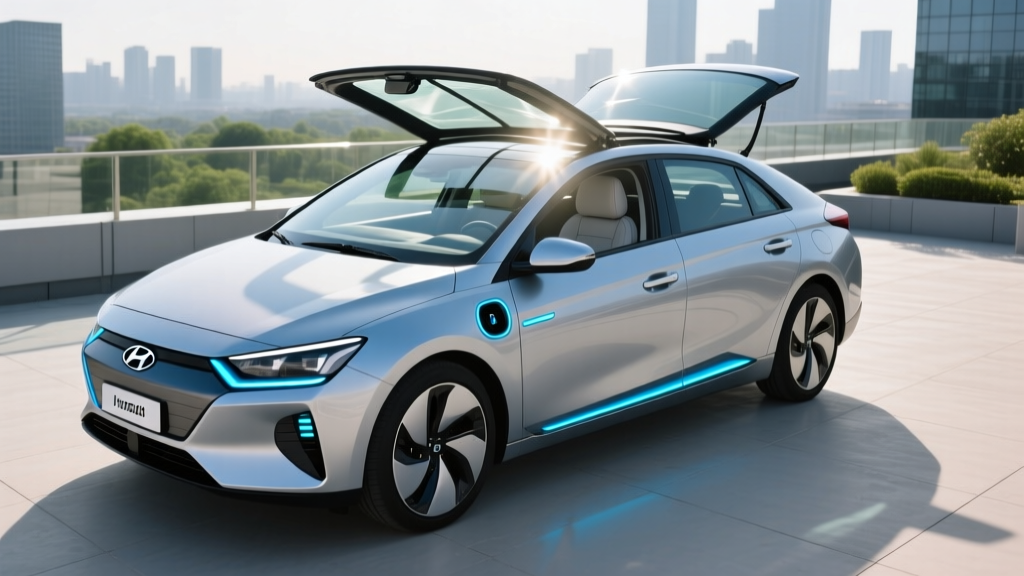
If you're shopping the 2026 Hyundai Ioniq lineup specifically for an open-roof experience, you've probably noticed the options aren't straightforward. Hyundai uses a fixed panoramic glass roof on the Ioniq 5, a traditional power tilt-slide moonroof on the Ioniq 6, and a dual-panel panoramic moonroof on the flagship Ioniq 9. Each configuration affects headroom, cabin heat load, and trim availability differently — and not every trim offers one.
This guide maps every 2026 Hyundai Ioniq model that comes with a sunroof or moonroof, pairs that with the hard EV data you need — EPA range, DC fast-charge curves, battery chemistry, and federal tax-credit eligibility — so you can decide whether the glass roof is worth the trim-level jump.
Which 2026 Hyundai Ioniq Models Have a Sunroof or Moonroof?
Hyundai segments its glass-roof offerings across three Ioniq vehicles for the 2026 model year. Here's what's standard, what's optional, and what's unavailable:
| Model | Roof Type | Trims With Roof | Standard or Optional | Opens? |
|---|---|---|---|---|
| Ioniq 5 | Fixed panoramic glass roof (vision roof) | SEL (w/ Convenience Pkg), Limited | Pkg option / Standard (Limited) | No — fixed glass |
| Ioniq 6 | Power tilt-slide moonroof | SEL (w/ Convenience Pkg), Limited | Pkg option / Standard (Limited) | Yes — tilts and slides open |
| Ioniq 9 | Dual-panel panoramic moonroof | SEL Premium, Limited, Calligraphy | Standard on all listed trims | Yes — front panel opens |
Key takeaway: If you want a roof that actually opens to let air in, the Ioniq 6 and Ioniq 9 are your options. The Ioniq 5's vision roof floods the cabin with light but is a fixed panel — it does not ventilate. This matters for cabin temperature management, which directly affects your battery thermal load and, by extension, range in hot climates.
2026 Hyundai Ioniq 5: Glass Roof, Range, and Charging
The Ioniq 5 remains Hyundai's volume EV, riding on the E-GMP platform with its 800V electrical architecture. For 2026, the model receives a refreshed battery pack and the addition of the North American Charging Standard (NACS) port natively — no adapter required at Tesla Superchargers.
| Spec | SEL AWD (w/ Convenience Pkg) | Limited AWD |
|---|---|---|
| EPA Range | 290 miles | 267 miles |
| Battery (usable) | 84.0 kWh, NMC | 84.0 kWh, NMC |
| Drivetrain | Dual-motor AWD | Dual-motor AWD |
| Horsepower | 320 hp | 320 hp |
| 0–60 mph | 4.5 sec | 4.5 sec |
| Max DC Fast Charge | 238 kW (peak) | 238 kW (peak) |
| 10–80% DC Time | ~20 min | ~20 min |
| Level 2 Home Charge | 10.9 kW (~37 mi/hr) | 10.9 kW (~37 mi/hr) |
| MPGe (combined) | 110 MPGe | 104 MPGe |
| Efficiency | 30 kWh/100 mi | 32 kWh/100 mi |
| Cargo (behind rear seats) | 27.2 cu ft | 27.2 cu ft |
| Cargo (rear seats folded) | 59.3 cu ft | 59.3 cu ft |
| Base MSRP | $50,250 | $55,400 |
Charging-curve insight: The Ioniq 5's 800V architecture lets it peak at 238 kW at a 350 kW DC fast charger, but that peak only holds between roughly 10–45% State of Charge (SoC). From 45–80%, the rate tapers to 100–150 kW. The advertised 10–80% time of ~20 minutes assumes optimal battery preconditioning — use the "charge navigation" feature in the infotainment system to warm the battery en route to the station. Without preconditioning in cold weather, add 5–10 minutes.
2026 Hyundai Ioniq 6: The Moonroof That Actually Opens
The Ioniq 6's swoopy sedan profile is the most aerodynamic vehicle Hyundai sells (drag coefficient of 0.21), and that slippery shape translates directly to range efficiency. For 2026, the Ioniq 6 also adopts the native NACS port, and its power tilt-slide moonroof is available on the SEL with the Convenience Package and standard on the Limited.
| Spec | SEL RWD (w/ Convenience Pkg) | SEL AWD (w/ Convenience Pkg) | Limited RWD |
|---|---|---|---|
| EPA Range | 361 miles | 316 miles | 342 miles |
| Battery (usable) | 77.4 kWh, NMC | 77.4 kWh, NMC | 77.4 kWh, NMC |
| Drivetrain | Single-motor RWD | Dual-motor AWD | Single-motor RWD |
| Horsepower | 225 hp | 320 hp | 225 hp |
| 0–60 mph | 6.2 sec | 4.5 sec | 6.2 sec |
| Max DC Fast Charge | 235 kW (peak) | 235 kW (peak) | 235 kW (peak) |
| 10–80% DC Time | ~18 min | ~20 min | ~18 min |
| Level 2 Home Charge | 10.9 kW (~44 mi/hr) | 10.9 kW (~37 mi/hr) | 10.9 kW (~44 mi/hr) |
| MPGe (combined) | 140 MPGe | 111 MPGe | 132 MPGe |
| Efficiency | 24 kWh/100 mi | 30 kWh/100 mi | 25 kWh/100 mi |
| Cargo (trunk) | 12.3 cu ft | 12.3 cu ft | 12.3 cu ft |
| Base MSRP | $45,200 | $49,200 | $52,850 |
Trade-off alert: The Ioniq 6's sleek roofline costs you rear headroom (37.1 inches vs. the Ioniq 5's 39.5 inches) and trunk space (12.3 cu ft vs. 27.2 cu ft). If you regularly carry adults in back or haul cargo, test-sit before committing. The moonroof mechanism further reduces front headroom by approximately 1.5 inches compared to the standard solid roof.
2026 Hyundai Ioniq 9: Three-Row SUV with Dual-Panel Moonroof
The Ioniq 9 is Hyundai's largest EV, targeting families who need three rows and serious cargo capacity. Its dual-panel panoramic moonroof is standard on the SEL Premium, Limited, and Calligraphy trims — the front panel slides open while the rear panel is fixed, creating an expansive open-air experience across both rows.
| Spec | SEL Premium AWD | Limited AWD | Calligraphy AWD |
|---|---|---|---|
| EPA Range | 311 miles | 295 miles | 288 miles |
| Battery (usable) | 110.3 kWh, NMC | 110.3 kWh, NMC | 110.3 kWh, NMC |
| Drivetrain | Dual-motor AWD | Dual-motor AWD | Dual-motor AWD |
| Horsepower | 378 hp | 378 hp | 378 hp |
| 0–60 mph | 4.9 sec | 4.9 sec | 4.9 sec |
| Max DC Fast Charge | 240 kW (peak) | 240 kW (peak) | 240 kW (peak) |
| 10–80% DC Time | ~24 min | ~24 min | ~24 min |
| Level 2 Home Charge | 10.9 kW (~32 mi/hr) | 10.9 kW (~32 mi/hr) | 10.9 kW (~32 mi/hr) |
| MPGe (combined) | 99 MPGe | 95 MPGe | 93 MPGe |
| Efficiency | 34 kWh/100 mi | 35 kWh/100 mi | 36 kWh/100 mi |
| Cargo (behind 3rd row) | 19.7 cu ft | 19.7 cu ft | 19.7 cu ft |
| Cargo (all seats folded) | 86.2 cu ft | 86.2 cu ft | 86.2 cu ft |
| Base MSRP | $62,350 | $67,500 | $72,100 |
Home charging reality: With a 110.3 kWh battery, a full Level 2 charge at 10.9 kW takes approximately 10 hours from 10% to 100%. Most owners will need a dedicated 48-amp Level 2 home charger (requiring a 60-amp circuit) to make overnight charging practical. If your home has a 100-amp electrical panel, a panel upgrade to 200 amps may be necessary — budget $1,500–$3,000 for that electrical work, per typical electrician estimates.
Federal Tax Credit Eligibility (§30D) for 2026 Ioniq Models
The IRS §30D Clean Vehicle Credit offers up to $7,500 for qualifying new EVs, but eligibility depends on MSRP caps, buyer income limits, and battery-component/critical-minerals sourcing requirements that shift annually. Here's where each Ioniq model stands for 2026:
| Model | MSRP Cap (SUV/Sedan) | Qualifies? | Key Caveat |
|---|---|---|---|
| Ioniq 5 (SUV classification) | $80,000 | Likely — up to $7,500 | Battery sourcing rules apply; confirm via dealer VIN lookup at time of purchase |
| Ioniq 6 (Sedan classification) | $55,000 | Trim-dependent | Limited trim ($52,850) qualifies; high-option builds approaching cap need verification |
| Ioniq 9 (SUV classification) | $80,000 | Likely — up to $7,500 | All trims under $80K cap; sourcing requirements must be met at delivery |
Income caps for 2026: Modified adjusted gross income (MAGI) must not exceed $300,000 (married filing jointly), $225,000 (head of household), or $150,000 (single). The credit is now transferable at point of sale, meaning you can apply it as an immediate discount on the purchase price rather than waiting for tax filing — a significant cash-flow advantage.
Battery sourcing is the wildcard. The §30D credit is split into two $3,750 halves: one for battery-component assembly (North America requirement) and one for critical-minerals sourcing (U.S. or FTA-partner countries). Hyundai has been progressively shifting Ioniq battery production to the Georgia Metaplant, but the critical-minerals half depends on supply-chain factors that can change mid-year. Always verify eligibility via the fueleconomy.gov tax credit lookup using the specific VIN before signing paperwork.
| Model & Trim | MSRP | Est. Credit | Effective Price |
|---|---|---|---|
| Ioniq 5 SEL AWD (w/ roof) | $50,250 | $7,500 | ~$42,750 |
| Ioniq 5 Limited AWD | $55,400 | $7,500 | ~$47,900 |
| Ioniq 6 SEL RWD (w/ moonroof) | $45,200 | $7,500 | ~$37,700 |
| Ioniq 6 Limited RWD | $52,850 | $7,500 | ~$45,350 |
| Ioniq 9 SEL Premium AWD | $62,350 | $7,500 | ~$54,850 |
| Ioniq 9 Calligraphy AWD | $72,100 | $7,500 | ~$64,600 |
Warranty, Tech, and Driver Assistance
Every 2026 Ioniq model carries Hyundai's strong warranty package:
- Battery warranty: 10 years / 100,000 miles (capacity retention above 70% of original)
- Powertrain warranty: 10 years / 100,000 miles
- New-vehicle limited warranty: 5 years / 60,000 miles
- Complimentary maintenance: 3 years / 36,000 miles
Tech highlights across the lineup:
- 12.3-inch dual-screen setup (digital cluster + infotainment) with wireless Apple CarPlay and Android Auto
- Hyundai Digital Key 2 (phone-as-key via NFC/UWB, shareable with family members)
- Vehicle-to-Load (V2L): 3.6 kW output — enough to power a laptop workstation, campsite, or emergency home appliances via the interior 120V outlet or exterior adapter
- Highway Driving Assist 2 (HDA2): adaptive cruise with stop-and-go, lane-centering, and lane-change assist — this is an SAE Level 2 system, meaning you must keep hands on or near the wheel and eyes on the road at all times
- Remote Smart Parking Assist (Ioniq 6 Limited, Ioniq 9 Limited/Calligraphy): the car can park and unpark itself in tight spaces while you stand outside via the key fob
How Do the Ioniq Models Compare to Key Competitors?
The sunroof/moonroof question often comes down to which vehicle in your cross-shop list offers the feature at the price point you want. Here's how the Ioniques stack up against their most common alternatives:
| Vehicle | EPA Range | Roof Option | 10–80% DC | Starting w/ Roof |
|---|---|---|---|---|
| 2026 Hyundai Ioniq 5 Limited AWD | 267 mi | Fixed panoramic glass | ~20 min (238 kW) | $55,400 |
| 2026 Tesla Model Y Long Range AWD | 320 mi | Fixed glass roof (all trims) | ~25 min (250 kW) | $48,990 |
| 2026 Ford Mustang Mach-E Premium AWD | 290 mi | Panoramic fixed glass (standard on Premium) | ~33 min (150 kW) | $51,875 |
| 2026 Hyundai Ioniq 6 SEL RWD | 361 mi | Power moonroof (w/ pkg) | ~18 min (235 kW) | $45,200 |
| 2026 BMW i4 eDrive40 (Gran Coupe) | 301 mi | Power moonroof (standard) | ~31 min (205 kW) | $57,975 |
| 2026 Kia EV9 GT-Line AWD | 280 mi | Dual panoramic moonroof | ~24 min (236 kW) | $65,390 |
Where the Ioniq wins: The Ioniq 5 and 6 charge faster than nearly every competitor thanks to the 800V architecture. Most rivals charge at 400V, meaning they peak lower and taper earlier on the charge curve. On a road trip, the Ioniq 5/6 saves you 5–15 minutes per DC fast-charge stop.
Where competitors win: The Tesla Model Y offers more EPA range at a lower price with the glass roof standard across all trims. The Kia EV9 is the Ioniq 9's closest sibling (same E-GMP platform) but undercuts on price for a similar dual-moonroof experience.
Pros and Cons: Buying an Ioniq for the Sunroof/Moonroof
Pros
- 800V charging architecture delivers 10–80% in ~18–24 minutes across the lineup
- Native NACS port for 2026 — access to 25,000+ Tesla Superchargers without an adapter
- Industry-leading 10-year/100,000-mile battery and powertrain warranty
- Ioniq 6 SEL RWD delivers 361 miles EPA at ~$37,700 after tax credit — exceptional value
- V2L capability turns any Ioniq into a mobile power source (3.6 kW)
- Ioniq 9 offers genuine three-row space with 86.2 cu ft max cargo and standard dual-panel moonroof on upper trims
- HDA2 is one of the smoothest Level 2 systems for highway commuting
Cons
- Ioniq 5's glass roof is fixed — no ventilation; cabin can get hot in summer, increasing HVAC load
- Ioniq 6 moonroof reduces front headroom by ~1.5 inches; rear headroom already tight at 37.1 inches
- Ioniq 6 trunk (12.3 cu ft) is small for a vehicle of its footprint — no hatchback versatility
- Ioniq 9's 110.3 kWh battery means 10+ hour Level 2 home charges; may require panel upgrade
- Glass/moonroof only available on mid-to-high trims — base SE models do not offer it
- Tax-credit eligibility depends on battery-sourcing rules that can change mid-year — not guaranteed
- Real-world highway and cold-weather range is 15–30% below EPA across all models
Who Should Buy a 2026 Hyundai Ioniq with a Sunroof or Moonroof?
Choose the Ioniq 5 (fixed glass roof) if: You want a practical crossover with excellent cargo space (27.2 cu ft), fast 800V charging, and a bright, airy cabin — but don't need the roof to physically open. Best for commuters and small families who road-trip 2–3 times per year.
Choose the Ioniq 6 (power moonroof) if: Range is your top priority (361 miles EPA in RWD), you prefer a sedan with a ventilating moonroof, and you rarely carry rear-seat adults or bulky cargo. Best for solo commuters and couples who want maximum efficiency.
Choose the Ioniq 9 (dual-panel moonroof) if: You need three rows, want a standard panoramic moonroof on upper trims, and can invest in a robust home charging setup. Best for families who need the space and want an open-air experience for all three rows.
Frequently Asked Questions
Does the 2026 Hyundai Ioniq 5 have a moonroof that opens?
No. The Ioniq 5 features a fixed panoramic glass roof (called a "vision roof" by Hyundai) on the SEL with the Convenience Package and on the Limited trim. It provides an expansive view of the sky and floods the cabin with natural light, but it does not tilt or slide open. If ventilation from an open roof is a priority, look at the Ioniq 6 or Ioniq 9.
What is the real-world range of the 2026 Hyundai Ioniq models with a glass roof or moonroof?
Real-world range varies by model and driving conditions. The Ioniq 5 Limited AWD (EPA 267 mi) delivers roughly 220–240 miles on highway trips and 200–230 miles in freezing weather. The Ioniq 6 SEL RWD (EPA 361 mi) achieves 300–320 miles in moderate mixed driving but drops to 270–290 at sustained highway speeds above 75 mph. The Ioniq 9 SEL Premium AWD (EPA 311 mi) provides 250–275 miles highway and 220–250 miles in cold weather. Always precondition the battery for maximum range and charging speed.
How fast do the 2026 Ioniq models charge at home and on DC fast chargers?
All three models feature Hyundai's 800V architecture. On a 350 kW DC fast charger, the Ioniq 5 peaks at 238 kW (10–80% in ~20 min), the Ioniq 6 at 235 kW (10–80% in ~18 min), and the Ioniq 9 at 240 kW (10–80% in ~24 min). At home on a Level 2 charger (10.9 kW / 48 amps), expect a full charge in approximately 7–8 hours for the Ioniq 5 and 6, and about 10 hours for the Ioniq 9's larger 110.3 kWh battery.
Do all 2026 Hyundai Ioniq models qualify for the $7,500 federal tax credit?
Eligibility depends on the specific model, trim MSRP, buyer income, and battery-sourcing requirements under IRS §30D rules. The Ioniq 5 and Ioniq 9 (classified as SUVs, $80K MSRP cap) are likely eligible across all trims. The Ioniq 6 (classified as a sedan, $55K MSRP cap) qualifies on most trims, but heavily optioned builds near the cap require verification. Buyer income must not exceed $300K (joint), $225K (head of household), or $150K (single). The credit can be transferred at point of sale as an immediate purchase discount. Verify via the IRS or fueleconomy.gov at time of purchase.
Is the Hyundai Ioniq worth buying over the Tesla Model Y or Kia EV9?
It depends on your priorities. The Ioniq 5 and 6 charge significantly faster than the Model Y and Mach-E thanks to 800V architecture, saving 5–15 minutes per road-trip stop. The Ioniq 6 offers more EPA range than any competitor in its price class. However, the Model Y offers more range at a lower price with a glass roof standard on every trim, and the Kia EV9 undercuts the Ioniq 9 on price for a similar three-row, dual-moonroof experience. Hyundai's 10-year battery warranty is a strong differentiator for long-term ownership peace of mind.
Does the glass roof or moonroof affect EV range?
Indirectly, yes. A large glass roof increases solar heat gain in summer, forcing the HVAC system to work harder to cool the cabin — this can reduce range by 2–5% in hot, sunny conditions. Hyundai uses tinted, UV-filtering glass to mitigate this, and the Ioniq's heat pump (standard on all trims) helps manage cabin temperature efficiently. In winter, the glass roof can increase heat loss slightly compared to an insulated metal roof, but the effect is minor compared to the overall impact of cold temperatures on battery chemistry (20–30% range reduction in freezing weather regardless of roof type).
What's the difference between kW and kWh on these spec sheets?
kW (kilowatts) measures power — how fast energy flows. On a DC fast charger, a higher kW number means faster charging. kWh (kilowatt-hours) measures energy capacity — how much total energy the battery holds. Think of kW as the width of a hose and kWh as the size of the bucket. The Ioniq 9 has a 110.3 kWh bucket (big battery, long range) and can accept up to 240 kW through the hose (fast fill rate).
Sources: fueleconomy.gov (EPA range and efficiency data), IRS.gov (§30D Clean Vehicle Credit rules), Hyundai USA official specifications. Pricing and tax-credit eligibility reflect 2026 model-year data available at time of publication and are subject to change. Consult a tax professional for personal credit eligibility.