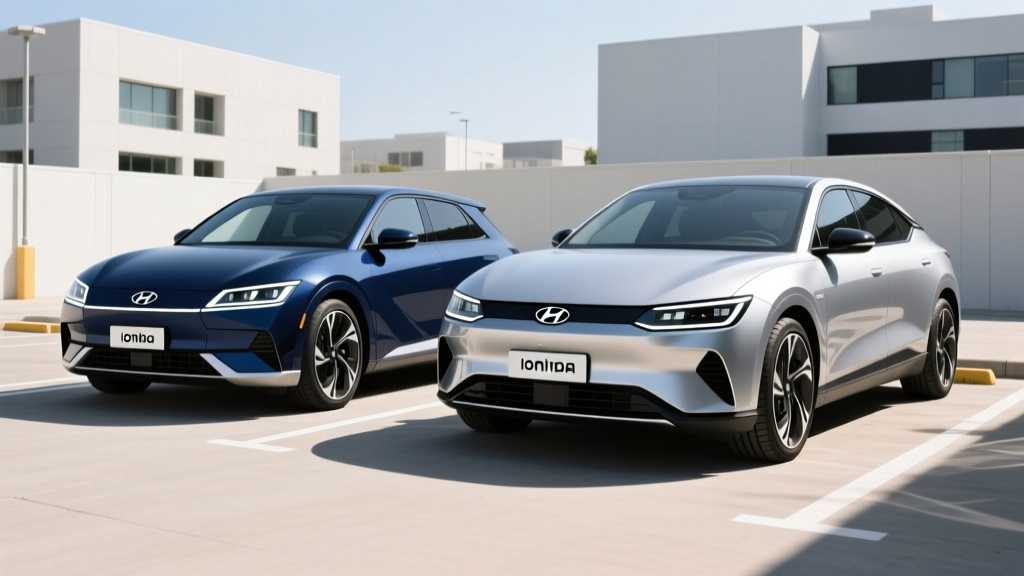
If you've been searching for Hyundai Ioniq lease deals, you've likely hit a wall of conflicting information: manufacturer incentives that change monthly, federal tax credit pass-through rules, and two very different vehicles sharing the same nameplate. The Ioniq lineup in 2026 includes the crossover-styled Ioniq 5 and the aerodynamic sedan Ioniq 6, both riding on Hyundai's E-GMP 800V architecture. Both are compelling, but they serve different use cases and carry different lease economics.
This guide breaks down the real-world numbers — range, charging, pricing, and total monthly cost — so you can decide which Ioniq lease makes financial sense for your driving pattern.
Which Hyundai Ioniq Are We Talking About?
Hyundai's "Ioniq" badge now spans multiple body styles. As of the 2026 model year, the two core models available for lease in the U.S. are:
- Ioniq 5 — A midsize crossover SUV with retro-futuristic styling, available in RWD and AWD configurations. The high-performance Ioniq 5 N is also available but targets a niche audience.
- Ioniq 6 — A sleek, low-slung sedan optimized for aerodynamic efficiency, also available in RWD and AWD.
The original Ioniq hatchback (hybrid/PHEV/EV) was discontinued after the 2022 model year. If you see "Ioniq" lease ads referencing a hatchback, they're likely leftover inventory or third-party used leases. The Ioniq 7 three-row SUV remains announced but is not yet available for order as of early 2026.
Side-by-Side Specs: Ioniq 5 vs Ioniq 6 (2026)
| Spec | Ioniq 5 (RWD Long Range) | Ioniq 5 (AWD Long Range) | Ioniq 6 (RWD Long Range) | Ioniq 6 (AWD Long Range) |
|---|---|---|---|---|
| EPA Range | 303 mi | 260 mi | 361 mi | 316 mi |
| Battery (usable) | 77.4 kWh, NMC | 77.4 kWh, NMC | 77.4 kWh, NMC | 77.4 kWh, NMC |
| Horsepower | 168 hp | 320 hp | 168 hp | 320 hp |
| 0–60 mph | 7.4 sec | 5.0 sec | 7.1 sec | 5.1 sec |
| Drivetrain | RWD single motor | AWD dual motor | RWD single motor | AWD dual motor |
| Combined MPGe | 114 MPGe | 101 MPGe | 140 MPGe | 120 MPGe |
| Efficiency (kWh/100 mi) | 30 | 33 | 24 | 28 |
| Peak DC Fast Charge | ~240 kW | ~240 kW | ~240 kW | ~240 kW |
| 10–80% DCFC Time | ~18 min | ~18 min | ~18 min | ~18 min |
| Level 2 Home Charge | 10.9 kW (~36 mi/hr) | 10.9 kW (~36 mi/hr) | 10.9 kW (~44 mi/hr) | 10.9 kW (~44 mi/hr) |
| Cargo Volume | 27.2 cu ft (rear up) / 59.3 cu ft (folded) | 27.2 / 59.3 cu ft | 12.3 cu ft trunk + 0.5 cu ft frunk | 12.3 cu ft + 0.5 cu ft frunk |
| Rear Legroom | 39.4 in | 39.4 in | 35.1 in | 35.1 in |
| Base MSRP | $42,600 | $46,600 | $37,500 | $42,500 |
| Battery/Powertrain Warranty | 10 yr / 100,000 mi | 10 yr / 100,000 mi | 10 yr / 100,000 mi | 10 yr / 100,000 mi |
Source: fueleconomy.gov and Hyundai USA. Specs reflect 2026 model year Long Range trims. Standard-range Ioniq 5 (58 kWh battery, ~220 mi EPA) also available at lower MSRP.
Real-World Range: What the EPA Sticker Doesn't Tell You
Ioniq 6 RWD Long Range: EPA 361 mi → Expect ~310–330 mi highway, ~270–290 mi in cold weather.
AWD models: Subtract ~30–40 mi from the above due to higher energy consumption.
The Ioniq 6's teardrop shape gives it a significant efficiency advantage — its 0.21 drag coefficient translates directly to more miles per kWh, especially at highway speeds where aerodynamic drag dominates. On a 250-mile road trip at 75 mph in mild weather, the Ioniq 6 RWD can arrive with roughly 60 miles of buffer remaining; the Ioniq 5 RWD will arrive with closer to 20–30 miles.
In cold climates (below freezing), both vehicles lose 20–30% of their EPA range due to battery heating demands and cabin climate load. Hyundai includes a battery preconditioning feature that warms the pack when you navigate to a DC fast charger, which helps recover some charging speed in cold weather — but it does not fully offset range loss. If you live in the Upper Midwest or Northeast, budget for the cold-weather figure, not the sticker.
Charging Speed: 800V Architecture Done Right
Both Ioniq models use Hyundai's E-GMP platform with native 800V electrical architecture, which allows them to accept DC fast-charge rates that most competitors still can't match. Here's what that looks like in practice:
| Charge Level | Power (kW) | Speed (mi/hr added) | Typical Use Case |
|---|---|---|---|
| Level 1 (120V household) | ~1.4 kW | ~4–5 mi/hr | Emergency / overnight trickle |
| Level 2 (240V home, 48A) | 10.9 kW | 36–44 mi/hr | Daily home charging (~7–8 hr for full) |
| DC Fast Charge (350 kW station) | Peak ~240 kW | ~150–180 mi/hr (10–40%) | Road trips; 10–80% in ~18 min |
| DC Fast Charge (150 kW station) | ~130–145 kW sustained | ~90–110 mi/hr | Common public chargers; 10–80% in ~25 min |
The charging curve matters more than peak kW. The Ioniq 5 and 6 can hit ~240 kW on a 350 kW charger, but only between roughly 10–40% state of charge. Above 50%, the rate tapers to ~150 kW; above 80%, it drops further to ~50–60 kW to protect the NMC cells. On a road trip, plan your stops around 10–80% charges (~18 minutes) rather than topping off to 100%, which can take over 45 minutes total.
For home charging, a Level 2 wallbox (240V, 48-amp circuit) will fully replenish either vehicle overnight. A typical Level 2 installation runs $800–$2,000 including electrician labor, depending on whether your panel needs an upgrade to support a 60-amp dedicated circuit.
Pricing, Lease Deals, and Tax Credit Math
Leasing an Ioniq in 2026 involves three overlapping financial layers: the manufacturer's lease offer, Hyundai's dealer incentives, and the federal EV tax credit (§30D) which can be passed through to the lessee.
| Model / Trim | Base MSRP | Est. Monthly Lease (before credit) | §30D Credit (passed through) | Effective Monthly (after credit) |
|---|---|---|---|---|
| Ioniq 5 SE RWD (Std Range) | $42,600 | ~$450 | $0–$7,500* | ~$240–$450 |
| Ioniq 5 SEL AWD | $49,100 | ~$530 | $0–$7,500* | ~$320–$530 |
| Ioniq 6 SE RWD | $37,500 | ~$380 | $0–$7,500* | ~$170–$380 |
| Ioniq 6 SEL AWD | $45,000 | ~$470 | $0–$7,500* | ~$260–$470 |
*Federal tax credit amounts vary based on battery sourcing compliance and buyer income. See eligibility checklist below. Lease payments are estimates based on typical money factors and residuals for well-qualified lessees; dealer offers vary by region.
Federal §30D Tax Credit Eligibility Checklist
- MSRP cap: Vans/SUVs/pickups ≤ $80,000; sedans ≤ $55,000. (Ioniq 6 sedan must be under $55K — all current trims qualify. Ioniq 5 classified as SUV — all trims qualify.)
- Buyer income cap (modified AGI): $300K joint / $225K head of household / $150K single.
- Battery component sourcing: Must meet North American assembly and critical-mineral thresholds per IRS §30D rules. As of 2026, Hyundai's Georgia-built Ioniq 5 meets battery assembly requirements; critical-mineral sourcing may qualify for $3,750 of the total $7,500. Confirm with your dealer.
- Lease pass-through: Under the commercial clean vehicle credit (§45W), lessors may claim the credit and pass savings as a capitalized-cost reduction. This can sometimes bypass the §30D sourcing restrictions, making leased Ioniqs eligible for the full $7,500 even if a purchased equivalent is not. Ask the dealer how the credit is applied.
- Point-of-sale transfer: For purchases (not leases), the credit can be transferred to the dealer at sale for an immediate price reduction. Lease structures vary — confirm in writing how the incentive reduces your payment.
Lease vs. buy decision: Leasing currently offers a strategic advantage for Hyundai Ioniqs. Because the §45W commercial credit applies to the lessor (Hyundai Motor Finance or a bank), the full $7,500 can be applied even when the vehicle's battery sourcing doesn't fully qualify under §30D purchase rules. This "lease loophole" remains active in 2026, though Congress has proposed closing it. Consult a tax professional for your specific situation.
Who Should Lease Which Ioniq?
Choose the Ioniq 5 if:
- You need cargo versatility (27.2 cu ft behind rear seats, hatchback-style opening)
- You want higher seating position and easier ingress/egress
- You plan to install a roof rack or carry bulky gear
- You prefer crossover styling and don't mind a ~60-mile range penalty vs the 6
Choose the Ioniq 6 if:
- Maximum range is your priority (361 mi EPA in RWD — best-in-class for sedans)
- You commute long distances on highways where aero efficiency matters most
- You want the lowest monthly lease payment (lower MSRP + better efficiency = cheaper to operate)
- You rarely need to haul large cargo (12.3 cu ft trunk is tight)
Use-Case Matchup
- Daily commuter (under 60 mi round trip): Either model works; the Ioniq 6 SE RWD at ~$170/month effective lease is a standout value.
- Family with kids: Ioniq 5 — the 39.4 inches of rear legroom and wide-opening rear doors beat the 6's tighter cabin.
- Road-trip enthusiast: Ioniq 6 RWD for range, but note that its sedan trunk limits gear. The Ioniq 5 AWD is the pragmatic road-tripper despite lower range.
- Towing: Neither is rated for serious towing. The Ioniq 5 AWD has a 1,650-lb tow rating (braked) — enough for a small utility trailer, not a boat.
Pros and Cons: The Honest Summary
Pros
- 800V architecture delivers genuine 18-min 10–80% DC fast charges at 350 kW stations
- Ioniq 6 achieves 140 MPGe combined — among the most efficient EVs on sale
- Class-leading 10-year/100,000-mile battery and powertrain warranty
- Lease loophole can unlock full $7,500 federal credit regardless of battery sourcing
- Standard Hyundai SmartSense suite (AEB, lane-keeping, adaptive cruise) across trims
- Vehicle-to-load (V2L) capability — power a laptop, TV, or campsite from the car's battery
- Ioniq 5 crossover practicality with genuine 59 cu ft cargo space
Cons
- Ioniq 6 trunk is small (12.3 cu ft) and the sloping roofline limits usability
- No NACS (Tesla) charge port from factory — CCS1 only; NACS adapter required for Superchargers
- Infotainment uses Hyundai's older UI; functional but less polished than Tesla or Rivian
- Highway range drops noticeably in cold weather (20–30% loss is real)
- AWD models lose significant range for modest traction gains in most climates
- Rear visibility in Ioniq 6 is compromised by the fastback design — rely on the backup camera
- Insurance premiums run 15–25% higher than comparable gas crossovers (varies by state and driver profile)
Tech, Driver Assistance, and Interior
Both Ioniq models come with a 12.3-inch digital instrument cluster and 12.3-inch infotainment touchscreen running Hyundai's connected navigation system. Wireless Apple CarPlay and Android Auto are standard. Over-the-air (OTA) updates keep the software current without dealer visits.
Driver assistance: Hyundai's Highway Driving Assist 2 (HDA2) is a SAE Level 2 system — it handles lane centering and adaptive cruise on divided highways, but requires continuous driver supervision. It is not self-driving. Unlike Ford's BlueCruise or GM's Super Cruise, HDA2 does not support hands-off operation on mapped highways. Your hands must remain on the wheel.
Unique features:
- V2L (Vehicle-to-Load): An interior 120V outlet and exterior V2L adapter let you draw up to 3.6 kW from the traction battery — enough to power a campsite, tailgate, or emergency home appliances.
- Digital key: Use your smartphone (NFC + UWB) to unlock and start the car, and share access with family members.
- Relaxation seats (Limited trim): Front seats with powered leg rests and recline for charging-stop naps.
- Heat pump (standard on Long Range): Improves cold-weather range by 5–10% compared to resistive cabin heating by scavenging waste heat from the drivetrain.
Is an Ioniq Lease Worth It vs the Competition?
At these effective monthly rates, the Ioniq 5 and 6 compete directly with the Tesla Model Y, Ford Mustang Mach-E, Chevrolet Equinox EV, and Volkswagen ID.4. Here's how they stack up on the metrics that matter:
- vs Tesla Model Y (LR AWD, ~$44,990 MSRP): The Model Y has NACS native access to the Supercharger network, slightly more cargo space, and faster OTA updates. The Ioniq 5 counters with a longer warranty (10yr vs 4yr/50K basic), V2L, and often lower effective lease rates thanks to the §45W pass-through.
- vs Ford Mustang Mach-E (ER RWD, ~$42,995 MSRP): The Mach-E offers sportier driving dynamics and Ford's BlueCruise hands-off highway driving. The Ioniq 5 charges faster (18 min vs ~30 min 10–80%) and has better real-world efficiency.
- vs Chevrolet Equinox EV (3RS, ~$41,900 MSRP): The Equinox EV offers 319 miles EPA and NACS native, but charges slower on DCFC and lacks the Ioniq 5's cargo versatility and V2L.
- vs Volkswagen ID.4 (Pro S, ~$43,995 MSRP): The ID.4 is a competent, roomy crossover but its peak DC charge rate (~175 kW) and 10–80% time (~28 min) lag the Ioniq 5 significantly.
Bottom line: If you prioritize charging speed, efficiency, warranty coverage, and low lease cost, the Ioniq lineup is among the strongest values in the 2026 EV market. If native Supercharger access or hands-off driving assist is non-negotiable, look to Tesla or Ford respectively.
Frequently Asked Questions
What is the real-world range of the Hyundai Ioniq 5 and Ioniq 6?
The Ioniq 5 RWD Long Range is EPA-rated at 303 miles, but expect 260–280 miles in real highway driving at 70–80 mph and 220–240 miles in freezing temperatures. The Ioniq 6 RWD Long Range is EPA-rated at 361 miles, with real-world highway range of 310–330 miles and cold-weather range of 270–290 miles. AWD variants lose roughly 30–40 miles from these figures.
How fast does the Ioniq charge at home and on the road?
On a 350 kW DC fast charger, both models peak at ~240 kW and charge from 10–80% in approximately 18 minutes. At a more common 150 kW public charger, expect 10–80% in roughly 25 minutes. At home on a Level 2 (240V, 48A) wallbox, the onboard charger accepts 10.9 kW, adding about 36 miles per hour of charging in the Ioniq 5 and 44 miles per hour in the Ioniq 6 — enough for a full overnight charge.
How much does an Ioniq lease cost after tax credits?
With the §45W commercial credit pass-through (up to $7,500 applied as a cap-cost reduction), effective monthly lease payments for a 36-month term can range from roughly $170/month for an Ioniq 6 SE RWD to $320/month for an Ioniq 5 SEL AWD, depending on your region, dealer incentives, and credit tier. Always confirm in writing how the dealer applies the federal credit to your lease.
Does the Hyundai Ioniq qualify for the $7,500 federal EV tax credit?
Eligibility depends on the credit pathway. For purchases under §30D, the Ioniq must meet MSRP caps (all trims qualify), buyer income limits, and battery-sourcing requirements (which may limit the credit to $3,750 depending on critical-mineral compliance). For leases under §45W, the lessor claims the credit and can pass the full $7,500 to you as a lease incentive — often bypassing sourcing restrictions. Consult IRS guidance and your dealer for current-year specifics.
Is the Hyundai Ioniq worth leasing vs buying?
Leasing is often the smarter financial move for an Ioniq in 2026 because: (1) the §45W lease loophole can unlock the full $7,500 credit even when purchase sourcing rules limit it, (2) EV depreciation remains uncertain, and a 36-month lease lets you exit without resale risk, and (3) Hyundai's generous warranty covers most of the lease term anyway. If you drive over 15,000 miles/year or want to keep the car 8+ years, buying may still make sense — but run the numbers with your dealer's finance office.
Can I use Tesla Superchargers with a Hyundai Ioniq?
Not natively. The Ioniq 5 and 6 use the CCS1 connector. Hyundai offers a NACS adapter (sold separately, ~$200–$300) that enables access to Tesla's V3 and V4 Supercharger stalls equipped with the Magic Dock or CCS-compatible connectors. Hyundai has announced a transition to native NACS ports for future model years, but 2026 Ioniqs still ship with CCS1.
What is the battery warranty on the Hyundai Ioniq?
Hyundai covers the Ioniq 5 and 6 battery pack and electric powertrain for 10 years or 100,000 miles, whichever comes first. The warranty guarantees the battery will retain at least 70% of its original capacity during the coverage period. This is among the longest EV battery warranties in the U.S. market, and it aligns closely with a typical 36-month lease term, meaning battery degradation is the lessor's problem, not yours.