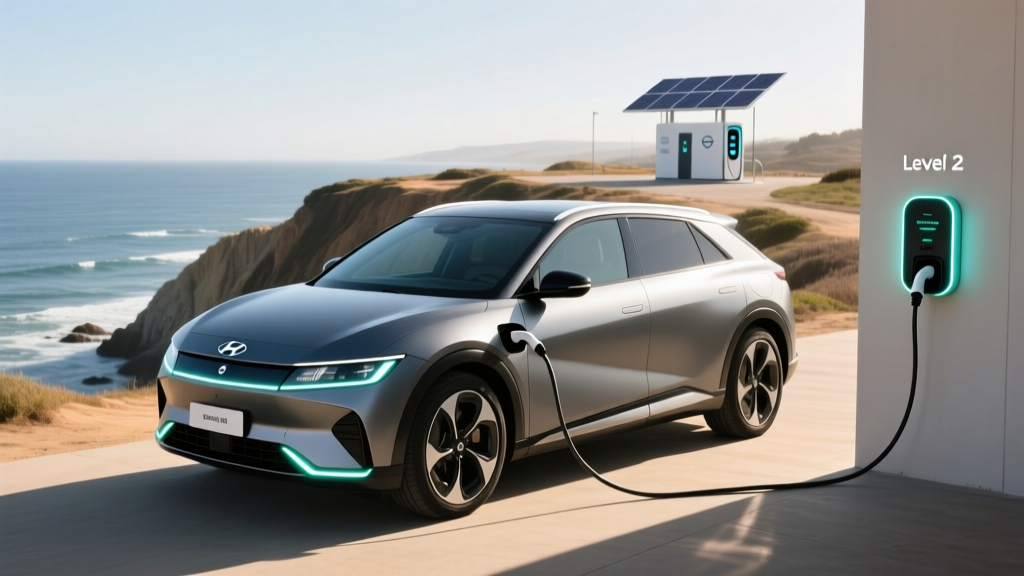
The Hyundai Ioniq 9 arrives for the 2025 model year as the flagship of Hyundai's dedicated electric lineup, and by the 2026 model year it has settled into its role as a three-row, full-size electric SUV built on the E-GMP platform. With seating for up to seven, a large battery pack, and Hyundai's signature 800-volt architecture enabling ultra-fast DC charging, the Ioniq 9 targets families who need serious passenger and cargo space without the compromises that often plague large EVs. We spent time with the 2026 Hyundai Ioniq 9 SUV to evaluate its real-world range, charging behavior, ownership costs, and how it stacks up against the Kia EV9, Tesla Model X, and Rivian R1S.
Quick Verdict: Who the Ioniq 9 Is For
The 2026 Ioniq 9 is best suited for families and long-distance commuters who prioritize cabin space, three-row comfort, and fast DC charging above outright performance. If you need a six- or seven-seat EV that can add meaningful range during a 20-minute road-trip stop, this is one of the strongest options on the market. It is less ideal for buyers who want sports-SUV acceleration or who lack access to high-power DC fast chargers, since the 800V architecture's benefits are fully realized only at 350-kW stations.
Consider alternatives if: You prioritize 0–60 performance under 4 seconds, want a NACS port without an adapter, or need maximum off-road capability (look at the Rivian R1S).
Range, Battery, and Efficiency
The 2026 Hyundai Ioniq 9 SUV is powered by a 110.3-kWh (total) battery pack using NMC (nickel manganese cobalt) chemistry, yielding approximately 104.0 kWh of usable capacity. Hyundai pairs this large pack with its fourth-generation electric drivetrain to deliver competitive efficiency for a vehicle of this size.
| Spec | SE/SEL (RWD) | Limited / AWD |
|---|---|---|
| EPA Est. Range | 311 mi | 280 mi |
| Battery (Usable/Total) | ~104 / 110.3 kWh (NMC) | ~104 / 110.3 kWh (NMC) |
| Efficiency (MPGe) | ~89 MPGe combined | ~82 MPGe combined |
| Drivetrain | Single-motor RWD, 215 hp | Dual-motor AWD, 378 hp |
| 0–60 mph | ~7.6 sec | ~4.9 sec |
| Max DC Fast Charge | ~240 kW (peak) | ~240 kW (peak) |
| 10–80% DC Charge | ~24 min (350-kW station) | ~24 min (350-kW station) |
| Level 2 Charge Rate | 10.9 kW (~31 mi/hr) | 10.9 kW (~31 mi/hr) |
| Base MSRP | ~$52,095 | ~$66,595 |
Efficiency is measured at approximately 34–38 kWh per 100 miles depending on trim and driving conditions. For a three-row SUV, this is competitive — the Kia EV9 returns similar figures, while the heavier Rivian R1S typically consumes 40–48 kWh/100mi.
Charging Speed: DC Fast and Level 2 Home Charging
The Ioniq 9 uses Hyundai's E-GMP 800-volt architecture, which enables rapid DC fast charging when paired with a compatible high-power station. The vehicle uses a CCS1 connector natively (a NACS adapter is available for Tesla Supercharger access).
| Level | Power | Speed | Notes |
|---|---|---|---|
| Level 1 (120V) | ~1.4 kW | ~3–4 mi/hr | Emergency/trickle only; full charge in 70+ hours |
| Level 2 (240V) | 10.9 kW | ~31 mi/hr | Full 10–100% in ~10–11 hours; ideal overnight |
| DC Fast (350 kW station) | ~240 kW peak | 10–80% in ~24 min | Sustained rate tapers above 60% SoC; preconditioning recommended |
| DC Fast (150 kW station) | ~130 kW avg | 10–80% in ~38 min | More common station type; still viable for road trips |
The 800V architecture's real advantage is sustained charge rate. While some 400V competitors hit a peak kW figure and immediately taper, the Ioniq 9 holds near-peak power from roughly 10% to 55% SoC before gradually stepping down. Battery preconditioning activates automatically when you navigate to a DC fast charger in the infotainment system, warming the pack for optimal charge acceptance — this is critical in cold weather and can shave 5–10 minutes off your session.
For home charging, a 48-amp Level 2 wallbox on a 60-amp circuit delivers the full 10.9 kW. A complete overnight charge from near-empty takes roughly 10–11 hours. Most owners charging from 20–80% overnight will need only 6–7 hours. Installation costs for a Level 2 home charger typically range from $800 to $2,500 depending on panel capacity and conduit run — consult a licensed electrician for a site-specific quote.
Performance, Drivetrain, and Ride Quality
The 2026 Ioniq 9 offers two powertrain configurations. The base single-motor RWD produces 215 horsepower and 258 lb-ft of torque, achieving a 0–60 mph time of approximately 7.6 seconds. This is adequate for daily driving and highway merging, though the 5,000+ lb curb weight is noticeable during quick lane changes.
The dual-motor AWD variant combines front and rear motors for a total of 378 horsepower and 446 lb-ft of torque, dropping the 0–60 time to approximately 4.9 seconds. Hyundai's HTRAC AWD system distributes torque between axles dynamically, providing confident traction in rain and light snow. The Ioniq 9 is not designed for serious off-roading — ground clearance is moderate at approximately 7.1 inches, and there is no dedicated off-road drive mode.
Ride quality is a strong point. The rear multi-link suspension and available electronically controlled dampers absorb highway imperfections well, and cabin noise is low thanks to acoustic laminated glass on the front rows. Regenerative braking offers four levels adjustable via steering-wheel paddles, including an i-Pedal mode for one-pedal driving in city traffic.
Interior Space, Cargo, and Technology
The Ioniq 9's cabin is its strongest selling point. Hyundai offers both six-seat (2+2+2 with second-row captain's chairs) and seven-seat (2+3+2 with a second-row bench) configurations. Second-row legroom is generous at approximately 39.4 inches, while the third row accommodates adults on shorter trips with roughly 31.0 inches of legroom — tight for anyone over 5'8" on long drives.
Cargo volume measures approximately 21.0 cubic feet behind the third row, 44.0 cubic feet with the third row folded, and up to 80.0 cubic feet with both rear rows down. A modest front trunk (frunk) adds about 1.6 cubic feet of lockable storage — useful for charging cables but not much more.
Technology highlights include a dual 12.3-inch curved display cluster running Hyundai's latest infotainment software, wireless Apple CarPlay and Android Auto, a head-up display with augmented-reality navigation (on Limited trims), and over-the-air software updates. The available Highway Driving Assist 2 (HDA2) system provides SAE Level 2 driver assistance with lane-centering, adaptive cruise, and lane-change assist — but it requires continuous driver supervision and is not a self-driving system.
Pricing, Trims, and Federal Tax Credit Eligibility
The 2026 Hyundai Ioniq 9 is offered in four primary trims. Pricing below reflects base MSRP including destination charge but before any incentives:
| Trim | Drivetrain | MSRP | Est. After §30D Credit* |
|---|---|---|---|
| SE Standard Range | RWD | ~$46,595 | ~$39,095 |
| SE (Long Range) | RWD | ~$52,095 | ~$44,595 |
| SEL | AWD | ~$58,595 | ~$51,095 |
| Limited | AWD | ~$66,595 | ~$59,095 |
| Calligraphy | AWD | ~$71,095 | ~$63,595 |
*Tax credit estimates assume full $7,500 eligibility under IRS §30D. Actual eligibility depends on buyer income, battery sourcing, and MSRP caps. Verify current rules at IRS.gov and consult a tax professional.
- MSRP Cap: SUVs/vans must have an MSRP ≤ $80,000 to qualify — all Ioniq 9 trims currently meet this threshold.
- Buyer Income Cap: Modified AGI must not exceed $150,000 (single), $225,000 (head of household), or $300,000 (joint filers).
- Battery Sourcing: A percentage of critical minerals and battery components must be sourced from the U.S. or FTA partners — Hyundai has shifted significant battery production to the Georgia plant, improving eligibility for many trims.
- Point-of-Sale Transfer: As of 2024+, eligible buyers can transfer the credit to the dealer at purchase, reducing the upfront price rather than waiting for a tax refund.
Warranty and Ownership Costs
Hyundai backs the Ioniq 9 with one of the strongest warranty packages in the EV segment:
- Battery: 10 years / 100,000 miles (capacity retention above 70%)
- Powertrain: 10 years / 100,000 miles
- New Vehicle: 5 years / 60,000 miles
- Roadside Assistance: 5 years / unlimited miles
- Complimentary Maintenance: 3 years / 36,000 miles
For comparison, Tesla offers 8 years/120,000 miles on the Model X battery, and Kia matches Hyundai's 10/100k on the EV9. The 10-year coverage provides meaningful peace of mind for buyers concerned about long-term battery degradation.
Estimated 5-year total cost of ownership for the Ioniq 9 SEL AWD, assuming 15,000 miles/year, home charging at $0.14/kWh, and standard insurance rates, falls in the $52,000–$58,000 range including depreciation, energy, insurance, and maintenance — competitive with a comparably equipped gas SUV when the $7,500 federal credit is applied.
Ioniq 9 vs. Key Competitors
| Attribute | Hyundai Ioniq 9 | Kia EV9 | Rivian R1S |
|---|---|---|---|
| Max EPA Range | 311 mi | 304 mi | 410 mi (Max Pack) |
| 10–80% DC Charge | ~24 min | ~24 min | ~30 min |
| Starting MSRP | ~$46,595 | ~$54,900 | ~$79,900 |
| Battery Warranty | 10yr/100k mi | 10yr/100k mi | 8yr/175k mi |
| Third-Row Usability | Good (short trips) | Good | Tight |
| Towing Capacity | ~3,500 lb | ~5,000 lb | ~7,700 lb |
Pros and Cons
- Ultra-fast DC charging (10–80% in ~24 min at 350 kW)
- Spacious, well-finished interior with genuine three-row seating
- Industry-leading 10-year/100k-mile battery and powertrain warranty
- Competitive pricing; all trims under the $80k §30D MSRP cap
- Standard heat pump for cold-weather efficiency
- Comfortable ride quality with low cabin noise
- RWD base model is underpowered for a vehicle this heavy
- Third-row legroom is tight for adults on long trips
- CCS1 port requires adapter for Tesla Supercharger access
- Towing capacity (~3,500 lb) trails the EV9 and R1S
- Frunk is very small (1.6 cu ft)
- Real-world highway range drops noticeably from EPA estimates
Frequently Asked Questions
What is the real-world range of the 2026 Hyundai Ioniq 9?
The EPA rates the RWD Ioniq 9 at 311 miles and the AWD at 280 miles. In real-world highway driving, expect 260–275 miles (RWD) or 235–250 miles (AWD). Cold weather can reduce these figures by 20–30%. Plan conservatively for road trips and use the vehicle's route planner to pre-plan charging stops.
How fast does the Ioniq 9 charge at home and on the road?
At a 350-kW DC fast charger, the Ioniq 9 charges from 10% to 80% in approximately 24 minutes, peaking near 240 kW. On a home Level 2 charger (10.9 kW), it adds roughly 31 miles of range per hour, with a full charge taking 10–11 hours. A standard 120V outlet provides only 3–4 miles per hour — not practical for daily use.
Does the 2026 Ioniq 9 qualify for the $7,500 federal EV tax credit?
Most trims of the Ioniq 9 are expected to qualify for the full $7,500 federal tax credit under IRS §30D, as all trims fall below the $80,000 SUV MSRP cap and Hyundai has shifted battery manufacturing to the U.S. (Georgia). However, eligibility depends on your income (capped at $150k single / $300k joint), battery sourcing percentages, and current-year IRS rules. Always verify at IRS.gov before purchasing.
Is the Ioniq 9 worth buying over the Kia EV9 or Rivian R1S?
The Ioniq 9 wins on value — it undercuts the EV9 on price while sharing the same excellent 800V charging platform and offering comparable range. The EV9 offers slightly more towing capacity (5,000 vs. 3,500 lb). The Rivian R1S is a premium, adventure-oriented alternative with superior towing (7,700 lb) and off-road capability, but starts above $79,000 and may not qualify for the full federal credit on all trims. For most families prioritizing daily comfort and fast road-trip charging, the Ioniq 9 is the strongest value proposition in this segment.
What is the biggest drawback of the Ioniq 9?
The most common complaint is that the base RWD powertrain feels underpowered for a 5,000+ lb vehicle. If you frequently carry a full load of passengers and cargo, or drive in mountainous terrain, the AWD dual-motor variant is strongly recommended. The other notable limitation is the small frunk and modest towing capacity compared to competitors.
What connector does the Ioniq 9 use?
The Ioniq 9 uses a CCS1 connector for DC fast charging and a J1772 inlet for Level 2 AC charging. Hyundai offers a NACS adapter for access to Tesla Supercharger stations, but native NACS integration is expected in future model years. At home, any standard J1772 Level 2 wallbox will work.
Sources: EPA fueleconomy.gov, Hyundai Newsroom, IRS §30D Clean Vehicle Credits. Pricing and credit eligibility reflect 2026 model year data and are subject to change. Confirm all figures with your dealer and tax professional before purchasing.