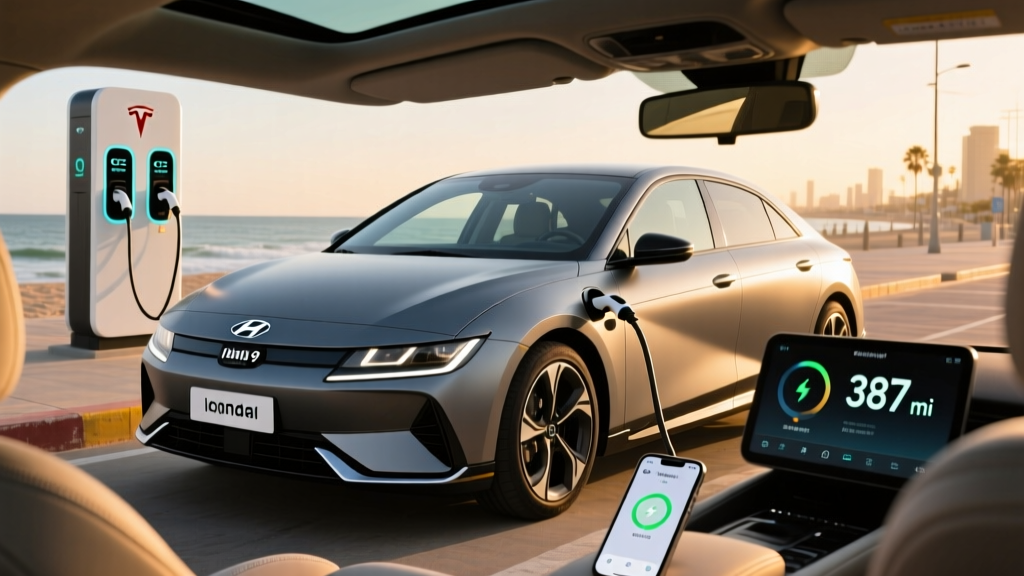
The three-row electric SUV segment has been crowded by the Kia EV9, Tesla Model X, and Rivian R1S, but Hyundai's flagship E-GUN platform entry demands attention. The 2026 Hyundai Ioniq 9 brings a massive 110.3 kWh battery, ultra-fast 800V charging architecture, and genuine seven-passenger space to the table. Below, we break down every Ioniq 9 spec that matters — from real-world range expectations to the nuances of its federal tax credit eligibility — so you can decide if this is the right electric family hauler for your driveway.
2026 Hyundai Ioniq 9 Spec Sheet at a Glance
| Specification | SE / SEL (RWD) | SEL AWD | Calligraphy AWD |
|---|---|---|---|
| EPA Range | 335 miles | 305 miles | 290 miles |
| Battery (Usable) | 110.3 kWh, NMC (Nickel Manganese Cobalt) | ||
| Horsepower | 215 hp | 379 hp | 379 hp |
| 0–60 mph | 7.8 sec | 5.2 sec | 5.2 sec |
| Drivetrain | RWD (single motor) | AWD (dual motor) | AWD (dual motor) |
| Peak DC Fast Charge | 350 kW (800V architecture) | ||
| 10–80% DC Charge Time | ~24 minutes (at 350 kW station) | ||
| Level 2 Home Charge Rate | 10.9 kW (~35 miles/hr) | ||
| MPGe (Combined) | 89 MPGe | 83 MPGe | 80 MPGe |
| kWh/100 mi | 34 kWh | 40 kWh | 42 kWh |
| Base MSRP | $51,900 | $58,400 | $71,900 |
| Battery/Powertrain Warranty | 10 years / 100,000 miles | ||
Range and Efficiency: EPA vs. the Real World
Real-World Expectation: Plan for ~270–295 miles on mixed highway driving in the RWD model. Sustained 75+ mph highway speeds reduce efficiency to roughly 2.4–2.6 mi/kWh. In cold weather (below 30°F), expect a 15–25% reduction — putting the RWD at roughly 250–280 usable miles before you'll want to find a charger.
The Ioniq 9's 110.3 kWh NMC battery pack is among the largest in the segment, and that capacity shows on the EPA sticker. The RWD SE's 335-mile rating beats the Kia EV9 Long Range AWD (279 miles) and slots in near the Rivian R1S Max Pack (352 miles, at a significantly higher price point).
Efficiency is where physics works against a 5,500-pound three-row SUV. The RWD model's 89 MPGe combined translates to 34 kWh per 100 miles — reasonable for the class but noticeably thirstier than a two-row crossover like the Ioniq 5 (101 MPGe). The AWD Calligraphy, weighted down by extra luxury equipment and larger 21-inch wheels, drops to 80 MPGe. If most of your driving is suburban and below 65 mph, you'll likely meet or exceed EPA estimates. If your routine involves mountain passes or sustained interstate speeds, budget for the lower real-world figure.
The Ioniq 9 does come equipped with a standard heat pump, which helps mitigate cold-weather range loss compared to vehicles without one. Hyundai's thermal management system also includes battery preconditioning — when you route to a DC fast charger via the navigation system, the pack warms itself to optimize charge acceptance, a critical feature we'll revisit in the charging section.
Charging Speed: 800V Architecture in Practice
| Charging Level | Power | Speed / Notes |
|---|---|---|
| Level 1 (120V household) | ~1.4 kW | ~3–4 miles/hr — emergency top-up only |
| Level 2 (240V home) | 10.9 kW | ~35 miles/hr — full 0–100% in ~11 hours |
| DC Fast Charge (350 kW station) | Peak 350 kW | 10–80% in ~24 min; 10–100% in ~36 min |
| DC Fast Charge (150 kW station) | Peak ~150 kW | 10–80% in ~40 min |
Hyundai's E-GMP 800V architecture is the Ioniq 9's secret weapon. The ability to accept up to 350 kW at a compatible DC fast charger means you can add roughly 175 miles of range in 10 minutes under ideal conditions. That's competitive with the fastest-charging EVs on the market and a meaningful advantage over 400V rivals like the VW ID. Buzz (peak ~170 kW).
Here's the charging-curve reality that spec sheets don't advertise: the 350 kW peak rate holds roughly from 10% to 45% state of charge, then tapers progressively. From 80% to 100%, charging slows dramatically to protect the NMC cells — expect that final 20% to take nearly as long as the 10–80% session. On road trips, the practical strategy is to charge to 80% and go, unless you specifically need the full battery for a long stretch between chargers.
For home charging, the onboard 10.9 kW AC charger is solid. With a 48-amp Level 2 wallbox on a dedicated 60-amp circuit, you'll add about 35 miles of range per hour. A full overnight charge from near-empty takes roughly 11 hours. Most owners who plug in nightly will never need a full recharge — starting each morning with a full battery makes the 110.3 kWh pack feel even larger than it is.
The Ioniq 9 ships with a NACS (North American Charging Standard) port for the 2026 model year, giving native access to Tesla Supercharger stalls without an adapter. This dramatically expands the available DC fast-charging network, particularly in rural corridors where Electrify America and EVgo coverage is sparse. For legacy CCS1 stations, Hyundai includes a NACS-to-CCS adapter.
Performance and Driving Dynamics
The dual-motor AWD models produce 379 horsepower and 446 lb-ft of torque, launching this large SUV to 60 mph in 5.2 seconds. That's brisk enough to merge confidently onto any freeway and pass without drama, though it's no Tesla Model X Plaid. The RWD single-motor variant prioritizes efficiency with 215 hp and a 7.8-second 0–60 — adequate for daily driving but noticeably leisurely when fully loaded with passengers and cargo.
Ride quality is a strong suit. The Ioniq 9 uses a multi-link rear suspension with available electronically controlled dampers on the Calligraphy trim, and it absorbs highway expansion joints and broken pavement with the composure of a luxury sedan. Cabin noise is well-suppressed — Hyundai uses acoustic laminated glass on the front and rear doors.
Towing capacity is rated at 5,000 pounds for AWD models with the factory tow package, enough for a small boat trailer or a pair of dirt bikes. RWD models are rated at 3,300 pounds. Expect significant range reduction when towing — plan on 50–60% of your unloaded range if you're hauling near max capacity at highway speeds.
Interior Space, Cargo, and Technology
The Ioniq 9's 123.2-inch wheelbase — longer than the Kia EV9 — translates directly into third-row usability. Adults up to about 5'10" can sit in the third row for short trips without serious discomfort. Second-row captain's chairs (standard on SEL and above) offer generous legroom and a sliding function that lets you prioritize either second- or third-row space depending on who's riding.
Cargo volume behind the third row is approximately 16 cubic feet — enough for a few grocery bags or a compact stroller. Fold the third row and you get roughly 44 cubic feet; fold both rear rows for a flat load floor and up to 96 cubic feet. There's also a modest front trunk (frunk) at about 3.2 cubic feet, useful for charging cables and small items.
The infotainment system runs on a curved panoramic display that integrates a 12.3-inch instrument cluster and a 12.3-inch central touchscreen. Wireless Apple CarPlay and Android Auto are standard. The Ioniq 9 also features Hyundai's latest Digital Key 2 (UWB-based, so your phone acts as the key), over-the-air software updates, and a robust Hyundai SmartSense suite including Highway Driving Assist 2 — a Level 2 driver-assistance system combining adaptive cruise, lane centering, and lane-change assist. Note: this is not autonomous driving. The driver must remain attentive with hands on or near the wheel at all times.
Vehicle-to-load (V2L) capability is standard, allowing the Ioniq 9 to power external devices — camping gear, power tools, or even a home circuit during an outage — through an interior 120V outlet and an exterior V2L adapter. The 110.3 kWh battery makes this feature genuinely practical; you could run a 1,500W appliance for days.
Pricing, Trims, and Federal Tax Credit Eligibility
| Trim | Base MSRP | Destination | Est. Out-the-Door* | §30D Credit Eligible? |
|---|---|---|---|---|
| SE (RWD) | $51,900 | $1,495 | ~$53,395 | Likely — see caveats below |
| SEL (RWD) | $55,400 | $1,495 | ~$56,895 | Likely — see caveats below |
| SEL (AWD) | $58,400 | $1,495 | ~$59,895 | Likely — see caveats below |
| Limited (AWD) | $65,400 | $1,495 | ~$66,895 | Likely — see caveats below |
| Calligraphy (AWD) | $71,900 | $1,495 | ~$73,395 | Likely — see caveats below |
*Out-the-door estimates exclude dealer fees, taxes, and state registration. Actual prices vary by dealer.
- MSRP Cap: SUVs/vans must be at or below $80,000. All Ioniq 9 trims qualify.
- Buyer Income Cap: Modified AGI ≤ $150,000 (single) / $225,000 (head of household) / $300,000 (joint).
- Battery Sourcing: The credit splits into two halves ($3,750 + $3,750). One half requires critical minerals sourced from the US or FTA partners; the other requires battery components manufactured/ assembled in North America. Sourcing requirements tighten annually — verify current-year compliance on the IRS eligible vehicles list.
- Point-of-Sale Transfer: Eligible buyers can transfer the credit to the dealer at purchase, reducing the purchase price immediately rather than waiting to claim it on their tax return.
Ownership Costs and Warranty
Hyundai's warranty coverage remains one of the strongest in the industry. The Ioniq 9 includes:
- Battery & Powertrain: 10 years / 100,000 miles (covers battery capacity below 70% of original)
- New Vehicle Limited: 5 years / 60,000 miles
- Complimentary Maintenance: 3 years / 36,000 miles (oil changes don't apply, but tire rotations, inspections, and fluid top-offs are covered)
Electricity costs for the Ioniq 9 vary by region. At the national average residential rate of ~$0.16/kWh (EIA data), fully charging the 110.3 kWh battery at home costs roughly $17.65 — yielding about $0.055 per mile for the RWD model. Compare that to a gas three-row SUV averaging 22 MPG at $3.30/gallon ($0.15 per mile), and the per-mile fuel savings are substantial. Over 15,000 miles annually, that's roughly $1,400 in fuel savings per year.
Insurance premiums for the Ioniq 9 are likely to run 10–20% higher than a comparable gas Hyundai Palisade, reflecting the higher replacement cost of EV battery packs and specialized repair requirements. Get quotes before committing.
How the Ioniq 9 Stacks Up Against Competitors
| Spec | Hyundai Ioniq 9 (AWD SEL) | Kia EV9 (GT-Line AWD) | Rivian R1S (Dual Max) | VW ID. Buzz (AWD) |
|---|---|---|---|---|
| EPA Range | 305 mi | 279 mi | 352 mi | 231 mi |
| Battery | 110.3 kWh NMC | 100.0 kWh NMC | 149 kWh NMC | 91 kWh NMC |
| Peak DC Charge | 350 kW | 236 kW | 220 kW | 170 kW |
| 10–80% Time | ~24 min | ~25 min | ~30 min | ~26 min |
| 0–60 mph | 5.2 sec | 5.0 sec | 4.5 sec | 5.7 sec |
| Starting MSRP | $58,400 | $63,900 | $89,800 | $61,545 |
| 3rd-Row Usability | Good (adults, short trips) | Good | Tight | Good |
The Ioniq 9's strongest competitive advantages are its 350 kW peak charging speed (fastest in class), its 110.3 kWh battery at a sub-$60K starting point for AWD, and its NACS native compatibility. The Kia EV9 is its closest sibling and shares the E-GMP platform, but the Ioniq 9 rides on a longer wheelbase, carries a larger battery, and offers more third-row room. The Rivian R1S is more capable off-road and quicker, but starts $30K+ higher. The VW ID. Buzz is charming but short on range and charging speed.
Pros, Cons, and Who Should Buy the Ioniq 9
- Class-leading 350 kW DC fast charging
- 110.3 kWh battery delivers 300+ mile range (RWD)
- Genuine three-row passenger space for adults
- NACS port standard — native Tesla Supercharger access
- 10-year/100,000-mile battery warranty
- V2L capability with a massive battery
- Heat pump standard for cold-climate efficiency
- Calligraphy trim pushes past $73K — luxury territory
- AWD efficiency drops noticeably (80 MPGe on top trim)
- RWD model's 7.8-sec 0–60 feels sluggish when loaded
- Third-row cargo space is modest (16 cu ft)
- Insurance costs higher than gas alternatives
- Large footprint makes tight parking garages challenging
- Families needing three rows who want genuine adult-capable third-row seating and don't want to spend Rivian money.
- Road trippers who value fast DC charging — 350 kW capability means less time at chargers on long drives.
- Home chargers with overnight Level 2 access who can exploit the massive battery for daily driving without ever visiting a public station.
- V2L users — campers, tailgaters, and those wanting home backup power from a 110 kWh rolling battery.
Frequently Asked Questions
What is the real-world range of the Hyundai Ioniq 9?
The RWD model's EPA rating is 335 miles, but expect roughly 270–295 miles in real-world mixed driving with highway speeds. In cold weather below 30°F, plan for 250–280 miles. The AWD Calligraphy's real-world range is closer to 240–260 miles mixed, and less in winter.
How fast does the Ioniq 9 charge at home and on the road?
At a 350 kW DC fast charger, the Ioniq 9 goes from 10% to 80% in approximately 24 minutes. On a home Level 2 charger (240V, 48A), it adds about 35 miles of range per hour, and a full charge takes roughly 11 hours.
Does the Hyundai Ioniq 9 qualify for the $7,500 federal EV tax credit?
It likely qualifies for at least a portion of the credit. The Ioniq 9 is assembled in Georgia (helping the North American component requirement), and all trims fall under the $80,000 SUV MSRP cap. However, full $7,500 eligibility depends on critical-mineral sourcing compliance (which tightens yearly) and your personal income falling under IRS thresholds. Verify on IRS.gov and consult a tax professional.
Is the Ioniq 9 worth buying over the Kia EV9?
If range and charging speed are top priorities, yes. The Ioniq 9's 110.3 kWh battery (vs. the EV9's 100.0 kWh) and 350 kW peak charge rate (vs. 236 kW) are meaningful advantages. The Ioniq 9 also has a longer wheelbase and slightly more third-row space. If you prefer the EV9's styling or find a better dealer deal, the EV9 remains an excellent choice — they share the same fundamental platform.
Can the Ioniq 9 use Tesla Superchargers?
Yes. The 2026 Ioniq 9 comes with a native NACS charge port, meaning it can plug directly into Tesla Supercharger stalls without an adapter. Hyundai also includes a NACS-to-CCS adapter for use at Electrify America, EVgo, and other CCS1-equipped networks.
What is the towing capacity?
AWD models with the factory tow package are rated for 5,000 pounds. RWD models are rated for 3,300 pounds. Towing significantly reduces range — expect roughly 50–60% of your unloaded EPA range at highway speeds near max capacity.