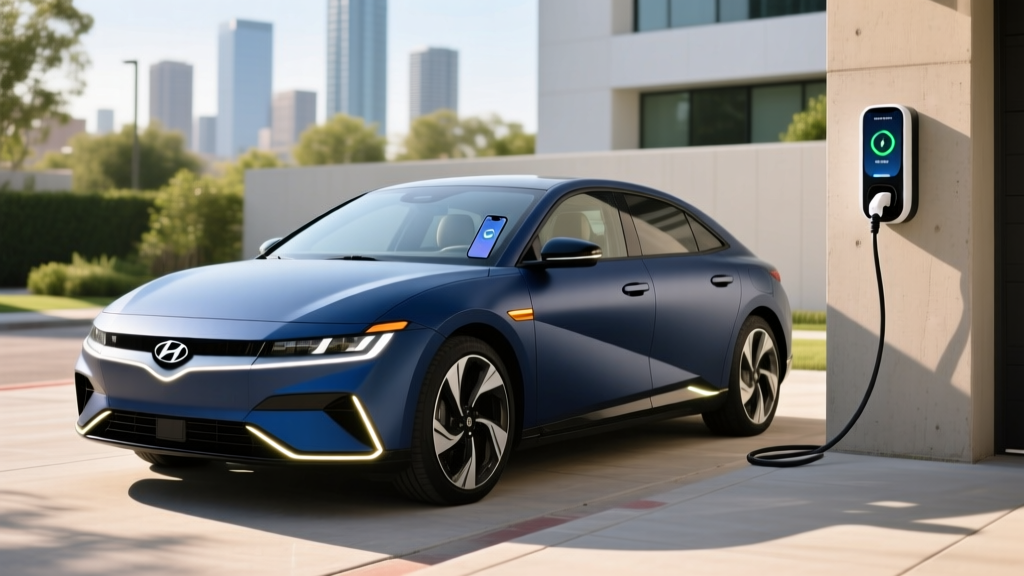
The Hyundai Ioniq 9 arrives for the 2026 model year as the brand's flagship three-row electric SUV, slotting above the Ioniq 5 and directly targeting the Tesla Model X, Kia EV9, and Rivian R1S. Built on Hyundai Motor Group's E-GMP platform with an 800-volt architecture, the Ioniq 9 promises ultra-fast DC charging and a spacious cabin wrapped in a design that splits opinion but delivers on interior volume. This review focuses on the mid-tier Ioniq 9 SEL — the volume trim most buyers will cross-shop — with real-world range data, charging-curve analysis, and a clear-eyed look at what this SUV does well and where it falls short.
The Ioniq 9 SEL (RWD, 19-inch wheels) carries an EPA-estimated 311 miles of range. In real-world highway driving at 70-75 mph, expect approximately 255-275 miles before needing a charge. In cold weather (below 32°F), range can drop an additional 20-30%, potentially reducing effective range to 200-230 miles. City driving with regenerative braking recovers more energy and can approach or slightly exceed the EPA sticker. These figures assume the 110.3 kWh usable battery (NMC chemistry).
Spec Sheet: 2026 Hyundai Ioniq 9 SEL at a Glance
| Specification | Ioniq 9 SEL (RWD) | Ioniq 9 SEL (AWD) |
|---|---|---|
| EPA Range | 311 miles | 282 miles |
| Battery (usable) | 110.3 kWh NMC | 110.3 kWh NMC |
| Horsepower | 215 hp | 378 hp |
| 0-60 mph | 7.8 sec (est.) | 4.9 sec (est.) |
| Peak DC Charge Rate | 350 kW | 350 kW |
| 10-80% DC Time | ~24 min | ~24 min |
| Level 2 Charge Rate | 10.9 kW (~33 mi/hr) | 10.9 kW (~33 mi/hr) |
| Efficiency (combined) | 89 MPGe / 36 kWh/100mi | 82 MPGe / 41 kWh/100mi |
| Base MSRP | $53,095 | $56,595 |
| Drivetrain | Single-motor RWD | Dual-motor AWD |
Sources: fueleconomy.gov, Hyundai Motor America official specifications. AWD range and 0-60 figures are preliminary estimates based on E-GMP platform data.
Charging: 800-Volt Architecture Delivers Real Speed
The Ioniq 9's headline advantage is its 800-volt electrical architecture — the same system proven in the Ioniq 5 and Ioniq 6. This enables a peak DC fast-charge rate of 350 kW at compatible chargers ( Electrify America's 350-kW stalls, for instance). Hyundai quotes a 10-80% charge time of approximately 24 minutes under optimal thermal conditions.
The 350-kW peak is not sustained for the entire session. Expect peak rates between roughly 10-50% State of Charge (SoC), after which the rate tapers progressively. From 80-100%, charging slows dramatically to protect battery health — a full 80-100% top-off can add another 30-40 minutes. For road trips, the practical strategy is to charge to 80% and move on; the Ioniq 9's fast 10-80% time makes this viable. Battery preconditioning activates automatically when a DC fast charger is set as your navigation destination, which is essential for achieving peak charge rates in cooler weather.
| Charging Level | Power (kW) | Miles of Range Added per Hour | Full Charge Time (0-100%) |
|---|---|---|---|
| Level 1 (120V household) | ~1.4 kW | ~4 mi/hr | ~78 hours |
| Level 2 (240V, 48A) | 10.9 kW | ~33 mi/hr | ~10.5 hours |
| DC Fast (peak) | 350 kW | ~800+ mi/hr (at peak) | 10-80% in ~24 min |
At home on a Level 2 charger (240V, 48-amp hardwired unit recommended), the Ioniq 9 accepts up to 10.9 kW, adding roughly 33 miles of range per hour. A full overnight charge from near-empty takes about 10-11 hours — easily accomplished during sleep hours. The Ioniq 9 uses the NACS (Tesla-style) connector for both AC and DC charging, reflecting Hyundai's adoption of the North American Charging Standard for 2026 models. This grants native access to Tesla Superchargers without an adapter — a meaningful practical advantage over CCS-equipped competitors still requiring adapters.
Performance and Driving Dynamics
The Ioniq 9 SEL RWD sends 215 horsepower to the rear wheels via a single electric motor. Acceleration is adequate rather than thrilling — expect a 0-60 mph time around 7.8 seconds. For a three-row family SUV, this is perfectly reasonable; the instant electric torque makes city merging and highway on-ramps effortless even if the Ioniq 9 won't win drag races against the dual-motor AWD variant (378 hp, ~4.9 seconds to 60).
Ride quality is a strong suit. The Ioniq 9 uses a multi-link rear suspension with frequency-selective dampers, and the result is composed highway cruising with minimal harshness over broken pavement. The 110.3 kWh battery pack sits low in the chassis, giving the Ioniq 9 a planted feel through corners that belies its roughly 5,300-pound curb weight. Steering is light and numb — typical Hyundai tuning — but predictable. Noise isolation is excellent; at 70 mph, the cabin is whisper-quiet thanks to acoustic laminated glass on the front and rear doors.
Regenerative braking offers four levels selectable via steering-wheel paddles, from coasting (Level 0) to near one-pedal driving (Level 3, or i-PEDAL mode). The transition between regen and friction braking is smooth — an area where some competitors still struggle.
Interior Space, Cargo, and Practicality
The Ioniq 9's primary selling point over the Ioniq 5 is third-row seating. Hyundai positions this as a genuine seven-passenger vehicle (2+3+2 configuration on the SEL), and the dimensions support that claim:
- First-row legroom: 41.7 inches
- Second-row legroom: 39.4 inches
- Third-row legroom: 31.5 inches
- Cargo behind 3rd row: 15.9 cu ft
- Cargo behind 2nd row (3rd row folded): 44.2 cu ft
- Cargo behind 1st row (all rear rows folded): 85.3 cu ft
- Front trunk (frunk): 2.3 cu ft (enough for charging cables and a small bag)
The third row is best suited for children or occasional adult use on short trips — the 31.5 inches of legroom is tight for adults on long journeys. However, it's competitive with the Kia EV9 and meaningfully more usable than the Tesla Model X's cramped rearmost seats. Second-row captain's chairs (reducing capacity to six) are available on higher trims but not standard on the SEL.
The SEL trim includes a power liftgate, roof rails (rated for crossbars and cargo boxes), and a flat load floor when rear seats are folded. Towing capacity is rated at 2,645 pounds (braked) — enough for a small utility trailer or a pair of dirt bikes, but not a full-size camping trailer.
Technology, Infotainment, and Driver Assistance
The Ioniq 9 SEL features Hyundai's latest infotainment system displayed on a curved panoramic panel combining a 12.3-inch digital instrument cluster and a 12.3-inch touchscreen. Wireless Apple CarPlay and Android Auto are standard. The system is responsive, with a clean tile-based interface and physical shortcut buttons for climate control — a welcome decision in an era of screen-only HVAC controls.
Standard driver-assistance technology on the SEL includes:
- Highway Driving Assist 2 (HDA 2): Adaptive cruise with lane centering, lane-change assist, and curve speed reduction. This is an SAE Level 2 system — the driver must keep hands on the wheel and remain attentive at all times.
- Forward collision-avoidance assist with pedestrian, cyclist, and junction-turning detection
- Blind-spot collision-avoidance assist with rear cross-traffic alert
- Remote Smart Parking Assist: The Ioniq 9 can pull itself in and out of tight parking spaces via the key fob while the driver stands outside
- Surround-view monitor with 3D perspective
HDA 2 is a driver-assist system, not autonomous driving. It requires active driver supervision, hands-on-wheel monitoring, and does not handle all road scenarios (construction zones, unmapped roads, severe weather). Hyundai does not offer a hands-free Level 3 system on the Ioniq 9 in the US market as of the 2026 model year.
A standout feature is the Digital Key 2, which allows your smartphone (UWB-equipped) to act as the vehicle key, including sharing access with family members. The Ioniq 9 also supports Vehicle-to-Load (V2L) via an interior 120V outlet and an exterior adapter, providing up to 3.6 kW of power — enough to run camping equipment, power tools at a job site, or keep essential appliances running during a home power outage.
Pricing, Trims, and Federal Tax Credit Eligibility
The 2026 Hyundai Ioniq 9 is offered in four trims. The SEL sits as the mid-tier option and represents the best value proposition for most buyers:
| Trim | Drivetrain | Base MSRP | Est. After §30D Credit* |
|---|---|---|---|
| SE Standard Range | RWD | $47,395 | ~$39,895 |
| SEL (reviewed) | RWD | $53,095 | ~$45,595 |
| SEL AWD | AWD | $56,595 | ~$49,095 |
| Limited | AWD | $65,495 | ~$57,995 |
| Calligraphy | AWD | $71,995 | ~$64,495 |
*Destination charge ($1,495) not included. Tax credit estimates assume full §30D eligibility.
The Ioniq 9 is expected to qualify for up to $7,500 under the federal §30D Clean Vehicle Credit, which can now be transferred to the dealer at point of sale as an instant discount. However, eligibility depends on several conditions that buyers must verify:
- MSRP cap: SUVs must have an MSRP at or below $80,000 — all Ioniq 9 trims comply.
- Buyer income cap: Modified adjusted gross income must not exceed $300,000 (joint), $225,000 (head of household), or $150,000 (single).
- Battery sourcing: Critical minerals and battery components must meet escalating domestic-sourcing thresholds that tighten annually. Hyundai has been actively localizing battery supply chains at its Georgia Metaplant, but buyers should confirm current-year compliance on the official IRS list at irs.gov before purchase.
- Point-of-sale transfer: The $7,500 can be applied as an instant rebate at the dealer, reducing your out-of-pocket cost without waiting to file taxes.
Ownership Costs, Warranty, and Efficiency
Hyundai backs the Ioniq 9 with one of the strongest warranty packages in the EV segment:
- Battery & electric powertrain: 10 years / 100,000 miles
- New vehicle limited: 5 years / 60,000 miles
- Anti-perforation: 7 years / unlimited miles
- Roadside assistance: 5 years / unlimited miles
The 10-year battery warranty covers capacity loss below 70% of original capacity — a competitive threshold that matches or exceeds most rivals. Hyundai's NMC battery chemistry prioritizes energy density (enabling the 311-mile range in a manageable package) but historically shows slightly faster long-term degradation than LFP chemistry found in some Tesla and BYD models. That said, real-world data from the E-GMP platform (Ioniq 5, Ioniq 6, EV6) suggests minimal meaningful degradation in the first 5-7 years of typical ownership.
Efficiency for the SEL RWD is rated at 89 MPGe combined (36 kWh per 100 miles). At the US average electricity rate of $0.17/kWh (per EIA data), charging the Ioniq 9 from empty to full costs roughly $18.75 — equating to approximately $0.06 per mile. Compare that to a gas-powered three-row SUV averaging 22 MPG at $3.40/gallon, which costs roughly $0.155 per mile. Over 15,000 annual miles, the Ioniq 9 saves approximately $1,425 per year in fuel costs alone.
How the Ioniq 9 SEL Compares to Key Rivals
The three-row electric SUV segment is heating up. Here's how the Ioniq 9 SEL stacks against its most direct competitors:
- vs. Kia EV9 Land (AWD, ~$60,095): The EV9 shares the E-GMP platform and battery, but the Ioniq 9 is slightly larger, offers a more premium interior, and (in RWD form) achieves longer range. The EV9's boxy design offers marginally better third-row headroom. Both share the 800V fast-charging advantage.
- vs. Tesla Model X (Long Range, ~$79,990): The Model X offers more range (~348 miles EPA), faster acceleration, and access to the Supercharger network (though NACS adoption is closing this gap). However, the Model X costs significantly more, has a less practical third row, and its interior quality doesn't match its price. The Ioniq 9 SEL undercuts it by over $25,000.
- vs. Rivian R1S (Dual-Motor, ~$75,900): The R1S excels off-road and offers a more adventurous character, but starts at a much higher price and uses CCS charging (slower peak rates). The Ioniq 9 is the pragmatic family choice; the R1S is the lifestyle choice.
- 800V architecture enables 350-kW peak DC charging (~24 min 10-80%)
- Genuine three-row seating with competitive cargo volume
- NACS connector — native Supercharger access
- 10-year/100,000-mile battery warranty
- V2L capability (3.6 kW) for camping and backup power
- Composed ride quality with excellent noise isolation
- Strong value at ~$45,595 after estimated tax credit
- Third-row legroom (31.5 in) is tight for adults on long trips
- RWD SEL's 215 hp feels underwhelming for a 5,300-lb SUV
- Real-world highway range drops to ~255-275 miles
- Cold-weather range loss of 20-30% is significant
- Numb steering feel — not an engaging driver's SUV
- Frunk is small (2.3 cu ft) — mostly useful for cables
- Polarizing exterior design may not appeal to all buyers
Who Should Buy the Ioniq 9 SEL?
- Choose the Ioniq 9 SEL if: You need three rows for family duty, prioritize fast road-trip charging over outright performance, want native Tesla Supercharger access via NACS, and value a strong warranty and competitive price point after the federal tax credit.
- Look elsewhere if: You need a third row for full-size adults regularly (consider a minivan), you want sports-SUV acceleration (look at the AWD variant or Rivian R1S), you lack home charging access and rely solely on public infrastructure in a charging-desert region, or you prioritize maximum range above all else (Tesla Model X offers more).
The Ioniq 9 SEL is best suited as a family daily driver and road-trip vehicle. Its combination of 311-mile EPA range, 24-minute fast-charge capability, three-row practicality, and sub-$54,000 MSRP (before credits) makes it one of the most compelling value propositions in the three-row EV segment. It's not the fastest, most luxurious, or longest-range option — but it may be the most rationally complete package for buyers who need three rows without spending $70,000+.
Frequently Asked Questions
What is the real-world range of the Hyundai Ioniq 9 SEL?
The EPA rates the Ioniq 9 SEL RWD at 311 miles. In real-world highway driving at 70-75 mph, expect 255-275 miles. In cold weather below freezing, range can drop to 200-230 miles. City driving with frequent regenerative braking can approach or slightly exceed the EPA figure.
How fast does the Ioniq 9 charge at home and on the road?
On a DC fast charger, the Ioniq 9 peaks at 350 kW and charges from 10-80% in approximately 24 minutes (with battery preconditioning active). At home on a Level 2 charger (240V, 48A), it accepts 10.9 kW, adding about 33 miles per hour and fully charging overnight in roughly 10-11 hours.
Does the 2026 Ioniq 9 qualify for the $7,500 federal EV tax credit?
The Ioniq 9 is expected to qualify for the full $7,500 §30D credit, which can be applied as a point-of-sale discount at the dealer. However, eligibility depends on your income (must be under $150K single / $300K joint), the vehicle's battery-sourcing compliance for the current year, and the MSRP cap (SUVs must be under $80,000 — all Ioniq 9 trims comply). Verify on irs.gov before purchasing.
Is the Ioniq 9 worth buying over the Kia EV9 or Tesla Model X?
The Ioniq 9 SEL offers the best value in the segment at approximately $45,595 after the tax credit. The Kia EV9 is its closest rival with similar underpinnings but a lower starting price and slightly less premium interior. The Tesla Model X offers more range and performance but costs $25,000+ more. For most families prioritizing value and fast charging, the Ioniq 9 SEL is the strongest pick.
Can the Ioniq 9 use Tesla Superchargers?
Yes. The 2026 Ioniq 9 comes equipped with the NACS (North American Charging Standard) connector, which is the same connector used by Tesla Superchargers. No adapter is required for native access to the Supercharger network.
How long will the Ioniq 9 battery last?
Hyundai warranties the Ioniq 9's battery for 10 years or 100,000 miles against capacity loss below 70%. Based on real-world data from the E-GMP platform (Ioniq 5, EV6), owners typically see 5-8% degradation over the first 3-5 years. With proper care (avoiding frequent 100% charges, using preconditioning for DC charging), the battery should provide reliable service well beyond 150,000 miles.
What is the towing capacity of the Ioniq 9?
The 2026 Ioniq 9 is rated to tow up to 2,645 pounds (braked trailer). This is sufficient for a small utility trailer, bike rack trailer, or light camping trailer, but not a full-size travel trailer or boat.