2026 Hyundai Ioniq 9: The Three-Row EV SUV Hyundai Built for the Long Haul
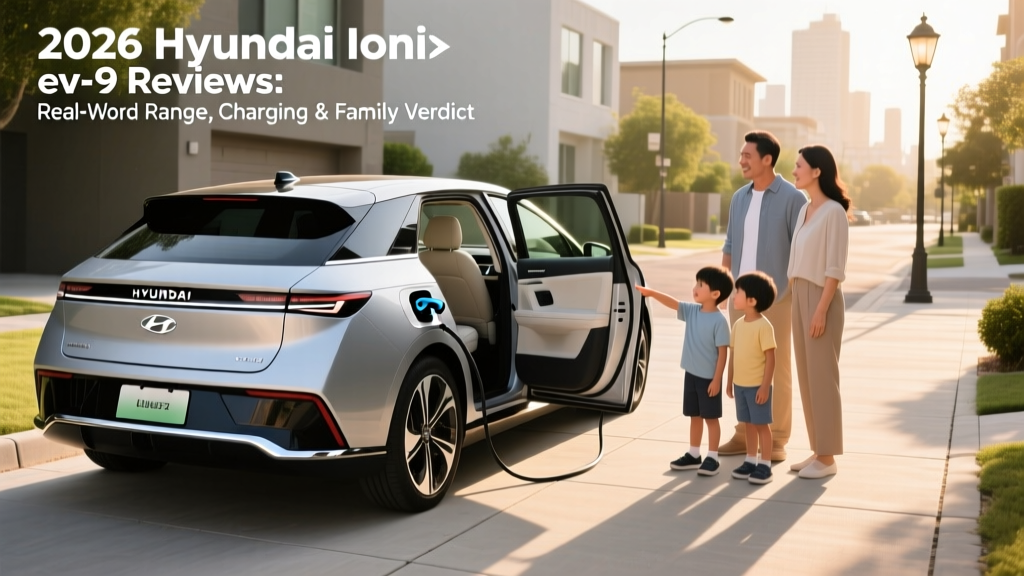
If you've been watching the three-row electric SUV segment explode with options, you've likely seen the Hyundai Ioniq 9 pop up in your research. Launched for the 2025 model year and now in its second model year for 2026, the Ioniq 9 is Hyundai's flagship electric SUV — a stretched, E-GMP-based platform sibling to the Kia EV9 but with its own design language, tuning, and interior execution. These 2026 Hyundai Ioniq 9 reviews break down everything a buyer needs to know: real-world range versus EPA estimates, charging speed reality, ownership costs, and whether it actually fits your family.
The Ioniq 9 arrives in a competitive space that includes the Kia EV9, Tesla Model X, Rivian R1S, and the Volvo EX90. Hyundai's pitch is straightforward: competitive range, fast 800V architecture charging, three usable rows of seating, and a price that undercuts most rivals before incentives. But does the spec sheet translate to daily-driver satisfaction? Let's look at the numbers.
EPA Range, Battery Specs, and Real-World Expectations
The 2026 Hyundai Ioniq 9 is available with two battery configurations depending on trim. The volume-selling models use Hyundai's large pack, while the base SE Standard Range opts for a smaller battery to keep the entry price accessible.
| Specification | SE Standard Range | SE / SEL / Limited (Long Range) |
|---|---|---|
| Battery Capacity (usable) | 76.1 kWh | 110.3 kWh |
| Battery Chemistry | NMC (Nickel Manganese Cobalt) | NMC (4th-gen cells) |
| EPA Estimated Range | ~230 miles | up to 335 miles (RWD) / ~310 miles (AWD) |
| EPA Efficiency (MPGe) | ~83 MPGe combined | ~89 MPGe combined (RWD) |
| Energy Consumption | ~40 kWh/100 mi | ~36 kWh/100 mi (RWD) |
The EPA rates the Ioniq 9 Long Range RWD at up to 335 miles — a strong figure for a three-row SUV. However, in real-world highway driving at 70-75 mph, expect roughly 270–290 miles in mild weather. In cold conditions (below 30°F), range drops to approximately 230–255 miles due to cabin heating demands and increased battery resistance, even with the standard heat pump. City driving with regenerative braking recovers more energy, and you'll see figures closer to or slightly above the EPA estimate in stop-and-go commuting. The AWD Long Range models sacrifice about 20–25 miles of range for the extra traction motor.
Hyundai uses fourth-generation NMC cells supplied primarily by SK On for the Long Range pack. These cells prioritize energy density — critical when you're pushing a 5,000+ lb SUV down the highway. The 110.3 kWh usable capacity is among the largest in the segment, and it's the main reason the Ioniq 9 can deliver over 300 miles despite its size and weight. Note that Hyundai does not currently offer an LFP (lithium iron phosphate) variant in the Ioniq 9 lineup; if you prioritize cycle longevity and daily 100% charging over maximum range, that's a consideration worth noting.
Charging Speed: DC Fast, Level 2, and the 800V Advantage
One of the Ioniq 9's strongest selling points is its carryover 800V electrical architecture from the E-GMP platform, which enables DC fast charging speeds that rival the best in the industry. Here's what you need to know about plugging in.
| Charging Level | Power / Rate | Time or Miles Added |
|---|---|---|
| Level 1 (120V household) | ~1.4 kW | ~3–4 miles per hour |
| Level 2 (240V home, 48A) | ~10.9 kW | ~25–28 miles per hour; full charge in ~11 hours (110.3 kWh pack) |
| DC Fast Charge (peak) | up to ~240 kW | 10–80% in approximately 24 minutes (Long Range) |
| DC Fast Charge (sustained avg) | ~160–180 kW avg | Real-world 10–80% closer to 28–32 min depending on conditions |
The headline number — 10% to 80% in approximately 24 minutes — applies to the Long Range battery under ideal conditions: a preconditioned battery, a charger capable of 350 kW or higher, and moderate ambient temperatures. The 800V architecture allows the Ioniq 9 to sustain high charge rates longer than 400V competitors, but physics still applies. Above 80% state of charge, the charge rate tapers significantly to protect the battery, dropping below 50 kW past 90%. If you're road-tripping and charging to 80%, plan on roughly 25–30 minutes at a high-power station.
For home charging, a Level 2 wallbox on a 60A circuit (delivering 48A continuous) replenishes the 110.3 kWh pack in about 11 hours from empty. Most owners who charge nightly from 30–80% will wake up fully topped off. Installation costs for a Level 2 home setup typically range from $500 (simple outlet nearby) to $2,500+ if your electrical panel needs an upgrade to 200A service — get a quote from a licensed electrician before assuming the simpler scenario.
The Ioniq 9 uses the NACS (Tesla-style) connector for the 2026 model year, giving native access to Tesla Supercharger stations with 15,000+ locations across North America. This is a significant practical advantage over CCS-only vehicles that still rely on adapters for Supercharger access.
Performance, Drivetrain, and Driving Dynamics
| Trim / Drivetrain | Horsepower | Torque (lb-ft) | 0–60 mph | Drivetrain |
|---|---|---|---|---|
| SE Standard Range (RWD) | 215 hp | 258 | ~7.8 sec | Rear-Wheel Drive |
| SE / SEL Long Range (RWD) | 215 hp | 258 | ~7.8 sec | Rear-Wheel Drive |
| SEL / Limited Long Range (AWD) | 379 hp | 516 | ~4.9 sec | Dual-Motor AWD |
| Performance / N-Line (AWD, if offered) | ~422+ hp (est.) | ~546 (est.) | ~4.5 sec | Dual-Motor AWD |
The RWD models aren't fast by EV standards, but they're perfectly adequate for a family SUV. The single rear motor delivers smooth, linear acceleration, and the RWD layout maximizes range. The dual-motor AWD variant transforms the character — 379 hp and 516 lb-ft of torque give the Ioniq 9 genuine passing confidence and respectable launch capability. The 4.9-second 0–60 time is quicker than most gas-powered three-row SUVs and makes merging onto highways effortless.
Ride quality is a strong point. Hyundai tuned the Ioniq 9's suspension for comfort over sportiness, which is the correct call for a vehicle targeting families. The long wheelbase (125.2 inches) helps absorb highway imperfections, and the cabin remains quiet at speed. The available electronically controlled suspension on upper trims further smooths rough pavement. Towing capacity is rated at up to 4,500 lbs with the factory tow package on AWD models — enough for a mid-size camper or boat trailer.
Interior Space, Cargo, and Technology
The Ioniq 9's dimensions are substantial: 198.6 inches long, 77.8 inches wide, and 70.5 inches tall on a 125.2-inch wheelbase. That translates to genuinely usable three-row seating, though the third row is best suited for children or shorter adults on trips under an hour.
| Measurement | Specification |
|---|---|
| Front Headroom | ~40.5 in |
| Front Legroom | ~41.7 in |
| Second-Row Legroom | ~39.4 in |
| Third-Row Legroom | ~31.5 in |
| Cargo (behind 3rd row) | ~12.5 cu ft |
| Cargo (3rd row folded) | ~40 cu ft |
| Cargo (all rows folded) | ~80 cu ft |
| Frunk (front trunk) | ~1.8 cu ft (AWD) / ~3.5 cu ft (RWD) |
Second-row passengers get the best deal, with available captain's chairs that recline, slide, and include a relaxation mode with powered leg rests (on Limited trim). The center console between front seats is a "universal island" that slides fore and aft, providing flexible storage. Hyundai's dual 12.3-inch curved panoramic display handles infotainment and instrument duties, running Hyundai's latest software with native navigation, wireless Apple CarPlay and Android Auto, and over-the-air updates.
On the driver-assistance front, the Ioniq 9 comes equipped with Hyundai SmartSense, a suite that includes adaptive cruise control with stop-and-go, lane-keeping assist, blind-spot monitoring, rear cross-traffic avoidance, and highway driving assist. This is an SAE Level 2 system — it assists with steering and speed but requires the driver to remain fully engaged at all times. It is not autonomous driving. The available Highway Driving Assist 2 (HDA2) adds lane-change assist and improved curve handling, which is competitive with Ford BlueCruise and GM Super Cruise in functionality, though it does not currently support hands-off operation the way those systems do on mapped highways.
Notable drawbacks: The third-row space, while present, is tighter than a minivan or full-size SUV like the Chevy Tahoe. The infotainment system, while feature-rich, relies on some touch-sensitive controls that can be distracting while driving. And the frunk is small on AWD models — essentially a charging cable storage bin rather than meaningful cargo space.
Pricing, Trim Levels, and Federal Tax Credit Eligibility
| Trim | Base MSRP (est.) | Drivetrain | Federal Credit Eligibility |
|---|---|---|---|
| SE Standard Range | ~$58,000 | RWD | Potential partial — see below |
| SE Long Range | ~$65,000 | RWD | Subject to sourcing rules |
| SEL Long Range | ~$69,000 | RWD or AWD | Subject to sourcing rules |
| Limited Long Range AWD | ~$76,000 | AWD | Subject to sourcing rules |
Under the current IRS §30D federal tax credit rules, the Ioniq 9's eligibility for the full $7,500 credit depends on several factors that shift annually:
- MSRP Cap: SUVs must have an MSRP at or below $80,000 to qualify. The Ioniq 9 Limited AWD sits near this cap — loaded with options, it may exceed it.
- Buyer Income Limits: Modified adjusted gross income must not exceed $300,000 (joint filers), $225,000 (head of household), or $150,000 (individual).
- Battery Component Sourcing: A percentage of battery components must be manufactured or assembled in North America, and critical minerals must meet sourcing thresholds. These thresholds tighten each year. Hyundai has been working to localize battery production through its Georgia Metaplant, but verify current-year compliance on the IRS eligible vehicle list before purchasing.
- Point-of-Sale Transfer: If eligible, the credit can be transferred to the dealer at purchase, reducing your out-of-pocket cost immediately rather than waiting for tax filing.
Because sourcing requirements and eligible vehicle lists update regularly, always check the latest information on fueleconomy.gov or consult a tax professional before relying on credit eligibility in your purchase decision. Some buyers may qualify for the full $7,500; others may get $3,750 (meeting only one of the two sourcing requirements); and some may get nothing depending on their income or the specific build date's compliance status.
How Does the Ioniq 9 Compare to Key Competitors?
| Specification | Hyundai Ioniq 9 (LR AWD) | Kia EV9 (LR AWD) | Tesla Model X (LR) | Rivian R1S (Dual-Motor) |
|---|---|---|---|---|
| EPA Range (AWD) | ~310 mi | ~280 mi | ~335 mi | ~321 mi |
| Battery (usable kWh) | 110.3 | 100.0 | ~100 | ~106 |
| DC Fast Charge Peak | ~240 kW | ~236 kW | ~250 kW | ~220 kW |
| 10–80% DCFC Time | ~24 min | ~24 min | ~25 min | ~27 min |
| Starting MSRP (AWD) | ~$69,000 | ~$67,000 | ~$82,000 | ~$79,900 |
| 3rd Row Usability | Good (compact adults) | Good (compact adults) | Tight | Good |
| Towing Capacity | 4,500 lbs | 4,500 lbs | 5,000 lbs | 7,700 lbs |
The Ioniq 9 and its corporate cousin the Kia EV9 share the E-GMP platform and 800V charging architecture, but they differ in design, interior execution, and tuning. The Ioniq 9 leans more upscale in materials and ride comfort, while the EV9 offers a slightly boxier, more utilitarian aesthetic. Against the Tesla Model X, the Ioniq 9 is significantly more affordable and offers a more conventional (and arguably more practical) interior, though the Model X still wins on raw range and access to the Supercharger network natively. The Rivian R1S is the adventure-oriented pick with far superior towing capacity and off-road capability, but at a higher price point.
- You want a comfortable, quiet three-row electric SUV for family commuting and road trips
- Fast DC charging speed matters for your travel patterns
- You prefer a more premium interior feel at a mainstream price point
- You value NACS native Supercharger access without an adapter
- You need maximum towing capacity (consider Rivian R1S)
- You want hands-free highway driving on mapped routes (Ford BlueCruise or GM Super Cruise)
- Third-row space for full-size adults is a priority (consider a minivan or full-size SUV)
- You want an LFP battery option for daily 100% charging without degradation concerns
Warranty Coverage and Long-Term Ownership
Hyundai backs the Ioniq 9 with one of the strongest warranty packages in the industry:
- Battery Warranty: 10 years / 100,000 miles (whichever comes first), covering defects and capacity loss below 70% of original capacity
- Powertrain Warranty: 10 years / 100,000 miles
- New Vehicle Limited Warranty: 5 years / 60,000 miles
- Roadside Assistance: 5 years / unlimited miles
- Complimentary Maintenance: 3 years / 36,000 miles (oil changes aren't relevant, but this covers cabin air filter, tire rotation, and multi-point inspections)
The 10-year battery warranty is a standout. Hyundai's 70% capacity retention threshold is in line with industry norms, though some competitors guarantee 70% while others set the bar at 65–70%. Based on data from earlier E-GMP vehicles like the Ioniq 5, Hyundai's NMC packs have shown relatively modest degradation — typically 5–8% loss over the first 50,000 miles, after which the curve flattens. For a 335-mile vehicle, even a 10% degradation after several years still leaves you with over 300 miles when new-equivalent, which is more than adequate for most use cases.
The Verdict: Who Should Buy the 2026 Hyundai Ioniq 9?
- Class-leading 800V DC fast charging (~240 kW, 10–80% in ~24 min)
- Up to 335 miles EPA range on Long Range RWD — competitive for a three-row SUV
- Genuinely usable second row with available premium captain's chairs
- NACS connector for native Tesla Supercharger access
- Industry-leading 10-year/100,000-mile battery and powertrain warranty
- Comfortable, quiet ride quality tuned for family use
- Competitive pricing vs. Tesla Model X and Rivian R1S
- Third row is tight for adults — best for children or short trips
- Frunk is small, especially on AWD models
- Touch-sensitive controls can be distracting while driving
- No LFP battery option for buyers who want maximum cycle life
- Federal tax credit eligibility is not guaranteed — depends on sourcing and income rules
- Highway and cold-weather range drop significantly from EPA sticker (expect ~230–255 mi in winter)
The 2026 Hyundai Ioniq 9 is best suited for families who need a three-row SUV for daily commuting, school runs, and periodic road trips — not full-time third-row passengers or heavy towing. If your household typically carries four or five people with occasional need for a sixth or seventh seat, the Ioniq 9 hits a sweet spot of range, charging speed, comfort, and value. The 800V charging architecture makes it one of the fastest-charging three-row EVs available, which matters enormously on road trips. And the 10-year warranty provides peace of mind that few competitors match.
Before purchasing, verify your federal tax credit eligibility through the IRS §30D guidelines, confirm the specific vehicle's battery-sourcing compliance, and test-fit your family — including car seats, strollers, and the cargo you actually haul — into the cabin. The Ioniq 9's numbers are compelling on paper. The real test is whether its real-world execution matches your household's specific needs.
Frequently Asked Questions
What is the real-world range of the 2026 Hyundai Ioniq 9?
The EPA rates the Long Range RWD at up to 335 miles and the AWD at approximately 310 miles. In real-world highway driving at 70–75 mph in mild weather, expect 270–290 miles. In cold weather (below 30°F), that drops to roughly 230–255 miles. City driving with regenerative braking will get you closer to the EPA figure or slightly above.
How fast does the Ioniq 9 charge at home and on the road?
On DC fast chargers, the Ioniq 9 peaks at approximately 240 kW and charges from 10% to 80% in about 24 minutes under ideal conditions. At home on a Level 2 (240V, 48A) charger, it adds roughly 25–28 miles of range per hour, fully recharging the 110.3 kWh pack in about 11 hours.
How much does the 2026 Ioniq 9 cost after tax credits?
Pricing starts around $58,000 for the SE Standard Range and climbs to approximately $76,000 for the Limited AWD. If you qualify for the full $7,500 federal tax credit under IRS §30D (meeting income, MSRP, and battery-sourcing requirements), effective pricing starts around $50,500. However, credit eligibility is not guaranteed — verify your specific situation before purchasing.
Does the Hyundai Ioniq 9 qualify for the $7,500 federal EV tax credit?
It may, but eligibility depends on current-year battery component and critical mineral sourcing rules under IRS §30D, your income level, and whether the specific trim's MSRP stays under the $80,000 SUV cap. Hyundai has been localizing production at its Georgia Metaplant, which improves eligibility odds, but the rules tighten annually. Check the IRS eligible vehicle list or consult a tax professional.
Is the Ioniq 9 worth buying over the Kia EV9 or Tesla Model X?
The Ioniq 9 offers a more premium interior feel than the EV9 at a modest price premium, with identical charging technology. Compared to the Model X, it's significantly more affordable ($10,000–$15,000 less) and offers a more practical cabin layout, though the Model X has slightly more range and the Tesla Supercharger ecosystem. If you value comfort, warranty coverage, and value, the Ioniq 9 is a strong pick. If you need hands-free driving or maximum towing, look at competitors.
What are the biggest pros and cons of the Ioniq 9?
Pros: fast 800V charging, strong range, comfortable ride, NACS native access, 10-year warranty, competitive pricing. Cons: tight third row, small frunk, touch controls while driving, no LFP option, and uncertain tax credit eligibility depending on sourcing compliance.