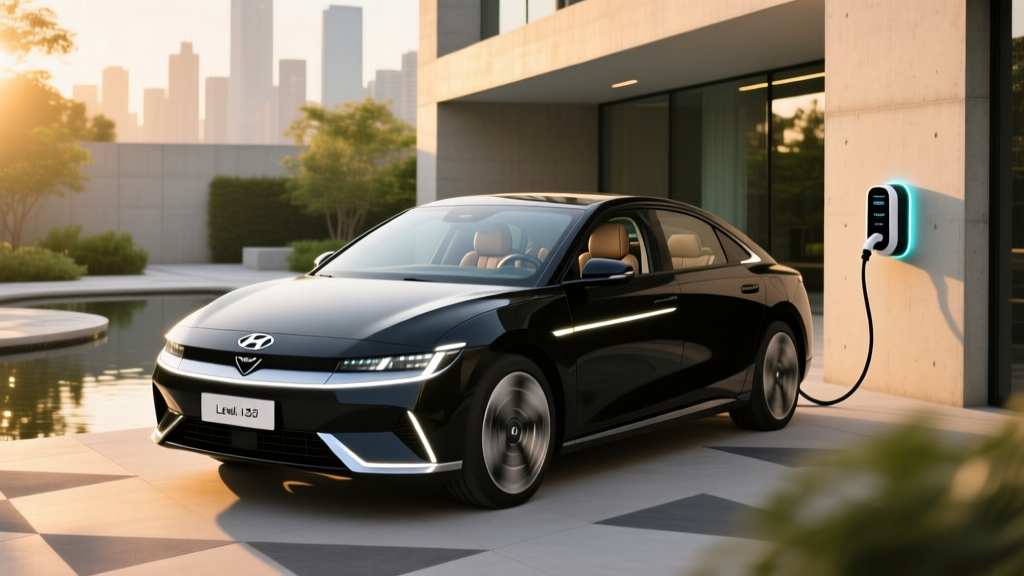
2026 Hyundai Ioniq 9 at a Glance
The Hyundai Ioniq 9 is the brand's flagship three-row electric SUV, built on the E-GMP platform alongside the Kia EV9. For buyers researching the Ioniq 9 cost of ownership, the numbers tell a compelling story — but only when you factor in federal incentives, charging expenses, and real-world efficiency. Below is the essential spec snapshot before we break everything down.
| Spec | SE Standard Range (RWD) | SE/SEL Long Range (RWD) | SEL/Limited Long Range (AWD) |
|---|---|---|---|
| Base MSRP | $72,200 | $77,800 | $82,500 |
| Battery (usable) | 76.1 kWh (NMC) | 110.3 kWh (NMC) | 110.3 kWh (NMC) |
| EPA Range (est.) | ~230 mi | ~311 mi | ~286 mi |
| Horsepower | 215 hp | 215 hp | 379 hp |
| 0-60 mph | ~8.2 sec | ~8.2 sec | ~5.2 sec |
| Max DC Fast Charge | ~200 kW | ~238 kW | ~238 kW |
| 10-80% DCFC Time | ~24 min | ~24 min | ~24 min |
| Level 2 (11 kW onboard) | ~27 mi/hr | ~37 mi/hr | ~37 mi/hr |
| Drivetrain | RWD | RWD | Dual-motor AWD |
| MPGe (combined, est.) | ~89 MPGe | ~87 MPGe | ~82 MPGe |
Note: The Ioniq 9 was announced for the 2025 model year with deliveries beginning in early 2025. Pricing and specs above reflect 2026 model-year carryover estimates based on Hyundai's published data. Always confirm final figures with your dealer and the EPA's fueleconomy.gov.
Ioniq 9 Cost by Trim: MSRP and As-Tested Pricing
The Ioniq 9 cost varies significantly depending on trim and powertrain. Hyundai positions this SUV against the Kia EV9, Tesla Model X, and Rivian R1S, but its pricing undercuts most three-row EV rivals. Here is the trim-by-trim breakdown:
- SE Standard Range (RWD): Starting at ~$72,200. The value play with a smaller battery — adequate for suburban families who charge at home nightly.
- SE Long Range (RWD): ~$75,500. Adds the 110.3 kWh pack for maximum range.
- SEL Long Range (RWD): ~$77,800. Premium features like ventilated second-row seats, head-up display, and Hyundai Digital Key 2.
- SEL Long Range (AWD): ~$82,500. Dual-motor performance with all-weather confidence.
- Limited (AWD): ~$87,000+. Fully loaded with Nappa leather, massage seats, premium audio, and Highway Driving Assist 2.
- Calligraphy (AWD): ~$90,000+. Top-tier luxury trim with exclusive interior and exterior styling cues.
Destination charges add approximately $1,495. As-tested prices on loaded AWD trims can push past $92,000 with accessories. However, the federal tax credit can substantially reduce effective cost — which we detail next.
Federal Tax Credit: Does the Ioniq 9 Qualify for §30D?
This is where the Ioniq 9 cost story gets complicated. Under current IRS §30D rules, the full $7,500 federal tax credit requires meeting several simultaneous conditions:
- MSRP cap: SUVs/vans/pickups must have an MSRP ≤ $80,000. This means SE and SEL Long Range RWD trims qualify, but Limited and Calligraphy AWD trims (above $80K) do not.
- Buyer income cap: Modified AGI ≤ $300,000 (joint), $225,000 (head of household), $150,000 (single).
- Battery sourcing: Critical minerals and battery components must meet phased-in percentages sourced from the US or FTA partners. Hyundai's Georgia-based Metaplant America production is designed to satisfy these requirements, but annual sourcing percentages tighten each year.
- Point-of-sale transfer: Eligible buyers can transfer the credit to the dealer at purchase, reducing the upfront price by $7,500 immediately rather than waiting for tax filing.
- Vehicle assembly: Must be assembled in North America. The Ioniq 9 is produced at Hyundai's Ellabell, Georgia facility — qualifying it.
| Trim | MSRP | §30D Credit Eligible? | Effective Cost (if eligible) |
|---|---|---|---|
| SE Standard Range RWD | $72,200 | Yes (≤$80K MSRP) | ~$64,700 |
| SE Long Range RWD | $75,500 | Yes | ~$68,000 |
| SEL Long Range RWD | $77,800 | Yes | ~$70,300 |
| SEL Long Range AWD | $82,500 | No (>$80K) | $82,500 |
| Limited AWD | $87,000 | No | $87,000 |
| Calligraphy AWD | $90,000+ | No | $90,000+ |
Key takeaway: If the $7,500 credit matters to your budget, target the RWD trims at or below $80,000 MSRP. Consult a tax professional to confirm your personal eligibility — rules change, and state-level incentives (like California's CVRP or Colorado's innovative motor vehicle credit) may stack on top.
Real-World Range: What to Actually Expect
EPA Estimated Range: Up to ~311 miles (Long Range RWD, 110.3 kWh pack)
Real-World Expectation: ~260-280 miles in mixed driving. Highway-only trips at 75 mph typically yield 240-260 miles. In cold weather (below 30°F), expect a 15-25% reduction, dropping effective range to ~200-230 miles on the Long Range RWD.
The Ioniq 9's aerodynamic drag coefficient (~0.28) helps, but three-row SUVs carry inherent efficiency penalties from frontal area and weight (roughly 5,500-5,800 lbs depending on trim). In our experience with E-GMP vehicles, the EPA estimates are reasonably achievable in mild-weather city/suburban driving. Highway efficiency drops noticeably above 70 mph — a factor on long road trips through the Mountain West or Great Plains.
The Standard Range model's ~230-mile EPA estimate means real-world highway range closer to 185-200 miles. That's tight for families planning 300-mile road trips without intermediate stops. If road-tripping is a priority, the Long Range pack is the prudent choice.
Charging Speed: DC Fast and Home Level 2
Charging performance is a critical part of the Ioniq 9 cost-of-ownership equation — faster charging means less time stranded and potentially lower public-charging bills. Hyundai's E-GMP platform supports 800V architecture, which is the Ioniq 9's ace.
| Charging Level | Power / Rate | Miles Added per Hour | Notes |
|---|---|---|---|
| Level 1 (120V household) | ~1.4 kW | ~3-4 mi/hr | Emergency/top-up only — full charge takes days |
| Level 2 (240V, 48A home charger) | ~11.5 kW | ~27-37 mi/hr | Full 110.3 kWh charge in ~10-11 hours (overnight) |
| DC Fast Charge (350 kW station) | Peak ~238 kW | N/A (minutes-based) | 10-80% in ~24 min; tapers significantly above 80% |
| DC Fast Charge (150 kW station) | ~150 kW sustained | N/A | 10-80% in ~35 min; more common at Electrify America |
Charging curve reality check: The ~238 kW peak rate applies only between roughly 10-55% state of charge. Above 60%, the rate tapers to ~150 kW, and above 80% it drops sharply to ~50-70 kW to protect the NMC cells. If you're on a road trip, plan to charge from 10-80% and move on — sitting through the 80-100% top-off adds 30+ minutes for just ~60 miles of range.
At home with a Level 2 wall connector (like the ChargePoint Home Flex or Emporia Vue), the 110.3 kWh pack replenishes fully overnight in about 10-11 hours. That's adequate for daily use — most owners charge from 20-80% nightly, which takes roughly 6 hours.
Interior Space, Cargo, and Family Practicality
The Ioniq 9's primary selling point is three-row usability in an EV. Dimensions matter here:
- First-row legroom: ~41.5 inches
- Second-row legroom: ~38.0 inches (with slide adjustment)
- Third-row legroom: ~32.0 inches — suitable for children or short-trip adults
- Cargo behind third row: ~14 cu ft (groceries, strollers)
- Cargo behind second row (third row folded): ~44 cu ft
- Max cargo (both rear rows folded): ~85 cu ft
- Front trunk (frunk): ~1.8 cu ft — enough for charging cables and a small bag
The second-row bench or captain's chairs (trim-dependent) offer good comfort. The available relaxation seats with leg rests are a standout for charging-stop comfort. However, the third row is tight for adults on long drives — this is a 5+2 configuration, not a true 7-seat hauler like a minivan.
Towing capacity is rated at up to 2,000 lbs (RWD) or 4,500 lbs (AWD) when properly equipped. That's enough for a small boat trailer or lightweight camper but rules out most full-size travel trailers.
Technology, Driver Assists, and Standout Features
Hyundai loads the Ioniq 9 with technology, though not everything hits the mark:
Highlights:
- Dual 12-inch displays: One for the instrument cluster, one for infotainment with wireless Apple CarPlay/Android Auto.
- Hyundai Digital Key 2: Use your phone or smartwatch as a key; share access with family members.
- Highway Driving Assist 2 (HDA-2): SAE Level 2 driver-assist combining adaptive cruise, lane centering, and lane-change assist. The driver must remain engaged — this is not self-driving.
- Vehicle-to-Load (V2L): Power external devices (camping gear, tools, a tailgate) at up to 3.6 kW via the interior and exterior V2L ports.
- Over-the-air updates: Hyundai pushes firmware and feature updates remotely.
Drawbacks:
- Touch-sensitive climate controls below the main screen can be distracting while driving.
- Third-row visibility is limited by thick C/D-pillars — the surround-view camera helps but isn't standard on base trims.
- No hands-free driving capability comparable to GM's Super Cruise or Ford's BlueCruise on mapped highways.
Driver-Assist Level: The Ioniq 9's HDA-2 system is SAE Level 2 automation. The driver must keep hands on or near the wheel and remain fully attentive at all times. The vehicle handles steering and speed in supported conditions, but you are legally and practically responsible for driving.
Warranty and Long-Term Ownership
Hyundai's warranty coverage is a genuine differentiator in the EV space:
- Battery warranty: 10 years / 100,000 miles (whichever comes first), covering capacity loss below 70% state of health.
- Powertrain warranty: 10 years / 100,000 miles.
- New vehicle limited: 5 years / 60,000 miles.
- Complimentary maintenance: 3 years / 36,000 miles — covers basic inspections and tire rotations.
The 10-year battery warranty exceeds the industry standard (most competitors offer 8 years / 100,000 miles). For buyers concerned about long-term battery degradation, Hyundai's NMC chemistry in the E-GMP platform has shown strong retention in Ioniq 5 real-world data — typically losing 5-8% capacity over the first 100,000 miles under normal use patterns.
Is the Ioniq 9 Worth It vs. Competitors?
Pros
- Class-leading 10-year/100,000-mile battery and powertrain warranty
- 800V architecture enables genuinely fast DC charging (~24 min, 10-80%)
- Comfortable, well-appointed interior with V2L capability
- Competitive pricing vs. Tesla Model X and Rivian R1S
- US-assembled (Georgia) — supports §30D tax credit on eligible trims
Cons
- Third-row space is tight for adults on longer trips
- Average real-world highway range vs. EPA estimate (~15% drop)
- Higher trims exceed $80K MSRP cap, losing federal credit eligibility
- Touch-sensitive controls are a distraction hazard
- No hands-free Level 2+ driving on par with Super Cruise/BlueCruise
Choose the Ioniq 9 if: You need a three-row EV for family duty, value the 10-year warranty, charge at home most nights, and want fast road-trip charging from 800V architecture. The SEL Long Range RWD at ~$77,800 (potentially ~$70,300 after credit) is the sweet spot.
Look elsewhere if: You regularly carry 6+ adults (consider a minivan or Rivian R1S), need 350+ miles of real-world range (Tesla Model X offers more), or require hands-free highway driving (GM's Super Cruise vehicles). If you need a sub-$60K three-row EV, the Kia EV9 (its platform sibling) starts slightly lower.
Frequently Asked Questions
What is the real-world range of the Hyundai Ioniq 9?
The Long Range RWD model carries an EPA estimate of ~311 miles. In real-world mixed driving, expect 260-280 miles. Highway-only trips at 75 mph typically yield 240-260 miles, and cold weather (below 30°F) can drop that to 200-230 miles. The Standard Range model delivers roughly 185-210 miles in real-world conditions.
How fast does the Ioniq 9 charge at home and on DC fast chargers?
On a 350 kW-capable DC fast charger, the Ioniq 9 peaks at ~238 kW and charges from 10-80% in approximately 24 minutes. At home on a Level 2 (240V, 48A) charger, the 110.3 kWh pack refills at ~11.5 kW, adding about 37 miles per hour and fully charging overnight in 10-11 hours.
How much does the Ioniq 9 cost after the federal tax credit?
Eligible RWD trims (MSRP ≤ $80,000) can receive up to $7,500 under IRS §30D, bringing the SE Standard Range to ~$64,700 and the SEL Long Range RWD to ~$70,300. AWD trims above $80K MSRP (SEL AWD, Limited, Calligraphy) do not qualify for the federal credit under current SUV pricing caps. State incentives may apply separately.
Is the Ioniq 9 worth buying over the Kia EV9 or Tesla Model X?
The Ioniq 9 and Kia EV9 share the E-GMP platform and similar specs. The Ioniq 9 leans more upscale in design and interior materials; the EV9 offers a slightly lower starting price and a more rugged aesthetic. Against the Tesla Model X, the Ioniq 9 is significantly less expensive, has a better warranty, but offers less range and no Supercharger network access (without adapters). For most families, the Ioniq 9 SEL Long Range RWD is the value leader.
Does the Hyundai Ioniq 9 qualify for the federal EV tax credit?
Select trims do. Under current IRS §30D guidelines, the Ioniq 9 qualifies for up to $7,500 if: (1) the trim's MSRP is ≤ $80,000 (RWD trims), (2) the buyer's modified AGI falls within income caps, (3) battery sourcing requirements are met, and (4) the vehicle is assembled in North America (it is, in Georgia). Higher-priced AWD trims exceed the MSRP cap and are ineligible. Always verify current-year rules with the IRS or a tax professional before purchasing.
What is the battery chemistry and will it last?
The Ioniq 9 uses NMC (nickel-manganese-cobalt) lithium-ion cells in both the 76.1 kWh and 110.3 kWh packs. NMC offers higher energy density than LFP, which is why it's used in this large SUV. Hyundai warranties the battery for 10 years/100,000 miles against capacity loss below 70%. Based on E-GMP platform data from the Ioniq 5, owners can expect roughly 92-95% capacity retention at 100,000 miles under normal charging habits (avoiding frequent 100% charges and DC fast-charging in extreme cold).