The three-row electric SUV segment is crowded, but the 2026 Hyundai Ioniq 9 carves out a distinct position by prioritizing interior volume and family practicality over outright performance. Built on Hyundai Motor Group's E-GMP platform and assembled at the new Metaplant in Ellabell, Georgia, the Ioniq 9 is a full-size electric crossover aimed squarely at buyers who need genuine third-row usability and generous cargo capacity. Below, we break down the Ioniq 9's cargo space dimensions, real-world range, charging behavior, pricing, and how it stacks up against the Kia EV9 and Rivian R1S.
Hyundai Ioniq 9 Cargo Space and Interior Dimensions
The headline reason buyers cross-shop the Ioniq 9 is cargo utility. Hyundai designed this SUV around a flat floor and a long 123.6-inch wheelbase, yielding cargo volume that rivals minivans when seats are folded.
| Measurement | Specification |
|---|---|
| Cargo behind 3rd row | 21.7 cu ft |
| Cargo behind 2nd row (3rd row folded) | 47.6 cu ft |
| Max cargo (all rear seats folded) | 85.3 cu ft |
| Front trunk (frunk) | 1.8 cu ft (RWD) / 1.2 cu ft (AWD) |
| 1st-row legroom | 41.7 in |
| 2nd-row legroom | 39.4 in |
| 3rd-row legroom | 30.1 in |
| 2nd-row headroom | 39.2 in |
| 3rd-row headroom | 37.0 in |
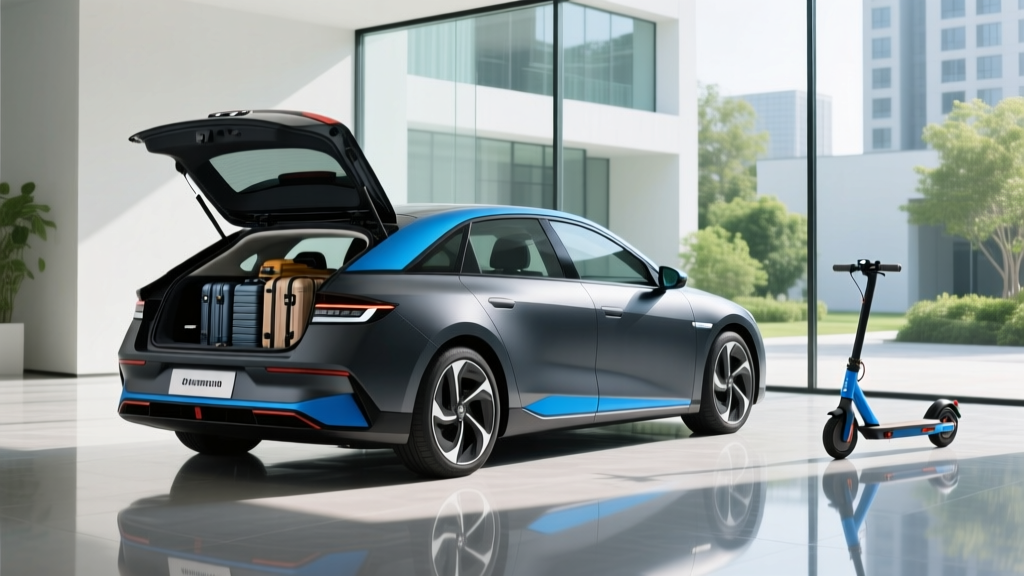
The 21.7 cu ft behind the third row is enough for roughly four carry-on suitcases or a week's groceries for a family of five. Fold the third row and the 47.6 cu ft opening accommodates a full-size stroller, several hockey bags, or a large dog crate with room to spare. The 85.3 cu ft maximum with both rear rows down is competitive with the Kia EV9 (81.7 cu ft max) and slightly ahead of the Rivian R1S (83.5 cu ft max). The frunk is modest — useful for charging cables and a small emergency kit, but not a substitute for a proper front trunk like the Ford F-150 Lightning offers.
Second-row captain's chairs (available on SEL and above) reduce seating from seven to six but dramatically improve third-row access and long-trip comfort. The third row is best suited for children or adults on short trips; 30.1 inches of legroom is tight for six-footers on extended highway drives.
Range, Battery, and Real-World Efficiency
The 2026 Ioniq 9 is offered with two battery configurations and three drivetrain layouts. The volume seller is the Long Range RWD, which pairs a 110.3 kWh (usable) NMC (nickel-manganese-cobalt) battery with a single rear motor.
| Trim/Config | Battery (usable kWh) | Drivetrain | Horsepower | 0-60 mph | EPA Range | MPGe (combined) |
|---|---|---|---|---|---|---|
| Standard Range RWD | 76.1 kWh (NMC) | RWD | 215 hp | 7.4 sec | 245 mi | 105 MPGe |
| Long Range RWD | 110.3 kWh (NMC) | RWD | 215 hp | 7.9 sec | 335 mi | 97 MPGe |
| Long Range AWD | 110.3 kWh (NMC) | Dual-motor AWD | 379 hp | 5.2 sec | 305 mi | 89 MPGe |
Efficiency lands at roughly 33 kWh/100 miles for the Long Range RWD — competitive for a 5,000+ lb three-row SUV but meaningfully thirstier than a sedan like the Ioniq 6 (25 kWh/100 mi). The AWD model's 89 MPGe combined reflects the added drivetrain loss and weight of the front motor.
Charging Speed: DC Fast Charging and Home Level 2
Charging speed remains a top concern for three-row SUV buyers planning road trips. The Ioniq 9 retains the E-GMP platform's 800-volt electrical architecture, enabling some of the fastest DC charging in the segment.
| Charging Method | Power / Rate | Time / Delivery |
|---|---|---|
| DC Fast Charge (peak) | 240 kW (Long Range) / 180 kW (Standard Range) | 10-80% in ~22 min (Long Range) |
| DC Fast Charge (sustained avg) | ~160 kW average (10-80%) | ~190 miles added in 22 min |
| Level 2 Home (240V, 48A) | 11.5 kW onboard charger | ~32 miles per hour of charging |
| Level 1 (120V, 12A) | 1.4 kW | ~4 miles per hour |
| Connector | NACS (native Tesla Supercharger access) | CCS adapter available |
The 800V architecture is the Ioniq 9's charging advantage. While many competitors peak at 150-180 kW on 400V systems, the Ioniq 9 sustains higher power deeper into the charge curve. The charge taper above 80% is still significant — going from 80-100% adds another 25-30 minutes — so road-trip strategy should target 10-80% top-ups at 350 kW Electrify America or Tesla Supercharger V4 stalls.
At home on a 48-amp Level 2 circuit, the 11.5 kW onboard charger replenishes the 110.3 kWh battery from empty in roughly 10 hours. Most owners will plug in overnight and wake to a full charge. A dedicated 60-amp circuit with a hardwired Level 2 station (such as a ChargePoint Home Flex or Emporia Level 2) is recommended; expect $800-$1,500 for professional installation depending on panel proximity, per ChargePoint installer network averages.
Pricing, Trims, and Federal Tax Credit Eligibility
The Ioniq 9's U.S. assembly at Hyundai's Metaplant America in Georgia is significant: it qualifies the vehicle for the federal §30D clean vehicle credit, provided buyers meet income and battery-sourcing requirements.
| Trim | Config | Base MSRP | Est. Price After §30D Credit* |
|---|---|---|---|
| SE Standard Range | RWD | $52,395 | $44,895 |
| SEL Long Range | RWD | $58,895 | $51,395 |
| SEL Long Range | AWD | $62,395 | $54,895 |
| Limited Long Range | AWD | $69,895 | $62,395 |
| Calligraphy Long Range | AWD | $73,395 | $65,895 |
*Estimated price after the $7,500 federal tax credit. Eligibility depends on IRS §30D requirements. Starting in 2026, buyers can transfer the credit to the dealer at point of sale for an immediate price reduction.
- MSRP cap: SUVs must be under $80,000 — all Ioniq 9 trims qualify.
- Buyer income cap: AGI must not exceed $150,000 (single), $225,000 (head of household), or $300,000 (joint filers).
- Battery sourcing: Critical minerals and battery components must meet phased-in domestic/free-trade sourcing thresholds. Hyundai's Georgia-built vehicles with U.S.-sourced battery modules are expected to qualify, but verify the specific VIN on fueleconomy.gov before purchase.
- Point-of-sale transfer: You can assign the credit to the dealer for an upfront discount — no need to wait until tax filing.
- One-time use: You can claim the §30D credit once per calendar year (personal use).
Technology, Driver Assistance, and Standout Features
Hyundai equips the Ioniq 9 with a curved panoramic display spanning 12.3 inches for the instrument cluster and 12.3 inches for infotainment, running the latest ccNC (Connected Car Navigation Cockpit) software. Wireless Apple CarPlay and Android Auto are standard across all trims.
Highway Driving Assist 2 (HDA 2) is Hyundai's Level 2 driver-assistance system, standard on all trims. It combines adaptive cruise control with stop-and-go, lane-centering, and lane-change assist. The system is competent on interstate highways but requires hands-on-wheel supervision at all times — this is not a self-driving system.
HDA 2 can manage steering, acceleration, and braking under driver supervision. The driver must remain attentive and is legally responsible for the vehicle at all times. This is comparable to Tesla Autopilot, Ford BlueCruise, and GM Super Cruise in capability level, though hands-free operation (eyes-off, hands-off-wheel in geo-fenced areas) is not offered on the Ioniq 9 at launch.
Notable tech features:
- Digital Key 2 with NFC and Ultra-Wideband (UWB) — use your phone as a key
- Vehicle-to-Load (V2L) — power external devices up to 3.6 kW via interior and exterior outlets
- Over-the-air (OTA) software updates for powertrain, navigation, and infotainment
- Highway Driving Assist 2 with lane-change assist
- Remote Smart Parking Assist (on Limited/Calligraphy) — the vehicle can park/unpark itself in tight spaces while you stand outside
- Second-row relaxation seats with powered leg rests (SEL and above)
Notable drawbacks:
- No hands-free driving mode (unlike GM Super Cruise or Ford BlueCruise on mapped highways)
- Third row is tight for adults on long trips
- Frunk is small — mostly cable storage
- Towing capacity limited to 2,645 lbs (AWD) — less than Rivian R1S (7,700 lbs)
- Infotainment relies on touch controls; no physical volume knob on base trims
How the Ioniq 9 Compares to Key Rivals
| Spec | Hyundai Ioniq 9 LR AWD | Kia EV9 GT-Line AWD | Rivian R1S Dual-Motor |
|---|---|---|---|
| EPA Range | 305 mi | 270 mi | 352 mi (Max Pack) |
| Battery (usable) | 110.3 kWh (NMC) | 100.0 kWh (NMC) | 141.0 kWh (NMC, Max) |
| Max DC Charge | 240 kW | 210 kW | 200 kW |
| 10-80% Time | ~22 min | ~24 min | ~30 min |
| 0-60 mph | 5.2 sec | 5.0 sec | 5.0 sec |
| Max Cargo | 85.3 cu ft | 81.7 cu ft | 83.5 cu ft |
| 3rd-Row Legroom | 30.1 in | 29.1 in | 30.4 in |
| Towing Capacity | 2,645 lbs | 5,000 lbs | 7,700 lbs |
| Base MSRP (AWD) | $62,395 | $63,900 | $82,700 |
| Federal Credit Eligible | Yes (expected) | Yes (expected) | Yes |
The Ioniq 9's strongest competitive advantage is its combination of fast 800V charging, generous cargo volume, and a starting price thousands below the Rivian R1S. The Kia EV9 is its closest sibling — sharing the E-GMP platform — but the Ioniq 9 offers a larger battery, more range, and a slightly roomier third row. Where the Ioniq 9 falls short is towing: 2,645 lbs is adequate for a small utility trailer but not a boat or camper. Buyers who need serious towing should look at the Rivian R1S or the upcoming electric trucks.
Warranty and Long-Term Ownership
Hyundai backs the Ioniq 9 with one of the strongest warranty packages in the segment:
- Battery: 10 years / 100,000 miles (capacity retention above 70%)
- Powertrain: 10 years / 100,000 miles
- New vehicle limited: 5 years / 60,000 miles
- Roadside assistance: 5 years / unlimited miles
- Complimentary maintenance: 3 years / 36,000 miles
The 10-year battery warranty is a standout. Hyundai's 70% capacity retention threshold is industry-standard, but the 100,000-mile coverage period exceeds most competitors (Tesla offers 8 years/120,000 miles for the Model X). For a family SUV likely to accumulate 12,000-15,000 miles annually, this warranty provides coverage through roughly seven to eight years of typical ownership.
NMC battery degradation for Hyundai's E-GMP platform has tracked well in real-world data from Ioniq 5 and Ioniq 6 fleets, averaging 5-8% capacity loss over the first 60,000 miles. The Ioniq 9's larger battery means degradation will be less noticeable in daily driving — even at 10% loss, you'd still have over 300 miles of range from the Long Range model.
Who Should Buy the 2026 Hyundai Ioniq 9?
- You need a three-row EV with strong cargo capacity and a usable third row for children
- Fast DC charging (800V, 240 kW) is a priority for road trips
- You want a sub-$65,000 starting price for a Long Range AWD family SUV
- 10-year/100,000-mile battery warranty gives you peace of mind
- You value V2L capability for camping, tailgating, or emergency backup power
- You need to tow more than 2,645 lbs (consider Rivian R1S or an electric truck)
- Adults will regularly ride in the third row on long trips
- You want a hands-free highway driving system (GM Super Cruise or Ford BlueCruise)
- You prioritize off-road capability (Rivian R1S with quad-motor is more capable)
Frequently Asked Questions
What is the real-world range of the Hyundai Ioniq 9?
The Long Range RWD is EPA-rated at 335 miles, but expect 280-295 miles in real-world highway driving at 70-75 mph, and 240-260 miles in freezing temperatures. The AWD model's 305-mile EPA rating translates to roughly 260-275 miles on the highway.
How fast does the Ioniq 9 charge at home and on the road?
On a 350 kW DC fast charger, the Long Range model peaks at 240 kW and charges from 10-80% in approximately 22 minutes. At home on a 48-amp Level 2 station (11.5 kW), you'll add about 32 miles of range per hour, or a full charge overnight in roughly 10 hours.
Does the Hyundai Ioniq 9 qualify for the $7,500 federal EV tax credit?
Yes, the Ioniq 9 is expected to qualify because it is assembled in Georgia (Metaplant America). However, eligibility depends on your income (AGI caps of $150K single / $300K joint), battery-sourcing compliance, and the MSRP being under $80,000 (all trims qualify). Verify the specific VIN on fueleconomy.gov and consult a tax professional. The credit can be transferred to the dealer at point of sale for an immediate discount.
Is the Ioniq 9 worth buying vs. the Kia EV9?
The Ioniq 9 offers a larger battery (110.3 vs. 100.0 kWh usable), more EPA range (335 vs. 304 miles RWD), and slightly more cargo space. The Kia EV9 starts at a lower price and offers a 5,000-lb towing capacity. If range and cargo volume are your top priorities, the Ioniq 9 has the edge. If towing and value matter more, the EV9 is the better pick.
What are the biggest pros and cons of the Ioniq 9?
Pros: 800V fast charging, 85.3 cu ft max cargo, 335-mile EPA range (LR RWD), 10-year battery warranty, competitive pricing, V2L capability, NACS connector for Tesla Supercharger access.
Cons: Limited towing (2,645 lbs), tight third row for adults, no hands-free driving mode, small frunk, efficiency drops in cold weather as expected for a large SUV.
How much cargo space does the Ioniq 9 have?
The 2026 Ioniq 9 provides 21.7 cu ft behind the third row, 47.6 cu ft with the third row folded, and 85.3 cu ft with both rear rows folded flat. A small 1.8 cu ft frunk (RWD models) adds space for charging cables. This makes it one of the most cargo-capable three-row EVs on the market.