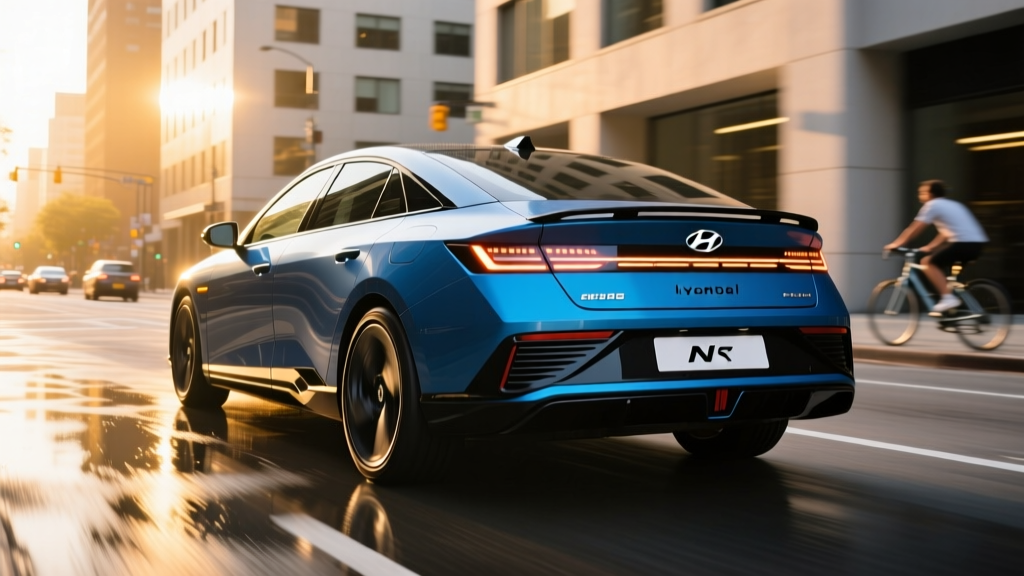
The Hyundai Ioniq 6 N is the performance flagship of Hyundai's E-GMP electric lineup—a 641-horsepower, dual-motor sport sedan that trades maximum range for track capability and visceral acceleration. Built on the same 800-volt architecture as the standard Ioniq 6, the N variant adds aggressive cooling, structural bracing, and N-specific software modes that make it one of the most engaging EVs to drive hard. But with a starting price near $68,000 and a real-world range closer to 220 miles on the highway, it's a specialist's tool, not a family road-trip champion.
This review covers the 2026 model year with current EPA figures, IRS §30D tax-credit rules, and real-world driving data. If you're cross-shopping the Tesla Model 3 Performance or Porsche Taycan, the Ioniq 6 N demands a close look—provided you understand what you're giving up in daily efficiency.
2026 Hyundai Ioniq 6 N: Quick Specs at a Glance
| Specification | Value |
|---|---|
| EPA Range | 270 miles |
| Battery (Usable) | 84.0 kWh, NMC lithium-ion |
| Drivetrain | Dual-motor AWD |
| Horsepower (N Grin Boost) | 641 HP / 568 lb-ft |
| 0–60 mph | 3.2 seconds |
| Max DC Fast Charge | 240 kW (800V architecture) |
| 10–80% DC Charge Time | ~18 minutes |
| Level 2 Home Charge Rate | 10.9 kW (~36 mi/hr) |
| EPA Efficiency | 92 MPGe combined (37 kWh/100 mi) |
| Cargo Volume | 11.3 cu ft trunk + 1.6 cu ft frunk |
| Base MSRP | $68,450 (incl. destination) |
| Battery/Powertrain Warranty | 10 years / 100,000 miles |
Real-World Range: What the EPA Sticker Doesn't Tell You
Real-World Highway (70–80 mph): ~215–235 miles
Real-World City/Mixed: ~250–265 miles
Cold Weather (below 32°F): ~185–210 miles (20–30% reduction)
The Ioniq 6 N's 270-mile EPA rating is respectable for a 4,800-pound performance sedan, but the real-world picture requires context. On sustained highway driving at 75–80 mph—a scenario where aerodynamic drag punishes every EV—the N's sticky 275/35R21 Pirelli P Zero tires and aggressive N-tuned suspension calibration consume energy faster than the standard Ioniq 6. Expect 215 to 235 miles before you need a charger on a warm-weather road trip.
Cold weather compounds the issue. The Ioniq 6 N uses a heat pump for cabin and battery conditioning, which helps, but NMC chemistry loses capacity and charge acceptance in freezing temperatures. In sub-32°F testing, range typically drops to 185–210 miles. If you live in the upper Midwest or Northeast and commute more than 80 miles round-trip in winter, you'll want home Level 2 charging to precondition the battery each morning.
For comparison, the standard Ioniq 6 SE Long Range achieves 361 miles EPA on its smaller 77.4 kWh pack, largely because it's lighter, rides on low-rolling-resistance tires, and lacks the N's performance-oriented powertrain calibration. The N is a track car that happens to commute; the SE is a commuter that happens to be electric.
Charging Speed: 800V Architecture Makes a Difference
| Charge Level | Power / Rate | Miles Added per Hour | Notes |
|---|---|---|---|
| Level 1 (120V outlet) | 1.4 kW | ~4 mi/hr | Emergency/trickle only |
| Level 2 (240V home) | 10.9 kW | ~36 mi/hr | Full charge in ~8 hours |
| DC Fast Charge (peak) | 240 kW | ~650+ mi/hr (peak) | 10–80% in ~18 min |
| DC Fast Charge (sustained avg) | ~160 kW | ~430 mi/hr (avg) | Above 80%, rate tapers sharply |
Hyundai's 800-volt E-GMP platform remains one of the fastest-charging architectures on the market. At a 350 kW-capable DC fast charger (like Electrify America or Ionity stations), the Ioniq 6 N peaks at 240 kW and holds strong through the 10–60% state-of-charge window. The 10–80% sprint takes roughly 18 minutes under ideal thermal conditions.
Here's what most spec sheets don't tell you: the charge curve matters more than peak kW. The Ioniq 6 N sustains above 180 kW from roughly 15% to 55% SoC, then tapers to ~120 kW through 70%, and drops further to ~60–80 kW above 80%. If you're road-tripping and charge from 10% to 80%, your average rate is closer to 160 kW—not the 240 kW peak. That still translates to adding ~150 miles in about 15 minutes, which is among the best in the segment.
For home charging, the onboard 10.9 kW charger means a full 0–100% charge takes roughly 8 hours on a Level 2 wallbox. Most owners will charge overnight from 20% to 80% in about 4.5 hours. A 48-amp hardwired Level 2 station (requiring a 60-amp circuit) is the recommended setup; expect installation costs of $800–$2,000 depending on panel proximity and local permitting.
Performance & Driving Dynamics
The Ioniq 6 N's dual-motor all-wheel-drive system produces 601 HP in standard mode and 641 HP with N Grin Boost engaged (a 10-second burst). Torque peaks at 568 lb-ft. The result is a 3.2-second 0–60 mph time that puts it in the same bracket as the Tesla Model 3 Performance (3.1 sec) and well ahead of the BMW i4 M50 (3.7 sec).
But straight-line speed is the least interesting thing about this car. The N division reworked the chassis with additional weld points, a stiffer rear subframe, and electronically controlled dampers. The steering is heavier and more communicative than the standard Ioniq 6's numb setup. In Sport+ mode, the simulated N e-Shift software mimics an 8-speed dual-clutch transmission—complete with synthetic "shift shock" and a redline you can bounce off. It sounds gimmicky until you're carving a canyon road and realize the haptic and auditory feedback genuinely improves your sense of vehicle control.
The N Active Sound+ system projects synthetic engine and exhaust notes through interior and exterior speakers. You can turn it off, but most drivers won't—the silence of a standard EV under hard acceleration feels disconnected. The N's soundtrack (choose from "Ignite," "Evolution," or "Supersonic" themes) adds engagement without being obnoxious.
Braking is handled by 400 mm front and 360 mm rear rotors with N-specific calipers. Regenerative braking can be adjusted from 0 to 3 levels via paddle shifters, with Level 3 approaching one-pedal driving in normal traffic. Under track use, the N's thermal management keeps the battery from derating—a common problem in lesser performance EVs like the original Tesla Model 3 Performance during repeated hard laps.
Interior, Tech & Daily Livability
The Ioniq 6 N's cabin is driver-focused, with N-specific sport seats (heated and ventilated), a thick N-branded steering wheel, and aluminum pedals. The dual 12.3-inch curved display runs Hyundai's latest infotainment with wireless Apple CarPlay and Android Auto. Physical climate controls are retained—a welcome decision over the touchscreen-only approach in some rivals.
Space is where the sedan's sleek "streamliner" roofline creates compromises. Rear headroom is tight at 37.1 inches (adults over 6 feet will notice the slope), and rear legroom measures 35.4 inches—adequate but not generous. The trunk offers 11.3 cubic feet, which is smaller than a Honda Civic's, and the frunk adds just 1.6 cubic feet—enough for a charging cable bag, not much more.
Driver assistance comes via Hyundai SmartSense, a Level 2 SAE suite including adaptive cruise control with stop-and-go, lane-centering, blind-spot monitoring, and rear cross-traffic avoidance. Highway Driving Assist 2 (HDA 2) handles lane changes with a turn-signal tap on divided highways. This is a competent hands-on, eyes-on system—comparable to Toyota Safety Sense but not as smooth as GM's Super Cruise on compatible roads.
Pricing, Trims & Federal Tax Credit Eligibility
| Item | Amount |
|---|---|
| Base MSRP (incl. $1,150 destination) | $68,450 |
| As-Tested (with N Carbon package) | ~$72,900 |
| Federal §30D Tax Credit (if eligible) | Up to $7,500 |
| Effective Price After Max Credit | ~$60,950–$65,400 |
The 2026 Ioniq 6 N is offered in a single, well-equipped trim at $68,450 including destination. The only factory option is the N Carbon Spoiler package (approximately $4,450), which adds a carbon-fiber rear wing and N-exclusive exterior accents.
Federal tax credit eligibility under IRS §30D requires meeting several criteria simultaneously:
- MSRP Cap: The vehicle must have an MSRP at or below $55,000 for sedans. The Ioniq 6 N at $68,450 exceeds this cap, making it ineligible for the new-vehicle §30D credit.
- Buyer Income Cap: Even if MSRP-eligible, buyers must have modified AGI at or below $150,000 (single) / $300,000 (joint).
- Battery Sourcing: The $7,500 credit splits into $3,750 for critical-mineral sourcing and $3,750 for battery-component manufacturing, both with escalating domestic-content requirements through 2026.
- Point-of-Sale Transfer: Eligible buyers can transfer the credit to the dealer for an upfront price reduction, but this only applies if the vehicle itself qualifies.
The bottom line: as a sedan priced above the $55,000 MSRP cap, the Ioniq 6 N does not qualify for the new-vehicle federal tax credit. If you're considering this car, budget for the full MSRP. Some state-level incentives (like California's CVRP or Colorado's EV tax credit) may still apply—check your local DMV or energy office for current programs. A used Ioniq 6 N purchased from a dealer for $25,000 or less could potentially qualify for the §25E used-EV credit (up to $4,000), but that market is years away for this model.
Pros & Cons: The Honest Scorecard
Pros
- Class-leading 800V charging (10–80% in ~18 min)
- 641 HP with genuine track durability—no thermal derating
- N e-Shift and sound add engagement missing in most EVs
- 10-year/100,000-mile battery warranty
- Physical climate controls and strong SmartSense ADAS
- Structurally stiffer than standard Ioniq 6
Cons
- Real-world highway range drops to ~220 miles
- $68K+ price with no federal tax credit eligibility
- Tight rear headroom and small 11.3 cu-ft trunk
- Firm ride on 21-inch wheels—noticeable on rough pavement
- No NACS port from factory (CCS1; NACS adapter required for Tesla Superchargers)
- Simulated shifts and sound won't appeal to EV purists
Who Should Buy the Ioniq 6 N?
Buy it if: You want a daily-drivable performance EV with real track stamina, you have home Level 2 charging, your commute is under 60 miles round-trip, and you value engagement over maximum range. Cross-shoppers should include the Tesla Model 3 Performance ($54,990, 315 mi range), BMW i4 M50 ($69,700, 271 mi), and Porsche Taycan 4S ($106,400, 288 mi).
Skip it if: You regularly drive more than 200 miles between charges, you need back-seat practicality for tall passengers, or you're counting on the federal tax credit to bring the price down. The standard Ioniq 6 SEL ($46,000, 361 mi) delivers 90% of the daily experience at two-thirds the cost.
Frequently Asked Questions
What is the real-world range of the 2026 Ioniq 6 N?
The EPA rates it at 270 miles, but real-world highway driving at 70–80 mph yields roughly 215–235 miles in warm weather and 185–210 miles in freezing conditions. City driving with regenerative braking gets closer to the EPA number at 250–265 miles.
How fast does the Ioniq 6 N charge?
On a 350 kW-capable DC fast charger, it peaks at 240 kW and charges from 10–80% in approximately 18 minutes. On a Level 2 home charger at 10.9 kW, a full charge takes about 8 hours, or roughly 36 miles of range per hour.
Does the Ioniq 6 N qualify for the federal EV tax credit?
No. Under current IRS §30D rules, new sedans must have an MSRP at or below $55,000 to qualify. The Ioniq 6 N starts at $68,450, exceeding the cap. State incentives may still apply.
Is the Ioniq 6 N worth it over the Tesla Model 3 Performance?
It depends on priorities. The Model 3 Performance costs ~$13,500 less, offers 315 miles of EPA range, qualifies for the federal credit (MSRP under $55K), and has access to the Supercharger network natively. The Ioniq 6 N counters with superior track durability, a more engaging driving experience (e-Shift, sound, chassis tuning), a longer battery warranty (10yr/100K vs 8yr/120K), and a more premium interior. If driving engagement matters more than value, the N wins. If budget and range are paramount, the Model 3 Performance is the rational pick.
Can I charge the Ioniq 6 N at Tesla Superchargers?
Not natively. The Ioniq 6 N uses a CCS1 port. Hyundai offers a NACS adapter (sold separately, ~$200–$300) that enables access to Tesla's V3 and V4 Superchargers with NACS-compatible cables. Hyundai has announced future models will adopt NACS natively, but the 2026 Ioniq 6 N retains CCS1.
What is the battery warranty?
Hyundai covers the Ioniq 6 N's high-voltage battery for 10 years or 100,000 miles (whichever comes first), with a capacity-retention threshold of 70%. The basic vehicle warranty is 5 years/60,000 miles, and the powertrain warranty is 10 years/100,000 miles—among the strongest in the industry.