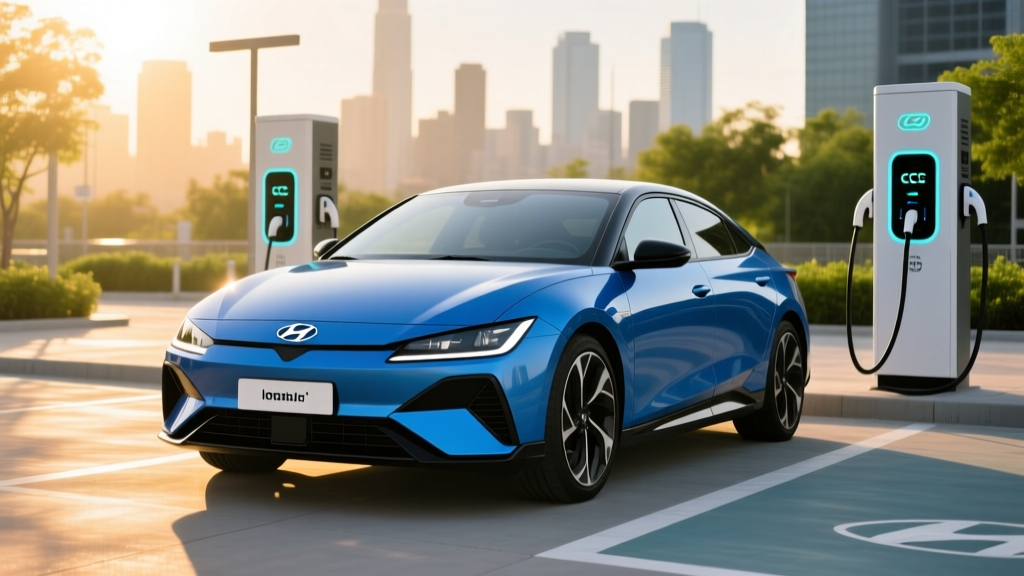
Search forums and EV communities long enough and you'll find enthusiasts referring to the base Hyundai Ioniq 6 SE Standard Range as the "Naked Gun" — a stripped-down, no-frills, point-and-shoot electric sedan that delivers flagship efficiency without the feature bloat. It's not an official Hyundai trim name, but the nickname has stuck for good reason: in an era where EVs keep adding weight, screens, and six-figure price tags, the entry-level Ioniq 6 is a deliberate exercise in less-is-more. For 2026, Hyundai continues this approach, and the result is one of the most aerodynamically efficient and affordable long-range electric sedans on the market. Here's exactly what you get — and what you give up.
Quick Verdict: The Efficiency King That Asks You to Compromise
The Hyundai Ioniq 6 SE Standard Range (the "Naked Gun" of the lineup) pairs a 53.0 kWh battery with rear-wheel drive to achieve an EPA-estimated 240 miles of range and a staggering 140 MPGe combined. Step up to the SE Long Range with the 77.4 kWh pack and you're looking at an EPA 361 miles — among the highest of any production EV sedan. The trade-off? The base car comes without heated seats, a heat pump, or advanced driver assists beyond the basics. It's an EV for the spec-sheet pragmatist who values dollars-per-mile of range over luxury appointments.
Range, Efficiency, and the Real-World Reality Check
| Trim | EPA Range | Real-World Highway | Cold Weather (20°F) |
|---|---|---|---|
| SE Standard Range (RWD, 53.0 kWh) | 240 mi | ~205–220 mi | ~170–190 mi |
| SE/SEL Long Range (RWD, 77.4 kWh) | 361 mi | ~300–320 mi | ~250–280 mi |
| SEL/Limited AWD (77.4 kWh) | 316 mi | ~270–290 mi | ~220–250 mi |
Real-world figures based on mixed highway driving at 70–75 mph. Cold-weather estimates assume no garage preconditioning. Source: fueleconomy.gov
The Ioniq 6's secret weapon is its drag coefficient of just 0.21 Cd — among the slipperiest production cars ever built. That teardrop shape, combined with active grille shutters and a smooth underbody, means the Ioniq 6 sips electrons at a rate of roughly 24–25 kWh per 100 miles on the Long Range RWD model. In our experience, that translates to genuine 300+ mile highway road-trip legs if you're driving at posted speed limits and not hammering the accelerator.
Where the "Naked Gun" Standard Range model gets tricky is cold weather. Without the optional heat pump (standard on higher trims), cabin heating draws directly from the traction battery, and range losses of 25–35% in sub-freezing temperatures are realistic. If you live in Minnesota or Massachusetts, the Standard Range car's 240-mile EPA sticker can shrink to a sobering 170 miles on a January commute. For Sun Belt buyers, this matters far less.
Battery, Charging, and the 800V Advantage
| Spec | Standard Range | Long Range / AWD |
|---|---|---|
| Battery Capacity (usable) | 53.0 kWh | 77.4 kWh |
| Chemistry | NMC (Nickel Manganese Cobalt) | NMC (Nickel Manganese Cobalt) |
| Architecture | 800V (E-GMP platform) | 800V (E-GMP platform) |
| Max DC Fast-Charge Rate | ~150 kW (peak) | ~240 kW (peak) |
| 10–80% DC Fast Charge | ~20 minutes | ~18 minutes |
| Level 2 Home Charging (240V) | 10.9 kW (~34 mi/hr) | 10.9 kW (~34 mi/hr) |
| Level 1 Trickle (120V) | ~1.4 kW (~4 mi/hr) | ~1.4 kW (~4 mi/hr) |
Hyundai's E-GMP platform uses an 800-volt electrical architecture — the same tech found in Porsche's Taycan and Kia's EV6 — which allows dramatically faster DC charging compared to the 400V systems in rivals like the Tesla Model 3 (which uses a proprietary architecture but achieves similar speeds). On a 350 kW Electrify America or compatible CCS1 station, the Long Range Ioniq 6 peaks near 240 kW and can add 10–80% in roughly 18 minutes.
A critical nuance many spec sheets gloss over: the charge curve taper. The Ioniq 6 holds its peak rate up to approximately 55–60% State of Charge (SoC), then progressively tapers. Charging from 80–100% on DC fast charging can add another 20+ minutes, which is why we recommend planning road-trip stops around 10–80% sessions. Preconditioning the battery — which the Ioniq 6 does automatically when a DC fast charger is set as your navigation destination — is essential for hitting peak charge rates in cold or moderate weather.
At home on a Level 2 (240V/48A) charger, the 77.4 kWh pack fills from empty in about 7–8 hours, which means a standard overnight session easily restores a full day's driving. Installation of a home Level 2 charger typically runs $500–$1,500 for equipment plus $800–$2,500 for electrician labor, depending on your panel capacity and run length.
Performance: Quick Enough, Not a Sports Sedan
| Metric | Std Range RWD | Long Range RWD | AWD (Dual Motor) |
|---|---|---|---|
| Horsepower | 149 hp | 225 hp | 320 hp |
| Torque | 258 lb-ft | 258 lb-ft | 446 lb-ft |
| 0–60 mph | ~8.0 sec | ~6.2 sec | ~4.5 sec |
| Drivetrain | Rear-Wheel Drive | Rear-Wheel Drive | Dual-Motor AWD |
| Top Speed | 115 mph | 115 mph | 115 mph |
The "Naked Gun" Standard Range model with its 149 hp single motor is adequate for commuting and city driving but noticeably soft on highway merges. This is the one area where the stripped-down approach is most felt. The Long Range RWD at 225 hp is the sweet spot — brisk enough for confident overtaking and still delivers the full 361-mile range. The AWD model sacrifices about 45 miles of range for a genuinely quick 4.5-second sprint, putting it in sports-sedan territory.
Ride quality across the lineup is firm but compliant, with Hyundai tuning the suspension for efficiency-oriented comfort rather than corner-carving dynamics. Regenerative braking offers four levels adjustable via steering-wheel paddles, including a near-one-pedal mode (i-Pedal) that can bring the car to a complete stop without touching the brake pedal.
Interior Space, Cargo, and the Design Trade-Offs
The Ioniq 6's swooping roofline looks stunning in photos but creates real compromises inside. Here are the hard numbers:
- Front headroom: 40.2 inches (adequate for most adults)
- Rear headroom: 37.1 inches (tight for passengers over 6'0")
- Rear legroom: 35.7 inches (competitive with Model 3)
- Trunk cargo: 11.3 cu ft (small — the sloping roofline eats into volume)
- Frunk (front trunk): 0.5 cu ft RWD / 0.2 cu ft AWD (barely fits a charging cable)
Compared to the Hyundai Ioniq 5 crossover (which offers 27.2 cu ft behind the rear seats), the Ioniq 6 sedan's cargo area is a clear step down. If you regularly haul strollers, golf bags, or Costco runs, this is a genuine limitation. The trunk opening is also narrow, making bulky items awkward to load.
Interior materials on the base SE are cloth with hard-touch plastics on the lower door panels and dash. It's durable and inoffensive but not luxurious. Higher trims add eco-processed leather, ambient lighting, and a more premium feel. All trims get dual 12-inch displays (instrument cluster and infotainment), wireless Apple CarPlay and Android Auto, and physical climate control buttons — a welcome decision Hyundai made versus the touch-only approach some competitors have adopted.
Pricing, Trims, and Federal Tax Credit Eligibility
| Trim | 2026 MSRP (est.) | Drivetrain | Federal §30D Credit | Effective Price |
|---|---|---|---|---|
| SE Standard Range | ~$38,650 | RWD | Up to $3,750* | ~$34,900 |
| SE Long Range | ~$43,500 | RWD | Up to $3,750* | ~$39,750 |
| SEL Long Range | ~$47,250 | RWD | Up to $3,750* | ~$43,500 |
| SEL AWD | ~$50,500 | AWD | Up to $3,750* | ~$46,750 |
| Limited AWD | ~$54,600 | AWD | Up to $3,750* | ~$50,850 |
- Maximum credit: Up to $7,500, split into $3,750 for battery components (North America assembly) + $3,750 for critical minerals sourcing.
- Hyundai Ioniq 6 status: Assembled in South Korea (not North America), the Ioniq 6 does NOT qualify for the full $7,500 new-vehicle credit under current §30D rules. Some partial credit may apply depending on annual critical-minerals sourcing updates — verify at irs.gov.
- MSRP cap: Sedans must be under $55,000 MSRP (the Limited AWD at ~$54,600 squeaks under this cap).
- Buyer income cap: AGI must not exceed $150,000 (single), $225,000 (head of household), or $300,000 (joint).
- Point-of-sale transfer: If eligible, the credit can be transferred to the dealer at purchase, reducing your out-of-pocket cost immediately.
- Lease loophole: Leased EVs may qualify for the commercial clean vehicle credit (§45W) regardless of assembly location, which leasing companies often pass through as reduced payments. This has been a popular path for Ioniq 6 lessees.
Tax rules change. Consult a tax professional and verify current eligibility at irs.gov before purchasing.
The "Naked Gun" value proposition is clearest at the SE Standard Range trim: under $39K before any incentives, with 240 miles of range, 800V charging, and a full suite of safety features. For buyers who can charge at home and whose daily commute is under 100 miles round-trip, this trim delivers an unmatched cost-per-mile-of-range ratio. The Long Range SE at ~$43,500 is the enthusiast's pick — 361 miles of EPA range with the quick-charge advantage of the larger battery.
Tech, Safety, and Driver Assistance
Every Ioniq 6 comes standard with Hyundai SmartSense, which includes:
- Forward collision-avoidance assist with pedestrian detection
- Lane keeping assist and lane following assist
- Blind-spot collision-avoidance assist
- Rear cross-traffic collision-avoidance assist
- Intelligent speed limit assist
- Highway driving assist (HDA) — a Level 2 system combining adaptive cruise with lane centering on divided highways
Highway Driving Assist (HDA) is a Level 2 driver-assistance system. You must keep your hands on the wheel and eyes on the road at all times. It is NOT autonomous driving. Hyundai does not currently offer a hands-free Level 3 system on the Ioniq 6 in the U.S. market.
The infotainment system uses Hyundai's latest ccNC (connected car Navigation Cockpit) software on SEL and above trims, with over-the-air updates, digital key support, and a responsive 12-inch touchscreen. The base SE uses the previous-generation interface, which is functional but looks dated. Wireless CarPlay/Android Auto works across all trims — a feature Tesla still doesn't offer.
Notable tech drawbacks: no rear wiper (the sloping rear glass relies on aerodynamics to shed water, which works imperfectly), and the camera-based digital side mirrors available in some markets are not offered in the U.S. due to regulatory restrictions.
Ioniq 6 vs. the Competition: Where It Wins and Loses
| Attribute | Ioniq 6 SE LR (RWD) | Tesla Model 3 LR (AWD) | Polestar 2 LR SM |
|---|---|---|---|
| EPA Range | 361 mi | 341 mi | 310 mi |
| Base MSRP | ~$43,500 | ~$47,740 | ~$49,900 |
| MPGe (combined) | 140 MPGe | 125 MPGe | 107 MPGe |
| Max DC Charge | ~240 kW | ~250 kW | ~205 kW |
| 10–80% Time | ~18 min | ~18 min | ~25 min |
| 0–60 mph | 6.2 sec | 4.2 sec | 5.9 sec |
| Charging Network | CCS1 (EA, EVgo, etc.) | NACS (Supercharger + adapters) | CCS1 (EA, EVgo, etc.) |
| Tax Credit (Purchase) | Limited* | Up to $7,500 | Limited* |
The Ioniq 6 wins decisively on efficiency (140 MPGe crushes the field) and range-per-dollar. The Model 3 counters with access to the Tesla Supercharger network (the most reliable DC fast-charging network in North America), stronger performance in AWD form, and potential full tax-credit eligibility since it's assembled in Fremont, CA. The Polestar 2 offers a more premium interior and Scandinavian design but can't match the Ioniq 6 on range or charging speed.
One growing concern for Ioniq 6 buyers: the industry's shift to the NACS (Tesla) charging connector. Hyundai has confirmed future models will adopt NACS, but the current Ioniq 6 uses CCS1. You can charge at Tesla Superchargers using a CCS-to-NACS adapter (sold separately, ~$200–$250), but native NACS vehicles get a more seamless experience. This is a meaningful factor if you road-trip frequently and rely on the Supercharger network.
Warranty and Long-Term Ownership
| Coverage | Term |
|---|---|
| New Vehicle Limited Warranty | 5 years / 60,000 miles |
| EV Battery & Powertrain | 10 years / 100,000 miles |
| Battery Capacity Retention Threshold | 70% of original capacity |
| Corrosion Perforation | 7 years / unlimited miles |
| Roadside Assistance | 5 years / unlimited miles |
Hyundai's 10-year/100,000-mile battery warranty is among the best in the industry, matching Kia and surpassing Tesla's 8-year/120,000-mile coverage. The 70% capacity retention threshold is standard — if your battery degrades below 70% of its original capacity within the warranty period, Hyundai will repair or replace it. Based on data from the E-GMP platform (shared with the Ioniq 5 and Kia EV6), real-world degradation has been modest: most owners report 3–6% loss over the first 50,000 miles, well within the warranty buffer.
Who Should Buy the Ioniq 6 "Naked Gun"?
- Your daily commute is under 80 miles round-trip
- You live in a mild climate (heat pump absence matters less)
- You can install a Level 2 home charger
- You prioritize lowest purchase price and maximum efficiency
- You don't need AWD or rapid acceleration
- You road-trip more than a few times a year
- You experience cold winters (larger battery buffers range loss)
- You want the 225 hp motor for confident highway merging
- You plan to keep the car 8+ years (larger batteries degrade more gracefully in absolute terms)
- You need maximum cargo space (consider the Ioniq 5 or EV9)
- Supercharger network access is critical to your use case (consider Model 3 or wait for NACS-equipped Hyundais)
- You want a full $7,500 federal tax credit on purchase (consider U.S.-assembled options)
Pros and Cons at a Glance
- Class-leading 140 MPGe efficiency (Long Range RWD)
- 800V architecture enables 18-min 10–80% DC charging
- 361-mile EPA range (Long Range RWD) is top-tier for the price
- 10-year/100,000-mile battery warranty
- Physical buttons for climate and volume — excellent ergonomics
- Under $39K entry price for the Standard Range
- Quiet, refined ride quality at highway speeds
- CCS1 connector (not native NACS — requires adapter for Superchargers)
- Tight rear headroom and small 11.3 cu ft trunk
- Standard Range lacks heat pump — cold-weather range suffers
- Limited federal tax credit eligibility (South Korea assembly)
- 149 hp on Standard Range feels underpowered for highway driving
- No rear wiper
- Base SE infotainment looks dated vs. ccNC on higher trims
Frequently Asked Questions
What is the real-world range of the Hyundai Ioniq 6?
The Long Range RWD achieves an EPA-estimated 361 miles, and in real-world highway driving at 70–75 mph you can expect approximately 300–320 miles. In cold weather (20°F or below), plan for 250–280 miles. The Standard Range model's 240-mile EPA figure drops to roughly 205–220 miles on the highway and 170–190 miles in deep cold without a heat pump.
How fast does the Ioniq 6 charge at home and on the road?
On a DC fast charger, the Long Range model peaks at approximately 240 kW and charges from 10–80% in about 18 minutes. At home on a Level 2 (240V) charger, the onboard 10.9 kW charger adds roughly 34 miles of range per hour, filling the 77.4 kWh battery from empty in about 7–8 hours.
Does the Hyundai Ioniq 6 qualify for the federal EV tax credit?
Under current IRS §30D rules, the Ioniq 6's eligibility is limited because it is assembled in South Korea, not North America. It does not qualify for the $3,750 battery-component portion of the credit. Depending on annual critical-minerals sourcing updates, partial credit (up to $3,750) may be available. Leasing may unlock the commercial vehicle credit (§45W) regardless of assembly location. Always verify current rules at fueleconomy.gov and consult a tax professional.
Is the Ioniq 6 worth buying over a Tesla Model 3?
If efficiency and range-per-dollar are your priorities, the Ioniq 6 Long Range RWD (140 MPGe, 361 miles, ~$43,500) is the stronger value proposition. If you need Supercharger network access, stronger performance, or full tax-credit eligibility, the Model 3 Long Range AWD (~$47,740, 341 miles, up to $7,500 credit) may be the better fit. The Ioniq 6 also offers physical buttons and a more traditional sedan driving experience, while the Model 3 leans into minimalist design and Autopilot functionality.
What's the biggest drawback of the Ioniq 6 "Naked Gun" base model?
The 149 hp motor on the Standard Range model feels underpowered for highway driving, and the absence of a heat pump means cold-weather range losses are more severe than on higher trims. If you live in a cold climate or regularly drive at highway speeds, the Long Range model's additional $4,850 is a worthwhile investment.
How long will the Ioniq 6 battery last?
Hyundai warrants the battery for 10 years or 100,000 miles against degradation below 70% of original capacity. Based on E-GMP platform data from the Ioniq 5 and Kia EV6, most owners report 3–6% degradation over the first 50,000 miles. With proper care (avoiding repeated 100% charges and minimizing DC fast charging in extreme heat), the NMC battery should comfortably exceed 150,000 miles before approaching the warranty threshold.