2026 Hyundai Ioniq 6 N: The Performance EV Sedan That Means Business
Hyundai's N performance division has a reputation for building driver-focused machines, and the Ioniq 6 N is their electric halo. Built on the E-GMP platform shared with the Ioniq 5 N, this aerodynamic sedan channels up to 641 horsepower through a dual-motor all-wheel-drive system while attempting to solve the classic performance-EV problem: sustaining repeated hard laps without thermal derating. If you're searching for Ioniq 6 N hp figures and wondering whether the numbers translate to real driving, this review covers every spec that matters — plus the ownership realities Hyundai's marketing won't emphasize.
Range Reality Check
EPA Estimated Range: 260 miles (N-specific 21-inch wheels, performance tires)
Real-World Expectation: Plan for 210–230 miles on highway road trips at 70–80 mph. In freezing temperatures (below 32°F), expect 175–200 miles without preconditioning. Track use will consume range dramatically faster — budget 3–4 miles per lap at a typical road course.
That range figure sits well below the standard Ioniq 6 Long Range (up to 361 miles EPA), but the trade-off buys you N-tuned suspension, massive brakes, and an 84 kWh battery pack pushed harder than any other Hyundai EV. Let's unpack what you're actually getting.
Ioniq 6 N Specs: Horsepower, Battery, and Performance Data
| Specification | 2026 Ioniq 6 N |
|---|---|
| Max Horsepower (N Grin Boost) | 641 hp (601 hp standard) |
| Torque | 568 lb-ft |
| 0-60 mph | 3.2 seconds |
| Top Speed | 162 mph (electronically limited) |
| Drivetrain | Dual-motor AWD |
| Battery Capacity (usable) | 84.0 kWh |
| Battery Chemistry | NMC (Nickel Manganese Cobalt) |
| EPA Range | 260 miles |
| Combined MPGe | 89 MPGe |
| Efficiency | 38 kWh/100 mi |
| Curb Weight | ~4,900 lbs |
| Base MSRP | $72,900 |
The headline number is 641 horsepower, but that figure requires engaging N Grin Boost — a temporary overboost mode that unlocks maximum output for short bursts. In standard driving, you have 601 hp available, which is still ferocious. The dual-motor setup provides 214 hp front and 387 hp rear (standard), with N Grin Boost temporarily increasing output on both axles.
The 84 kWh NMC battery uses a high-nickel formulation optimized for discharge rate rather than energy density. This is deliberate: Hyundai's N engineers prioritized the ability to dump power quickly and repeatedly over maximizing range. The thermal management system includes an enhanced cooling circuit that preconditions the battery more aggressively than the standard Ioniq 6, which matters for both track use and fast charging.
Charging Speed: DC Fast Charge and Home Level 2
| Charging Level | Power / Rate | Time / Range Added |
|---|---|---|
| DC Fast Charge (peak) | 270 kW (800V architecture) | 10–80% in ~18 minutes |
| DC Fast Charge (sustained avg) | ~190 kW (10–80%) | ~150 miles in 15 min |
| Level 2 Home (11 kW onboard) | 11 kW / 48A | ~32 miles per hour of charging |
| Level 2 Home (7.7 kW / 32A) | 7.7 kW | ~22 miles per hour of charging |
| Level 1 (120V household) | 1.4 kW | ~4 miles per hour |
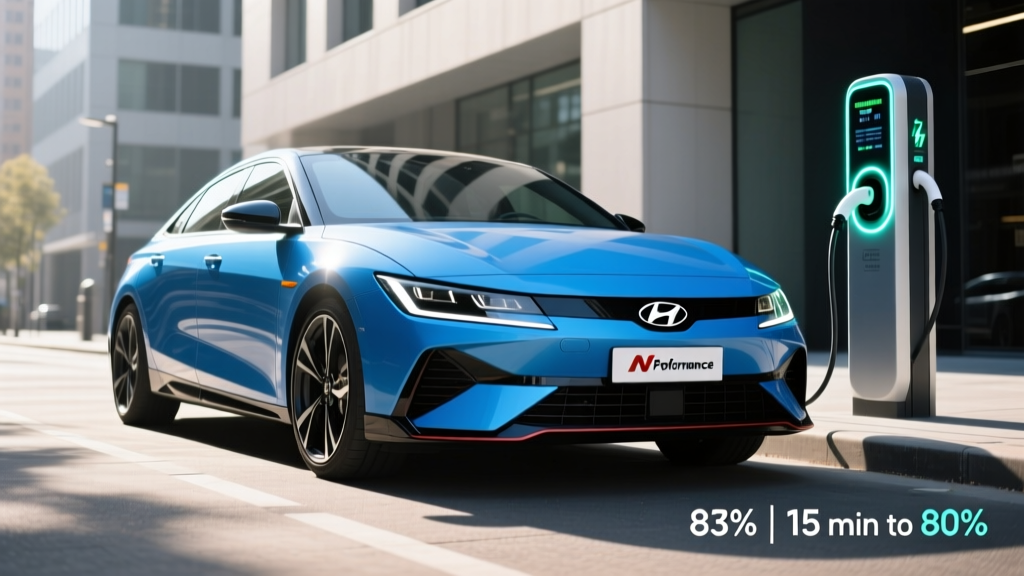
The Ioniq 6 N's 800-volt electrical architecture is one of its most practical features. On a 350 kW-capable DC fast charger (like Electrify America's latest stalls), the Ioniq 6 N peaks near 270 kW and can add 10–80% state of charge in approximately 18 minutes under ideal conditions. That said, peak kW is not sustained kW. The charge curve tapers significantly above 60% SoC to protect the NMC cells, so your real-world average from 10–80% is closer to 190 kW. Still, that's among the fastest charging rates in any production EV under $100,000.
For home charging, the 11 kW onboard charger means a full charge from empty in roughly 7.5 hours on a 48-amp Level 2 circuit (requiring a 60-amp breaker). Most Ioniq 6 N owners will plug in overnight and wake up full — the 260-mile range is more than adequate for daily driving, even with an aggressive right foot.
Connector note: The 2026 Ioniq 6 N ships with the NACS (Tesla-style) charge port as standard in the US market, giving native access to Tesla Supercharger stalls (V3 and V4) without an adapter. A CCS adapter is included for legacy Electrify America and other CCS-only networks.
Real-World Range: What 260 EPA Miles Actually Means
The 260-mile EPA estimate is measured on a blended cycle that includes low-speed city driving where regenerative braking recovers significant energy. Here's how that translates to real scenarios:
- City commuting (stop-and-go): 270–290 miles. Regen braking in traffic actually extends range beyond the EPA figure.
- Highway cruising (70 mph, 72°F): 220–240 miles. The Ioniq 6's slippery 0.21 Cd drag coefficient helps, but the N's stickier 275/35R21 Pirelli P Zero tires add rolling resistance.
- Highway cruising (80 mph, 72°F): 200–215 miles. Aerodynamic drag increases with the square of speed.
- Cold weather highway (32°F, heater on): 170–195 miles. The heat pump helps, but battery chemistry slows and cabin heating draws 2–4 kW continuously.
- Track day (road course): 60–90 miles of equivalent range per hour of lapping. Plan pit stops accordingly.
For context, a source at fueleconomy.gov confirms the Ioniq 6 N's combined efficiency at 38 kWh/100 mi — roughly 40% thirstier than the standard Ioniq 6 SE Long Range (26 kWh/100 mi). That's the cost of 641 hp, heavier brakes, and stickier rubber.
Pricing, Trims, and Federal Tax Credit Eligibility
| Item | Amount |
|---|---|
| Base MSRP (Ioniq 6 N) | $72,900 |
| Destination charge | $1,295 |
| As-tested (with N Performance package) | ~$76,500 |
| Federal §30D tax credit (if eligible) | Up to $7,500 |
| Effective price after max credit | ~$65,400–$69,000 |
The 2026 Ioniq 6 N starts at $72,900 before destination. There is effectively one trim level, though Hyundai offers an N Performance package (lightweight forged wheels, carbon-fiber aero bits, Alcantara interior accents) that pushes the as-tested price to approximately $76,500.
Federal tax credit (§30D) eligibility is conditional. According to IRS guidelines, the Ioniq 6 N must satisfy multiple requirements:
- MSRP cap: Sedars are capped at $55,000 for the full credit — the Ioniq 6 N at $72,900 exceeds this cap and does NOT qualify for the new-vehicle §30D credit.
- Buyer income limits: AGI must not exceed $150,000 (single) / $300,000 (joint) — moot here given the MSRP cap.
- Battery sourcing: Critical mineral and component requirements must be met — irrelevant given the MSRP disqualification.
- Point-of-sale transfer: Available for qualifying vehicles — not applicable here.
Bottom line on incentives: The Ioniq 6 N does not qualify for the $7,500 federal new-vehicle tax credit due to its MSRP exceeding the $55,000 sedan cap. Some state-level incentives (California's CVRP, Colorado's state credit) may still apply, and the used-EV credit (§25E) could apply in future years if the vehicle drops below the $25,000 used cap. Check your state's current programs — rules vary by jurisdiction and change frequently.
Interior, Cargo, and Daily Livability
The Ioniq 6 N shares its cabin architecture with the standard Ioniq 6, meaning you get Hyundai's dual 12.3-inch panoramic display setup, physical climate controls (a welcome choice), and N-specific sport bucket seats with enhanced bolsters. The N variant adds:
- N-branded steering wheel with N Grin Boost button and drive-mode dials
- Aluminum pedals and N-specific digital instrument cluster layouts
- Active sound design (N e-Shift simulates gear changes with synthetic engine notes — toggleable)
- Rear-seat USB-C ports and 64-color ambient lighting
Cargo space remains a known compromise of the Ioniq 6's streamlined roofline:
- Trunk: 11.2 cu ft (sedan trunk, not a hatchback)
- Frunk (front trunk): 0.7 cu ft (small — fits a charging cable bag)
- Rear legroom: 35.0 inches (adequate for adults, tighter than an Ioniq 5)
- Rear headroom: 37.0 inches (the sloping roofline cuts into space for taller passengers)
If cargo versatility is a priority, the Ioniq 5 N (hatchback, 27.2 cu ft behind rear seats) is substantially more practical. The Ioniq 6 N is a sedan first, performance machine second — and that trunk lid is genuinely small for road trips with more than two people.
Driving Dynamics, Tech, and Safety Systems
The Ioniq 6 N's chassis is where the N badge earns its keep. Key hardware includes:
- N-tuned adaptive dampers with electronically controlled stiffness
- Front and rear electronic limited-slip differentials (e-LSD)
- N Drift Optimizer (torque-vectoring for controlled oversteer — track use only)
- Regenerative braking with N-specific tuning and one-pedal driving capability
- 21-inch forged alloy wheels with Pirelli P Zero N-spec tires (275/35R21)
- 4-piston front brake calipers with 400 mm rotors
The N e-Shift system deserves specific mention. It simulates an 8-speed dual-clutch transmission, complete with synthetic shift shocks, rev-matching on downshifts, and a "redline" that limits power until you pull the paddle. Enthusiasts are divided — some find it gimmicky, others say it adds engagement on back roads. Fortunately, it's fully defeatable.
Driver assistance (SAE Level 2): The Ioniq 6 N includes Hyundai's Highway Driving Assist 2 (HDA2), which combines adaptive cruise control with lane-centering on divided highways. This is a Level 2 system — you must keep your hands on the wheel and eyes on the road. It is not autonomous driving. HDA2 performs well in highway traffic but requires active driver supervision at all times.
Safety ratings: The standard Ioniq 6 earned an IIHS Top Safety Pick+ designation. The N variant shares the same body structure; Hyundai has confirmed it targets equivalent crash performance, though N-specific testing results should be verified on iihs.org when published for the 2026 model year.
Ioniq 6 N vs. Competitors: How Does It Stack Up?
| Spec | Ioniq 6 N | Tesla Model 3 Performance | BMW i4 M50 |
|---|---|---|---|
| Horsepower | 641 hp | 510 hp | 536 hp |
| 0-60 mph | 3.2 sec | 2.9 sec | 3.7 sec |
| EPA Range | 260 mi | 315 mi | 227 mi |
| Battery (usable) | 84 kWh NMC | 75 kWh NMC | 81.5 kWh NMC |
| Peak DC Charge | 270 kW | 250 kW | 200 kW |
| 10-80% Time | ~18 min | ~22 min | ~31 min |
| Base MSRP | $72,900 | $54,990 | $69,700 |
| Federal Credit | No (MSRP cap) | Yes (if eligible) | No (MSRP cap) |
The Tesla Model 3 Performance is the value benchmark — quicker to 60, longer range, and eligible for the federal credit, all for $18,000 less. But the Ioniq 6 N counters with superior chassis hardware (e-LSDs, adaptive dampers, drift mode), faster 800V charging, and a more engaging driver experience. The BMW i4 M50 is a luxury play but charges slower and costs nearly as much.
Choose the Ioniq 6 N if you prioritize track-capable chassis dynamics, 800V charging speed, and analog-feeling controls over maximum range and value. Choose the Model 3 Performance if range, price, and software ecosystem matter more.
Warranty Coverage and Long-Term Ownership
Hyundai backs the Ioniq 6 N with the same warranty structure as its mainstream EVs:
- Battery warranty: 10 years / 100,000 miles (capacity retention above 70% of original)
- Powertrain warranty: 10 years / 100,000 miles
- New-vehicle limited warranty: 5 years / 60,000 miles
- Roadside assistance: 5 years / unlimited miles
The 10-year battery warranty is among the best in the industry and covers degradation below 70% state of health. Given the NMC chemistry and the aggressive thermal management, long-term degradation data from early Ioniq 5 N owners suggests 5–8% loss over the first 50,000 miles under normal use. Track-heavy use may accelerate this — Hyundai's warranty language excludes "competition use," so repeated track days are a gray area worth discussing with your dealer.
Pros
- 641 hp with N Grin Boost is genuinely thrilling
- 800V architecture enables 270 kW peak charging — best in class
- N-tuned chassis with e-LSDs and adaptive dampers
- 10-year/100,000-mile battery warranty
- NACS native — no adapter needed for Superchargers
- Physical buttons for climate and drive modes
Cons
- 260-mile EPA range is modest for a $73K EV
- Trunk is small (11.2 cu ft) — sedan, not hatch
- Does NOT qualify for $7,500 federal tax credit (MSRP cap)
- 21-inch performance tires are expensive to replace (~$350 each)
- Frunk is nearly useless (0.7 cu ft)
- Rear headroom is tight for passengers over 6'0"
Who Should Buy the Ioniq 6 N?
Choose the Ioniq 6 N if: You want a daily-drivable performance sedan with genuine track capability, value fast 800V charging for road trips, and don't need hatchback cargo space. You understand the range trade-off and have reliable home charging.
Look elsewhere if: Maximum range is your priority (get the standard Ioniq 6 SE LR at 361 mi), you need cargo versatility (Ioniq 5 N or Model Y Performance), you want federal tax credit eligibility (Model 3 Performance), or you regularly carry tall rear passengers.
Frequently Asked Questions
What is the real-world range of the Ioniq 6 N?
The EPA rates it at 260 miles, but expect 210–230 miles on highway trips and as little as 170–195 miles in cold weather. City driving with regenerative braking can stretch it to 270+ miles.
How fast does the Ioniq 6 N charge?
On a 350 kW DC fast charger, it peaks at 270 kW and charges 10–80% in about 18 minutes. At home on Level 2 (11 kW), a full charge takes roughly 7.5 hours.
Does the Ioniq 6 N qualify for the federal EV tax credit?
No. The $7,500 §30D credit has a $55,000 MSRP cap for sedans, and the Ioniq 6 N's $72,900 sticker exceeds it. State incentives may still apply — check your local programs.
How much horsepower does the Ioniq 6 N produce?
641 hp with N Grin Boost engaged (temporary overboost). In standard driving modes, it produces 601 hp. Both figures are combined front and rear motor output.
Is the Ioniq 6 N worth it vs. the Tesla Model 3 Performance?
The Model 3 Performance is faster to 60, has more range (315 mi), and costs $18,000 less while qualifying for the federal credit. The Ioniq 6 N wins on chassis dynamics, charging speed, and driver engagement. It depends on whether you value track hardware or value and range.
What is the battery warranty on the Ioniq 6 N?
Hyundai covers the 84 kWh battery for 10 years or 100,000 miles, guaranteeing at least 70% of original capacity retention over that period.
Does the Ioniq 6 N use NACS or CCS?
The 2026 US-market Ioniq 6 N ships with a native NACS (Tesla-style) charge port. A CCS adapter is included for non-Tesla DC fast-charging networks.