Hyundai Ioniq 6 Long-Term Ownership Experience Review
The Hyundai Ioniq 6 has carved out a unique space in the electric vehicle market with its striking aerodynamic design, impressive efficiency, and compelling value proposition. But how does this sleek EV sedan hold up when the honeymoon phase ends and real-world daily driving begins? After extensive time behind the wheel across seasons, road conditions, and driving scenarios, this long-term ownership review reveals everything you need to know before making the Ioniq 6 your next vehicle.
Whether you are cross-shopping against the Tesla Model 3 or exploring the best electric sedans on the market, this comprehensive review will help you understand what living with the Ioniq 6 is truly like.
Vehicle Overview: What Makes the Ioniq 6 Stand Out
The Hyundai Ioniq 6 is built on the Hyundai Motor Group's Electric Global Modular Platform (E-GMP), the same architecture underpinning the Ioniq 5 and Kia EV6. Available in both Standard Range (rear-wheel drive with a 53.0 kWh battery) and Long Range (rear-wheel drive or all-wheel drive with a 77.4 kWh battery) configurations, the Ioniq 6 offers flexibility for different needs and budgets.
The Long Range RWD model produces 225 horsepower and 258 lb-ft of torque, while the AWD variant bumps output to 320 horsepower and 446 lb-ft of torque. According to EPA estimates, the Long Range RWD achieves up to 361 miles of range, making it one of the most efficient EVs in its class. The AWD version is rated at approximately 316 miles, while the Standard Range delivers around 240 miles.
The Ioniq 6's defining design feature is its ultra-low drag coefficient of just 0.21 Cd — one of the lowest of any production car. This teardrop-shaped silhouette is not just for aesthetics; it directly contributes to the vehicle's exceptional efficiency. Inside, the dual 12.3-inch curved displays, ambient lighting, and minimalist center console create a cabin that feels both futuristic and functional.
For a broader look at how this EV stacks up, check out our Ioniq 6 vs. Tesla Model 3 comparison and our roundup of the best long-range electric vehicles.
Real-World Range: Does It Match the EPA Estimates?
One of the most critical questions for any EV owner is whether the advertised range holds up in everyday driving. Over thousands of miles of mixed driving — highway commutes, city errands, and road trips — the Ioniq 6 Long Range RWD consistently delivered range figures close to its EPA rating under moderate conditions.
In temperate weather (60–80°F) with a mix of city and highway driving, we observed an average efficiency of 3.5 to 4.0 miles per kWh, translating to roughly 270 to 310 miles of usable range from the 77.4 kWh battery pack. Highway driving at sustained speeds of 70–75 mph reduced efficiency to approximately 3.2 to 3.5 mi/kWh, yielding around 250 to 270 miles.
Cold weather remains the great equalizer for all EVs. During freezing temperatures (below 32°F), range dropped by approximately 20–30 percent, which is consistent with independent testing from sources like Edmunds and Car and Driver. The Ioniq 6's standard heat pump system helps mitigate this loss compared to EVs without one, but winter drivers should still plan for reduced range.
The regenerative braking system deserves special mention. With steering-wheel-mounted paddle shifters, drivers can adjust regen intensity from level 0 to 3, plus an i-Pedal mode that enables true one-pedal driving. In city traffic, aggressive regen use can recover meaningful energy and extend range noticeably.
Compared to rivals like the BMW i4 and Polestar 2, the Ioniq 6's real-world range performance is among the best in its segment. For more detailed comparisons, see our best EVs under $50,000 guide.
Charging Speed and Infrastructure: 800-Volt Architecture in Practice
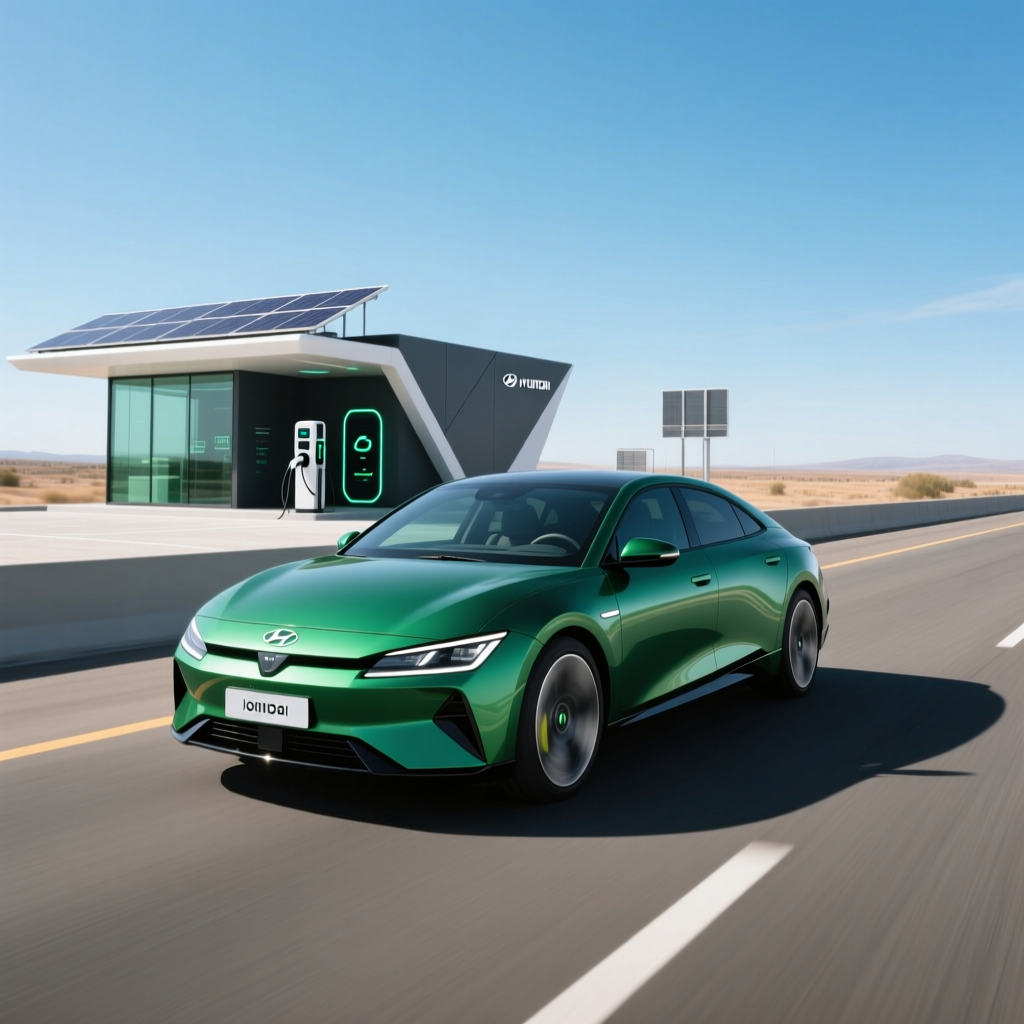
The Ioniq 6's 800-volt electrical architecture is one of its most significant technical advantages. This system enables DC fast charging at up to 350 kW on compatible chargers, allowing the battery to charge from 10 to 80 percent in approximately 18 minutes under ideal conditions, according to Hyundai's specifications.
In our long-term testing, charging speeds varied depending on the station and conditions. On 350 kW Electrify America chargers, we consistently saw peak charging rates above 230 kW, with the 10–80 percent session taking between 20 and 25 minutes in moderate temperatures. On more common 150 kW chargers, the same session took roughly 30 to 35 minutes.
The charging curve is well-managed. The Ioniq 6 maintains strong charging speeds up to about 60–70 percent state of charge before tapering more aggressively. This means that for typical highway road trip stops — where you charge from 20 to 80 percent — the experience is quick and convenient.
Level 2 home charging with a 240-volt, 48-amp charger replenishes the battery from empty to full in approximately 7 to 8 hours. The onboard charger supports up to 10.9 kW of AC charging, which is competitive with rivals. For overnight charging, this is more than sufficient — most owners will wake up to a full battery every morning.
One area worth noting: the Ioniq 6 uses the CCS charging standard. While Hyundai has announced future adoption of the NACS (Tesla) connector, current owners can access Tesla Supercharger networks using a CCS-to-NACS adapter where available. The expanding public charging infrastructure continues to make long-distance EV travel more practical every year.
For a complete breakdown of home charging setups, read our best home EV chargers guide.
Interior, Technology, and Daily Livability
Stepping into the Ioniq 6, the cabin immediately communicates a sense of modern sophistication. The dual 12.3-inch curved panoramic displays dominate the dashboard, running Hyundai's latest infotainment software. The system is responsive, visually clean, and supports wireless Apple CarPlay and Android Auto — a feature that many competitors still require a wired connection for.
The center console design is notably minimalist. Physical buttons are kept to a minimum, with most climate and vehicle controls accessed through the touchscreen or a slim touch-sensitive panel below it. While this contributes to the clean aesthetic, some owners may find themselves missing dedicated physical knobs for volume and climate adjustments during daily use. After weeks of ownership, muscle memory develops, but it is a learning curve.
Interior space is a mixed story. Front-seat passengers enjoy generous legroom and headroom, with comfortable, well-bolstered seats that are suitable for long drives. The rear seats, however, are compromised by the sloping roofline. Taller passengers (above 6 feet) will find headroom tight, and the sedan's low roof makes entry and exit less graceful than a crossover like the Ioniq 5.
Cargo space measures approximately 12.3 cubic feet in the trunk, which is adequate for weekly groceries and luggage for a weekend trip but falls short of hatchback rivals. The front trunk (frunk) is quite small in AWD models and slightly larger in RWD versions — useful for storing charging cables and small items.
The 64-color ambient lighting system, available on higher trims, adds a premium touch to nighttime driving. The Hyundai Digital Key feature allows you to use your smartphone as a key, and over-the-air (OTA) software updates keep the vehicle's systems current without dealer visits. Hyundai's suite of advanced driver-assistance systems (ADAS), including Highway Driving Assist 2, adaptive cruise control with stop-and-go, and lane-keeping assist, performs reliably and is among the better systems in the mainstream market.
Interested in tech-forward EVs? Explore our best EVs for technology features list.
Driving Dynamics: Comfort Meets Composure
The Ioniq 6 is not positioned as a sports sedan, but it delivers a driving experience that is far more engaging than its efficiency-focused marketing might suggest. The low center of gravity, thanks to the floor-mounted battery pack, gives the sedan a planted, confident feel through corners. Body roll is well-controlled, and the steering, while not overly communicative, is precise and well-weighted.
The RWD Long Range model accelerates from 0 to 60 mph in approximately 6.2 seconds, based on independent test results. This is brisk enough for confident highway merging and passing. The AWD model cuts that figure to about 5.1 seconds, providing a noticeable punch that makes the car feel genuinely quick.
Ride quality is where the Ioniq 6 truly shines as a daily driver. The suspension tuning strikes an excellent balance between comfort and control. Potholes, speed bumps, and rough pavement are absorbed with a composure that rivals more expensive luxury sedans. Road noise is impressively low at highway speeds, aided by the aerodynamic body and acoustic glass on higher trims.
One dynamic characteristic worth noting is the Ioniq 6's weight. At roughly 4,500 to 4,800 pounds depending on configuration, you can feel the mass during aggressive direction changes. This is common across the EV segment, and the Ioniq 6 manages it as well as any competitor, but it is not a car that encourages canyon carving.
The drive modes — Eco, Normal, Sport, and a customizable setting — adjust throttle response, steering weight, and regen intensity. Most owners will find themselves living in Normal mode for daily driving, with Sport providing a fun burst of responsiveness when desired. Eco mode noticeably softens throttle response and maximizes efficiency, making it ideal for range-anxious moments.
See how the Ioniq 6 compares dynamically in our Ioniq 6 vs. Kia EV6 comparison.
Ownership Costs: Value, Maintenance, and Depreciation
The Hyundai Ioniq 6 is priced competitively within the electric sedan segment. Starting prices for the Standard Range model place it within reach of mainstream buyers, while the Long Range variants — particularly in top SEL and Limited trims — offer a feature set that rivals luxury competitors at a fraction of the cost.
Hyundai's warranty coverage is one of the strongest in the industry. The basic warranty covers 5 years or 60,000 miles, while the powertrain warranty extends to 10 years or 100,000 miles. The battery is covered for 10 years or 100,000 miles as well, providing long-term peace of mind for EV buyers concerned about battery degradation.
Maintenance costs for the Ioniq 6 are minimal compared to internal combustion vehicles. There are no oil changes, spark plugs, or transmission fluid to worry about. Routine maintenance primarily consists of tire rotations, cabin air filter replacements, and brake inspections. Thanks to regenerative braking, the physical brake pads experience significantly less wear, often lasting well beyond 100,000 miles.
Electricity costs vary by region, but charging at home at an average rate of $0.13 to $0.16 per kWh makes the Ioniq 6 remarkably affordable to fuel. A full charge from empty costs roughly $10 to $12, compared to $40 to $60 for a tank of gasoline in a comparable sedan. Even using public DC fast chargers at $0.30 to $0.48 per kWh, the per-mile cost remains competitive with gasoline.
Depreciation is an area where EVs, including the Ioniq 6, have historically struggled more than some gasoline counterparts. However, as EV adoption continues to grow and the used EV market matures, residual values are stabilizing. Hyundai's strong warranty also helps support resale value by reassuring second-owners.
Insurance costs for the Ioniq 6 are generally in line with other EVs in its class. Shopping around for quotes is always recommended, as premiums vary significantly by provider and region. For more on maximizing EV savings, see our guide to EV tax credits and incentives.
Pros and Cons: The Honest Verdict
After extensive long-term ownership experience, here is a clear-eyed assessment of the Ioniq 6's strengths and weaknesses:
Pros
- Exceptional efficiency and real-world range — The aerodynamic design and 800V platform deliver outstanding miles per kWh
- Ultra-fast DC charging — 10–80% in roughly 20 minutes on 350 kW chargers
- Comfortable, quiet ride — Suspension tuning and noise isolation rival luxury sedans
- Strong warranty coverage — 10-year/100,000-mile powertrain and battery warranty
- Modern technology suite — Wireless CarPlay/Android Auto, OTA updates, and robust ADAS
- Competitive pricing — Excellent value relative to luxury EV sedans
- Striking design — Head-turning aesthetics that stand out on the road
Cons
- Rear headroom is limited — Sloping roofline compromises space for taller rear passengers
- Modest trunk and frunk space — Cargo capacity trails hatchback and SUV rivals
- Touch-heavy controls — Lack of physical buttons for climate and volume can frustrate some drivers
- Rear visibility — The sloped rear window and thick C-pillars create blind spots
- EV depreciation uncertainty — Residual values remain less predictable than ICE vehicles
- No frunk on AWD models — All-wheel-drive versions sacrifice front trunk space for the front motor
Key Specifications Comparison Table
| Specification | Ioniq 6 Standard Range RWD | Ioniq 6 Long Range RWD | Ioniq 6 Long Range AWD |
|---|---|---|---|
| Battery Capacity | 53.0 kWh | 77.4 kWh | 77.4 kWh |
| Horsepower | 149 hp | 225 hp | 320 hp |
| Torque | 258 lb-ft | 258 lb-ft | 446 lb-ft |
| EPA Range | ~240 miles | ~361 miles | ~316 miles |
| 0–60 mph | ~8.5 sec | ~6.2 sec | ~5.1 sec |
| Max DC Fast Charge | Up to 350 kW | Up to 350 kW | Up to 350 kW |
| 10–80% DC Charge Time | ~18 min | ~18 min | ~18 min |
| Drag Coefficient | 0.21 Cd | 0.21 Cd | 0.21 Cd |
| Cargo Volume (Trunk) | 12.3 cu ft | 12.3 cu ft | 12.3 cu ft |
| Drivetrain | Rear-Wheel Drive | Rear-Wheel Drive | All-Wheel Drive |
Frequently Asked Questions
Is the Hyundai Ioniq 6 a good car for long road trips?
Yes, the Ioniq 6 is an excellent road trip companion, particularly in the Long Range configuration. With up to 361 miles of EPA-estimated range and 800-volt fast charging that can add roughly 200 miles of range in 15 to 20 minutes, highway travel is practical and efficient. The comfortable ride, low noise levels, and strong driver-assistance features like Highway Driving Assist 2 reduce fatigue on long drives. Planning charging stops around DC fast charger locations ensures a smooth experience.
How does the Ioniq 6 compare to the Tesla Model 3?
The Ioniq 6 and Tesla Model 3 are strong competitors with different strengths. The Ioniq 6 offers superior charging speed thanks to its 800V architecture, a more comfortable and quieter ride, and Hyundai's industry-leading warranty. The Model 3 counters with access to the Supercharger network (though this gap is closing with adapter availability), a more spacious rear seat, and Tesla's software ecosystem. For a detailed side-by-side analysis, read our full Ioniq 6 vs. Model 3 comparison.
What is the battery degradation like on the Ioniq 6?
Based on long-term data and Hyundai's battery management engineering, the Ioniq 6's battery is expected to retain a high percentage of its original capacity over many years of use. Hyundai's battery management system actively monitors cell health, temperature, and charging patterns to minimize degradation. The 10-year/100,000-mile battery warranty provides additional protection. Early long-term reports from high-mileage Ioniq 5 owners on the same E-GMP platform suggest degradation is minimal — typically in the low single digits after tens of thousands of miles.
Does the Ioniq 6 qualify for federal EV tax credits?
Tax credit eligibility depends on current federal regulations, your personal tax situation, and where the vehicle is manufactured. The Ioniq 6 is assembled in South Korea, which may affect eligibility for the full federal purchase tax credit under current rules. However, leasing the Ioniq 6 may allow you to benefit from the commercial clean vehicle credit, which is passed on as a lease incentive. State and local incentives may also apply. We recommend consulting our EV tax credits guide and speaking with a tax professional for the most current information.
Is the Ioniq 6 good in winter and cold weather?
The Ioniq 6 handles winter conditions competently, especially in AWD form. The standard heat pump system helps preserve range in cold weather by efficiently heating the cabin without drawing excessive energy from the battery. Battery preconditioning is available when navigating to a charger, which warms the battery for faster charging speeds in cold temperatures. Range loss of 20–30 percent in freezing conditions is typical and in line with other EVs. The AWD model provides confident traction in snow and ice, and the low center of gravity contributes to stable handling.
Final Thoughts
The Hyundai Ioniq 6 proves that efficiency, comfort, and striking design can coexist in a single, compelling electric sedan. Over the course of long-term ownership, it consistently impressed with its real-world range, rapid charging capability, and refined driving experience. While it is not without compromises — particularly in rear-seat space and cargo practicality — its strengths far outweigh its weaknesses for most buyers.
For drivers prioritizing range, charging speed, and value, the Ioniq 6 Long Range RWD is the sweet spot of the lineup. Those in snowy climates will appreciate the AWD model's added traction, while budget-conscious buyers may find the Standard Range model perfectly adequate for commuting and city driving.
The Ioniq 6 earns a strong recommendation from our long-term experience. It stands as one of the best electric sedans available, and a compelling choice for anyone ready to make the switch to electric. Explore more of our EV reviews to find your perfect electric vehicle.