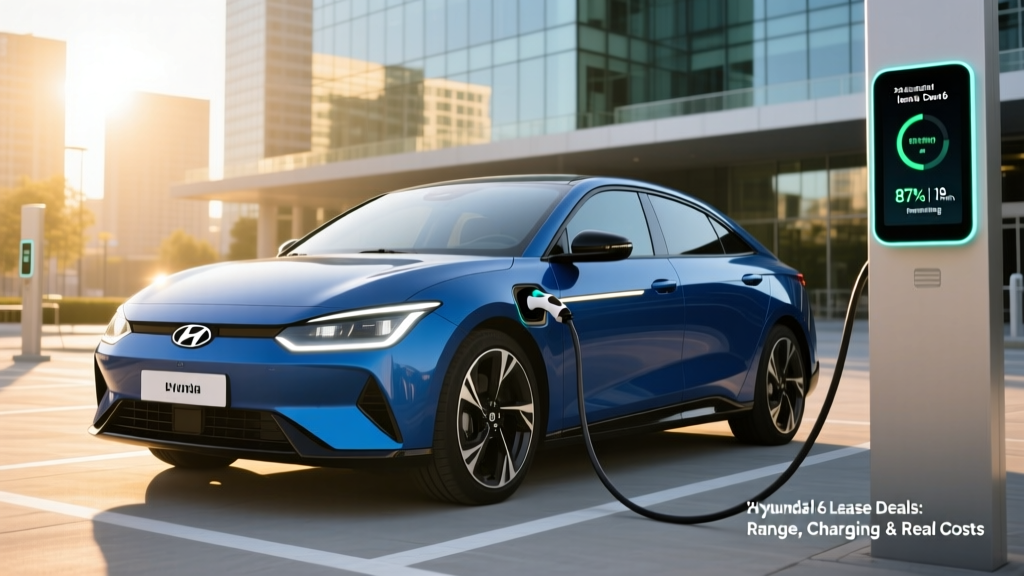
If you've been scanning Ioniq 6 lease deals in 2026, you're likely weighing Hyundai's sleekest electric sedan against the Tesla Model 3, BMW i4, and Polestar 2. The Ioniq 6 stands out for one reason above all else: efficiency. Its teardrop shape yields a drag coefficient of just 0.21 — one of the lowest of any production car — and that translates directly into class-leading range and lower energy costs. But lease shoppers need to look past the headline monthly payment to understand what they're actually getting: real-world range, charging infrastructure compatibility, tax credit pass-through, and long-term ownership economics.
This review dissects the 2026 Hyundai Ioniq 6 from a lease buyer's perspective, with exact specs, charging data, and the financial nuances that determine whether a lease deal is genuinely competitive or just marketed well.
2026 Ioniq 6 at a Glance: Key Specs by Trim
| Spec | SE Standard Range | SE / SEL Long Range RWD | SE / SEL / Limited AWD |
|---|---|---|---|
| EPA Range | 240 mi | 361 mi | 316 mi |
| Battery (usable) | 54.0 kWh (LFP) | 77.4 kWh (NMC) | 77.4 kWh (NMC) |
| Powertrain | RWD, 168 hp | RWD, 225 hp | Dual-motor AWD, 320 hp |
| 0-60 mph | ~7.5 sec | ~6.2 sec | ~4.5 sec |
| EPA MPGe (combined) | 135 MPGe | 140 MPGe | 117 MPGe |
| Efficiency | 25 kWh/100 mi | 24 kWh/100 mi | 29 kWh/100 mi |
| Max DC Fast Charge | ~150 kW | 235 kW (800V) | 235 kW (800V) |
| 10-80% DCFC Time | ~24 min | ~18 min | ~18 min |
| Level 2 Home Charging | 10.9 kW (~40 mi/hr) | 10.9 kW (~44 mi/hr) | 10.9 kW (~38 mi/hr) |
| Base MSRP (2026) | $38,650 | $43,350 | $47,050 |
Sources: EPA / fueleconomy.gov, Hyundai Motor America. Prices exclude destination ($1,195). Specs reflect 2026 model year.
Real-World Range: What the EPA Sticker Doesn't Tell You
The Long Range RWD Ioniq 6 carries an EPA estimate of 361 miles — among the highest of any EV under $50,000. In mixed real-world driving at moderate temperatures (60-80°F), expect 310-340 miles on a full charge. At sustained highway speeds of 75-80 mph, that drops to roughly 270-290 miles. In freezing conditions (below 30°F) with cabin heat running, plan for 230-260 miles of usable range. The AWD variant's 316-mile EPA rating translates to approximately 260-280 miles in mixed real-world use.
The Ioniq 6's efficiency advantage is real. On a 250-mile highway loop at 70 mph in 65°F weather, independent testers have recorded consumption as low as 23 kWh/100 mi in the RWD model — better than the EPA's 24 kWh/100 mi combined figure. The heat pump (standard on all trims) mitigates cold-weather range loss compared to EVs without one, but physics still applies: battery chemistry slows in the cold, and resistive heating draws significant energy.
For lease shoppers, the practical question is whether your daily commute plus errands fits within ~250 miles of real-world range without requiring mid-day charging. For the vast majority of American drivers (average daily commute: ~37 miles round trip, per FHWA data), even the Standard Range model's ~200 real-world miles is sufficient with nightly home charging.
Charging Speed: 800-Volt Architecture Makes a Difference
The Long Range Ioniq 6 uses Hyundai's E-GMP platform with 800-volt architecture, enabling DC fast charging at up to 235 kW on compatible chargers. Here's what that means in practice:
| Charging Level | Power / Rate | Speed (Long Range RWD) | Notes |
|---|---|---|---|
| Level 1 (120V outlet) | ~1.4 kW | ~5-6 miles per hour | Emergency/trickle only |
| Level 2 (240V, 48A) | 10.9 kW | ~44 miles per hour | Full charge in ~7.5 hrs |
| DC Fast (350 kW station) | Peak 235 kW | 10-80% in ~18 min | Sustains >180 kW to ~55% SoC |
| DC Fast (150 kW station) | Peak ~145 kW | 10-80% in ~25 min | Most common public charger type |
A critical nuance for road-trippers: the Ioniq 6's charge curve is aggressive in the mid-range. It sustains near-peak speeds from 10% to about 55% State of Charge (SoC), then tapers progressively. Charging from 80% to 100% on DC fast charge is painfully slow — plan to unplug at 80% and move on. This is typical of modern EVs but worth understanding before you budget travel time.
The Standard Range model's 400V architecture limits DC fast charging to approximately 150 kW peak, meaning a 10-80% session takes roughly 24 minutes on a capable charger. For lease buyers who road-trip more than a few times per year, the Long Range's 800V system is a meaningful upgrade.
The Ioniq 6 ships with a NACS (North American Charging Standard) port for 2026, granting native access to Tesla's Supercharger network — the most reliable and extensive DC fast-charging network in the U.S. (Hyundai Motor America). CCS adapters are no longer needed for most public charging.
Lease Pricing, Tax Credits, and True Monthly Cost
Leasing an EV in 2026 involves a unique financial dynamic: the federal §30D tax credit has specific eligibility requirements, but leased vehicles may qualify for the commercial clean vehicle credit (§45W), which automakers can pass through to lessees as a capitalized-cost reduction. Hyundai has consistently passed this credit through on Ioniq 6 leases.
| Financial Factor | Detail |
|---|---|
| SE Standard Range MSRP | $38,650 |
| SE Long Range RWD MSRP | $43,350 |
| Limited AWD MSRP | $52,250 |
| Lease Cash / Credit Pass-Through (2026) | Up to $7,500 applied as cap-cost reduction |
| Typical 36-mo Lease (LR RWD, $3,500 down) | ~$349-$429/month (varies by region & dealer) |
| §30D Purchase Credit Eligibility | Income caps: $150K single / $300K joint. MSRP cap: $55K sedans. Battery sourcing rules apply. |
| §45W Lease Credit | No income or MSRP caps; lessor claims and passes through |
Source: IRS.gov — Clean Vehicle Credits. Tax rules subject to change; consult a tax professional.
Here's why lease deals on the Ioniq 6 are particularly attractive right now: the §45W commercial credit loophole for leases has no income cap and no MSRP cap, meaning high-income buyers who are ineligible for the §30D purchase credit can still benefit from a $7,500 cap-cost reduction on a lease. This makes leasing the Ioniq 6 more financially rational than purchasing for many buyers.
However, lease deals vary dramatically by dealer and region. Hyundai's national lease offers (often advertised at $299-$379/month) typically require excellent credit (Tier 1, 740+), a specific down payment, and may only apply to the Standard Range trim. Always request a full lease breakdown showing the money factor, residual value, and cap-cost reduction before signing.
Interior, Cargo, and Daily Livability
The Ioniq 6's swooping roofline creates an interior that is genuinely comfortable for four adults but compromises cargo space compared to a crossover. Here are the numbers that matter:
- Front headroom: 40.2 inches
- Rear headroom: 37.8 inches (noticeably tight for passengers over 6'2")
- Rear legroom: 38.0 inches (generous — comparable to a Sonata)
- Trunk cargo volume: 12.3 cubic feet
- Frunk (front trunk):strong> 0.5 cu ft (AWD) / 1.6 cu ft (RWD) — enough for a charging cable, not luggage
- Wheelbase: 116.1 inches (longer than a Tesla Model 3)
The 12.3-cubic-foot trunk is the Ioniq 6's most obvious practicality weakness. A Tesla Model 3 offers 23 cu ft (hatchback design), and the Hyundai Ioniq 5 crossover offers 27.2 cu ft. If you regularly haul cargo — strollers, hockey gear, Costco runs — the sedan form factor will frustrate. The 60/40 split-folding rear seats help for long items but don't solve the narrow trunk opening.
Tech highlights include dual 12-inch displays (instrument cluster and infotainment), wireless Apple CarPlay and Android Auto (a feature Tesla still lacks), Hyundai's Digital Key 2 (phone-as-key via NFC/UWB), and over-the-air software updates. The center console's physical climate-control buttons are a welcome ergonomic choice in an era of screen-only interfaces.
Driver Assistance: Highway Driving Assist 2 (SAE Level 2)
The Ioniq 6's Highway Driving Assist 2 (HDA2) and Smart Cruise Control with Stop & Go are Level 2 systems. The driver must remain fully engaged, hands on or near the wheel, and eyes on the road at all times. These are convenience features, not autonomous driving systems.
HDA2 combines adaptive cruise control with lane-centering and can handle highway merges, speed adjustments based on GPS/curve data, and lane changes when the driver activates the turn signal (on equipped trims). It's competent and smooth — comparable to Toyota's TSS 3.0 and Honda Sensing, though not as assertive as GM's Super Cruise or Ford's BlueCruise on pre-mapped highways.
The Ioniq 6 earned a 2025-2026 IIHS Top Safety Pick+ designation when equipped with specific headlights, reflecting strong crash-test performance across all trims (IIHS.org).
Who Should Lease the Ioniq 6 — and Who Shouldn't
- Commuters driving 30-80 miles/day round trip
- Efficiency-focused buyers who want maximum miles per kWh
- Tech-savvy drivers who value wireless CarPlay, OTA updates, and V2L
- Buyers who want Supercharger access via NACS without adapters
- Those who qualify for lease credit pass-through but not §30D purchase credit
- You need cargo space for families, gear, or frequent travel
- You regularly carry rear passengers taller than 6'2"
- You live in a charging desert with no reliable DCFC access
- You want one-pedal driving (Ioniq 6's regen doesn't bring the car to a full stop without brake input)
- You prioritize 0-60 performance over efficiency
The Ioniq 6 is a driver's EV sedan — quiet, planted, and remarkably efficient on the highway. It's not a family hauler or a performance car. If your use case involves road trips with luggage for four, the Ioniq 5 or Kia EV6 (both on the same E-GMP platform with hatchback cargo) are better fits. If you want a luxury badge, the BMW i4 offers more refinement at higher cost.
Warranty and Long-Term Reliability
Hyundai backs the Ioniq 6 with one of the strongest warranty packages in the EV market:
- Battery: 10 years / 100,000 miles (retains ≥70% capacity)
- Powertrain: 10 years / 100,000 miles
- New Vehicle: 5 years / 60,000 miles
- Roadside Assistance: 5 years / unlimited miles
- Complimentary Maintenance: 3 years / 36,000 miles
The 10-year battery warranty is particularly relevant for lease buyers considering a 24- or 36-month term: the battery will remain under full manufacturer warranty for the entire lease and well beyond. Hyundai's LFP battery in the Standard Range model also carries inherently slower degradation characteristics compared to NMC chemistry, though at the cost of lower energy density (hence the shorter range).
Frequently Asked Questions
What is the real-world range of the Hyundai Ioniq 6?
The Long Range RWD model is EPA-rated at 361 miles. In real-world mixed driving, expect 310-340 miles. Highway driving at 75+ mph reduces this to approximately 270-290 miles. Cold weather (below freezing) can drop usable range to 230-260 miles. The Standard Range model delivers roughly 200 real-world miles in mixed conditions.
How fast does the Ioniq 6 charge at home and on the road?
On a Level 2 home charger (240V, 48A), the Long Range adds about 44 miles of range per hour, reaching a full charge in roughly 7.5 hours. On a 350 kW DC fast charger, the 800V system charges from 10-80% in approximately 18 minutes. On a more common 150 kW public charger, expect 10-80% in about 25 minutes.
Does the 2026 Ioniq 6 qualify for the federal EV tax credit?
For purchases, the §30D credit (up to $7,500) is subject to buyer income caps ($150K single / $300K joint), an MSRP cap of $55,000 for sedans, and battery-component and critical-mineral sourcing requirements that change annually. For leases, the §45W commercial credit has no income or MSRP caps, and Hyundai has historically passed the full $7,500 through as a cap-cost reduction. Always verify current eligibility with your dealer and tax advisor.
Is it better to lease or buy the Ioniq 6 in 2026?
Leasing currently offers a structural advantage: the §45W lease credit bypasses the income and MSRP restrictions that limit the §30D purchase credit. If you earn above the income cap or prefer lower monthly payments with warranty coverage for the entire term, leasing is financially compelling. If you plan to keep the car 8+ years and want to build equity, purchasing with the §30D credit (if eligible) may be better long-term.
How does the Ioniq 6 compare to the Tesla Model 3?
The Ioniq 6 Long Range RWD (361 mi EPA, ~$43,350) offers more range than the Model 3 Long Range (~341 mi, ~$47,740) at a lower price. The Model 3 has significantly more cargo space (23 cu ft hatchback vs. 12.3 cu ft trunk), a more extensive proprietary Supercharger network (though Ioniq 6 now has native NACS access), and a more minimalist interior. The Ioniq 6 wins on efficiency, physical controls, and wireless phone integration; the Model 3 wins on cargo, performance, and software ecosystem.
What are the biggest pros and cons of the Ioniq 6?
Pros: Class-leading efficiency (140 MPGe combined), 800V ultra-fast charging, native NACS/Supercharger access, excellent 10-year battery warranty, strong safety ratings, quiet highway ride, physical climate buttons.
Cons: Small 12.3 cu ft trunk, tight rear headroom for tall passengers, no true one-pedal driving, rear visibility limited by sloping roofline, infotainment learning curve, AWD range drops to 316 mi EPA.
Can the Ioniq 6 use Tesla Superchargers?
Yes. The 2026 Ioniq 6 is equipped with a native NACS charge port, allowing direct access to Tesla's Supercharger network without an adapter. This adds over 15,000 DC fast-charging stalls to your public charging options across the U.S. and Canada.