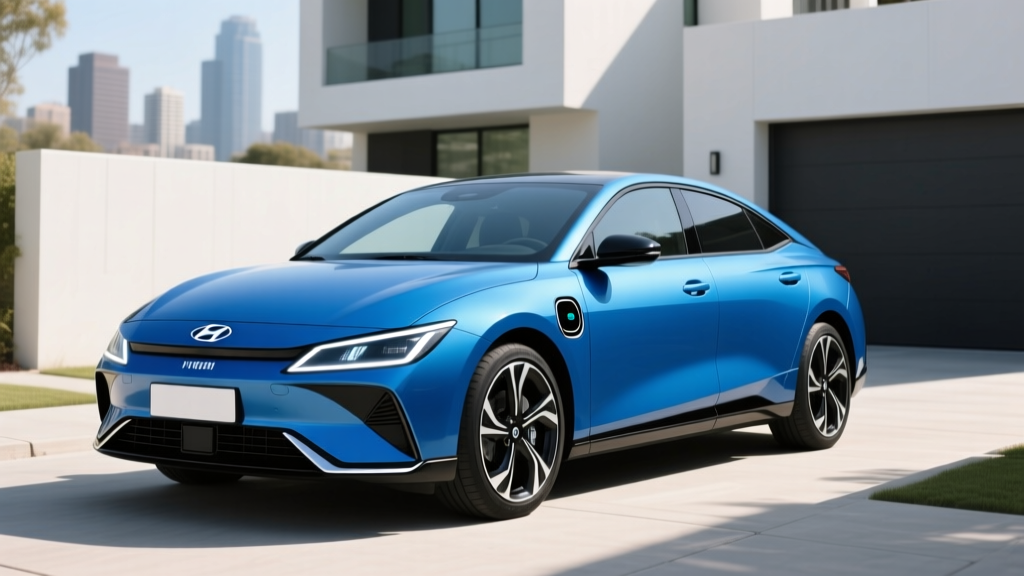
The Hyundai Ioniq 6 has carved out a unique position in the midsize electric sedan segment: a slippery 0.21 drag coefficient, up to 361 miles of EPA-estimated range, and 800V architecture that enables blistering DC fast-charge speeds. But for many buyers in 2026, the real question isn't about its 320 horsepower or its 10-80% charging time — it's whether current Hyundai Ioniq 6 EV lease deals actually make financial sense compared to buying, and how the total cost of ownership stacks up against a gas-powered competitor.
This guide dissects the real numbers behind leasing and owning an Ioniq 6 in 2026. We'll walk through the federal tax credit passthrough mechanism that makes leases uniquely attractive, model out a full five-year cost-of-ownership projection, and confront the expenses that EV skeptics love to highlight — namely higher insurance premiums and steeper depreciation curves.
Why 2026 Hyundai Ioniq 6 EV Lease Deals Deserve a Hard Look
The lease-versus-buy calculus for electric vehicles shifted dramatically when the IRS clarified that the §30D clean vehicle credit's MSRP caps, income limits, and battery-sourcing requirements can be sidestepped through the commercial clean vehicle credit (§45W) when a vehicle is leased rather than purchased. In practical terms: when you lease an Ioniq 6 through Hyundai Motor Finance, the leasing company (the legal owner) can claim the full $7,500 credit regardless of your personal income, the vehicle's MSRP, or where the battery minerals were sourced — and most dealerships pass that credit through as a capitalized-cost reduction.
For the 2026 model year, the Ioniq 6 lineup starts at an MSRP of approximately $37,500 for the SE Standard Range trim and climbs to roughly $52,000 for the Limited AWD. Under a purchase scenario, the Limited trim exceeds the $55,000 sedan MSRP cap for §30D eligibility, but a buyer earning above $150,000 (single filer) or $300,000 (joint) would be disqualified regardless. Through a lease, those barriers vanish.
| EPA Range | 270 mi (SE Std Range RWD) / 361 mi (SEL/Limited RWD) |
| Battery | 53.0 kWh usable (Std Range) / 77.4 kWh usable (Long Range), NMC chemistry |
| Peak DC Fast Charge | 239 kW (Long Range), 10-80% in ~18 minutes on a 350 kW charger |
| Level 2 Charge Rate | 10.9 kW onboard charger |
| Powertrain | 149-225 hp (RWD) / 320 hp (AWD) |
| 0-60 mph | 5.1 sec (AWD Long Range) |
| MPGe (Combined) | 140 MPGe (SE RWD Long Range) per fueleconomy.gov |
| Battery Warranty | 10 years / 100,000 miles |
A typical 36-month Ioniq 6 lease in early 2026 with the $7,500 credit applied as cap-cost reduction lands in the $299-$449/month range depending on trim, money factor, and down payment. That monthly figure alone doesn't tell the full story — you need to understand what happens during and after those 36 months.
Federal Tax Credit: How the Lease Loophole Works in 2026
The distinction between purchasing and leasing is the single most important financial variable for an Ioniq 6 buyer in 2026. Here's the regulatory framework:
- Purchase (§30D Clean Vehicle Credit): You claim up to $7,500 on your federal tax return (or transfer it to the dealer as a point-of-sale discount). However, you must meet all of the following requirements.
- Lease (§45W Commercial Clean Vehicle Credit): The lessor (Hyundai Motor Finance or another leasing entity) is the legal "owner" and claims the credit. Most pass it through as a cap-cost reduction. No income, MSRP, or sourcing restrictions apply to the lessee.
- ✓ Adjusted gross income ≤ $150,000 (single) / $225,000 (head of household) / $300,000 (married filing jointly)
- ✓ Vehicle MSRP ≤ $55,000 for sedans (Ioniq 6 qualifies in most trims; Limited AWD may exceed)
- ✓ Battery components manufactured or assembled in North America (phase-in percentages increase annually per IRS guidance)
- ✓ Critical minerals sourced from the U.S. or free-trade-agreement partners (percentage thresholds rise each year)
- ✓ Vehicle assembled in North America (the Ioniq 6 is built in South Korea — this alone can disqualify a purchase from the full credit)
- ✓ Cannot have transferred the credit to the dealer if your tax liability is less than $7,500
Source: IRS §30D guidance. Rules are subject to legislative change. Consult a tax professional for your specific situation.
The assembly-location requirement is the critical wrinkle for the Ioniq 6. Because Hyundai manufactures the Ioniq 6 at its Asan plant in South Korea, a purchased Ioniq 6 may not qualify for the full §30D credit — potentially only the $3,750 critical-minerals half or none at all, depending on the latest IRS sourcing lists. Through a lease, this limitation is entirely bypassed, making the full $7,500 available as a cap-cost reduction. This is precisely why Hyundai Ioniq 6 EV lease deals are disproportionately attractive compared to purchasing the same vehicle.
Five-Year Total Cost of Ownership: Ioniq 6 vs. Gas Sedan Baseline
To contextualize what you're actually signing up for, we've modeled a five-year ownership scenario for the 2026 Ioniq 6 SEL RWD (Long Range, 77.4 kWh battery, ~$43,000 MSRP) against a comparable gas-powered midsize sedan averaging 30 MPG combined. We assume 12,000 miles driven annually, home Level 2 charging at the national average electricity rate of $0.16/kWh, and gasoline at $3.50/gallon.
| Category | Ioniq 6 SEL RWD | Gas Sedan (30 MPG) |
|---|---|---|
| Purchase / Cap Cost | $43,000 | $33,000 |
| Federal Tax Credit | -$7,500 (lease) or $0-$7,500 (purchase) | $0 |
| Fuel / Energy (5 yrs) | $3,510 | $7,000 |
| Maintenance (5 yrs) | $1,800 | $3,500 |
| Insurance (5 yrs) | $11,400 | $8,400 |
| Estimated Depreciation | $19,350 (45%) | $13,200 (40%) |
| Net 5-Year Cost (w/ lease credit) | $32,210 | $38,900 |
With the lease credit applied, the Ioniq 6's five-year net cost undercuts the gas sedan by approximately $6,690. The savings come primarily from the tax credit passthrough, energy-cost advantage, and reduced maintenance. Those savings are partially offset by higher insurance premiums and steeper depreciation — which we'll examine in detail below.
If you purchase the Ioniq 6 and cannot claim the full $7,500 credit (due to South Korean assembly or income limits), the five-year advantage narrows significantly or disappears. This is why the lease structure is so central to the Ioniq 6 value proposition in 2026.
Charging Costs vs. Gasoline: The Per-Mile Math
The Ioniq 6 SEL RWD Long Range achieves an EPA-rated 140 MPGe combined, which translates to roughly 24 kWh per 100 miles of driving. At the U.S. average residential electricity rate of $0.16/kWh, that works out to:
- Ioniq 6 (home charging, $0.16/kWh): $0.038/mile — roughly $458/year at 12,000 miles
- Ioniq 6 (public DC fast charging, $0.40/kWh avg): $0.096/mile — roughly $1,152/year
- Gas sedan (30 MPG, $3.50/gallon): $0.117/mile — roughly $1,400/year
The home-charging advantage is massive: an Ioniq 6 owner who charges primarily at home saves roughly $940 per year versus a 30 MPG gas sedan. However, if you rely exclusively on public DC fast charging — which is the reality for apartment dwellers or those without garage access — the per-mile cost nearly triples and the advantage over gasoline shrinks to about $248 annually. This is why home Level 2 charging access is the single biggest variable in EV ownership economics.
One nuance often missed: DC fast-charging costs vary wildly by network and time of day. Electrify America, EVgo, and ChargePoint all offer off-peak rates that can drop below $0.30/kWh, while peak rates at highway chargers can exceed $0.55/kWh. Plan your charging habits accordingly.
Maintenance Savings: Where EVs Genuinely Shine
The Ioniq 6's electric powertrain eliminates dozens of maintenance items that a gas-powered car requires over five years and 60,000 miles. Here's a side-by-side breakdown:
| Service Item | Ioniq 6 | Gas Sedan | Gas Sedan Cost |
|---|---|---|---|
| Oil changes (5-6 over 5 yrs) | N/A | Required | $350-$600 |
| Transmission fluid | N/A | Required at ~60k mi | $150-$300 |
| Spark plugs | N/A | Required at ~60k mi | $200-$400 |
| Engine air filter | N/A | Required | $100-$150 |
| Brake pads | Rarely (regen braking) | 1-2 replacements | $400-$700 |
| Cabin air filter | Required | Required | $100-$150 |
| Tire rotation | Required (EVs wear tires faster) | Required | $150-$250 |
| Coolant flush | Required (battery thermal mgmt) | Required | $100-$200 |
| Estimated 5-Year Total | ~$1,800 | ~$3,500 |
The Ioniq 6's regenerative braking system handles most deceleration, dramatically reducing friction-brake wear. Many EV owners report original brake pads lasting 80,000+ miles. However, one cost that partially offsets the savings: EV tires. The Ioniq 6's instant torque and heavier curb weight (~4,500 lbs for the Long Range) accelerate tire wear by roughly 20-30% compared to a gas sedan. Budget for a tire replacement around 35,000-45,000 miles — approximately $800-$1,200 for a set of EV-optimized touring tires.
The Insurance Reality: Expect to Pay More
This is where the EV ownership narrative gets less rosy. Insurance premiums for the Ioniq 6 typically run 20-35% higher than a comparably priced gas sedan. Based on national averages and quotes from major carriers, expect to pay $1,800-$2,400 annually for full coverage on an Ioniq 6 — compared to $1,400-$1,800 for a gas-powered midsize sedan.
The reasons are structural, not arbitrary:
- Higher repair costs: EV battery packs and power electronics are expensive to replace after collision damage. Even minor rear-end impacts can trigger battery-safety protocols requiring full high-voltage system inspection.
- Specialized labor: Fewer body shops have high-voltage-certified technicians, driving up labor rates for EV repairs.
- Higher vehicle cost: The Ioniq 6's MSRP is higher than many gas competitors, increasing collision and comprehensive premium bases.
- Total-loss frequency: Insurers are more likely to declare an EV a total loss after battery-adjacent damage, increasing claim severity.
Over five years, the insurance differential adds roughly $2,000-$3,000 to the Ioniq 6's ownership cost. This is a real expense that must be factored into any honest TCO calculation. Shop quotes from multiple carriers — some insurers (notably Geico, Progressive, and USAA) have narrowed the EV insurance gap more than others.
Depreciation and Resale Value: The EV Wild Card
Electric vehicles have experienced steeper depreciation than their gas counterparts over the past several years, and the Ioniq 6 is no exception. Industry data from sources like Kelley Blue Book and iSeeCars shows that midsize EV sedans have depreciated 40-50% over three years, compared to 30-40% for gas sedans. Several factors drive this:
- Price wars and incentive shifts: Aggressive price cuts by Tesla and new market entrants have compressed used-EV values across the segment.
- Battery-health uncertainty: Used buyers remain cautious about long-term battery degradation, even though Hyundai's 10-year/100,000-mile battery warranty provides strong coverage (note: the warranty may not fully transfer to second owners — confirm terms with Hyundai).
- Rapid technology cycles: Newer EVs with faster charging, longer range, and NACS connectors make older models feel dated more quickly than gas cars.
- Lease returns flooding the market: High lease volumes (driven by the $7,500 credit passthrough) create a steady supply of off-lease EVs, pressuring used prices.
For our five-year model, we estimate the Ioniq 6 SEL will retain approximately 55% of its net-after-credit value, translating to roughly $19,350 in depreciation from the effective $35,500 net purchase price ($43,000 MSRP minus $7,500 credit). A gas sedan purchased at $33,000 might retain 60%, losing about $13,200.
Here's the key insight: if you lease rather than purchase, depreciation is the lessor's problem, not yours. The lease payment already bakes in a residual-value estimate. If the market depreciates more than expected, you simply return the car at lease-end and walk away. This is a significant risk-mitigation advantage of leasing an EV in a volatile resale market.
State, Local, and Utility Incentives: Stack Your Savings
Beyond the federal credit, dozens of states, municipalities, and electric utilities offer additional incentives that can further reduce the Ioniq 6's effective cost. These vary enormously by location and change frequently, but here are representative examples:
- California: Clean Fuel Rebate of up to $1,000 for eligible EVs (income-dependent); additional CVRP incentives for low-income buyers
- Colorado: State tax credit of up to $5,000 for EVs with MSRP under $80,000
- New York: Drive Clean Rebate of up to $2,000 (income and price caps apply)
- Utility rebates: Many utilities (e.g., PG&E, ConEdison, Xcel Energy) offer $250-$1,000 rebates for EV purchase/lease and additional rebates for home Level 2 charger installation
- HOV lane access: Several states grant EVs single-occupant HOV lane access — a significant non-monetary benefit in congested metro areas
- Home charger tax credits: The federal §30C alternative fuel infrastructure credit covers up to 30% (max $1,000) of home charger equipment and installation costs in eligible census tracts
Always verify incentive availability with your state energy office, utility provider, and the Alternative Fuels Data Center before relying on specific amounts.
A Colorado buyer leasing an Ioniq 6, for example, could potentially stack the $7,500 federal lease credit with a $5,000 state credit and a $500 utility rebate — reducing the effective cap cost by $13,000 and dramatically lowering monthly payments.
Real-World Range and Efficiency: What to Actually Expect
The Ioniq 6's EPA-estimated range figures are among the best in the segment, but real-world results depend heavily on driving conditions. Based on aggregated owner data and independent testing:
- EPA sticker (SE RWD Long Range): 361 miles
- Real-world highway (70-80 mph, moderate temps): ~290-310 miles
- Real-world mixed driving (spring/fall): ~320-340 miles
- Cold weather (below 32°F, cabin heat): ~240-280 miles (20-30% reduction)
- Cold weather + highway: ~220-250 miles
The Ioniq 6's heat pump (standard on Long Range trims) mitigates some cold-weather range loss by efficiently extracting ambient heat rather than relying solely on resistive heating. If you live in a cold climate, the heat pump is a meaningful efficiency advantage over EVs without one.
On the charging side, the Ioniq 6's 800V electrical architecture is a genuine differentiator. At a 350 kW DC fast charger, the Long Range model peaks at approximately 239 kW and sustains high charge rates through the middle of the curve, reaching 10-80% in roughly 18 minutes. However, above 80% State of Charge, the charge rate tapers sharply — a 10-100% session takes approximately 40-45 minutes. For road trips, plan your stops around 10-80% increments to maximize time efficiency.
Frequently Asked Questions
How much does it really cost to own a 2026 Hyundai Ioniq 6 over 5 years?
Our model estimates a net five-year cost of approximately $32,210 for the Ioniq 6 SEL RWD when leased with the $7,500 federal credit applied, assuming 60,000 miles driven, home charging at $0.16/kWh, and national-average insurance rates. Without the credit (or if purchasing without eligibility), the five-year cost rises to approximately $39,710. The lease-with-credit scenario is currently the most cost-effective path to Ioniq 6 ownership.
Do I qualify for the $7,500 federal tax credit on the Ioniq 6?
If you purchase: possibly not the full amount. The Ioniq 6 is assembled in South Korea, which may disqualify it from the §30D credit's assembly requirement. Income caps ($150K single / $300K joint) and the $55,000 sedan MSRP cap also apply. If you lease: yes, effectively. The lessor claims the credit under §45W and typically passes the full $7,500 to you as a cap-cost reduction, regardless of your income or the vehicle's sourcing. Always confirm with your dealer and a tax professional before relying on credit eligibility.
How much do I save on fuel and maintenance with the Ioniq 6?
With home charging at $0.16/kWh, expect to save approximately $940 per year on energy costs versus a 30 MPG gas sedan at $3.50/gallon. Over five years, that's roughly $4,700 in fuel savings. Maintenance savings add approximately $1,700 over the same period, primarily from eliminated oil changes, transmission service, and reduced brake wear. Combined annual savings of around $1,280 are realistic for a home-charging owner.
Are EVs like the Ioniq 6 more expensive to insure?
Yes, typically 20-35% more expensive than comparable gas sedans. Expect $1,800-$2,400 per year for full coverage on an Ioniq 6. Higher repair costs, specialized labor requirements, and the vehicle's higher MSRP all contribute. Over five years, this adds $2,000-$3,000 in additional costs versus a gas sedan. Always get quotes from multiple insurers before purchasing or leasing.
How well does the Ioniq 6 hold its value?
Midsize EV sedans have depreciated 40-50% over three years in recent market conditions — steeper than the 30-40% typical for gas sedans. Factors include rapid technology advancement, price competition, and battery-health uncertainty among used buyers. If you lease, depreciation risk transfers to the lessor. If you purchase, plan for 45-50% depreciation over five years and factor that into your TCO calculation.
What's the best Hyundai Ioniq 6 lease deal right now?
Lease terms fluctuate monthly and vary by region and dealership. As of early 2026, competitive Ioniq 6 lease deals typically feature the $7,500 federal credit applied as a cap-cost reduction, 36-month terms, and monthly payments in the $299-$449 range depending on trim and money-down. Hyundai's own website and local dealer inventory pages list current offers. Negotiate the capitalized cost (sale price) independently of the lease terms — a lower cap cost directly reduces your monthly payment.