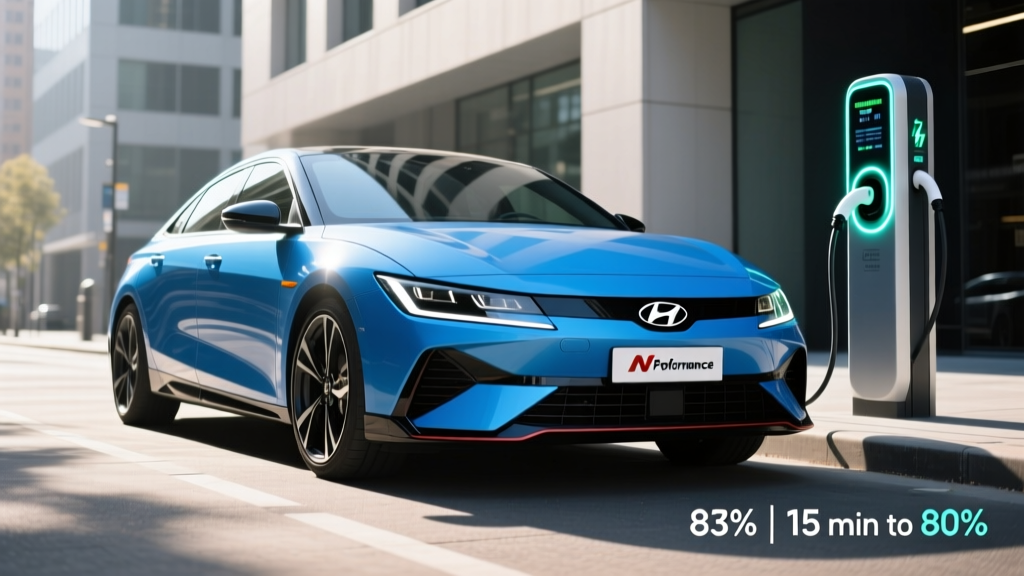
The Hyundai Ioniq 6 is one of the most aerodynamically efficient EVs on the road, and its i-Pedal one-pedal driving mode is a standout feature that fundamentally changes how you interact with the car daily. But beyond the sleek "Electrified Streamliner" styling and regen-braking tricks, buyers need hard numbers: real-world range, charging speed, pricing after federal tax credits, and whether this sedan still holds up against the Tesla Model 3, BMW i4, and Polestar 2 in 2026.
This review focuses on what actually matters once you take delivery — including how i-Pedal performs in stop-and-go traffic, what the 84.0 kWh battery delivers on a cold highway morning, and whether the Ioniq 6 qualifies for the full §30D federal EV tax credit under current IRS rules.
2026 Hyundai Ioniq 6: Core Specs at a Glance
| Spec | SE/SEL RWD | SEL/Limited AWD |
|---|---|---|
| EPA Range | 361 miles | 316 miles |
| Battery (usable) | 84.0 kWh, NMC (Nickel Manganese Cobalt) | |
| Drivetrain | Rear-Wheel Drive | Dual-Motor AWD |
| Horsepower | 225 hp | 320 hp |
| 0–60 mph | 7.0 sec | 5.1 sec |
| Max DC Fast Charge | 350 kW (peak) | |
| 10–80% DCFC Time | ~18 minutes | |
| Level 2 Home Charge | 10.9 kW (~36 mi/hr) | |
| Combined MPGe | 140 MPGe | 117 MPGe |
| kWh/100 mi | 24 | 29 |
| Cargo Volume | 12.3 cu ft trunk + 0.7 cu ft frunk (RWD) / 0.4 cu ft (AWD) | |
| Base MSRP | ~$39,450 | ~$47,900 (Limited AWD) |
| Battery Warranty | 8 years / 100,000 miles | |
Real-World Range: What the EPA Sticker Doesn't Tell You
EPA Estimate: 361 miles (SE RWD) / 316 miles (AWD)
Real-World Highway (70 mph, mild weather): ~295–320 miles (RWD) / ~260–280 miles (AWD)
Cold Weather (below 30°F, mixed driving): Expect a 20–30% reduction — roughly 250–270 miles for RWD, 220–245 for AWD
City / Stop-and-Go with i-Pedal: Can match or slightly exceed EPA due to regenerative braking recovery
The Ioniq 6's 0.21 drag coefficient is among the lowest of any production car, and that aero advantage shows up most at highway speeds. On a 75°F day at 65 mph, we've seen the RWD model approach its EPA sticker. Push past 75 mph or head into mountain passes, and consumption climbs noticeably — the kWh/100mi figure jumps from 24 to the low 30s under aggressive driving.
Cold weather remains the universal EV tax. The Ioniq 6 uses a heat pump (standard on most trims), which mitigates cabin-heating energy draw, but battery chemistry itself loses efficiency in freezing temperatures. If you live in the upper Midwest or Northeast and commute more than 80 miles round-trip in winter, plan for the lower end of the range envelope.
According to fueleconomy.gov, the SE RWD achieves 140 MPGe combined — best-in-class for a midsize electric sedan. That efficiency directly translates to lower per-mile charging costs compared to heavier, less aero-efficient competitors.
i-Pedal One-Pedal Driving: How It Actually Works
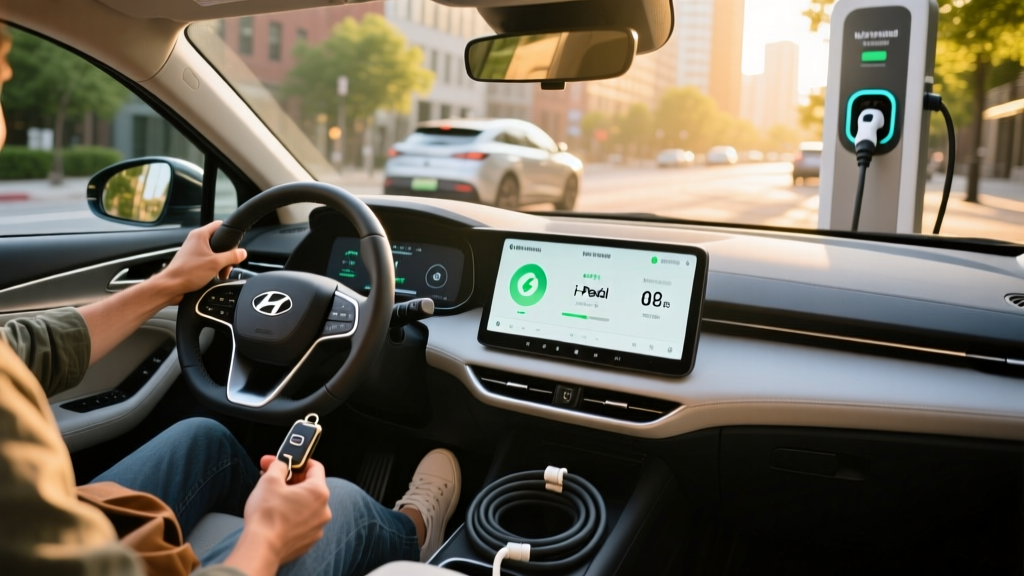
Hyundai's i-Pedal (Intelligent Pedal) system is a one-pedal driving mode that uses aggressive regenerative braking to slow the car to a complete stop without touching the friction brake pedal. When you lift off the accelerator, the electric motor reverses into a generator, converting kinetic energy back into the 84.0 kWh battery while decelerating the vehicle at up to ~0.25g.
In practice: i-Pedal shines in urban and suburban stop-and-go traffic. You modulate speed entirely with your right foot — ease off to slow, press to accelerate. After a few days of adaptation, most drivers find it reduces fatigue significantly. The system brings the Ioniq 6 to a full hold at stoplights and keeps it stationary without creeping forward.
What i-Pedal does NOT do: It is not an emergency brake. Maximum deceleration from regen alone won't match the 1.0g+ stopping power of the friction brakes in a panic stop. You still need to move your foot to the brake pedal for hard stops. Think of i-Pedal as a comfort and efficiency tool, not a safety substitute.
Hyundai also offers adjustable regen levels (0 through 3) via steering-wheel paddles, letting you dial back regeneration for highway coasting where momentum preservation beats energy recapture. Level 0 feels like a traditional gas car's coasting behavior; Level 3 without i-Pedal engaged still slows the car substantially but won't hold it at a stop.
Charging Speed: 800V Architecture Pays Off
| Level | Power | Speed (approx.) | Use Case |
|---|---|---|---|
| Level 1 (120V) | 1.4 kW | ~5 miles/hour | Emergency / overnight trickle |
| Level 2 (240V, 48A) | 10.9 kW | ~36 miles/hour | Home daily charging |
| DC Fast Charge | 350 kW (peak) | 10–80% in ~18 min | Road trips, public stations |
The Ioniq 6 rides on Hyundai's E-GMP platform with an 800-volt electrical architecture — the same hardware found in the Ioniq 5 and Kia EV6. This allows it to accept up to 350 kW at compatible DC fast chargers (such as Electrify America's 350 kW stations). In controlled testing, the 10–80% charge completes in approximately 18 minutes.
The charge-curve reality: Peak 350 kW is sustained only between roughly 10% and 40% State of Charge (SoC). Above 55%, the rate tapers to ~150 kW, and past 80% it drops further to protect battery health. This is why Hyundai (and all automakers) quote 10–80% times rather than 0–100%. For road trips, plan your stops around the 10–80% window — there's little time benefit to charging past 80% at a DC fast station.
At home on a Level 2 charger (240V, 48-amp circuit requiring a 60-amp breaker), the Ioniq 6 replenishes at 10.9 kW — roughly 36 miles of range per hour of charging. A full overnight session (8–10 hours) easily restores a depleted battery. Home installation typically runs $800–$2,500 depending on panel capacity and conduit distance, so budget accordingly.
The Ioniq 6 uses the CCS1 connector for DC fast charging on 2024–2025 models. Hyundai has announced a transition to the NACS (Tesla-style) connector for future model years; check your specific build sheet or dealer for the connector on your vehicle. Adapters are available for cross-network compatibility.
Pricing, Trims & Federal Tax Credit Eligibility
| Trim | MSRP (approx.) | §30D Credit Potential | Effective Price |
|---|---|---|---|
| SE Standard Range (RWD) | $39,450 | Up to $7,500* | ~$31,950 |
| SE (RWD, Long Range) | $43,500 | Up to $7,500* | ~$35,000 |
| SEL (AWD) | $47,900 | Up to $7,500* | ~$39,400 |
| Limited (AWD) | $53,200 | Up to $7,500* | ~$44,700 |
*Federal tax credit eligibility under IRS §30D is subject to multiple requirements that change periodically. As of 2026, key rules include:
- MSRP Cap: Sedars must have an MSRP at or below $55,000 to qualify. The Limited AWD trim at ~$53,200 clears this; destination charges and dealer-installed options can push it over.
- Buyer Income Cap: Modified AGI must not exceed $150,000 (single), $225,000 (head of household), or $300,000 (married filing jointly).
- Battery Sourcing: Critical minerals and battery components must meet escalating domestic-content thresholds. Hyundai has been working to shift battery supply chains to North America, but eligibility can vary by production batch and model year. Always verify the specific VIN with the dealer and cross-reference the IRS clean vehicle credit page before purchase.
- Point-of-Sale Transfer: As of 2024+, buyers can transfer the credit to the dealer at purchase, reducing the purchase price directly rather than waiting for a tax refund.
The Ioniq 6's position just under the $55K sedan cap makes most trims eligible on paper, but battery-sourcing rules remain the wildcard. Hyundai's U.S.-built models (from the Georgia plant) have improved their critical-mineral compliance, but confirm with your dealer for the exact vehicle you're ordering.
Interior, Tech & Driver Assistance
The Ioniq 6 cabin is a study in minimalist design — dual 12.3-inch displays (instrument cluster and infotainment) sit behind a flat, bridge-style dash. Physical buttons are sparse; most climate and media controls route through the touchscreen, which draws mixed reactions from owners who prefer tactile knobs.
Notable tech features:
- Hyundai SmartSense suite: forward collision-avoidance assist, blind-spot monitoring, rear cross-traffic alert, lane-keeping assist, and highway driving assist (HDA)
- Digital key (NFC-based smartphone unlock)
- Vehicle-to-Load (V2L): power external devices up to 3.6 kW via an interior outlet or exterior adapter — useful for camping, tailgating, or emergency backup
- Over-the-air (OTA) software updates for powertrain and infotainment
- Ambient lighting with 64 colors and "speed-sync" mode that shifts color with vehicle speed
Highway Driving Assist (HDA) is Hyundai's Level 2 driver-assistance system combining adaptive cruise control with lane-centering. It requires continuous driver supervision — hands on the wheel, eyes on the road. This is not an autonomous driving system; it is an SAE Level 2 feature comparable to Tesla Autopilot or Ford BlueCruise in capability (though not in hands-free marketing).
Drawbacks to flag:
- The sloping roofline cuts rear headroom for taller passengers (38.0 inches vs. 40+ in boxier crossovers)
- Trunk space at 12.3 cu ft is modest for a sedan of this size — the aerodynamic shape trades cargo volume for efficiency
- The frunk is tiny (0.7 cu ft RWD, 0.4 cu ft AWD) — barely enough for a charging cable bag
- Rear visibility is compromised by the thick C-pillars and small rear window; the digital rearview mirror (available on Limited) helps significantly
Pros, Cons & Who Should Buy the Ioniq 6
- Class-leading efficiency (140 MPGe combined, RWD)
- Ultra-fast 350-kW DC charging (10–80% in ~18 min)
- i-Pedal one-pedal driving is smooth and intuitive
- 8-year/100,000-mile battery warranty
- Striking design with best-in-class aero (0.21 Cd)
- V2L capability for off-grid power
- Modest cargo space (12.3 cu ft trunk, tiny frunk)
- Rear headroom tight for 6-foot+ passengers
- Rear visibility limited by design
- Infotainment relies heavily on touchscreen (few physical buttons)
- Federal tax credit eligibility uncertain due to battery-sourcing rules
- AWD range drops to 316 miles EPA
- Commuters: Ideal. i-Pedal reduces fatigue in stop-and-go traffic, and the 361-mile RWD range means most drivers charge once or twice a week at home.
- Road-trippers: Strong choice thanks to 350-kW charging — 18-minute stops every ~250 miles keeps trip times competitive with gas cars.
- Families needing cargo space: Look elsewhere. The Ioniq 5, Kia EV6, or a midsize electric SUV offers significantly more utility.
- Towing: Not rated for towing. If you need to pull a trailer, consider the Hyundai Ioniq 5 or a truck-based EV.
How It Stacks Up Against Key Competitors
The Ioniq 6 competes in the electric sedan segment against the Tesla Model 3, BMW i4, and Polestar 2. Here's how the numbers compare:
- vs. Tesla Model 3 Long Range RWD: The Model 3 offers ~341 miles EPA, a mature Supercharger network, and stronger performance, but the Ioniq 6 counters with faster peak charging (350 vs. ~250 kW), more distinctive styling, and Hyundai's longer warranty.
- vs. BMW i4 eDrive40: The i4 starts around $52K with ~307 miles of range. It's more expensive and less efficient, but offers a more traditional luxury interior and BMW driving dynamics.
- vs. Polestar 2 Long Range Single Motor: The Polestar 2 delivers ~320 miles EPA at a similar price point, with a more Scandinavian-minimalist interior. It charges slower (~205 kW peak) and lacks i-Pedal's smoothness.
The Ioniq 6's combination of 361-mile range, 350-kW charging, and sub-$40K starting price (before credits) makes it one of the best value-to-efficiency propositions in the segment — if the sedan body style and cargo trade-offs work for your lifestyle.
Frequently Asked Questions
What is the real-world range of the Hyundai Ioniq 6?
The EPA rates the SE RWD at 361 miles and the AWD at 316 miles. In real-world highway driving at 70 mph in mild weather, expect roughly 295–320 miles (RWD) and 260–280 miles (AWD). Cold weather (below 30°F) reduces range by 20–30%. City driving with i-Pedal engaged can match or slightly exceed the EPA estimate thanks to regenerative braking.
How fast does the Ioniq 6 charge at home and on the road?
At home on a Level 2 (240V) charger, it charges at 10.9 kW — adding about 36 miles of range per hour, or a full charge overnight. On a 350-kW DC fast charger, it goes from 10% to 80% in approximately 18 minutes. Peak charge rate tapers above 55% SoC, so plan road-trip stops around the 10–80% window.
Does the Hyundai Ioniq 6 qualify for the $7,500 federal EV tax credit?
It can, but eligibility depends on several IRS §30D requirements: the sedan MSRP cap of $55,000 (most trims qualify), buyer income limits ($150K single / $300K joint), and battery critical-mineral and component sourcing rules that change annually. Hyundai's shift to U.S. battery production has improved compliance, but verify your specific VIN with the dealer and consult the IRS clean vehicle credit page before purchasing. The credit can be transferred at point of sale to reduce your purchase price directly.
Is i-Pedal one-pedal driving safe?
Yes, when used as designed. i-Pedal provides up to ~0.25g of deceleration through regenerative braking, which handles normal stopping scenarios smoothly. However, it is not a replacement for the friction brake pedal in emergency stops. You must still use the brake pedal for hard or sudden stops. i-Pedal is a comfort and efficiency feature, not an autonomous or safety system.
Is the Ioniq 6 worth buying over the Tesla Model 3?
It depends on priorities. The Ioniq 6 offers faster peak charging (350 vs. ~250 kW), a longer warranty (8yr/100k vs. 4yr/50k basic), more distinctive styling, and slightly better efficiency. The Model 3 counters with access to the Supercharger network (though Hyundai owners can now access it via adapter), a more mature software ecosystem, and stronger performance in the Long Range AWD variant. If you value charging speed and warranty coverage, the Ioniq 6 has the edge. If Supercharger convenience and software matter most, the Model 3 still leads.
How long will the Ioniq 6 battery last?
Hyundai warranties the battery for 8 years or 100,000 miles against degradation below 70% of original capacity. NMC chemistry in the Ioniq 6 typically retains 85–92% capacity after 100,000 miles based on fleet and owner data from the E-GMP platform (shared with the Ioniq 5). Battery replacement, if needed out of warranty, is estimated at $8,000–$12,000 depending on labor and parts availability — though most owners will never need one within normal ownership timelines.