The "Fake Tesla" Question: Why the 2026 Hyundai Ioniq 6 Earns the Comparison
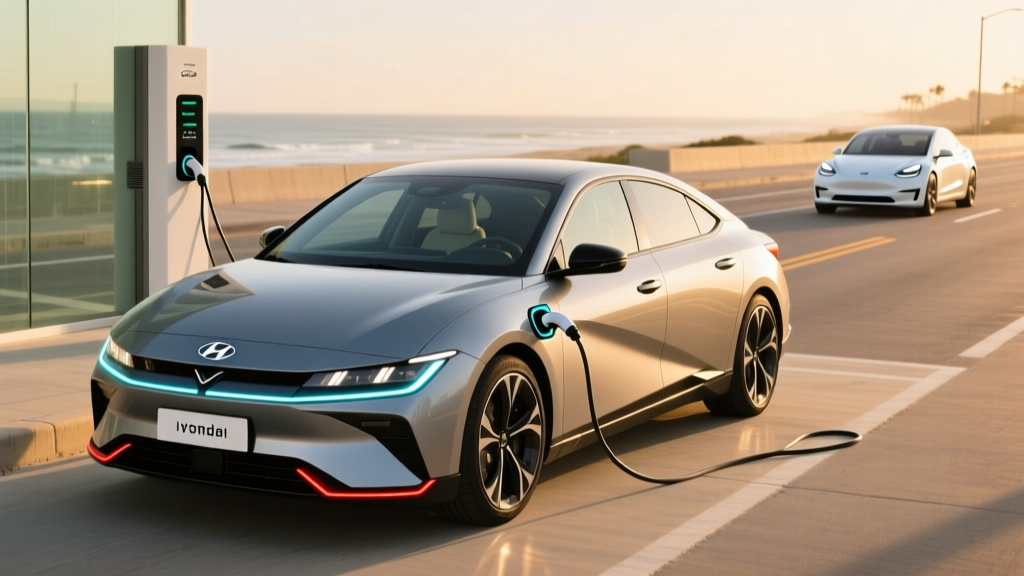
Search forums and EV comment sections long enough, and you'll encounter the term "fake tesla" — a half-joking label applied to any sleek, tech-forward electric sedan that borrows Tesla's minimalist playbook. The 2026 Hyundai Ioniq 6 doesn't run from the comparison; it leans into it. With a slippery 0.21 drag coefficient, a massive 361-mile EPA range on the SE Long Range trim, and an interior that strips away physical buttons in favor of dual 12.3-inch displays, Hyundai is clearly aiming at the Model 3 buyer who wants something different.
But does the Ioniq 6 actually compete with Tesla on the metrics that matter — charging speed, real-world efficiency, software polish, and total cost of ownership? After analyzing EPA data, manufacturer specs, and real-world driving reports, here's the complete breakdown.
| Specification | SE Long Range RWD | SEL AWD | Limited AWD |
|---|---|---|---|
| EPA Range | 361 mi | 316 mi | 295 mi |
| Battery (usable) | 77.4 kWh (NMC) | 77.4 kWh (NMC) | 77.4 kWh (NMC) |
| Drivetrain | RWD, single motor | Dual-motor AWD | Dual-motor AWD |
| Horsepower | 225 hp | 320 hp | 320 hp |
| 0–60 mph | 6.9 sec | 5.1 sec | 5.1 sec |
| Max DC Fast Charge | 239 kW (peak) | 239 kW (peak) | 239 kW (peak) |
| 10–80% DCFC Time | ~18 min | ~18 min | ~18 min |
| Level 2 Home Charge | 10.9 kW (~36 mi/hr) | 10.9 kW (~36 mi/hr) | 10.9 kW (~36 mi/hr) |
| MPGe (combined) | 140 MPGe | 117 MPGe | 111 MPGe |
| kWh/100 mi | 24 | 29 | 30 |
| Base MSRP | $42,450 | $47,900 | $53,600 |
Range and Efficiency: Where the Ioniq 6 Beats Tesla on Paper — and Mostly Delivers
The SE Long Range RWD's 361-mile EPA rating is one of the highest of any mainstream EV sedan sold in the U.S., edging past the Tesla Model 3 Long Range AWD's 341-mile EPA figure. Hyundai achieves this through a combination of factors: the E-GMP platform's heat pump (standard on all trims), aggressive aerodynamic optimization, and a relatively modest 225-hp single motor on the base long-range variant.
- EPA Sticker: 361 miles
- Mixed driving (city + suburban, 65°F): ~330–345 miles
- Highway sustained (75 mph, 75°F): ~280–300 miles
- Cold weather (30°F, highway + city mix): ~240–270 miles (heat pump helps, but expect 20–30% reduction)
The Ioniq 6's 24 kWh/100 mi combined efficiency on the SE RWD is genuinely excellent — comparable to the Model 3 RWD and better than most dual-motor competitors. If range-per-dollar is your priority, this trim is the sweet spot.
One caveat: the 361-mile figure applies only to the SE Long Range RWD. Step up to the SEL or Limited AWD trims, and larger wheels, added weight, and the dual-motor system drop range to 316 and 295 miles respectively. This is a meaningful gap — roughly 65 miles lost by choosing AWD and premium features.
Charging Speed: 800-Volt Architecture Is the Real Advantage
Hyundai's E-GMP platform supports 800-volt DC fast charging, a feature Tesla also uses but most competitors (including the VW ID.7 and many legacy OEMs) still lack at this price point. The practical result: the Ioniq 6 can accept up to 239 kW at a compatible 350-kW charger, enabling a 10–80% charge in approximately 18 minutes under ideal thermal conditions.
| Charge Level | Power / Voltage | Rate | Typical Use Case |
|---|---|---|---|
| Level 1 (120V household) | 1.4 kW | ~5 mi/hr | Emergency/overnight trickle |
| Level 2 (240V, 48A home charger) | 10.9 kW | ~36 mi/hr | Daily home charging; 0–100% in ~8.5 hr |
| DC Fast (350 kW station, 800V) | 239 kW peak | ~18 min (10–80%) | Road-trip stops; precondition battery via nav |
| DC Fast (150 kW station, CCS) | ~130–140 kW sustained | ~25–28 min (10–80%) | More common public infrastructure |
Charging curve reality check: The 239-kW peak only holds between roughly 10% and 45% State of Charge. Above 55%, the rate tapers to ~150 kW, and above 80%, it drops sharply to protect the NMC cells. If you arrive at a charger at 5% SoC with a preconditioned battery (use the Ioniq 6's navigation-based battery conditioning), you'll see the fastest times. Show up cold-soaked at 2% and expect 25+ minutes to 80%.
For home Level 2 charging, you'll need a 240V/48A hardwired station (or a 60A circuit with a 48A charger) to hit the full 10.9 kW onboard charger rate. A standard NEMA 14-50 outlet on a 50A circuit delivers ~9.6 kW — still sufficient for overnight replenishment of even the full 77.4 kWh battery.
Performance and Driving Dynamics: Quick but Not a Sports Sedan
The dual-motor AWD trims (SEL, Limited) deliver 320 hp and a 5.1-second 0–60 mph time — brisk, but not in the same league as the Tesla Model 3 Performance's ~3.1-second sprint. Hyundai has tuned the Ioniq 6 for comfort and efficiency rather than track capability, and the steering feel reflects that: light, numb, and adequate for commuting but uninspiring on back roads.
Where the Ioniq 6 shines is ride quality. The multi-link rear suspension absorbs highway imperfections noticeably better than the Model 3's firmer setup, and cabin noise levels are low thanks to acoustic laminated glass on higher trims. Regenerative braking offers four levels selectable via steering-wheel paddles, including a "i-Pedal" one-pedal mode that brings the car to a complete stop without touching the brake pedal.
Interior, Tech, and the "Minimalist" Trade-Off
The Ioniq 6's cabin is where the "fake tesla" comparison is most deliberate — and most divisive. The dual 12.3-inch curved display cluster handles both instrumentation and infotainment, and physical buttons are nearly absent. Climate controls, media, and vehicle settings all route through the touchscreen or a small touch-sensitive panel below it.
Standout tech features:
- Hyundai Digital Key 2 (NFC + UWB phone-as-key)
- Over-the-air (OTA) software updates for powertrain, ADAS, and infotainment
- Highway Driving Assist 2 (HDA2) — a competent Level 2 system with lane-centering, adaptive cruise, and lane-change assist
- Vehicle-to-Load (V2L) — powers external devices up to 3.6 kW via interior outlet or external adapter
- Bluelink connected services with remote preconditioning and charge scheduling
Notable drawbacks:
- Touch-capacitive buttons for climate and volume are frustrating to use while driving — a common complaint
- Rear headroom is tight (37.1 inches) due to the sloping roofline; taller passengers will notice
- Cargo volume is 11.2 cu ft in the trunk — modest for a midsize sedan, with no hatchback or frunk
- Infotainment, while improved for 2026, still lags Tesla's UI responsiveness and app ecosystem
Pricing, Tax Credits, and the Cost Question
The 2026 Ioniq 6 lineup starts at $42,450 for the SE Long Range RWD and climbs to $53,600 for the Limited AWD. Here's how federal incentives interact with these prices under current IRS §30D rules:
| Trim | MSRP | MSRP Cap (§30D) | Est. Credit | Effective Price (if eligible) |
|---|---|---|---|---|
| SE Long Range RWD | $42,450 | Passes ($55k sedan cap) | Up to $7,500* | ~$34,950 |
| SEL AWD | $47,900 | Passes | Up to $7,500* | ~$40,400 |
| Limited AWD | $53,600 | Passes | Up to $7,500* | ~$46,100 |
*Full $7,500 credit requires meeting both critical-mineral and battery-component sourcing thresholds per IRS §30D guidelines. Buyer income must not exceed $150k single / $300k joint. Credit is non-refundable but can be transferred to the dealer as a point-of-sale reduction for 2026. Verify current-year battery-sourcing compliance on fueleconomy.gov before purchasing, as eligibility can change mid-year.
The Ioniq 6's biggest value advantage over the Model 3 is the potential for a full $7,500 federal credit applied at point of sale. Tesla's Model 3 Long Range also qualifies under current sourcing rules, but buyers should verify both vehicles' eligibility at time of purchase — battery component sourcing requirements tighten annually through 2032.
Ownership Costs and Warranty: Hyundai's Strong Suit
Hyundai backs the Ioniq 6 with one of the strongest warranties in the EV segment:
- Battery & Powertrain: 10 years / 100,000 miles (capacity retention threshold: 70%)
- New Vehicle Limited: 5 years / 60,000 miles
- Complimentary Maintenance: 3 years / 36,000 miles (oil changes don't apply, but tire rotations, cabin filter, and multi-point inspections are covered)
- Roadside Assistance: 5 years / unlimited miles
Compared to Tesla's 8-year/120,000-mile battery warranty (Model 3 RWD) or 8-year/100,000-mile (Long Range/Performance), Hyundai adds two extra years of coverage, though with a slightly shorter mileage cap on the base model. The 70% capacity retention threshold is industry-standard and matches Tesla's language.
Insurance costs for the Ioniq 6 tend to run 5–12% lower than the Model 3 in most U.S. markets, based on industry averages — a meaningful savings over five years of ownership. Depreciation remains the wildcard: Teslas historically held value better, though the gap narrowed significantly after 2023's price cuts and increased competition.
Verdict: Who Should Buy the Ioniq 6 — and Who Should Look Elsewhere?
- Class-leading 361-mi EPA range (SE LR RWD) at a sub-$43k starting price
- 800V architecture enables genuinely fast 18-min DC charging
- 10-year/100k-mile battery warranty beats most competitors
- Ride comfort and cabin quietness exceed the Model 3
- V2L capability for camping, tailgating, or emergency power
- Full §30D tax credit eligibility (verify sourcing at purchase)
- Touch-capacitive controls are a usability step backward
- 11.2 cu ft trunk with no hatch — less practical than Model 3's frunk + trunk combo
- Infotainment and OTA ecosystem still trails Tesla's maturity
- AWD trims lose 45–66 miles of range vs. RWD
- Rear headroom is tight for passengers over 6'1"
- CCS connector (not NACS) — requires adapter for Tesla Supercharger access
Choose the Tesla Model 3 instead if: You need native Supercharger network access without adapters, prefer a hatchback-style trunk, want a more mature software/app ecosystem, or value the Performance variant's 3.1-second 0–60 time.
Frequently Asked Questions
What is the real-world range of the 2026 Hyundai Ioniq 6?
The SE Long Range RWD is EPA-rated at 361 miles. In mixed real-world driving at moderate temperatures, expect 330–345 miles. Sustained highway driving at 75 mph drops this to roughly 280–300 miles, and cold weather (below 35°F) with cabin heating can reduce range by 20–30%, yielding 240–270 miles. The heat pump standard on all trims mitigates some cold-weather loss compared to EVs without one.
How fast does the Ioniq 6 charge at home and on the road?
At home on a 240V/48A Level 2 charger, the Ioniq 6 accepts up to 10.9 kW, adding roughly 36 miles of range per hour and fully charging the 77.4 kWh battery in about 8.5 hours. On a 350-kW DC fast charger with a preconditioned battery, it peaks at 239 kW and reaches 10–80% in approximately 18 minutes. At more common 150-kW CCS stations, expect 25–28 minutes for the same 10–80% session.
Does the 2026 Ioniq 6 qualify for the $7,500 federal EV tax credit?
All Ioniq 6 trims pass the §30D MSRP cap for sedans ($55,000). Full $7,500 credit eligibility depends on meeting both critical-mineral and battery-component sourcing requirements, which tighten annually. Buyer adjusted gross income must not exceed $150,000 (single) or $300,000 (joint). For 2026, the credit can be transferred to the dealer as a point-of-sale price reduction. Always verify current sourcing compliance on fueleconomy.gov and consult a tax professional for your specific situation.
Is the Ioniq 6 worth buying over the Tesla Model 3?
For buyers who value ride comfort, longer warranty coverage, V2L capability, and lower insurance costs, the Ioniq 6 SE Long Range RWD at ~$35,000 after the federal credit is a compelling alternative. The Model 3 retains advantages in native Supercharger access, software maturity, cargo versatility (frunk + hatchback trunk), and available Performance variant acceleration. It's a close call — your preference for charging network and UI ecosystem will likely decide it.
Does the Ioniq 6 use NACS or CCS for charging?
The 2026 Ioniq 6 uses a CCS1 connector for DC fast charging. Hyundai has announced NACS adoption for future models, but the current-generation Ioniq 6 requires a CCS-to-NACS adapter to access Tesla Supercharger stalls. Hyundai provides or subsidizes this adapter for many trims; confirm with your dealer. For home Level 2 charging, the standard J1772 connector is compatible with all Level 2 stations.
How does the Ioniq 6's battery hold up over time?
The 77.4 kWh NMC battery is covered by a 10-year/100,000-mile warranty with a 70% capacity retention threshold. Independent data from Ioniq 5 owners (which shares the E-GMP platform and similar NMC chemistry) suggests degradation of approximately 8–12% over the first 100,000 miles under normal use — well within warranty coverage. Best practices for longevity: avoid routinely charging to 100% on DC fast chargers, use Level 2 for daily charging, and take advantage of the built-in charge-limit settings (80% or 90% daily cap).
Sources: U.S. EPA / fueleconomy.gov, Hyundai Motor America Press Room, IRS §30D New Clean Vehicle Credit.