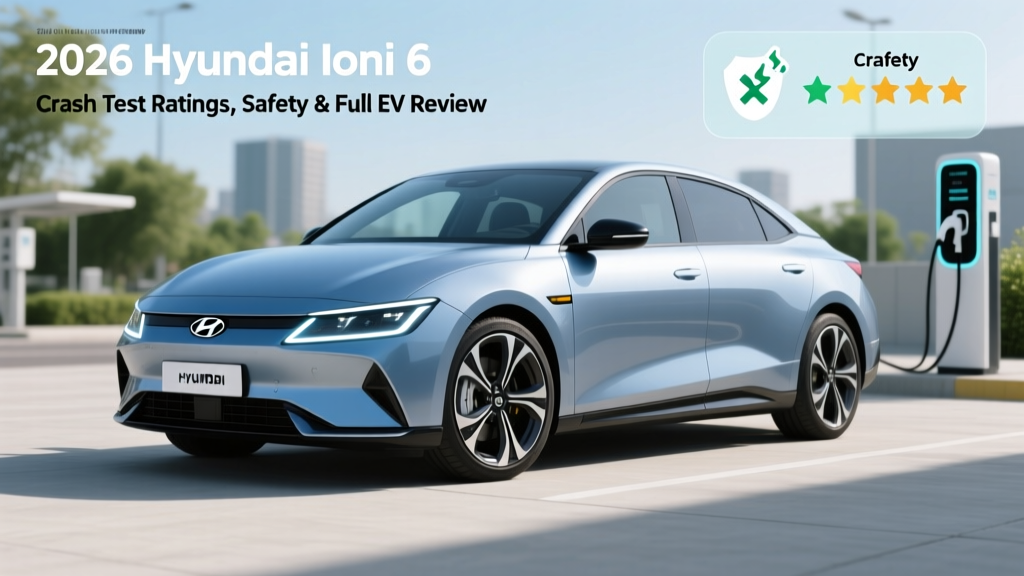
The Hyundai Ioniq 6 has earned a reputation as one of the most aerodynamically efficient electric sedans on the market, but for safety-conscious EV shoppers, the headline question is simpler: how does it protect its occupants? The Hyundai Ioniq 6 crash test results from both the Insurance Institute for Highway Safety (IIHS) and the National Highway Traffic Safety Administration (NHTSA) tell a compelling story — one that pairs top-tier crash protection with segment-leading efficiency and rapid DC fast charging.
In this full review, we break down every safety rating, then go deep on the numbers that matter for daily ownership: real-world range versus the EPA sticker, charging-curve behavior at public DC stations, battery chemistry and warranty, and exactly what you'll pay after federal tax credits.
Hyundai Ioniq 6 Crash Test Ratings: IIHS and NHTSA Results
The Ioniq 6 has been rigorously evaluated by both major U.S. safety bodies. Here's how it performed:
| Test | IIHS Rating | NHTSA Rating |
|---|---|---|
| Driver-Side Small Overlap Front | Good | — |
| Passenger-Side Small Overlap Front | Good | — |
| Moderate Overlap Front (Original) | Good | — |
| Moderate Overlap Front (Updated) | Good | — |
| Side Impact (Updated) | Good | — |
| Roof Strength | Good | — |
| Head Restraints & Seats | Good | — |
| Overall Crash Rating | TOP SAFETY PICK+ | 5 Stars (Overall) |
| Frontal Crash | — | 5 Stars |
| Side Crash | — | 5 Stars |
| Rollover | — | 4 Stars |
The IIHS awarded the Ioniq 6 its TOP SAFETY PICK+ designation — the organization's highest honor — when equipped with specific headlight trims. The updated moderate overlap front test, which now evaluates rear-seat occupant protection, is a particular differentiator: many competitors have stumbled here, but the Ioniq 6 scored Good across the board.
On the NHTSA side, the Ioniq 6 earned a 5-Star Overall Safety Rating, with 5 stars in frontal and side crash tests and 4 stars in rollover resistance. The 4-star rollover score is typical for sedans with a low center of gravity — the Ioniq 6's battery pack sits beneath the floor, giving it inherent stability.
Standard and Available Safety Technology
Crash test performance is only half the equation. The Ioniq 6 comes standard with Hyundai SmartSense, a comprehensive suite of active safety features:
- Forward Collision-Avoidance Assist (FCA) with pedestrian, cyclist, and junction-turning detection
- Blind-Spot Collision-Avoidance Assist (BCA)
- Rear Cross-Traffic Collision-Avoidance Assist (RCCA)
- Navigation-Based Smart Cruise Control with Stop & Go
- Lane Following Assist (LFA) and Lane Keeping Assist (LKA)
- Safe Exit Warning
- Highway Driving Assist 2 (HDA 2) — available on SEL and above, adds lane-change assist and hands-on detection via steering-wheel grip sensors
Important: Highway Driving Assist 2 is an SAE Level 2 driver-assistance system. It provides steering, acceleration, and braking support, but the driver must remain fully engaged with hands on the wheel and eyes on the road at all times. It is not self-driving.
Range, Battery, and Real-World Efficiency
The Ioniq 6 is offered with two battery configurations, and the range spread between them is substantial:
| Specification | Standard Range (SE) | Long Range (SE/SEL/Limited) |
|---|---|---|
| Battery Capacity (Usable) | 54.0 kWh | 77.4 kWh |
| Chemistry | NMC (Nickel Manganese Cobalt) | NMC (Nickel Manganese Cobalt) |
| Drivetrain | RWD | RWD or AWD |
| EPA Range | 240 mi | 361 mi (RWD) / 316 mi (AWD) |
| EPA Combined MPGe | 118 MPGe | 140 MPGe (RWD) / 111 MPGe (AWD) |
| Efficiency (kWh/100 mi) | 28 kWh | 24 kWh (RWD) / 30 kWh (AWD) |
Real-World Range Reality Check: The Long Range RWD's EPA rating of 361 miles is among the highest of any production EV. In mixed real-world driving, expect approximately 310–340 miles in moderate temperatures. At sustained highway speeds of 75+ mph, range drops to roughly 270–300 miles. In cold weather (below 32°F), plan for a 20–30% reduction, bringing usable range down to 230–270 miles depending on cabin heat usage. The Ioniq 6's standard heat pump helps mitigate cold-weather losses compared to EVs without one, but physics still applies.
The Ioniq 6 Long Range RWD's 140 MPGe combined and 24 kWh/100 mi efficiency figures make it one of the most energy-efficient EVs available, rivaling the Tesla Model 3 and Lucid Air in electrons-per-mile. That slipstream-shaped body (drag coefficient of just 0.21) is doing real work here.
Charging Speed: DC Fast, Level 2, and the Charge Curve
Hyundai's E-GMP platform supports 800-volt architecture, which translates into some of the fastest public DC charging speeds in the industry.
| Charging Level | Power | Speed / Time | Notes |
|---|---|---|---|
| Level 1 (120V household) | ~1.4 kW | ~4 mi/hr | Emergency/top-up only |
| Level 2 (240V home) | 10.9 kW (max) | ~38 mi/hr; full charge in ~7.5 hr (LR) | Requires 48A circuit |
| DC Fast Charge (peak) | 239 kW | 10–80% in ~18 min (LR) | Requires 350 kW station |
| DC Fast Charge (50 kW station) | 50 kW | 10–80% in ~65 min | Common older stations |
The 18-minute 10–80% figure is a peak-scenario number achievable at a 350 kW-rated charger (such as Electrify America's latest stalls) with battery preconditioning active. Here's what the charge curve actually looks like in practice:
- 10–40% SoC: Sustains near-peak power, approximately 200–239 kW
- 40–65% SoC: Gradual taper to roughly 150–180 kW
- 65–80% SoC: Further taper to ~100–120 kW
- Above 80% SoC: Sharp taper below 60 kW — this is why the 10–80% metric is standard; charging from 80–100% can take as long as 10–80%
The Ioniq 6 uses the CCS1 connector natively. For Tesla Supercharger access, Hyundai provides a NACS adapter (or you can purchase one separately), opening up the Supercharger network. Charge speeds via adapter are comparable to native CCS at equivalent-power stalls.
For home Level 2 charging, the onboard charger maxes at 10.9 kW. A 48-amp hardwired Level 2 station (such as a ChargePoint Home Flex or Emporia Level 2) will replenish the Long Range battery from empty in about 7.5 hours — ideal for overnight charging on a 240V/60A circuit.
Performance and Drivetrain
| Trim/Config | Drivetrain | Horsepower | Torque (lb-ft) | 0–60 mph |
|---|---|---|---|---|
| SE Standard Range | RWD (single motor) | 149 hp | 258 | 8.5 sec |
| SE/SEL/Limited Long Range RWD | RWD (single motor) | 225 hp | 258 | 6.2 sec |
| SEL/Limited Long Range AWD | AWD (dual motor) | 320 hp | 446 | 4.5 sec |
The AWD dual-motor variant is genuinely quick — 4.5 seconds to 60 mph puts it in sports-sedan territory. But the efficiency story is the RWD Long Range: 225 hp is more than adequate for merging and passing, and the 361-mile EPA range is the trade-off worth making for most buyers. Regenerative braking is adjustable via steering-wheel paddles (levels 0–3 plus an i-PEDAL one-pedal mode), and the system is among the smoothest in the segment.
Pricing, Trims, and Federal Tax Credit Eligibility
| Trim | Drivetrain | Base MSRP | Est. After §30D Credit* |
|---|---|---|---|
| SE Standard Range | RWD | $38,650 | $31,150 |
| SE Long Range | RWD | $43,600 | $36,100 |
| SEL Long Range | RWD | $46,600 | $39,100 |
| SEL Long Range AWD | AWD | $50,100 | $42,600 |
| Limited Long Range | RWD | $52,600 | $45,100 |
| Limited Long Range AWD | AWD | $56,100 | $48,600 |
*Estimated price assumes full $7,500 federal tax credit. Actual eligibility depends on income, battery sourcing, and MSRP caps per IRS §30D rules.
The Ioniq 6 qualifies as a sedan under §30D, meaning it falls under the $55,000 MSRP cap (not the $80,000 SUV/truck cap). This is critical: the Limited AWD at $56,100 exceeds the cap and may not qualify. All other trims fall within the limit.
Federal §30D Tax Credit Checklist (2026 rules):
- MSRP cap: Sedan — must be ≤ $55,000
- Buyer income cap: Modified AGI ≤ $150,000 (single) / $225,000 (head of household) / $300,000 (joint)
- Battery sourcing: Critical minerals and battery components must meet escalating percentage thresholds from qualifying trade partners; non-compliant sourcing reduces the credit to $3,750 or $0
- Point-of-sale transfer: Eligible buyers can transfer the credit to the dealer for an immediate price reduction at purchase
- Filed with IRS: Must claim on Form 8936 or elect point-of-sale transfer at time of purchase
Always verify current eligibility on IRS.gov and consult a tax professional, as battery-sourcing requirements tighten annually.
Cargo, Interior Space, and Daily Practicality
The Ioniq 6's swooping roofline looks stunning but exacts a practicality toll:
- Cargo volume (trunk): 11.4 cu ft — competitive with a mid-size sedan trunk, but significantly less than the Ioniq 5's hatchback layout (27.2 cu ft)
- Front headroom: 39.4 in
- Rear headroom: 37.1 in — adequate for most adults, but taller passengers (6'2"+) will notice the sloping roofline
- Rear legroom: 35.1 in — generous, thanks to the E-GMP platform's flat floor and long wheelbase (116.1 in)
- Frunk (front trunk): RWD models include a small 0.5 cu ft frunk (enough for a charging cable bag); AWD models forgo this due to the front motor
Inside, the dual 12.3-inch displays (instrument cluster and infotainment) run Hyundai's latest software with wireless Apple CarPlay and Android Auto. The center console features a bridge-style design with physical buttons for climate control — a welcome choice over touchscreen-only setups. The Limited trim adds a panoramic fixed glass roof, ventilated front seats, heated rear seats, a Bose premium audio system, and a digital key (phone-as-key via NFC/UWB).
Warranty and Long-Term Battery Outlook
| Coverage | Duration |
|---|---|
| New Vehicle Limited | 5 years / 60,000 mi |
| EV Battery (capacity retention) | 10 years / 100,000 mi |
| Powertrain | 10 years / 100,000 mi |
| Corrosion (perforation) | 7 years / unlimited mi |
| Roadside Assistance | 5 years / unlimited mi |
Hyundai's 10-year/100,000-mile battery warranty guarantees that the pack will retain at least 70% of its original capacity during the coverage period. NMC chemistry in the Ioniq 6 has shown modest degradation in early fleet data — most owners report 5–8% capacity loss after 60,000 miles, which is well within warranty thresholds. Best practices for longevity: avoid routinely charging to 100% (use the 80% daily limit setting), minimize repeated DC fast charging in extreme heat, and use battery preconditioning when navigating to a charger.
Pros and Cons
Pros
- Class-leading 361-mile EPA range (Long Range RWD)
- 239 kW peak DC fast charging — 10–80% in ~18 min
- TOP SAFETY PICK+ (IIHS) and 5-Star NHTSA ratings
- 140 MPGe combined efficiency rivals the best in the EV market
- Standard heat pump for improved cold-weather range retention
- 10-year/100,000-mile battery warranty
- Generous rear legroom and smooth ride quality
- Physical climate-control buttons alongside modern infotainment
Cons
- 11.4 cu ft trunk is small for the segment; no hatchback option
- Rear headroom tight for taller passengers due to roofline
- CCS1 native port requires adapter for Tesla Supercharger access
- Limited AWD trim exceeds $55K MSRP cap — may lose §30D credit
- No frunk on AWD models
- Camera-based side mirrors (Digital Side Mirrors) not available in U.S.
- Road noise more noticeable than in luxury-priced competitors
Who Should Buy the Hyundai Ioniq 6?
Choose the Ioniq 6 Long Range RWD if: You prioritize maximum range and efficiency, commute 30–80 miles daily, take occasional road trips, and want top safety ratings at a sub-$50K price after credits.
Choose the Ioniq 6 AWD if: You need all-weather traction, want 4.5-second 0–60 performance, and don't mind trading ~45 miles of range for dual-motor grip — but verify the trim's MSRP stays under $55K for §30D eligibility.
Look elsewhere if: You regularly haul cargo or need hatchback versatility (consider the Ioniq 5 or Kia EV6), you need three rows, or you exclusively charge on the Tesla Supercharger network and don't want to manage adapters.
Frequently Asked Questions
What is the real-world range of the Hyundai Ioniq 6?
The Long Range RWD has an EPA rating of 361 miles. In real-world mixed driving at moderate temperatures, expect 310–340 miles. Sustained highway driving at 75+ mph reduces this to roughly 270–300 miles. In sub-freezing conditions, plan for 230–270 miles depending on cabin heat demand and whether you precondition the battery.
How fast does the Ioniq 6 charge at home and on DC fast chargers?
At a 350 kW DC fast charger, the Long Range model peaks at 239 kW and charges from 10–80% in approximately 18 minutes. At a typical 50 kW DC station, that same session takes about 65 minutes. At home on a Level 2 (240V) charger at 10.9 kW, a full charge takes roughly 7.5 hours for the Long Range battery.
How much does the Hyundai Ioniq 6 cost after the federal tax credit?
Most trims qualify for the full $7,500 §30D credit (subject to buyer income limits and battery-sourcing compliance). The SE Long Range starts at $43,600 MSRP and drops to an estimated $36,100 after the credit. The Limited AWD at $56,100 may exceed the $55,000 sedan MSRP cap and lose eligibility.
Does the Hyundai Ioniq 6 qualify for the federal EV tax credit?
Yes, most trims qualify, provided the buyer meets income caps ($150K single / $300K joint), the MSRP is at or below $55,000, and battery critical-mineral and component sourcing meets current-year thresholds. Verify on IRS.gov before purchasing, as sourcing rules tighten each year.
Is the Ioniq 6 worth buying versus the Tesla Model 3 or Kia EV6?
The Ioniq 6 wins on EPA range (361 mi vs. Model 3 Long Range's ~341 mi) and matches both on safety. The Model 3 has a native NACS connector and Supercharger access without an adapter, plus a more minimal interior. The Kia EV6 shares the E-GMP platform and 800V charging but offers a hatchback body style with more cargo room. If range and efficiency are your top priorities in a sedan, the Ioniq 6 is the strongest pick.
What are the Hyundai Ioniq 6's biggest safety advantages?
The TOP SAFETY PICK+ rating from IIHS (with Good scores in every crash test including the updated moderate overlap and side tests) combined with a 5-Star NHTSA overall rating makes it one of the safest EVs available. Standard Hyundai SmartSense with pedestrian/cyclist/junction FCA and available HDA 2 provide comprehensive active safety coverage.
Sources: IIHS, NHTSA, fueleconomy.gov, IRS §30D.