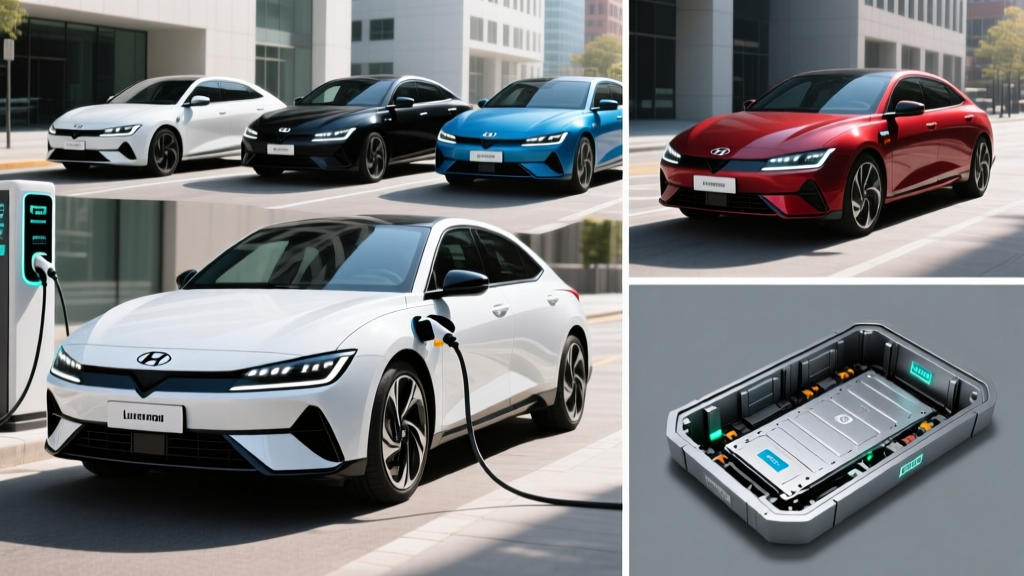
The Hyundai Ioniq 6 remains one of the most aerodynamically efficient electric sedans on the market, and for 2026, Hyundai has refined the palette while keeping the underpinnings that made this car a standout. If you've been searching for Ioniq 6 colors alongside hard data on range, charging speed, and pricing, this guide consolidates everything you need to make an informed purchase decision.
Beneath its streamlined "Electrified Streamliner" bodywork sits Hyundai's E-GMP platform with an 800-volt electrical architecture — the same hardware underpinning the Ioniq 5 and Kia EV6. That architecture translates directly into some of the fastest DC charging speeds available in this price segment. But aesthetics matter too, and the 2026 color lineup tells a story about where Hyundai is positioning this car: premium, tech-forward, and quietly confident.
2026 Hyundai Ioniq 6 Color Options by Trim
Hyundai offers the 2026 Ioniq 6 across four trims — SE Standard Range, SE, SEL, and Limited — and color availability varies by trim level. Here is the full breakdown:
| Color | SE Std Range | SE | SEL | Limited | Finish Type |
|---|---|---|---|---|---|
| Onyx Black | ✓ | ✓ | ✓ | ✓ | Metallic |
| Curated Silver | ✓ | ✓ | ✓ | ✓ | Metallic |
| Ultimate Red | ✓ | ✓ | ✓ | ✓ | Metallic ($425 premium) |
| Transmission Blue | — | ✓ | ✓ | ✓ | Mica |
| Gravity Gold (Matte) | — | — | — | ✓ | Matte ($1,000 premium) |
| Serenity White | — | ✓ | ✓ | ✓ | Pearl |
| Biophilic Blue | — | ✓ | ✓ | ✓ | Metallic |
| Nocturne Gray | ✓ | ✓ | ✓ | ✓ | Metallic |
The headline color for 2026 remains Gravity Gold (Matte), exclusive to the Limited trim. It's a warm, satin-champagne tone that photographs exceptionally well but requires specific care — matte finishes cannot be polished the same way as gloss clear coats, so budget for matte-specific detailing products. Transmission Blue and Biophilic Blue are the two most distinctive non-premium options and help the Ioniq 6 stand out in a sea of grayscale EVs.
Interior Color Pairings
Interior options are more constrained and depend on your exterior selection:
- Black (H-Tex) — Available on all trims; standard on SE and SEL.
- Gray/Light Green (H-Tex + recycled fabric) — Available on SEL and Limited; pairs best with Serenity White, Curated Silver, and Biophilic Blue exteriors.
- Dark Teal (H-Tex) — Limited trim only; designed to complement Gravity Gold and Onyx Black.
Range, Battery, and Efficiency
The 2026 Ioniq 6 continues with two battery configurations. The SE Standard Range uses a smaller pack on a rear-wheel-drive layout, while the SE, SEL, and Limited trims offer both RWD (long-range) and AWD options.
| Spec | SE Standard Range (RWD) | SE/SEL/Limited Long Range (RWD) | SE/SEL/Limited (AWD) |
|---|---|---|---|
| Battery Capacity (usable) | 54.0 kWh | 77.4 kWh | 77.4 kWh |
| Battery Chemistry | NMC (Nickel Manganese Cobalt) | NMC | NMC |
| EPA Range | 240 mi | 361 mi | 316 mi |
| Combined MPGe | 140 MPGe | 140 MPGe | 123 MPGe |
| Efficiency (kWh/100 mi) | 24 kWh | 24 kWh | 27 kWh |
| Horsepower | 149 hp | 225 hp | 320 hp |
| Torque | 258 lb-ft | 258 lb-ft | 446 lb-ft |
| 0-60 mph | 8.5 sec | 6.2 sec | 4.5 sec |
| Drivetrain | RWD | RWD | Dual-Motor AWD |
The EPA-estimated 361 miles for the Long Range RWD is among the highest of any EV in this class. However, in sustained highway driving at 70-75 mph, expect approximately 290-320 miles in moderate temperatures (60-80°F). In cold weather (below 32°F), plan for a 20-30% reduction, bringing realistic range to roughly 250-280 miles on the RWD Long Range. The AWD variant sees a steeper drop in cold conditions due to increased energy demand from dual motors and cabin heating. These figures are consistent with EPA data on fueleconomy.gov.
Hyundai uses NMC (nickel manganese cobalt) chemistry across the Ioniq 6 lineup. NMC offers higher energy density than LFP (lithium iron phosphate), which is how Hyundai achieves 361 miles from a 77.4 kWh pack. The trade-off: NMC batteries generally prefer you don't charge to 100% daily (80% is the recommended daily maximum for longevity), whereas LFP packs tolerate full charges better. Hyundai's battery management system includes a buffer — roughly 3-4 kWh below the gross capacity — to protect against deep discharge degradation.
Charging Speed: 800V Architecture Advantage
The Ioniq 6's 800V electrical architecture is its most significant engineering advantage over competitors still running 400V systems. Here's what that means in practice at the charger:
| Charging Level | Power / Voltage | Charge Time | Miles Added per Hour |
|---|---|---|---|
| Level 1 (120V household) | 1.4 kW | ~55 hours (10-100%) | ~4 mi/hr |
| Level 2 (240V home, 48A) | 10.9 kW | ~7 hr 15 min (10-100%) | ~33 mi/hr |
| DC Fast (350 kW station) | Peak 235 kW | ~18 min (10-80%) | N/A |
| DC Fast (150 kW station) | Peak ~145 kW | ~28 min (10-80%) | N/A |
| DC Fast (50 kW station) | 50 kW | ~1 hr 15 min (10-80%) | N/A |
A few important nuances about these numbers:
- Peak vs. sustained charge rate: The 235 kW figure is a peak, not a sustained rate. The Ioniq 6 holds above 200 kW from roughly 10-55% SoC, then tapers progressively. From 80-100%, charging slows dramatically — expect an additional 25-30 minutes to complete the final 20%. This is normal lithium-ion charge-curve behavior, not a flaw.
- Preconditioning matters: The Ioniq 6 includes battery preconditioning when you navigate to a DC fast charger in the built-in navigation. If you arrive at a charger without preconditioning (e.g., using a third-party app or in cold weather without preconditioning), your peak rate may drop to 150-180 kW initially until the pack warms.
- Connector: The 2026 Ioniq 6 ships with the CCS1 connector as standard. Hyundai has confirmed NACS (Tesla-style) adoption beginning with 2026 model-year vehicles built after Q1 2026, but early-build 2026 cars may still have CCS1 with a NACS adapter included. Verify with your dealer at purchase.
For home Level 2 charging, you'll need a 240V circuit rated for at least 60 amps to support the Ioniq 6's 10.9 kW onboard charger at its full 48-amp draw. Installation costs for a Level 2 home setup typically range from $500 to $2,500 depending on panel capacity and conduit run length — budget toward the higher end if your electrical panel needs an upgrade from 100A to 200A service.
Pricing, Trims, and Federal Tax Credit
The 2026 Ioniq 6 pricing structure is straightforward, though federal tax credit eligibility requires careful attention to IRS §30D rules.
| Trim | Drivetrain | Base MSRP | As-Tested (Typical) | §30D Credit Eligible? |
|---|---|---|---|---|
| SE Standard Range | RWD | $38,650 | $39,400 | Yes (up to $7,500) |
| SE | RWD | $43,600 | $44,800 | Yes (up to $7,500) |
| SE | AWD | $47,500 | $48,900 | Yes (up to $7,500) |
| SEL | RWD | $47,100 | $49,500 | Yes (up to $7,500) |
| SEL | AWD | $51,000 | $53,200 | Yes (up to $7,500) |
| Limited | RWD | $52,600 | $55,800 | Yes (up to $7,500) |
| Limited | AWD | $56,100 | $59,400 | Yes (up to $7,500) |
Important tax credit caveats: The federal §30D credit of up to $7,500 is subject to multiple requirements that change periodically. As of 2026, key rules include:
- MSRP cap: Sedans must have an MSRP at or below $55,000. This means the Ioniq 6 Limited AWD ($56,100) may exceed the cap — verify the final MSRP including mandatory options with your dealer.
- Buyer income limits: Modified adjusted gross income (MAGI) must not exceed $150,000 (single), $225,000 (head of household), or $300,000 (joint filers).
- Battery sourcing requirements: A percentage of critical minerals and battery components must be sourced from the U.S. or free-trade-agreement countries. Hyundai has worked to localize battery supply chains for U.S.-built Ioniq 6 models (produced at the Metaplant in Georgia), but the exact credit amount ($3,750 or $7,500) depends on current-year sourcing percentages.
- Point-of-sale transfer: You can transfer the credit to the dealer at purchase, reducing your out-of-pocket cost immediately rather than waiting for a tax refund.
Always confirm eligibility with your tax professional and reference the latest guidance at IRS.gov before purchasing.
Interior Space, Cargo, and Daily Practicality
The Ioniq 6's swooping roofline looks dramatic but creates real compromises in rear-seat headroom and cargo access. Here are the concrete dimensions:
- Front headroom: 40.2 inches
- Front legroom: 41.7 inches
- Rear headroom: 37.1 inches (noticeably tight for passengers over 6'1")
- Rear legroom: 35.7 inches
- Trunk volume: 11.3 cubic feet (sedan trunk, not a hatchback liftgate)
- Front trunk (frunk): 0.5 cubic feet (AWD) / 1.6 cubic feet (RWD) — enough for a charging cable bag, not much else
The trunk opening is relatively narrow due to the sedan body style. If you regularly haul bulky items — strollers, camping gear, large boxes — the Ioniq 5 or Kia EV6 (both hatchback/crossover designs) offer substantially more cargo flexibility. The Ioniq 6 is optimized for commuters and couples, not families who need maximum cargo versatility.
Technology, Safety, and Driver Assistance
The 2026 Ioniq 6 features dual 12.3-inch displays (instrument cluster + infotainment) running Hyundai's latest Bluelink connected services. Key tech highlights:
- Hyundai SmartSense suite: forward collision-avoidance assist, blind-spot collision-avoidance, rear cross-traffic collision-avoidance, lane-keeping assist, highway driving assist (HDA-2 with lane-change assist)
- Digital side mirrors (Limited trim, replaces traditional mirrors with camera-based displays — takes adaptation but reduces drag)
- Vehicle-to-Load (V2L): The Ioniq 6 can power external devices up to 3.6 kW via an interior outlet and an exterior V2L adapter — useful for camping, tailgating, or emergency backup power
- Over-the-air (OTA) updates: Hyundai pushes firmware updates for powertrain calibration, infotainment, and ADAS improvements
- Highway Driving Assist 2: This is Hyundai's Level 2 (SAE) driver-assistance system — it handles adaptive cruise, lane centering, and lane-change initiation on mapped highways. The driver must remain attentive with hands on or near the wheel at all times.
Hyundai's Highway Driving Assist 2 is a Level 2 system. It does not drive the car autonomously. You are the driver, and you are responsible for monitoring the road, steering input, and braking at all times. Do not confuse this with Level 4 driverless systems like Waymo.
Safety ratings are strong: the Ioniq 6 earned IIHS Top Safety Pick+ status and a 5-star NHTSA overall rating. Check current ratings at IIHS.org and NHTSA.gov.
Warranty Coverage
Hyundai's warranty remains one of the strongest in the EV segment:
- Battery: 10 years / 100,000 miles (capacity retention threshold: 70% of original capacity)
- Electric powertrain: 10 years / 100,000 miles
- New vehicle limited: 5 years / 60,000 miles
- Roadside assistance: 5 years / unlimited miles
- Complimentary maintenance: 3 years / 36,000 miles (oil changes don't apply, but this covers tire rotations, cabin air filter, and multi-point inspections)
The 10-year battery warranty is particularly valuable. NMC chemistry degrades gradually — industry data suggests 8-12% capacity loss over 100,000 miles under normal use. Hyundai's 70% threshold means you'd need to lose more than 30% before a warranty claim is valid, which is unlikely under normal ownership but provides long-term peace of mind.
Pros and Cons
Pros
- Class-leading EPA range (361 mi RWD Long Range)
- 800V architecture enables ~18 min 10-80% DC fast charging
- Striking aerodynamic design with distinctive color options (Gravity Gold Matte, Transmission Blue)
- Excellent efficiency (140 MPGe combined RWD)
- V2L capability for external power
- Strong 10-year/100,000-mi battery warranty
- IIHS Top Safety Pick+ and 5-star NHTSA
Cons
- Sedan trunk limits cargo flexibility vs. hatchback competitors
- Rear headroom tight for tall passengers (37.1 in)
- Frunk is nearly useless on AWD trims (0.5 cu ft)
- Matte Gravity Gold paint requires specialized care
- Limited AWD may exceed $55K MSRP cap for §30D credit
- Infotainment lacks native Apple Maps / Google Maps integration (uses Hyundai nav)
- CCS-to-NACS transition may cause adapter confusion for early 2026 builds
Who Should Buy the 2026 Ioniq 6?
Choose the Ioniq 6 if:
- You're a commuter or couple who prioritizes range and efficiency over cargo space
- You take regular road trips and want fast 800V charging to minimize stop times
- You want a sedan's driving dynamics (lower center of gravity, quieter cabin at highway speed) rather than a crossover
- Design and color expression matter — the Ioniq 6 turns heads in ways conservative EV sedans don't
Look elsewhere if:
- You need hatchback cargo access (consider the Ioniq 5, Kia EV6, or Tesla Model Y)
- You regularly carry tall rear-seat passengers
- You need towing capability (the Ioniq 6 is not rated for towing)
- You want Tesla's Supercharger network without adapter concerns (though Hyundai's NACS transition is resolving this)
2026 Ioniq 6 vs. Key Competitors
How does the Ioniq 6 stack up against its closest rivals?
| Spec | Hyundai Ioniq 6 LR RWD | Tesla Model 3 LR RWD | BMW i4 eDrive40 | Polestar 2 LR SM |
|---|---|---|---|---|
| EPA Range | 361 mi | 363 mi | 307 mi | 320 mi |
| Battery (usable) | 77.4 kWh | 75.0 kWh | 81.5 kWh | 78.0 kWh |
| Peak DC Charge | 235 kW | 250 kW | 205 kW | 205 kW |
| 10-80% DC Time | ~18 min | ~15 min | ~31 min | ~28 min |
| 0-60 mph | 6.2 sec | 5.8 sec | 5.5 sec | 6.2 sec |
| Base MSRP | $43,600 | $44,130 | $57,900 | $51,300 |
| MPGe (combined) | 140 | 132 | 109 | 114 |
The Ioniq 6's value proposition is clear: it matches or beats most competitors on efficiency and charging speed while undercutting the BMW and Polestar on price significantly. The Tesla Model 3 is its closest rival in both range and price, but the Ioniq 6 offers a more distinctive design, V2L capability, and a quieter highway ride. Tesla retains the advantage in Supercharger network access (though this gap is narrowing as NACS opens up).
Frequently Asked Questions
What is the real-world range of the 2026 Hyundai Ioniq 6?
The EPA estimates 361 miles for the Long Range RWD model. In real-world highway driving at moderate temperatures, expect 290-320 miles. In freezing weather, plan for 250-280 miles. The AWD version drops to approximately 260-290 miles in mixed real-world use and 220-250 miles in cold conditions.
How fast does the Ioniq 6 charge at home and on the road?
At home on a Level 2 (240V, 48A) charger, the Ioniq 6 adds roughly 33 miles per hour and charges from 10-100% in about 7 hours and 15 minutes. On a 350 kW DC fast charger, it peaks at 235 kW and charges 10-80% in approximately 18 minutes, thanks to its 800V architecture.
Does the 2026 Ioniq 6 qualify for the federal EV tax credit?
Most trims qualify for up to $7,500 under IRS §30D, provided the buyer meets income limits (up to $150K single / $300K joint), the vehicle MSRP stays at or below $55,000 (sedan cap), and battery-sourcing requirements are met. The Limited AWD trim at $56,100 MSRP may exceed the cap — confirm with your dealer and tax professional. The credit can be transferred to the dealer at point of sale.
How much does the Ioniq 6 cost after tax credits?
The SE Standard Range at $38,650 could drop to approximately $31,150 with the full $7,500 credit applied. The popular SE Long Range RWD at $43,600 could reach roughly $36,100 after credit. Actual savings depend on your individual tax situation and whether the vehicle meets all current-year sourcing requirements.
Is the Ioniq 6 worth buying over the Tesla Model 3 or Hyundai Ioniq 5?
If you want maximum range, a sedan form factor, and distinctive styling, the Ioniq 6 is a strong pick. Choose the Model 3 if Supercharger network access and software ecosystem are priorities. Choose the Ioniq 5 if you need hatchback cargo versatility, more rear headroom, and a larger frunk. All three share the E-GMP platform, so charging performance and battery technology are comparable.
What Ioniq 6 color holds its value best?
Historically, Onyx Black, Curated Silver, and Serenity White have the broadest resale appeal due to buyer preference for neutral tones. The Gravity Gold Matte is eye-catching but may narrow your buyer pool at trade-in time. Transmission Blue and Biophilic Blue are distinctive and may appeal to enthusiasts but can polarize used-car buyers.
Does the Ioniq 6 have a frunk?
Yes, but it's small. RWD models offer 1.6 cubic feet — enough for a charging cable kit or small bag. AWD models shrink to just 0.5 cubic feet due to the front motor. Don't expect to store much beyond emergency supplies up front.