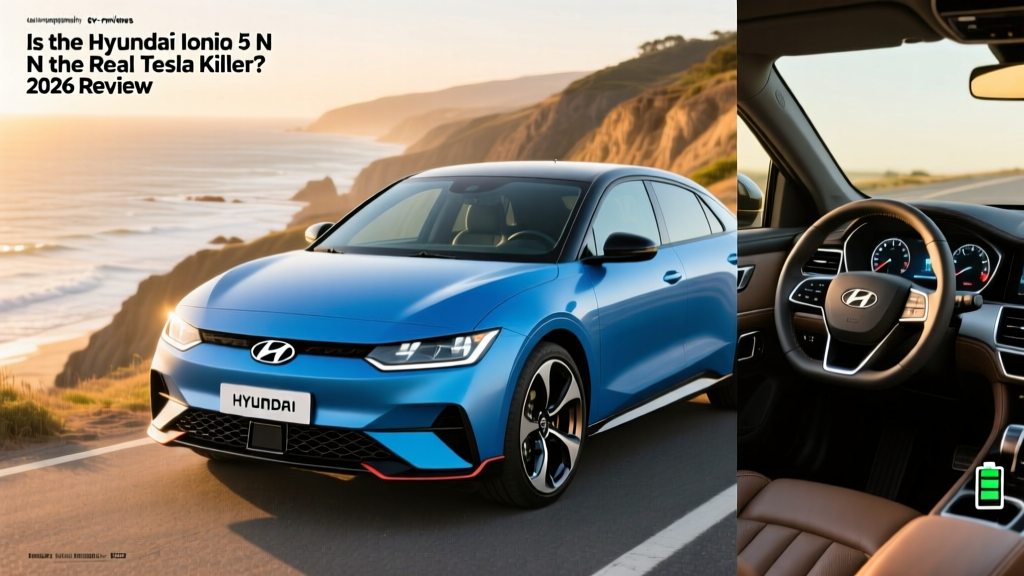
The Contender: Why the Ioniq 5 N Keeps Coming Up in 'Tesla Killer' Debates
The phrase "Tesla killer" has been attached to dozens of EVs over the past decade, and most have fallen short. The 2026 Hyundai Ioniq 5 N is different — not because it outsells the Model Y Performance, but because it does something Tesla has never prioritized: making an electric car genuinely thrilling to drive on a back road while retaining daily-usable range and charging speed. With 641 horsepower on N Grin Boost, a track-capable thermal management system, and an 84.0 kWh battery, the Ioniq 5 N is the EV enthusiast community keeps asking about.
But does it actually dethrone Tesla's performance benchmark, or is it a niche halo car with a high price tag? This review breaks down every number that matters — range, charging curves, real-world efficiency, tax credit eligibility, and ownership costs — so you can decide.
Spec Sheet: 2026 Hyundai Ioniq 5 N at a Glance
| Specification | Value |
|---|---|
| EPA Range | 221 miles (est.)* |
| Battery Capacity | 84.0 kWh usable, NMC lithium-ion |
| Drivetrain | Dual-motor AWD |
| Horsepower | 601 HP (641 HP w/ N Grin Boost, 10-sec bursts) |
| 0–60 mph | 3.25 seconds (manufacturer est.) |
| Top Speed | 161 mph |
| Max DC Fast Charge | 240 kW (peak) |
| 10–80% DC Charge Time | ~18 minutes |
| Level 2 Home Charge Rate | 10.9 kW (~36 mi/hr) |
| MPGe (combined) | ~90 MPGe (est.) |
| Cargo Volume | 27.2 cu ft (rear seats up) / 59.3 cu ft (folded) |
| Base MSRP | $67,885 (incl. destination) |
| Battery Warranty | 8 years / 100,000 miles |
| Vehicle Warranty | 5 years / 60,000 miles |
*EPA range for the Ioniq 5 N has been revised across model years. The 2025 model year was rated at 221 miles; 2026 estimates remain in this range pending final certification. Check fueleconomy.gov for the latest official figure.
Range & Efficiency: The Trade-Off for Performance
Real-World Highway (70–75 mph): ~175–190 miles
Real-World City/Mixed: ~200–215 miles
Cold Weather (below 32°F): ~145–170 miles (20–35% loss typical for NMC packs without aggressive preconditioning)
The Ioniq 5 N's range is the first spec that gives buyers pause. At 221 miles EPA, it trails the standard Ioniq 5 Long Range (305 miles EPA) and the Tesla Model Y Long Range (~310 miles EPA) substantially. The reason is physics: the N variant adds roughly 300 pounds of structural bracing, cooling hardware, and reinforced components, runs stickier 275/35R21 Pirelli P Zero tires, and uses a performance-tuned dual-motor setup that prioritizes response over efficiency.
In real-world highway driving at sustained 70–75 mph speeds, expect closer to 175–190 miles before you need to plug in. That is a meaningful gap for road trippers. Efficiency lands around 2.2–2.4 kWh/mile on the highway, which translates to roughly 84–90 MPGe combined — well below the 110–130 MPGe you'd see in a standard Ioniq 5 or Model Y.
The Ioniq 5 N does feature a heat pump, which helps mitigate cold-weather range loss compared to EVs without one. However, NMC chemistry is inherently more sensitive to low temperatures than LFP, so winter commuters in northern climates should budget 20–35% range reduction. Battery preconditioning for DC fast charging works automatically when a charger is set in the navigation, warming the pack to optimal temperature for peak charge rates.
Charging Speed: 240 kW Peak, but Read the Curve
Hyundai's E-GMP platform has consistently delivered some of the best DC fast-charging performance in the industry, and the Ioniq 5 N is no exception. The 800-volt architecture enables a peak charge rate of 240 kW at compatible chargers (Electrify America 350 kW stalls, Ionity in Europe).
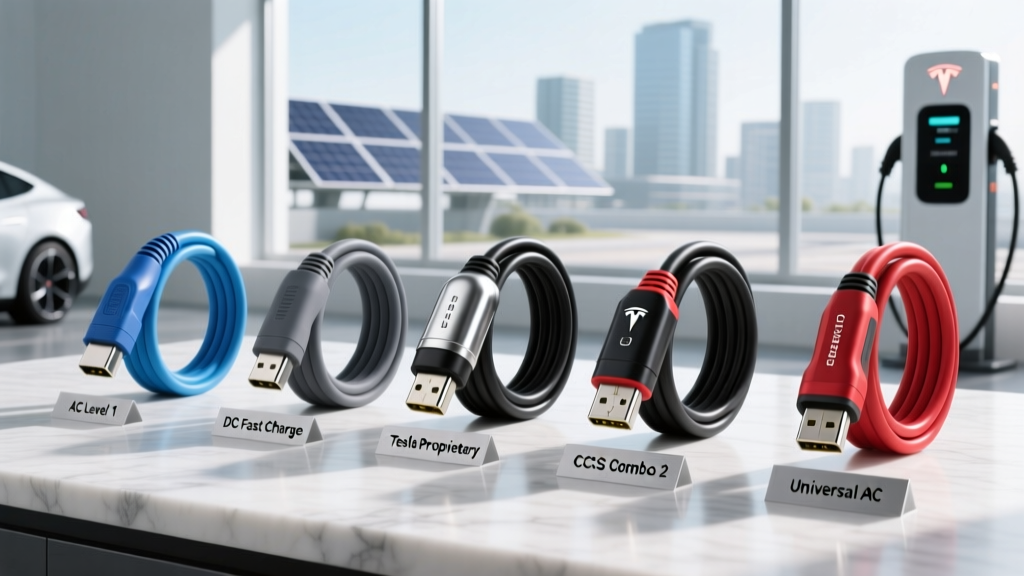
| Charging Level | Power / Rate | Time or Miles Added |
|---|---|---|
| Level 1 (120V household) | ~1.4 kW | ~5 mi/hr |
| Level 2 (240V / 48A home) | 10.9 kW | ~36 mi/hr — full charge in ~8 hrs |
| DC Fast (peak 240 kW) | 240 kW peak, ~170 kW sustained avg. | 10–80% in ~18 min |
| DC Fast (50 kW station) | 50 kW | 10–80% in ~55 min |
The critical nuance is the charge curve. The Ioniq 5 N sustains above 200 kW from roughly 10% to 40% state of charge, then tapers to around 150–170 kW through 60%, and drops further to under 80 kW past 80%. The advertised 10–80% time of 18 minutes is achievable at a 350 kW-capable station in moderate ambient temperatures (55–80°F). At older 50 kW CHAdeMO or CCS stalls, expect closer to an hour for the same range recovery.
For home charging, the onboard 10.9 kW charger means a full 0–100% charge takes roughly 8 hours on a hardwired 48-amp Level 2 station. This is adequate for overnight replenishment, and most owners will rarely charge past 80% daily to preserve long-term battery health.
Performance: Where the 'Tesla Killer' Claim Has Teeth
With 641 horsepower available in 10-second N Grin Boost bursts and 601 HP continuously, the Ioniq 5 N posts a 0–60 mph time of approximately 3.25 seconds. That puts it within a tenth of the Tesla Model Y Performance (3.5 seconds per Motor Trend testing) and well ahead of most internal-combustion performance SUVs.
But straight-line acceleration is only part of the story. The Ioniq 5 N's real separation from the Tesla lineup is chassis engagement. Hyundai N engineers added a reinforced body structure, an electronically controlled limited-slip differential (e-LSD), adaptive dampers with track-focused tuning, and a brake system with 400 mm front rotors and regenerative blending that actually feels natural. The car also features N e-Shift, which simulates the torque interruption and "gear changes" of a dual-clutch transmission — a polarizing feature among EV purists, but one that adds visceral engagement on a twisty road.
The dual-motor AWD system can torque-vector between front and rear axles, and the N Torque Distribution system allows the driver to adjust front/rear power split. On a track, the thermal management system is rated for sustained high-output laps without the power derating that plagues many performance EVs after a few hot laps.
For context, the Tesla Model Y Performance is quicker in a straight line and has a vastly larger Supercharger network advantage. But on a canyon road or track day, the Ioniq 5 N delivers feedback, adjustability, and engagement that no Tesla currently offers. That is the core of the "Tesla killer" argument: it kills Tesla not in specs, but in driving feel.
Interior, Cargo & Technology
The Ioniq 5 N's cabin retains the standard Ioniq 5's retro-futuristic design but adds N-specific elements: heavily bolstered sport seats with N badging, a thick flat-bottom steering wheel with N Grin Boost buttons, aluminum pedals, and a unique digital cluster with track-oriented displays including lap timers, G-meters, and battery temperature readouts.
Cargo space is practical for a performance crossover: 27.2 cubic feet behind the rear seats and 59.3 cubic feet with them folded. That is slightly less than the Model Y (30.2 / 72.1 cu ft) but sufficient for a week's luggage for two or a full grocery run. The front trunk (frunk) is small — roughly 2.0 cubic feet — useful for charging cables but not much else.
Rear-seat legroom measures 39.4 inches, which is generous for the segment. Two adults are comfortable on longer trips; three across is tight due to the transmission tunnel-like battery packaging raising the floor slightly.
Infotainment runs on Hyundai's latest ccNC (Connected Car Navigation Cockpit) system with dual 12.3-inch screens, wireless Apple CarPlay and Android Auto, over-the-air updates, and Hyundai's Digital Key 2 (NFC/BLE phone-as-key). The driver-assistance suite includes Highway Driving Assist 2 (HDA2), which is an SAE Level 2 system combining adaptive cruise control with lane-centering — it requires continuous driver supervision and is not autonomous driving.
Pricing, Trims & Federal Tax Credit Eligibility
The 2026 Hyundai Ioniq 5 N is offered in a single, well-equipped trim at a base MSRP of $67,885 including destination. There are no major option packages — you select a color and potentially the N Performance Package (lightweight forged wheels, carbon-fiber spoiler), which adds approximately $2,500, pushing an as-tested price to around $70,400.
| Item | Amount |
|---|---|
| Base MSRP (incl. destination) | $67,885 |
| N Performance Package (optional) | ~$2,500 |
| As-Tested Price | ~$70,385 |
| Federal Tax Credit (§30D) | Up to $7,500 (if eligible) |
| Effective Price After Credit | ~$60,385–$62,885 |
Federal tax credit eligibility is not guaranteed. Under current IRS §30D rules, the Ioniq 5 N qualifies as an SUV for the $80,000 MSRP cap (it clears that threshold at $67,885 base). However, buyer income caps apply: modified adjusted gross income must not exceed $150,000 (single), $225,000 (head of household), or $300,000 (joint). Additionally, the vehicle must meet critical-mineral and battery-component sourcing requirements that shift annually. Hyundai has worked to localize battery sourcing for U.S.-built Ioniq 5 models, but eligibility can change mid-year. The credit can now be transferred to the dealer at point of sale as an instant rebate. Always verify current eligibility on IRS.gov and confirm with your dealer before signing.
Ownership Costs & Warranty Coverage
Hyundai backs the Ioniq 5 N with an 8-year/100,000-mile battery and powertrain warranty, covering defects and capacity loss below 70% state of health. The bumper-to-bumper warranty is 5 years/60,000 miles, and Hyundai includes 3 years/36,000 miles of complimentary maintenance (tire rotation, multi-point inspection).
Insurance premiums for the Ioniq 5 N are notably higher than the standard Ioniq 5. Expect quotes in the $2,800–$3,600/year range depending on your profile — performance EVs with 641 HP carry higher collision and comprehensive rates. Get quotes from multiple carriers before purchasing.
Depreciation is a wildcard. Performance EVs have historically depreciated faster than mainstream variants, and Hyundai EVs have not held value as well as Teslas. Budget-conscious buyers should factor in an estimated 40–50% depreciation over 5 years, though this could improve as the Ioniq 5 N's enthusiast reputation grows in the used market.
Who Should Buy the Ioniq 5 N — and Who Shouldn't
- You want a performance EV that is genuinely engaging on back roads and track days
- You prioritize driving dynamics over maximum range
- You have reliable home Level 2 charging and access to 150+ kW DC fast chargers for road trips
- You want something distinctive that isn't another Tesla
- You need 300+ miles of range for frequent long-distance driving
- You want the lowest cost per mile and maximum efficiency
- You need maximum cargo space for family hauling
- You rely heavily on the Tesla Supercharger network (though NACS adapters are available)
The Ioniq 5 N is best understood as a hot hatch in crossover clothing — an enthusiast's EV that sacrifices range and efficiency for engagement and track capability. It's a commuter that can do a track day, not a track car pretending to be a commuter.
Pros & Cons
- Best-in-class driving dynamics for a performance EV — steering feel, chassis balance, brake modulation
- 240 kW peak DC fast charging (10–80% in ~18 min)
- 800V architecture with excellent charge curve management
- Track-capable thermal management — sustained performance without derating
- 8-year/100,000-mile battery warranty
- Eligible for up to $7,500 federal tax credit (subject to sourcing/income rules)
- Unique character — stands out in a sea of appliance EVs
- 221-mile EPA range is below average for the price point
- $67,885 base MSRP is steep for a Hyundai
- Higher insurance premiums than standard Ioniq 5 or Model Y
- Heavier than the standard Ioniq 5 (~4,900 lbs curb weight)
- N e-Shift simulated gear changes may annoy EV purists
- No NACS port standard (CCS1; NACS adapter required for Superchargers)
- Stronger depreciation risk vs. Tesla
Is the Ioniq 5 N Really a Tesla Killer?
If "Tesla killer" means outselling the Model Y, the answer is no. Tesla's production volume, Supercharger network, and brand recognition are insurmountable advantages for any single rival model. But if the term means offering a compelling alternative that exposes Tesla's weaknesses — specifically, the absence of driving engagement, chassis sophistication, and personality — then the Ioniq 5 N makes the strongest case of any EV on the market.
It won't be the right choice for most EV buyers. The range is too low, the price is too high, and the performance is overkill for a daily commute. But for the enthusiast who wants an EV that rewards the driver the way a Golf R or M2 once did, the Ioniq 5 N is the car to beat — Tesla or otherwise.
Frequently Asked Questions
What is the real-world range of the Ioniq 5 N?
The EPA rates the Ioniq 5 N at approximately 221 miles. In real-world highway driving at 70–75 mph, expect 175–190 miles. City and mixed driving yields closer to 200–215 miles. In cold weather below freezing, plan for 145–170 miles due to NMC chemistry sensitivity and increased cabin heating load.
How fast does the Ioniq 5 N charge at home and on the road?
On a 48-amp Level 2 home charger, the Ioniq 5 N charges at 10.9 kW, adding roughly 36 miles of range per hour and reaching a full charge in about 8 hours. At a 350 kW-capable DC fast charger, it peaks at 240 kW and charges from 10–80% in approximately 18 minutes, though the charge curve tapers significantly above 80% state of charge.
How much does the Ioniq 5 N cost after the federal tax credit?
The base MSRP is $67,885. If you qualify for the full $7,500 federal tax credit under §30D (income caps apply: $150K single / $300K joint, and the vehicle must meet battery sourcing requirements), the effective price drops to approximately $60,385. The credit can be transferred to the dealer at point of sale as an instant discount. Verify eligibility at IRS.gov.
Does the Ioniq 5 N qualify for the federal EV tax credit?
It is eligible, but qualification depends on your income, the vehicle's battery component and critical-mineral sourcing compliance, and MSRP (the $80,000 SUV cap applies). Hyundai has localized significant battery production for U.S.-market Ioniq 5 models, but sourcing requirements tighten annually. Always confirm with your dealer and check the IRS's current qualified vehicle list before purchase.
Is the Ioniq 5 N worth buying over the Tesla Model Y Performance?
If driving engagement, chassis feel, and track capability matter to you, yes — the Ioniq 5 N offers a fundamentally more rewarding experience. If you prioritize range (Model Y: ~285 mi vs. Ioniq 5 N: ~221 mi), Supercharger access, cargo space, and lower starting price, the Model Y Performance remains the more practical choice. They serve different buyers.
What is the Ioniq 5 N's battery chemistry and how long will it last?
The Ioniq 5 N uses an NMC (nickel-manganese-cobalt) lithium-ion battery pack with 84.0 kWh of usable capacity. NMC offers higher energy density than LFP but is slightly more sensitive to extreme temperatures and benefits from not being regularly charged to 100%. Hyundai warranties the battery for 8 years or 100,000 miles against capacity loss below 70% state of health. Based on E-GMP platform data from standard Ioniq 5 models, degradation has been modest — most owners report 90–95% capacity retention after 2 years / 30,000 miles.