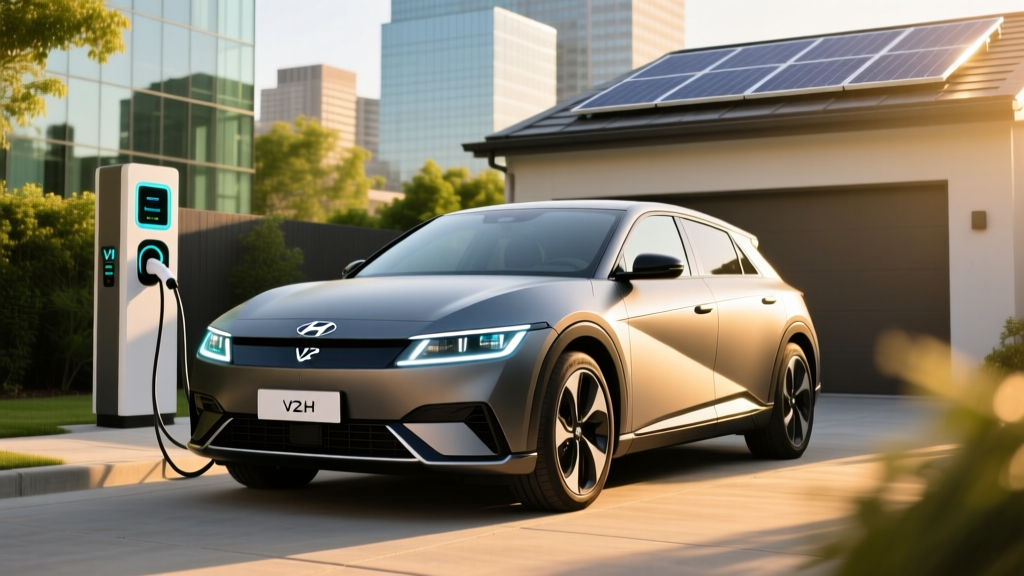
The Hyundai Ioniq 5 has been a segment favorite since its E-GMP platform debut, but the 2026 model year adds a capability that moves the needle for home-owning EV drivers: full Vehicle-to-Home (V2H) bidirectional power. If the grid goes down, the Ioniq 5 can now feed electricity back into your house — turning its 84 kWh battery into a rolling backup generator. But V2H is just one layer of a very complete electric crossover. Below, we break down every number that matters: real-world range, charging curves, tax credit math, and how the Ioniq 5 stacks up against the Tesla Model Y, Ford Mustang Mach-E, and Kia EV6.
2026 Hyundai Ioniq 5 at a Glance: Core Specifications
| Spec | SE/SEL RWD | SEL/Limited AWD | Ioniq 5 N |
|---|---|---|---|
| EPA Range | 318 mi | 290 mi | 260 mi |
| Battery (usable) | 84 kWh NMC | 84 kWh NMC | 84 kWh NMC |
| Horsepower | 168 hp | 320 hp | 641 hp (650 w/ N Grin Boost) |
| 0–60 mph | 7.0 sec | 4.5 sec | 3.25 sec |
| Max DC Fast Charge | 240 kW | 240 kW | 240 kW |
| 10–80% DC Time | ~18 min | ~18 min | ~18 min |
| Level 2 (240V/48A) | 11.5 kW | 11.5 kW | 11.5 kW |
| MPGe (combined) | 117 MPGe | 110 MPGe | 96 MPGe |
| Efficiency | 29 kWh/100 mi | 31 kWh/100 mi | 35 kWh/100 mi |
| Cargo (rear seats up) | 27.2 cu ft | 27.2 cu ft | 24.0 cu ft |
| Cargo (rear folded) | 59.3 cu ft | 59.3 cu ft | 54.0 cu ft |
| Rear Legroom | 39.4 in | 39.4 in | 38.2 in |
| Base MSRP | $42,600 | $49,100 | $67,500 |
| V2H Bidirectional | Yes (V2L + V2H) | Yes (V2L + V2H) | No |
Source: fueleconomy.gov and Hyundai Motor America 2026 spec sheets.
Range & Efficiency: EPA Sticker vs. Real-World Miles
The RWD Long Range Ioniq 5 carries an EPA-estimated 318 miles — a strong figure for a two-row crossover. The AWD trims drop to 290 miles due to the added front motor and weight, while the performance-oriented Ioniq 5 N sacrifices range for its 641 hp output, landing at 260 miles.
EPA estimate: 318 mi (RWD), 290 mi (AWD)
Highway cruising (70–75 mph, mild weather): Expect ~255–275 mi (RWD) and ~235–250 mi (AWD). Aerodynamic drag at sustained highway speeds cuts efficiency roughly 15–20% below the combined EPA cycle.
Cold weather (below 30°F): Plan for a 20–30% reduction, yielding ~220–250 mi (RWD). The Ioniq 5's standard heat pump helps mitigate cabin-heating losses compared to resistance heaters, but battery chemistry still loses throughput in freezing temps.
City / suburban mixed driving: Typically meets or slightly exceeds EPA — regenerative braking recovers energy that gas cars waste as heat.
The 84 kWh usable battery uses nickel-manganese-cobalt (NMC) chemistry, which prioritizes energy density over the extreme cycle life of LFP (lithium iron phosphate). For most owners, NMC is the right call — it delivers the range needed for road trips without the weight penalty of an equivalently sized LFP pack. Hyundai includes a battery preconditioning feature that warms the pack when a DC fast charger is entered in navigation, which is essential for hitting peak charge rates in cool weather.
Charging Speed: DC Fast, Level 2, and V2H Bidirectional
Hyundai's 800V E-GMP architecture remains one of the fastest-charging platforms on the market. Here's the full breakdown:
| Charging Level | Power | Speed / Time | Notes |
|---|---|---|---|
| Level 1 (120V) | ~1.4 kW | ~4 mi/hr | Emergency trickle; overnight adds ~40–50 mi |
| Level 2 (240V, 48A) | 11.5 kW | ~35 mi/hr; full charge in ~8.5 hr | Requires hardwired 60A circuit or NEMA 14-50 |
| DC Fast (peak) | 240 kW | 10–80% in ~18 min | Requires 350 kW-capable station; preconditioning recommended |
| DC Fast (sustained avg) | ~180 kW | 10–80% realistic avg | Charge curve tapers above 80% SoC to protect battery |
| V2L (Vehicle-to-Load) | 3.6 kW (outlet) | Powers appliances directly | Standard on all trims; runs tools, laptops, camp gear |
| V2H (Vehicle-to-Home) | Up to 10 kW | Powers home circuits during outage | Requires compatible bidirectional charger (e.g., Wallbox Quasar 2); available on SE/SEL/Limited |
Understanding the charge curve: The "240 kW peak" figure is a maximum rate, not a sustained average. In real-world DC fast charging, the Ioniq 5 ramps quickly to ~230–240 kW between 10–55% State of Charge (SoC), then progressively tapers. From 80–100%, charging slows dramatically to protect the NMC cells — expect that final 20% to take as long as the first 70%. For road trips, plan stops around 10–80% to minimize time at the charger.
What V2H actually means: The 2026 Ioniq 5's V2H system can push up to 10 kW back through a compatible bidirectional wallbox into your home's electrical panel. During an outage, an 84 kWh battery at 90% SoC could power an average U.S. home (~30 kWh/day) for roughly 2.5 days — covering lights, fridge, HVAC blower, and electronics. This is a significant differentiator vs. the Tesla Model Y, which does not currently support V2H, and the Ford F-150 Lightning's V2H system (which requires Ford's Charge Station Pro and Home Integration System at additional cost).
V2H is not plug-and-play. You need a bidirectional-capable charger (such as the Wallbox Quasar 2, ~$1,200–$1,500 for hardware) plus professional electrical installation and a transfer switch or whole-home energy management system. Total installed cost for a V2H-ready setup typically runs $3,500–$6,000 depending on your panel capacity and wiring distance. Consult a licensed electrician for a site-specific quote.
Performance & Drivetrain: From Commuter to Track Day
The Ioniq 5 lineup covers an unusually wide performance spectrum:
- RWD (168 hp, 258 lb-ft): Adequate for commuting and highway merging. The 7.0-second 0–60 time is leisurely by EV standards but perfectly acceptable for daily driving. Efficiency is the priority here.
- AWD (320 hp, 446 lb-ft): The sweet spot for most buyers. Dual motors provide confident acceleration (4.5 sec 0–60) and all-weather traction. The front motor disengages under light loads to preserve efficiency.
- Ioniq 5 N (641 hp, 568 lb-ft): A legitimate performance machine with N Grin Boost delivering 650 hp in 10-second bursts. Track-oriented cooling, an electronic limited-slip differential, and simulated gear shifts make it a driver's EV — but at the cost of 58 miles of range vs. the AWD model.
All trims feature a flat floor thanks to the E-GMP skateboard platform, yielding a low center of gravity that translates to composed handling. The 12.3-inch dual-screen setup (instrument cluster + infotainment) runs Hyundai's latest software with wireless Apple CarPlay and Android Auto, over-the-air updates, and a digital key via NFC/Bluetooth.
Pricing, Tax Credits, and Total Cost
The 2026 Ioniq 5 starts at $42,600 for the SE RWD and climbs to $67,500 for the Ioniq 5 N. Here's how the federal tax credit factors in:
| Trim | Base MSRP | §30D Credit (est.) | Effective Price | MSRP Cap Compliant? |
|---|---|---|---|---|
| SE RWD | $42,600 | Up to $7,500 | ~$35,100 | Yes (SUV cap: $80,000) |
| SEL AWD | $49,100 | Up to $7,500 | ~$41,600 | Yes |
| Limited AWD | $54,600 | Up to $7,500 | ~$47,100 | Yes |
| Ioniq 5 N | $67,500 | Up to $7,500 | ~$60,000 | Yes |
- MSRP cap: The Ioniq 5 qualifies as an SUV under IRS rules, so the cap is $80,000 — all trims clear this.
- Income cap (2026 §30D): Modified AGI must not exceed $150,000 (single), $225,000 (head of household), or $300,000 (married filing jointly).
- Battery sourcing: The credit splits into two halves — $3,750 for critical minerals and $3,750 for battery component assembly. Hyundai has shifted significant battery sourcing to the Georgia plant (SK On JV), but the exact credit amount depends on current-year sourcing thresholds. Verify at irs.gov before purchasing.
- Point-of-sale transfer: As of 2024, buyers can transfer the credit to the dealer at purchase, reducing the out-of-pocket price immediately rather than waiting to claim it on a tax return.
Always consult a tax professional for eligibility specifics. Sourcing rules tighten annually.
Interior, Cargo, and Daily Livability
The Ioniq 5's 118.1-inch wheelbase (longer than a Toyota RAV4) creates genuinely spacious rear seating — 39.4 inches of legroom accommodates adults comfortably, even behind a tall driver. The flat floor (no transmission tunnel) makes the middle rear seat usable, a rarity in this segment.
Cargo volume stands at 27.2 cu ft behind the rear seats and 59.3 cu ft with them folded — competitive with the Model Y (30.2/74.1 cu ft, though Tesla's measurement methodology differs). The front trunk (frunk) on RWD models adds 0.85 cu ft for charging cables; AWD models have a smaller frunk due to the front motor.
Notable interior features include:
- Vehicle-to-Load (V2L) interior outlet (120V, 3.6 kW) — charge laptops, power tools, or a coffee maker on camping trips
- Relaxation seats with leg rests (front, Limited trim)
- Dual 12.3-inch curved displays with OTA updates
- Highway Driving Assist 2 (Level 2 ADAS) with lane-centering, adaptive cruise, and auto lane-change
- Blind-spot view monitor, remote smart parking assist
Safety, Warranty, and Long-Term Ownership
The Ioniq 5 has earned a 5-star overall rating from NHTSA and a Top Safety Pick+ designation from IIHS (when equipped with specific headlights). Hyundai's warranty coverage is among the strongest in the industry:
- Battery: 10 years / 100,000 miles (capacity retention threshold: 70%)
- Powertrain: 10 years / 100,000 miles
- New vehicle limited: 5 years / 60,000 miles
- Roadside assistance: 5 years / unlimited miles
The 10-year battery warranty is a meaningful advantage over Tesla's 8-year/120,000-mile coverage and provides long-term peace of mind, particularly for buyers concerned about NMC degradation. Based on current fleet data, Hyundai-Kia E-GMP packs show approximately 8–12% degradation over the first 100,000 miles under normal use patterns.
Pros, Cons, and the Competition
- Class-leading 240 kW DC fast charging with 10–80% in ~18 min
- V2H bidirectional capability (non-N trims) — rare in this segment
- 10-year/100,000-mile battery and powertrain warranty
- Spacious rear seat (39.4 in legroom) and flat floor
- Strong federal tax credit eligibility across all trims
- Standard heat pump for cold-weather efficiency
- Cargo space trails Tesla Model Y by ~15 cu ft (seats folded)
- No rear wiper (dealer-installed accessory only)
- V2H requires additional $3,500–$6,000 home electrical setup
- RWD base model feels underpowered vs. rivals' base AWD
- Ioniq 5 N sacrifices 58 mi of range for performance
- Infotainment learning curve with touch-sensitive climate controls
- You need V2H backup power and want a crossover (not a truck)
- DC fast charging speed is your top priority for road trips
- You value the 10-year battery warranty
- Rear-seat passenger comfort matters (family, rideshare)
- Maximum cargo volume is critical → Tesla Model Y
- You want the lowest entry price → Chevrolet Equinox EV (~$33,000)
- Track performance on a budget → consider a used Model 3 Performance
2026 Hyundai Ioniq 5 V2H FAQ
What is the real-world range of the Hyundai Ioniq 5?
The EPA rates the RWD at 318 miles and AWD at 290 miles. In real-world highway driving at 70–75 mph, expect 255–275 miles (RWD) and 235–250 miles (AWD). In freezing temperatures, subtract 20–30%. City driving with regenerative braking often matches or slightly exceeds the EPA figure.
How fast does the Ioniq 5 charge at home and on the road?
On a Level 2 home charger (240V, 48A), the Ioniq 5 charges at 11.5 kW, adding ~35 miles per hour — a full charge takes about 8.5 hours. On a DC fast charger rated at 350 kW, it peaks at 240 kW and charges from 10–80% in approximately 18 minutes, though the charge curve tapers above 80% SoC.
How much does the Ioniq 5 cost after the federal tax credit?
The SE RWD starts at $42,600 and can drop to ~$35,100 with the full $7,500 §30D credit. Credit eligibility depends on buyer income (AGI caps of $150K/$225K/$300K), battery sourcing compliance, and the $80,000 SUV MSRP cap — all Ioniq 5 trims clear the cap. The credit can be transferred to the dealer at point of sale.
Does the Hyundai Ioniq 5 qualify for the federal EV tax credit?
Yes, all 2026 Ioniq 5 trims qualify under the SUV MSRP cap of $80,000. However, the actual credit amount ($3,750 or $7,500) depends on battery critical-mineral and component sourcing thresholds, which tighten each year. Check the latest eligibility at irs.gov and consult a tax professional.
How does V2H (Vehicle-to-Home) work on the Ioniq 5?
V2H allows the Ioniq 5 to send up to 10 kW of power from its 84 kWh battery back through a bidirectional wallbox to your home's electrical panel during an outage. At 90% SoC, that's roughly 2.5 days of average home power. You need a compatible bidirectional charger (e.g., Wallbox Quasar 2) and professional installation — budget $3,500–$6,000 for the full setup. V2H is available on SE, SEL, and Limited trims but not the Ioniq 5 N.
Is the Ioniq 5 worth buying vs. the Tesla Model Y or Kia EV6?
The Ioniq 5 wins on charging speed (240 kW vs. Model Y's ~250 kW peak but on a proprietary network transitioning to NACS), warranty coverage (10 years vs. 8 years), and V2H capability. The Model Y wins on cargo volume and Supercharger network access (though NACS adoption is closing that gap). The Kia EV6 shares the E-GMP platform and is mechanically similar — choose based on styling preference and dealer experience. For most two-row EV crossover buyers in 2026, the Ioniq 5 is the most well-rounded option when V2H is a priority.
What is the battery warranty on the Ioniq 5?
Hyundai covers the Ioniq 5's battery for 10 years or 100,000 miles, whichever comes first, with a capacity retention threshold of 70%. The powertrain (motors, reduction gear, inverter) is also covered for 10 years/100,000 miles. This is two years longer than Tesla's battery warranty.