The Hyundai Ioniq 5 as a Towing EV: What Buyers Need to Know
The Hyundai Ioniq 5 has been one of the most popular electric crossovers since its debut, praised for its 800-volt architecture, distinctive design, and strong value proposition. But a growing number of buyers are searching specifically for Ioniq 5 towing capability — whether for a small camper, a utility trailer, or a pair of dirt bikes. The 2026 Ioniq 5 continues to offer a factory tow rating, but the real question is how towing affects range, charging logistics, and overall ownership practicality. This review covers every spec that matters, from battery chemistry to real-world range loss under load, so you can decide whether the Ioniq 5 fits your towing needs.
2026 Ioniq 5 Specifications at a Glance
| Spec | SE/SEL RWD | SE/SEL AWD | Limited AWD | N (Performance) |
|---|---|---|---|---|
| EPA Range | 318 mi | 290 mi | 266 mi | 238 mi |
| Battery (usable) | 84.0 kWh (NMC) | 84.0 kWh (NMC) | 84.0 kWh (NMC) | 84.0 kWh (NMC) |
| Horsepower | 168 hp | 320 hp | 320 hp | 641 hp |
| 0–60 mph | 7.4 sec | 4.5 sec | 4.5 sec | 3.3 sec |
| Drivetrain | RWD single motor | AWD dual motor | AWD dual motor | AWD dual motor |
| Max DC Fast Charge | ~240 kW | ~240 kW | ~240 kW | ~240 kW |
| 10–80% DC Time | ~18 min | ~18 min | ~18 min | ~18 min |
| Level 2 Home Charge | 10.9 kW (~37 mi/hr) | 10.9 kW (~37 mi/hr) | 10.9 kW (~37 mi/hr) | 10.9 kW (~37 mi/hr) |
| Towing Capacity | 2,300 lb | 2,300 lb | 2,300 lb | Not rated |
| MPGe (combined) | 117 MPGe | 110 MPGe | 101 MPGe | 88 MPGe |
| Base MSRP | $43,600 | $47,100 | $54,200 | $67,500 |
Towing Capacity, Hitch Setup, and What You Can Actually Pull
The 2026 Hyundai Ioniq 5 (non-N trims) carries a maximum towing capacity of 2,300 pounds when equipped with the factory-installed tow hitch and wiring harness. This rating applies to both the RWD and AWD configurations. The Ioniq 5 N is not rated for towing.
What does 2,300 pounds get you in practice? Here are common trailer scenarios that fall within the Ioniq 5's rating:
- Small teardrop camper (1,200–2,000 lb loaded) — viable for weekend trips
- Utility trailer with ATVs or dirt bikes (1,500–2,200 lb) — within limits
- Light cargo trailer (800–1,500 lb) — comfortable margin
- Small boat on a single-axle trailer (1,800–2,300 lb) — at the upper limit
You will not be pulling a full-size travel trailer or a horse trailer. The 2,300-lb rating is competitive with the Tesla Model Y (3,500 lb) trailing behind, but it matches or exceeds several other electric crossovers in the segment. Hyundai requires the dealer-installed tow package, which includes a Class II hitch receiver and a 4-pin wiring connector. Expect to pay roughly $400–$600 for the hitch kit plus installation.
A critical note on payload: the Ioniq 5's Gross Combined Weight Rating (GCWR) and payload capacity mean you need to account for passengers and cargo inside the vehicle in addition to tongue weight. Tongue weight should remain at roughly 10% of trailer weight — approximately 230 lb at maximum tow rating. A weight-distributing hitch is not required at this capacity, but a sway-control device is recommended for boxy trailers.
Real-World Range: EPA Sticker vs. Highway vs. Towing
EPA Estimated: 290 mi (AWD SE/SEL) / 266 mi (Limited, 20" wheels)
Real-World Highway (70 mph, mild weather): ~230–255 mi
Real-World Highway (cold weather, 30°F): ~190–215 mi
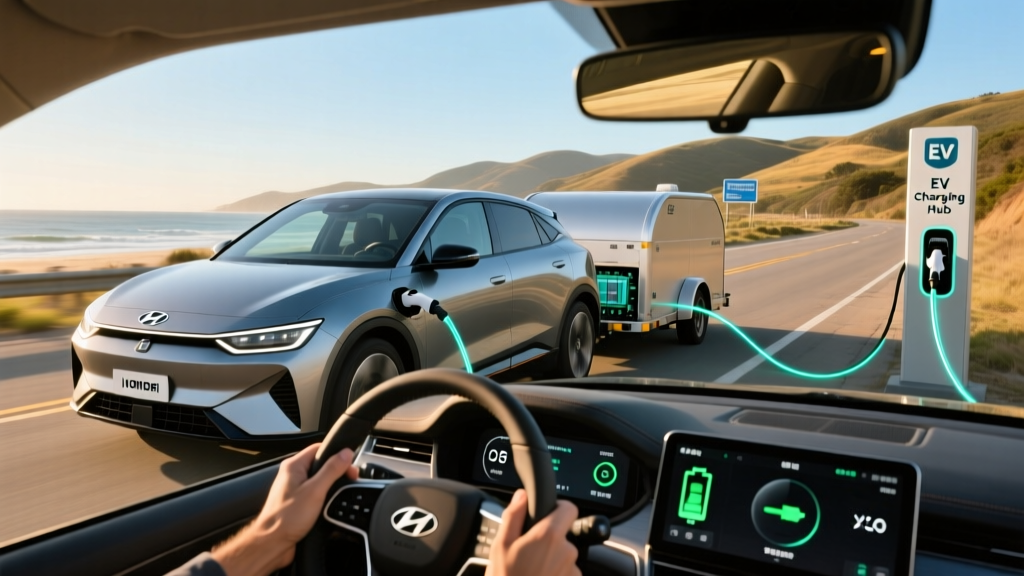
While Towing (2,000 lb trailer, 60 mph): ~120–160 mi estimated
The Ioniq 5 uses an 84.0 kWh usable NMC (nickel manganese cobalt) battery pack across all trims. The EPA range figures from fueleconomy.gov reflect a blended city/highway cycle, but EVs consume significantly more energy at sustained highway speeds than in stop-and-go driving, where regenerative braking recovers energy.
When towing, expect range to drop by roughly 40–55% compared to the EPA combined number. This is consistent across virtually all EVs — the aerodynamic penalty of a trailer and the additional rolling resistance demand substantially more energy. At 60 mph with a 2,000-lb teardrop camper, you can expect consumption to rise from roughly 30 kWh/100 mi to 55–70 kWh/100 mi. That translates to approximately 120–160 miles of range on a full charge, depending on terrain, wind, and speed.
This is the single biggest practical limitation of Ioniq 5 towing. For a 200-mile trip with a trailer, you will need at least one DC fast-charging stop. Plan routes around reliable charging stations — ideally 150 kW or faster — and use tools like A Better Routeplanner to model energy consumption with a trailer load.
Charging Speed: 800V Architecture Still Sets the Pace
| Charging Level | Power / Rate | Miles Added per Hour | Notes |
|---|---|---|---|
| Level 1 (120V household) | ~1.4 kW | ~4–5 mi/hr | Emergency/trickle only |
| Level 2 (240V home, 48A) | 10.9 kW | ~37 mi/hr | Full charge in ~8.5 hours |
| DC Fast Charge (peak) | ~240 kW | — | 10–80% in ~18 min (ideal conditions) |
| DC Fast Charge (50 kW station) | 50 kW | ~170 mi/hr | 10–80% in ~75 min |
The Ioniq 5's 800-volt electrical architecture remains one of its strongest selling points. On a 350 kW-capable DC fast charger (like Electrify America's latest stalls), the Ioniq 5 can accept a peak rate of approximately 240 kW, enabling a 10–80% charge in roughly 18 minutes under ideal battery-temperature conditions.
Here's the charging-curve reality that spec sheets don't show: the 240 kW peak is sustained from approximately 10% to 45% State of Charge (SoC). Between 45% and 65%, the rate tapers to roughly 150–170 kW. Above 80%, the rate drops sharply to protect battery longevity — expect 50 kW or less. This is why the 10–80% metric is the industry standard; charging from 80–100% can add another 25–30 minutes.
Preconditioning matters. The Ioniq 5 can precondition its battery for optimal fast-charging speed when you navigate to a DC charger using the built-in route planner. If you arrive at a charger with a cold battery (below ~60°F), peak charge rates may drop to 150 kW or lower until the thermal management system warms the pack. Always use the nav-based preconditioning feature in cool weather.
For home Level 2 charging, the Ioniq 5's onboard charger accepts up to 10.9 kW on a 48-amp, 240-volt circuit. This adds roughly 37 miles of range per hour, meaning a full overnight charge from near-empty takes about 8.5 hours. A licensed electrician will typically install a NEMA 14-50 outlet or hardwire a Level 2 EVSE (like the ChargePoint Home Flex or Emporia Level 2) on a 60-amp breaker.
2026 Pricing, Trims, and Federal Tax Credit Eligibility
| Trim | MSRP | §30D Credit (est.) | Effective Price | Eligibility Notes |
|---|---|---|---|---|
| SE Standard Range (RWD) | $43,600 | Up to $7,500 | ~$36,100 | Subject to sourcing/income rules |
| SE (RWD) | $47,100 | Up to $7,500 | ~$39,600 | Subject to sourcing/income rules |
| SEL AWD | $49,600 | Up to $7,500 | ~$42,100 | Subject to sourcing/income rules |
| Limited AWD | $54,200 | Up to $7,500 | ~$46,700 | Under $80,000 MSRP cap ✓ |
| N (Performance) | $67,500 | Up to $7,500 | ~$60,000 | Under $80,000 MSRP cap ✓ |
The 2026 Ioniq 5 remains under the IRS §30D MSRP cap of $80,000 for SUVs/pickups/vans, so all trims pass the price test. However, federal tax credit eligibility depends on several factors that change regularly:
- Buyer income caps: Modified AGI must not exceed $150,000 (single), $225,000 (head of household), or $300,000 (joint filing).
- Battery component and critical mineral sourcing: The credit is split into two halves ($3,750 each) based on battery component manufacturing and critical mineral sourcing requirements. Hyundai has been working to shift sourcing to qualify, but eligibility can vary by production batch and model year. Always verify the specific VIN with your dealer and cross-reference the fueleconomy.gov tax credit database.
- Point-of-sale transfer: Since 2024, qualifying buyers can transfer the credit to the dealer at purchase, reducing the purchase price directly rather than waiting for a tax refund.
Hyundai also offers competitive lease deals on the Ioniq 5, and leased vehicles may qualify for a separate commercial clean vehicle credit that the leasing company passes through as a reduced monthly payment — this pathway often has fewer sourcing restrictions. Consult a tax professional for your specific situation.
Cargo, Passenger Space, and Daily Practicality
The Ioniq 5's dedicated E-GMP (Electric Global Modular Platform) gives it a flat floor and a long 118.1-inch wheelbase, translating to generous interior volume:
- Rear legroom: 39.4 inches — more than most midsize SUVs, including the Toyota RAV4
- Cargo behind rear seats: 27.2 cu ft
- Cargo with rear seats folded: 59.3 cu ft
- Front trunk (frunk): 0.85 cu ft (AWD) / 2.1 cu ft (RWD) — enough for a charging cable bag, not much more
The rear seat is a standout for child seats and adult passengers alike. The flat floor means no transmission tunnel hump, making the middle seat genuinely usable. Cargo space is adequate for a family road trip but trails the Tesla Model Y's 30.2 cu ft behind the second row. If you regularly haul bulky gear, a roof cargo box is an option, though it will reduce range by roughly 5–10% due to added aerodynamic drag.
Tech, Driver Assists, and Standout Features
The 2026 Ioniq 5 comes equipped with Hyundai's Digital Key 2 (phone-as-key via NFC and UWB), dual 12.3-inch displays running Hyundai's latest infotainment software with wireless Apple CarPlay and Android Auto, and over-the-air update capability.
Hyundai's Highway Driving Assist 2 (HDA 2) is standard on SEL and above. This is an SAE Level 2 driver-assistance system — it handles lane centering, adaptive cruise control, and lane-change assist, but the driver must keep hands on the wheel and eyes on the road at all times. It is not autonomous driving. HDA 2 performs well on divided highways but can struggle with faded lane markings and tight construction zones.
Other notable tech features:
- Vehicle-to-Load (V2L): The Ioniq 5 can supply up to 3.6 kW of AC power from its high-voltage battery through an interior outlet or an external V2L adapter. This is genuinely useful for camping, tailgating, or powering tools at a job site — and can theoretically trickle-charge another EV in an emergency.
- Heat pump: Standard on AWD trims, the heat pump significantly reduces range loss in cold weather by efficiently heating the cabin without relying solely on resistive heating. Expect 10–15% better winter range compared to EVs without one.
- 800V architecture: Enables the class-leading DC fast-charge speeds detailed above, and also supports future high-power charging infrastructure as it rolls out.
Drawbacks to note: the Ioniq 5 still uses Hyundai's capacitive-touch climate controls rather than physical buttons, which some drivers find frustrating to use while driving. The rear wiper was added for the 2025 model year after widespread complaints. The infotainment system, while improved, can occasionally lag when switching between navigation and media.
Warranty and Battery Longevity
Hyundai backs the Ioniq 5 with one of the strongest warranty packages in the EV segment:
- Battery warranty: 10 years / 100,000 miles (whichever comes first), covering defects and capacity loss below 70% of original capacity
- Powertrain warranty: 10 years / 100,000 miles
- New vehicle limited warranty: 5 years / 60,000 miles
- Roadside assistance: 5 years / unlimited miles
- Complimentary maintenance: 3 years / 36,000 miles
NMC battery degradation in the Ioniq 5 has been well-documented by early adopters. Most 2022–2024 models show approximately 5–8% capacity loss after 40,000–60,000 miles, with the rate of degradation slowing after the initial break-in period. The 10-year/100,000-mile battery warranty and 70% retention threshold provide meaningful long-term protection. If you tow frequently, the additional charge-discharge cycles will contribute to gradual degradation, but the large 84 kWh pack provides a buffer that should keep the Ioniq 5 practical for well over a decade of normal use.
How the Ioniq 5 Stacks Up Against Key Competitors
For buyers specifically evaluating EV towing options, here's how the Ioniq 5 compares to its closest rivals:
- Tesla Model Y (Long Range AWD): 3,500-lb tow rating, 310-mi EPA range, ~$48,000 base. The Model Y tows more and has broader Supercharger access, but the Ioniq 5 charges faster on non-Tesla networks and offers a more comfortable ride quality.
- Ford Mustang Mach-E (AWD Extended Range): 2,200-lb tow rating (with California Route 1 package), 290-mi EPA range, ~$50,000. Very similar tow capacity, but the Mach-E's DC charging speeds (peak ~150 kW) lag significantly behind the Ioniq 5.
- Volkswagen ID.4 (AWD Pro S): 2,700-lb tow rating, 275-mi EPA range, ~$50,000. Slightly higher tow rating, but slower charging and less engaging driving dynamics.
- Kia EV6 (AWD): 2,300-lb tow rating, 282-mi EPA range, ~$49,000. The Ioniq 5's platform sibling shares the 800V architecture and similar specs. The EV6 has a sportier design but less rear headroom.
Choose the Ioniq 5 if: You want the fastest DC charging in the segment, value V2L capability for camping or job-site use, and your towing needs stay under 2,300 lb.
Choose the Model Y if: You need 3,500+ lb of tow capacity, prioritize Supercharger network reliability, or want maximum cargo space.
Choose the ID.4 if: You need a slightly higher tow rating (2,700 lb) and prefer a more conservative, traditional crossover interior layout.
Pros, Cons, and Final Verdict
- Class-leading DC fast-charge speed (~240 kW peak, 18 min 10–80%)
- 800V architecture future-proofs for next-gen chargers
- V2L capability (3.6 kW) — great for camping and tailgating
- Spacious rear seat with flat floor
- Heat pump on AWD trims improves cold-weather range
- Strong 10-yr/100,000-mi battery and powertrain warranty
- Comfortable, compliant ride quality
- 2,300-lb tow rating trails Tesla Model Y (3,500 lb)
- Towing reduces range to 120–160 mi — frequent charging stops required
- Small frunk, especially on AWD models
- Capacitive-touch climate controls are distracting while driving
- Tax credit eligibility varies by battery sourcing batch
- Rear visibility is compromised by thick C-pillars
The 2026 Hyundai Ioniq 5 is a capable light-towing EV for buyers whose trailer needs stay within the 2,300-pound limit. Its biggest advantage — blistering DC fast-charge speeds — partially offsets the range loss that comes with towing, since you can recover meaningful range in 15–20 minutes at a 350 kW station. If you're towing a teardrop camper on weekend trips and have access to reliable DC fast charging along your route, the Ioniq 5 is a practical and enjoyable choice. If you need to tow heavier loads regularly, the Tesla Model Y or a plug-in hybrid like the Toyota RAV4 Prime may better serve your needs.
Frequently Asked Questions
What is the real-world range of the Ioniq 5 while towing?
With a loaded trailer near the 2,300-lb limit at highway speeds around 60 mph, expect approximately 120–160 miles of range depending on terrain, wind, and temperature. This represents a 40–55% reduction from the EPA combined estimate. Plan charging stops accordingly.
How fast does the Ioniq 5 charge at home and on the road?
On a 48-amp Level 2 home charger, the Ioniq 5 charges at 10.9 kW, adding about 37 miles per hour for a full overnight charge. On a 350 kW DC fast charger, it peaks at approximately 240 kW and charges from 10–80% in roughly 18 minutes under ideal conditions.
Does the 2026 Ioniq 5 qualify for the $7,500 federal EV tax credit?
All Ioniq 5 trims fall under the $80,000 MSRP cap. However, full credit eligibility depends on your income (below $150K single / $300K joint), the battery's critical mineral and component sourcing for your specific VIN, and whether you purchase (not lease). Check the fueleconomy.gov database and consult a tax professional.
Can I install a tow hitch on the Ioniq 5 myself?
Hyundai offers a dealer-installed tow package that includes a Class II hitch receiver and 4-pin wiring harness. While aftermarket hitches exist, the factory package ensures compatibility with the Ioniq 5's wiring and does not risk voiding related warranty coverage. Expect $400–$600 total for parts and installation.
Is the Ioniq 5 a good EV for road trips with a trailer?
It can be, with planning. The 18-minute DC fast-charge capability means shorter stops than most competitors. However, towing range of 120–160 miles means you'll stop every 2 hours or so on the highway. Map your route using tools that account for trailer load, and verify charger availability — particularly 150 kW+ stations — before departing.
What's the difference between kW and kWh?
kW (kilowatts) measures power — how fast energy flows, like the flow rate of a hose. kWh (kilowatt-hours) measures energy capacity — the total amount stored, like the size of a tank. The Ioniq 5 charges at up to 240 kW (power) and stores 84.0 kWh (energy). Confusing these two is the most common mistake in EV spec reading.