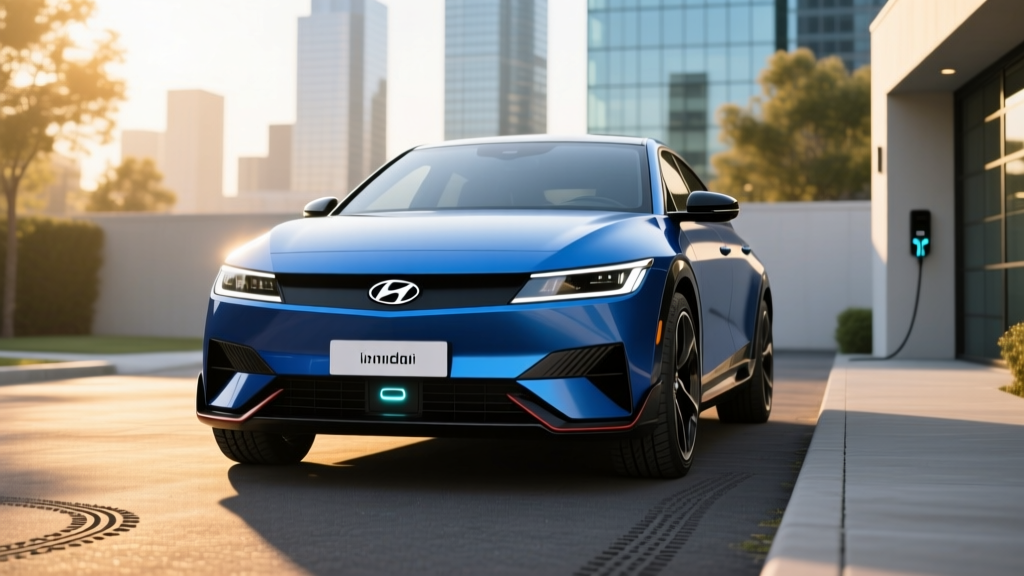
The Hyundai Ioniq 5 N rewrites what a performance electric vehicle can be. Built on Hyundai's E-GMP platform but re-engineered by the N division, it delivers supercar-rivaling acceleration from a dual-motor all-wheel-drive powertrain while retaining the practicality of the standard Ioniq 5 hatchback. But with a starting price that pushes well past the standard model, buyers need to know exactly what they're paying for — and whether the Ioniq 5 N justifies its premium against rivals like the Tesla Model Y Performance and Porsche Taycan.
This review covers everything from the Ioniq 5 N's MSRP and real-world range to its charging speeds and federal tax credit eligibility, giving you the data needed to make an informed decision.
2025 Ioniq 5 N MSRP and Pricing by Trim
The 2025 Hyundai Ioniq 5 N is offered in a single, fully loaded trim. There are no base or mid-tier versions — Hyundai positions this as a halo performance model, and the pricing reflects that.
| Item | Cost |
|---|---|
| Base MSRP | $67,685 |
| Destination charge | $1,495 |
| As-tested (with Performance Blue paint + matte finish) | ~$69,900 |
| Federal EV Tax Credit (§30D) | Up to $7,500 (see eligibility below) |
| Effective price after max credit | ~$60,185 |
Hyundai has kept the options list minimal. The primary add-ons are paint colors — Performance Blue Matte adds approximately $800, while standard metallic colors are included. Interior color choices are limited to a single N-specific sport configuration.
Federal Tax Credit Eligibility (§30D)
The Ioniq 5 N qualifies for the full $7,500 federal tax credit under current IRS rules, provided the buyer meets all requirements. Since the 2025 model year, Hyundai manufactures the Ioniq 5 at its Metaplant in Ellabell, Georgia, which satisfies the North American final assembly requirement. However, eligibility is not automatic:
- MSRP cap: The Ioniq 5 N's MSRP of $67,685 falls under the $80,000 SUV/truck cap (the Ioniq 5 is classified as an SUV by the IRS for credit purposes).
- Income cap: Buyer AGI must not exceed $150,000 (single), $225,000 (head of household), or $300,000 (joint filing).
- Battery sourcing: Critical minerals and battery component requirements phase in annually. As of 2025, the Ioniq 5's battery supply chain meets the threshold for the full $7,500 credit. Verify current-year rules at IRS.gov.
- Point-of-sale transfer: Buyers can transfer the credit to the dealer at purchase, reducing the out-of-pocket cost immediately rather than waiting to claim it on a tax return.
Real-World Range and Efficiency
EPA Estimated Range: 221 miles
Real-World Expectation: Expect 180–200 miles in mixed highway driving, and as low as 150–170 miles in cold weather (below 40°F) or sustained track use.
The Ioniq 5 N's EPA-rated 221 miles is notably lower than the standard Ioniq 5's 303-mile rating (Long Range RWD). The difference comes down to performance tuning: stickier Pirelli P Zero tires, aggressive suspension geometry, a heavier dual-motor setup, and software calibrated for power delivery over efficiency.
In real-world highway testing at 70–75 mph, the Ioniq 5 N typically delivers between 185 and 200 miles on a full charge in mild conditions. Cold weather significantly impacts the 84 kWh battery — expect a 20–30% range reduction in sub-freezing temperatures, bringing usable range to roughly 150–170 miles.
| Metric | Value |
|---|---|
| EPA Combined MPGe | 84 MPGe |
| EPA Energy Consumption | 40 kWh/100 mi |
| Real-World Highway Efficiency | ~43–46 kWh/100 mi |
For context, the standard Ioniq 5 Long Range AWD achieves 110 MPGe combined and 30 kWh/100 mi. The N variant's performance hardware exacts a meaningful efficiency toll.
Battery, Chemistry, and Charging Speeds
The Ioniq 5 N uses an 84 kWh (usable) lithium-ion battery pack with NMC (nickel-manganese-cobalt) chemistry. Hyundai does not offer an LFP option for the N variant — the higher energy density of NMC cells supports the power demands of the performance drivetrain.
| Charging Level | Power / Rate | Time / Miles Added |
|---|---|---|
| Level 1 (120V household) | ~1.4 kW | ~3–4 mi/hr |
| Level 2 (240V home) | 10.9 kW | ~30 mi/hr; full charge in ~8.5 hrs |
| DC Fast Charge (peak) | 233 kW (N-specific) | 10–80% in ~18 min |
| DC Fast Charge (sustained) | ~150–180 kW average to 80% | Curve tapers sharply above 80% |
The Ioniq 5 N's standout charging feature is its N-specific DC fast-charge capability. Hyundai raised the peak rate to 233 kW (up from 235 kW on the standard Long Range AWD, though the N's thermal management is tuned to sustain higher rates longer during repeated sessions). Thanks to the E-GMP platform's native 800V architecture, the 10–80% charge completes in approximately 18 minutes at a compatible 250+ kW charger.
Charging curve reality: Peak 233 kW is achieved between roughly 10–40% state of charge. Above 55%, the rate tapers to approximately 150 kW, and above 80% it drops to under 60 kW. Plan your road-trip stops around the 10–80% window for the fastest sessions.
The N variant also includes battery preconditioning — when you navigate to a DC fast charger in the infotainment system, the thermal management system warms or cools the pack to optimize charge acceptance. This is critical in cold weather, where an unconditioned battery may accept less than 100 kW at a 350 kW stall.
The Ioniq 5 N ships with a NACS (North American Charging Standard) port, granting native access to Tesla's Supercharger network. A CCS adapter is available for Electrify America and other CCS-based networks.
Performance: 0-60, Horsepower, and Drivetrain
This is where the Ioniq 5 N earns its badge. The dual-motor all-wheel-drive powertrain produces up to 640 horsepower and 568 lb-ft of torque when N Grin Boost (NGB) is engaged — a 10-second burst mode activated by a steering wheel button.
| Metric | Value |
|---|---|
| Drivetrain | Dual-motor AWD |
| Horsepower (N Grin Boost) | 640 hp |
| Torque (N Grin Boost) | 568 lb-ft |
| 0–60 mph | 3.25 seconds |
| Top Speed | 161 mph |
| Battery (usable) | 84 kWh, NMC |
| Curb Weight | ~4,894 lbs |
Without NGB, the Ioniq 5 N produces 601 hp — still blisteringly fast. The 0–60 time of 3.25 seconds places it in the territory of the Porsche Taycan 4S and well ahead of the Tesla Model Y Performance (3.5 seconds). The N's electronically limited top speed of 161 mph is higher than most EV competitors.
The N division added significant hardware upgrades: reinforced body structure, N-tuned adaptive dampers, an electronically controlled limited-slip differential (e-LSD), larger brakes with regenerative blending, and 275/35R21 Pirelli P Zero N-specific tires. The result is an EV that can handle a track day — something few electric crossovers can credibly claim.
Unique N features include N e-Shift, which simulates an 8-speed dual-clutch transmission with simulated shift shock and rev matching, and N Active Sound+, which pipes synthetic engine and exhaust sounds through the cabin speakers. These are polarizing — enthusiasts appreciate the engagement, while others find synthetic feedback gimmicky. You can disable both.
Interior Space, Cargo, and Daily Practicality
Despite its performance focus, the Ioniq 5 N retains the core dimensions of the standard Ioniq 5, making it a viable daily driver.
| Measurement | Value |
|---|---|
| Front legroom | 41.7 in |
| Rear legroom | 39.4 in |
| Cargo volume (behind rear seats) | 27.2 cu ft |
| Cargo volume (rear seats folded) | 59.3 cu ft |
| Frunk (front trunk) | 0.85 cu ft (N-specific reduced) |
The frunk is drastically smaller than the standard Ioniq 5's 2.1 cu ft unit — the N's additional cooling hardware consumes space. Cargo room is adequate for a weekend trip for two, but families will find the 27.2 cu ft rear area tighter than a Model Y's 30.2 cu ft.
Interior materials are a step above the standard Ioniq 5, with N-specific sport bucket seats upholstered in a leather/Alcantara blend, N-branded steering wheel with drive mode buttons, and aluminum pedals. The 12.3-inch dual-screen setup runs Hyundai's latest infotainment with wireless Apple CarPlay and Android Auto, Bluelink connected services, and over-the-air updates.
Driver Assistance and Safety Technology
The Ioniq 5 N includes Hyundai SmartSense, the brand's Level 2 (SAE) driver-assistance suite. This is a supervised system — the driver must remain engaged with hands on the wheel and eyes on the road at all times.
Standard SmartSense features include:
- Adaptive cruise control with stop-and-go
- Lane keeping assist and lane centering
- Forward collision-avoidance assist with pedestrian/cyclist detection
- Blind-spot collision-avoidance assist
- Rear cross-traffic collision-avoidance assist
- Highway driving assist (speed limit-based cruise adjustment)
The Ioniq 5 N has earned strong safety ratings, with the standard Ioniq 5 receiving a 5-star overall rating from NHTSA and IIHS Top Safety Pick+ honors. The N variant shares the same core structure.
Warranty Coverage
| Coverage | Term |
|---|---|
| Basic (bumper-to-bumper) | 5 years / 60,000 miles |
| Powertrain | 10 years / 100,000 miles |
| Battery (capacity retention ≥70%) | 10 years / 100,000 miles |
| Corrosion perforation | 5 years / unlimited miles |
| Roadside assistance | 5 years / unlimited miles |
Hyundai's 10-year/100,000-mile battery warranty is among the best in the industry, guaranteeing at least 70% state of health over the coverage period. For a performance EV that will see harder use than a commuter, this is a meaningful safety net. Source: Hyundai USA.
Ioniq 5 N vs. Key Competitors
| Spec | Ioniq 5 N | Tesla Model Y Perf. | Porsche Taycan 4S |
|---|---|---|---|
| MSRP | $67,685 | $54,490 | $105,000+ |
| 0–60 mph | 3.25 sec | 3.5 sec | 3.8 sec |
| Horsepower | 640 hp | 456 hp | 562 hp |
| EPA Range | 221 mi | 277 mi | 246 mi |
| DC Fast Charge Peak | 233 kW | 250 kW | 270 kW |
| 10–80% DC Time | ~18 min | ~15 min | ~22 min |
| Track Capability | High (N-tuned) | Moderate | Very High |
| Tax Credit Eligible | Up to $7,500 | Up to $7,500 | MSRP exceeds cap |
The Model Y Performance is the value play — significantly cheaper, longer range, and access to Tesla's Supercharger network natively. But it can't match the Ioniq 5 N's track manners, steering feel, or engagement features. The Taycan 4S offers superior chassis dynamics and build quality but costs nearly twice as much and doesn't qualify for the federal credit due to its MSRP exceeding the $80,000 cap.
Who Should Buy the Ioniq 5 N?
The Ioniq 5 N is built for a specific buyer: the driving enthusiast who wants an EV that can perform on a track or canyon road without sacrificing daily usability. It suits:
- Performance enthusiasts transitioning from sports sedans (BMW M3, Audi RS5) who want electric torque with real handling dynamics
- Track-day participants who need sustained power delivery and robust thermal management
- Daily commuters who want a fun-to-drive EV and can accept the range trade-off
It is not ideal for buyers who prioritize maximum range, family cargo capacity, or budget-consciousness. If range is your top concern, the standard Ioniq 5 Long Range or Tesla Model Y Long Range are better choices.
Pros
- Supercar-level 3.25-second 0–60 with 640 hp
- Genuine track capability with N-tuned suspension and cooling
- 800V architecture enables 18-minute 10–80% DC charging
- Industry-leading 10-year/100,000-mile battery warranty
- NACS port for native Tesla Supercharger access
- Qualifies for up to $7,500 federal tax credit
Cons
- 221-mile EPA range is low for the class
- $67,685 MSRP is steep for a Hyundai-branded vehicle
- Frunk nearly eliminated by performance cooling hardware
- Synthetic engine sounds and simulated shifts won't appeal to all
- Cold-weather range drops to ~150–170 miles
Frequently Asked Questions
What is the real-world range of the Ioniq 5 N?
The EPA rates the Ioniq 5 N at 221 miles. In real-world mixed driving at highway speeds, expect 185–200 miles in mild weather and 150–170 miles in cold conditions (below 40°F). Track driving will reduce range further due to sustained high-power output.
How fast does the Ioniq 5 N charge?
At a 250+ kW DC fast charger, the Ioniq 5 N peaks at 233 kW and charges from 10–80% in approximately 18 minutes. At home on a Level 2 (240V, 48A) charger, it adds about 30 miles per hour, with a full charge taking roughly 8.5 hours.
How much does the Ioniq 5 N cost after the federal tax credit?
With the maximum $7,500 §30D credit applied at point of sale, the effective price drops from $67,685 to approximately $60,185 (plus destination and any paint options). Eligibility requires meeting IRS income caps ($150K single / $300K joint), MSRP under $80K, and battery sourcing requirements.
Does the Ioniq 5 N qualify for the federal EV tax credit?
Yes — as of the 2025 model year, the Ioniq 5 N qualifies for the full $7,500 credit. It is assembled in Georgia (meeting the North American assembly requirement), its MSRP is under the $80,000 SUV cap, and its battery supply chain meets current critical-mineral and component sourcing thresholds. Always verify at fueleconomy.gov before purchasing, as rules update annually.
Is the Ioniq 5 N worth buying over a Tesla Model Y Performance?
If driving engagement, track capability, and steering feel matter to you, the Ioniq 5 N is worth the $13,000 premium. If range (277 vs. 221 miles), cargo space, and value are your priorities, the Model Y Performance is the more practical choice. The Ioniq 5 N is an enthusiast's EV; the Model Y is a practical family hauler that happens to be quick.
Can I use Tesla Superchargers with the Ioniq 5 N?
Yes. The 2025 Ioniq 5 N comes equipped with a native NACS port, giving you direct access to Tesla's Supercharger network without an adapter. For CCS-based networks like Electrify America, a NACS-to-CCS adapter is required.