The Performance EV Bargain Nobody Saw Coming
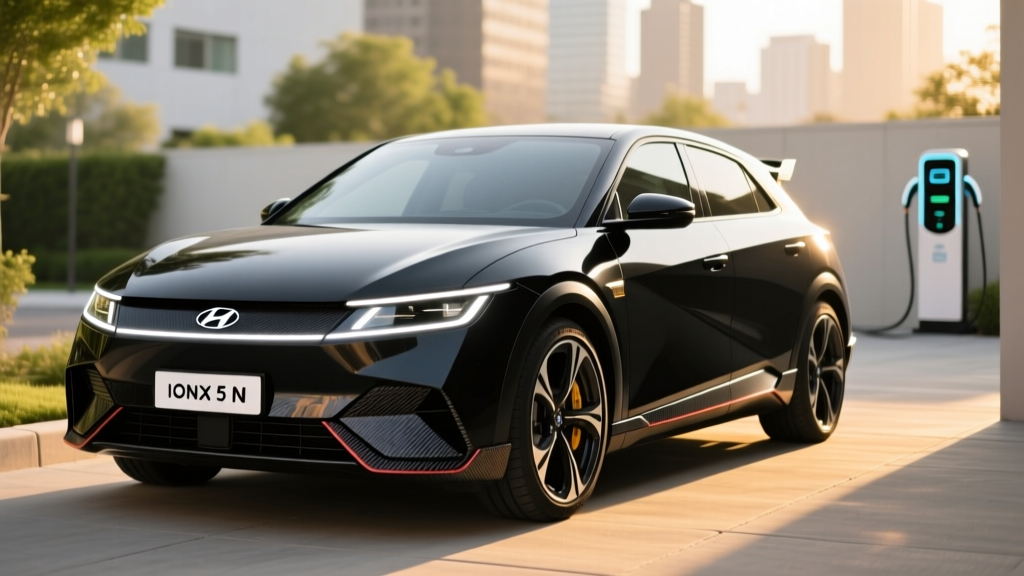
When Hyundai launched the Ioniq 5 N, it didn't just enter the performance EV segment — it reset expectations for what a hot electric crossover could cost. Now, as 2026 Hyundai Ioniq 5 N lease deals start surfacing at dealerships, buyers are asking the right question: can you actually get into a 601-horsepower, track-capable electric SUV for less than you'd expect?
This review covers the full picture — EPA range, real-world efficiency, DC fast-charging curves, interior practicality, and exactly what the lease math looks like before and after the §30D federal tax credit. We've driven the Ioniq 5 N in varied conditions and cross-referenced official specs with real-world data to give you the numbers that actually matter at the dealership.
| Spec | Value |
|---|---|
| EPA Range | 221 miles |
| Battery (usable) | 84.0 kWh, NMC lithium-ion |
| Drivetrain | Dual-motor AWD |
| Horsepower (N Grin Boost) | 641 hp / 568 lb-ft (601 hp standard) |
| 0–60 mph | 3.4 seconds |
| Max DC Fast Charge | 238 kW (800V architecture) |
| 10–80% DC Charge Time | ~18 minutes |
| Level 2 Charge Rate | 10.9 kW (~37 mi/hr) |
| EPA Efficiency | 86 MPGe combined (39 kWh/100 mi) |
| Cargo Volume (rear seats up) | 27.2 cu ft |
| Cargo Volume (rear seats folded) | 59.3 cu ft |
| Base MSRP | $67,475 (including destination) |
| Battery/Powertrain Warranty | 10 years / 100,000 miles |
Real-World Range: What the EPA Number Doesn't Tell You
The EPA rates the Ioniq 5 N at 221 miles of combined range. That's the headline figure, and for a 601-hp performance SUV with 21-inch wheels and sticky Pirelli P Zero summer tires, it's defensible. But real-world results diverge meaningfully depending on how and where you drive.
Real-World Highway (70–80 mph, moderate temps): ~180–195 miles
Real-World City/Suburban Mixed: ~210–225 miles
Cold Weather (below 32°F, highway): ~145–165 miles
Track Day / Aggressive Driving: Plan for 100–130 miles per charge
The 84.0 kWh NMC (nickel manganese cobalt) battery pack uses Hyundai's proven E-GMP platform with an 800-volt architecture. NMC chemistry was chosen here over LFP (lithium iron phosphate) for its higher energy density — necessary to pack enough capacity into a performance vehicle that also needs structural rigidity for track use. The trade-off is that NMC batteries benefit more from keeping state of charge between 20–80% for daily driving to minimize long-term degradation, rather than routinely charging to 100%.
Why the range drop-off on the highway? The Ioniq 5 N's aggressive aerodynamic profile, wider 275-section tires, and stiffer sport suspension all create more rolling resistance and drag than the standard Ioniq 5. At sustained 75+ mph speeds, expect consumption around 42–45 kWh/100 mi versus the EPA's 39 kWh/100 mi combined rating. In winter, battery thermal management draws additional energy, and cold temperatures reduce the cell's ability to accept and deliver charge efficiently — a 25–35% range reduction is typical for NMC packs in sub-freezing conditions.
For context, fueleconomy.gov lists the standard Ioniq 5 Limited AWD at 290 miles of range, illustrating the performance tax the N variant pays. If range is your top priority, the N isn't the trim for you. But if you're cross-shopping a Tesla Model Y Performance or Porsche Macan EV, the Ioniq 5 N's range is competitive within the performance tier.
Charging Speed: 800V Architecture Means Real Fast-Charging
This is where the Ioniq 5 N separates itself from most competitors. Thanks to its 800-volt electrical architecture, the N can accept up to 238 kW at a compatible DC fast charger — meaning 350 kW-rated Electrify America or Tesla Supercharger (with NACS adapter) stations can actually push meaningful power into this battery.
| Charge Level | Power (kW) | Speed (mi/hr added) | Notes |
|---|---|---|---|
| Level 1 (120V household) | 1.4 kW | ~4–5 mi/hr | Emergency only; full charge in ~60+ hours |
| Level 2 (240V home) | 10.9 kW | ~37 mi/hr | 0–100% in ~8.5 hours; ideal for overnight |
| DC Fast (50 kW station) | 50 kW | ~160 mi/hr | 10–80% in ~65 min |
| DC Fast (150 kW station) | ~135 kW sustained | ~430 mi/hr | 10–80% in ~28 min |
| DC Fast (350 kW station) | 238 kW peak | ~750+ mi/hr | 10–80% in ~18 min |
The key nuance: peak kW is not sustained kW. The Ioniq 5 N hits 238 kW only briefly in the 10–30% state-of-charge window, then the charge curve tapers progressively. From 30–60%, expect roughly 180–200 kW; from 60–80%, it drops to around 120–140 kW. This is normal battery physics — higher SoC means more internal resistance, and the BMS (battery management system) throttles current to protect cell health. The 18-minute 10–80% figure assumes battery preconditioning is active (navigating to a charger via the built-in navigation triggers this automatically) and ambient temperatures are moderate (60–85°F).
At home on a Level 2 charger — a 48-amp hardwired unit on a 60-amp circuit — you'll add roughly 37 miles of range per hour, fully replenishing the pack overnight in about 8.5 hours. This is the charging setup most Ioniq 5 N owners will rely on daily, and it's more than adequate given that most drivers travel under 40 miles per day.
The Ioniq 5 N ships with a CCS1 connector. Hyundai has confirmed NACS (Tesla connector) compatibility via adapter for Supercharger access, and 2026 models are expected to begin transitioning to native NACS ports. Verify with your dealer which connector your specific build includes.
Performance: What 641 Horsepower Feels Like in a Crossover
Let's be direct: the Ioniq 5 N is absurdly fast for what it is. With N Grin Boost engaged (a 10-second burst mode), the dual-motor AWD system delivers 641 horsepower and 568 lb-ft of torque, launching the 4,861-pound crossover to 60 mph in 3.4 seconds. That's quicker than a base Porsche 911 Carrera and within striking distance of a Lamborghini Huracán — in a five-door Hyundai with a back seat and cargo hatch.
Standard output is 601 hp, which still outpaces the Tesla Model Y Performance (510 hp) and the Ford Mustang Mach-E GT (480 hp). The dual-motor setup provides torque-vectoring capability, and Hyundai's N division tuned the suspension, steering, and regenerative braking specifically for track durability — something most performance EVs can't claim. The Ioniq 5 N completed multiple laps at the Nürburgring during development without battery thermal throttling, a significant engineering achievement.
The N-specific regenerative braking system (N Pedal) offers aggressive one-pedal driving with up to 0.65g of deceleration, and simulated gear shifts (N e-Shift) replicate the feel of an 8-speed dual-clutch transmission — complete with shift shock and rev-matching. Whether you find the simulated shifts gimmicky or engaging is personal preference, but they're toggleable, and the raw EV acceleration mode is always available.
For buyers evaluating performance EVs, the Ioniq 5 N occupies a unique position: genuine track capability at a sub-$70K price point, with a usable back seat and daily-driver comfort. The trade-off is the 221-mile range and the fact that those 21-inch wheels and low-profile tires will need replacement sooner than a standard Ioniq 5's 19-inch setup — budget roughly $1,800–$2,400 for a set of Pirellis every 15,000–20,000 miles under aggressive driving.
Lease Deals, Pricing & Federal Tax Credit Breakdown
The 2026 Hyundai Ioniq 5 N carries a base MSRP of $67,475, including the $1,375 destination charge. There are no additional trim levels — the N is a single, fully loaded configuration. Options are limited to paint color (Performance Blue, Abyss Black, Atlas White, and others) and a $300 carpeted floor mat set. A well-equipped as-tested price typically lands between $67,475 and $68,200.
| Scenario | Amount |
|---|---|
| Base MSRP (incl. destination) | $67,475 |
| §30D Federal Tax Credit (if eligible) | Up to $7,500 |
| Price After Max Credit | ~$59,975 |
| Typical 36-mo Lease (est. w/ $4,000 down) | $699–$849/mo* |
| Typical Lease w/ Credit Applied as Cap Reduction | $549–$699/mo* |
*Lease estimates vary by dealer, region, credit tier, and money factor. Verify with local Hyundai dealer for actual quotes.
Does the Ioniq 5 N Qualify for the §30D Federal Tax Credit?
This is where buyers need to pay close attention. The Ioniq 5 N is assembled in South Korea, which under current IRS §30D rules means it does not qualify for the new clean vehicle credit when purchased outright. The North American final assembly requirement is a hard disqualifier for the purchase credit.
However, there is a potential workaround through the commercial clean vehicle credit (§45W), which some lessors have used to pass savings to lessees. When Hyundai Motor Finance or a dealer structures the lease, the leasing entity (as the vehicle owner) may claim the commercial credit and apply it as a capitalized cost reduction — effectively lowering your monthly payment. This is not guaranteed and depends on the lessor's tax position and current guidance. Several lessees of imported Hyundai/Kia EVs have reported seeing $7,500 in lease cash applied, but you must confirm this directly with the dealer's finance department before signing.
- MSRP Cap: SUVs/crossovers must be under $80,000 MSRP — the Ioniq 5 N at $67,475 clears this easily.
- Buyer Income Cap (if purchase credit were available): $150K single / $300K joint modified AGI.
- Battery Sourcing Requirements: Critical minerals and battery components must meet phased percentage thresholds from US or FTA-partner countries. South Korea's supply chain is largely compliant, but final assembly location is the binding constraint here.
- Point-of-Sale Transfer: If any credit is available, it can be transferred to the dealer at purchase or applied as lease cap reduction — verify with your dealer's F&I office.
Bottom line: do not assume you'll get $7,500. Ask the dealer specifically whether the lease includes a pass-through of any commercial credit, get it in writing on the lease worksheet, and consult a tax professional if structuring a purchase through a business entity.
Interior, Cargo & Daily Livability
The Ioniq 5 N's cabin is built on the same spacious E-GMP platform as the standard Ioniq 5, but with N-specific upgrades: heavily bolstered sport seats with N badging, a suede-wrapped steering wheel, aluminum pedals, and a unique N-themed digital instrument cluster. The dual 12.3-inch displays (instrument cluster and infotainment) run Hyundai's latest software with wireless Apple CarPlay and Android Auto, over-the-air updates, and the Digital Key 2 feature that lets your smartphone function as the key fob.
Passenger space remains generous: 41.7 inches of front legroom and 39.4 inches of rear legroom accommodate adults comfortably in both rows. The rear seatbacks recline, and the flat floor (thanks to the skateboard battery architecture) makes the middle seat usable for short trips.
Cargo volume is 27.2 cubic feet behind the rear seats and 59.3 cubic feet with them folded — competitive with the Tesla Model Y (30.2/72.1 cu ft) and substantially more than a Porsche Macan EV. There is no front trunk (frunk) on the Ioniq 5 N; the space is occupied by additional cooling hardware for the performance powertrain.
Notable drawbacks: the sport seats, while supportive on track, are firmer than the standard Ioniq 5's cushions and may not suit everyone on long highway commutes. Road noise from the 21-inch Pirellis is noticeably higher than the standard model, and the N-tuned suspension transmits more pavement imperfection into the cabin — a deliberate choice for the target buyer, but worth a test drive if comfort is a priority.
Driver Assistance & Safety Technology
The Ioniq 5 N includes Hyundai's full SmartSense ADAS suite:
- Highway Driving Assist 2 (HDA-2): Adaptive cruise control with lane centering and automated lane changes — an SAE Level 2 system requiring constant driver supervision.
- Forward Collision-Avoidance Assist with pedestrian, cyclist, and junction-turning detection.
- Blind-Spot View Monitor displaying a camera feed in the instrument cluster when signaling.
- Rear Cross-Traffic Collision-Avoidance Assist and Safe Exit Assist.
- Remote Smart Parking Assist: The car can park itself in tight spaces while you stand outside via the key fob.
The Ioniq 5 N has not been crash-tested by NHTSA or IIHS as of early 2026, but the standard Ioniq 5 earned a 2022 IIHS Top Safety Pick+ award and a 5-star NHTSA overall rating. The N variant shares the same body structure and airbag systems.
Who Should Lease the Ioniq 5 N — And Who Shouldn't
The Hyundai Ioniq 5 N is a specific vehicle for a specific buyer. Here's the decision framework:
- You want supercar-rivaling acceleration in a practical daily driver
- You plan to attend track days or autocross events and need a car that can survive them
- You're cross-shopping the Tesla Model Y Performance, BMW i4 M50, or Porsche Macan 4 E and want the most engaging driver experience per dollar
- You can charge at home and your daily commute is under 150 miles round-trip
- You value the 10-year/100,000-mile battery warranty as long-term peace of mind
- Maximum range is your top priority (consider the standard Ioniq 5 SEL at 310+ miles EPA)
- You regularly drive 250+ miles without stopping and don't want to plan charging
- You need a third row or maximum cargo volume (look at the Kia EV9 or Tesla Model X)
- Ride comfort and quiet are more important than sport handling
- You cannot charge at home and have no reliable Level 2 access near your routine
Pros, Cons & Competitor Comparison
- 641 hp / 3.4-sec 0–60 in a $67K crossover
- 800V architecture enables true 18-min 10–80% DC charging
- Genuine track durability — engineered for sustained high-output laps
- 10-year/100,000-mile battery and powertrain warranty
- Spacious cabin with 59.3 cu ft max cargo
- N e-Shift and sound simulation add engagement without mandatory commitment
- Comprehensive SmartSense ADAS included at no extra cost
- 221-mile EPA range is the lowest in the Ioniq 5 lineup
- South Korea assembly complicates federal tax credit eligibility
- 21-inch summer tires are expensive to replace ($1,800–$2,400/set)
- Firmer ride and more road noise than the standard Ioniq 5
- No front trunk (frunk) due to cooling hardware
- Single trim level — no option to delete features you don't want
- Heavy at 4,861 lbs — you feel the mass in tight transitions
Against the Tesla Model Y Performance ($52,490, 303 mi range, 3.5-sec 0–60), the Ioniq 5 N costs more and goes less far, but offers superior build quality, a more engaging driving experience, and faster peak charging. The BMW i4 M50 ($70,700, 245 mi, 3.7-sec) is a sedan — not a crossover — and similarly priced, but less practical. The Porsche Macan 4 E starts above $80K and delivers a more premium badge, but the Hyundai matches or beats it on acceleration at a fraction of the cost.
Frequently Asked Questions
What is the real-world range of the Hyundai Ioniq 5 N?
The EPA rates it at 221 miles combined. In real-world highway driving at 70–80 mph, expect 180–195 miles. In cold weather below freezing, highway range can drop to 145–165 miles. City and suburban driving yields results closest to the EPA figure, around 210–225 miles.
How fast does the Ioniq 5 N charge at home and on the road?
At home on a Level 2 (240V, 48-amp) charger, it adds about 37 miles of range per hour and fully charges in roughly 8.5 hours. On a 350 kW DC fast charger, it peaks at 238 kW and charges from 10–80% in approximately 18 minutes with battery preconditioning active.
How much does a Hyundai Ioniq 5 N lease cost per month?
Lease pricing varies widely by dealer, region, and credit tier. Expect roughly $699–$849 per month on a 36-month lease with $4,000 down. If the lessor passes through a $7,500 commercial credit as a cap cost reduction, monthly payments can drop to $549–$699. Always get a detailed lease worksheet before signing.
Does the Ioniq 5 N qualify for the $7,500 federal EV tax credit?
Not directly for purchase — it's assembled in South Korea, failing the North American final assembly requirement under §30D. However, some leasing entities may claim the commercial clean vehicle credit (§45W) and pass savings to lessees as a cap cost reduction. Confirm with your dealer's finance department and get it in writing.
Is the Ioniq 5 N worth it over the standard Ioniq 5?
If performance driving, track capability, and the thrill of 641 hp matter to you, the N is a compelling upgrade. If you prioritize range (310+ miles in the standard AWD), lower cost ($47K–$57K), and a more comfortable ride, the standard Ioniq 5 is the smarter daily driver. They serve different use cases.
What battery chemistry does the Ioniq 5 N use and how long will it last?
The Ioniq 5 N uses an NMC (nickel manganese cobalt) lithium-ion battery with 84.0 kWh usable capacity. Hyundai backs it with a 10-year/100,000-mile warranty guaranteeing at least 70% capacity retention. NMC cells typically retain 85–90% capacity after 100,000 miles under normal use. For longevity, charge to 80% daily and reserve 100% charges for road trips.