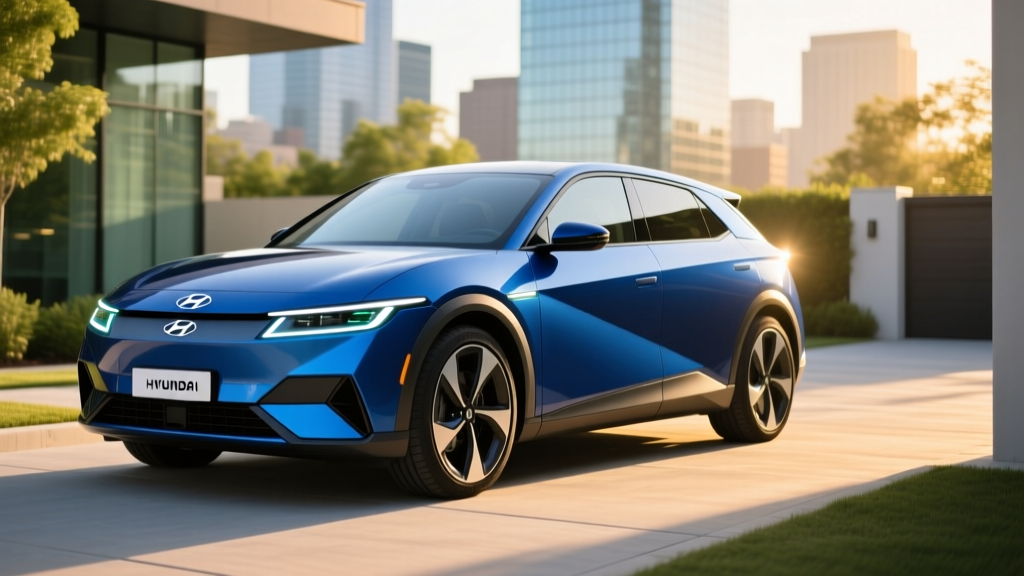
Lease promotions on the Hyundai Ioniq 5 shift monthly, and the June 2025 window lands at a pivotal moment: the refreshed 2025 model year is fully stocked at dealers, federal tax credit pass-through rules are in effect, and Hyundai's own leasing arm has been aggressively pricing the Ioniq 5 to compete with the Tesla Model Y, Ford Mustang Mach-E, and Kia EV6. Whether you're cross-shopping or ready to sign, here's the full technical and financial picture you need before committing.
2025 Hyundai Ioniq 5: Quick Verdict
The Ioniq 5 remains one of the best-rounded EVs in the midsize crossover segment. Its 800V architecture delivers genuinely fast DC charging, the cabin is spacious and well-built, and the updated infotainment system addresses most early complaints. The main trade-off is efficiency — it's slightly thirstier on the highway than a Model Y, and the base Standard Range model's 245-mile EPA rating won't suit road-trippers. For lessees, the calculus is different than buyers: Hyundai Motor Finance sometimes passes the $7,500 federal credit through as a lease capitalization cost reduction, which can make monthly payments extremely competitive. That dynamic makes the June 2025 window worth close attention.
Range, Battery, and Efficiency
The 2025 Ioniq 5 is offered with two battery packs across multiple trims. Here are the core specs:
| Spec | Standard Range (RWD) | Long Range (RWD) | Long Range (AWD) |
|---|---|---|---|
| Battery (usable) | 63.0 kWh | 84.0 kWh | 84.0 kWh |
| Chemistry | NMC | NMC (4th-gen) | NMC (4th-gen) |
| EPA Range | 245 mi | 318 mi | 290 mi |
| MPGe (combined) | 114 MPGe | 117 MPGe | 110 MPGe |
| kWh/100 mi | 29 | 29 | 30 |
| Horsepower | 168 hp | 225 hp | 320 hp |
| 0-60 mph | 7.4 sec | 6.7 sec | 4.5 sec |
| Drivetrain | RWD | RWD | Dual-motor AWD |
The 4th-generation NMC cells in the Long Range pack offer improved energy density and slightly better thermal stability over earlier Ioniq 5 iterations. Hyundai does not offer an LFP variant in the US market for this model year, which means you get higher energy density but should avoid routinely charging to 100% daily — keeping between 20–80% extends long-term battery health.
Charging Speed: DC Fast and Home Level 2
This is where the Ioniq 5's E-GMP platform and 800V architecture genuinely shine. The vehicle can accept up to 240 kW on a compatible DC fast charger, and the charge curve is notably flat compared to competitors — meaning it sustains high power deeper into the session rather than spiking and tapering immediately.
| Charging Level | Power / Rate | Time / Miles Added |
|---|---|---|
| Level 1 (120V household) | ~1.4 kW | ~4 mi/hr |
| Level 2 (240V home, 48A) | 10.9 kW | ~36 mi/hr; full charge ~8.5 hr |
| DC Fast Charge (peak) | 240 kW | 10–80% in ~18 min |
| DC Fast Charge (50 kW station) | 50 kW | 10–80% in ~75 min |
Charging curve reality: The Ioniq 5 peaks near 240 kW between roughly 10–35% state of charge, then gradually steps down to around 150 kW through 60%, and further tapers above 80%. That 18-minute 10–80% figure assumes a 350 kW-class charger and battery preconditioning (which the Ioniq 5 initiates automatically when you navigate to a DC fast charger via the built-in route planner). On Electrify America 150 kW stalls, expect 10–80% in roughly 25–28 minutes instead.
For home charging, the onboard 10.9 kW AC charger is competitive. On a 48-amp Level 2 circuit (requiring a 60-amp breaker), you'll add about 36 miles of range per hour, easily replenishing a full day's driving overnight. Installation cost for a home Level 2 setup typically runs $800–$2,000 depending on panel proximity and local permit fees, but this is a one-time cost that makes EV ownership dramatically cheaper than public charging.
Lease Pricing, Tax Credits, and June 2025 Deals
Pricing for the 2025 Ioniq 5 starts at $42,600 for the SE Standard Range and climbs through SE, SEL, Limited, and the new XRT trim. Here's the MSRP breakdown:
| Trim | MSRP | Est. Lease (36 mo, $3,999 down)* | Federal Credit Eligible? |
|---|---|---|---|
| SE Standard Range | $42,600 | ~$349–$399/mo | Yes (if income/sourcing met) |
| SE Long Range RWD | $46,650 | ~$399–$449/mo | Yes |
| SEL AWD | $50,100 | ~$449–$499/mo | Yes |
| Limited AWD | $56,200 | ~$529–$579/mo | Yes |
| XRT AWD | $54,300 | ~$499–$549/mo | Yes |
*Lease estimates are approximate and vary by dealer, region, credit tier, and current Hyundai Motor Finance promotions. June 2025 national offers may include lease cash or loyalty bonuses.
- Income cap: Modified AGI must not exceed $150,000 (single), $225,000 (head of household), or $300,000 (joint).
- MSRP cap: The vehicle MSRP must not exceed $80,000 for SUVs/crossovers (all Ioniq 5 trims qualify).
- Battery sourcing: Critical minerals and battery components must meet phased-in thresholds. Hyundai has confirmed US-market Ioniq 5s meet current sourcing requirements, but always verify the specific VIN on the IRS qualified vehicles list before purchasing.
- Point-of-sale transfer: You can transfer the credit to the dealer at purchase for an immediate price reduction — or, in a lease, the leasing company (Hyundai Motor Finance) claims the credit and may pass savings through as a lower capitalized cost.
Interior, Cargo, and Daily Practicality
The Ioniq 5's cabin is one of its strongest selling points. The flat floor (thanks to the dedicated EV platform) creates genuine limousine-like rear legroom — 39.4 inches in the back seat, which exceeds the Model Y and most gas-powered midsize SUVs. Cargo volume is 27.2 cubic feet behind the rear seats and 59.3 cubic feet with them folded. The front trunk (frunk) adds 0.85 cubic feet on AWD models and 2.0 cubic feet on RWD — enough for charging cables and a small bag but not a major storage space.
The dual 12.3-inch displays (instrument cluster and infotainment) run Hyundai's latest ccNC software, which supports wireless Apple CarPlay and Android Auto, over-the-air updates, and a native EV route planner with charging stop integration. Physical buttons for climate control and volume are retained — a welcome choice versus the touch-only trend.
Notable drawbacks: The rear wiper is absent (a common complaint on earlier models, though the 2025 refresh added one on select trims). The panoramic glass roof lacks a retractable shade on some trims, leading to cabin heat buildup in summer. And while the infotainment is improved, the native navigation's charging-station data occasionally lags behind PlugShare or A Better Route Planner in accuracy.
Driver Assistance and Safety
Hyundai equips the Ioniq 5 with Highway Driving Assist 2 (HDA2), which combines adaptive cruise control with lane-centering steering and automatic lane-change assist. This is an SAE Level 2 system — it requires continuous driver supervision and does not make the vehicle self-driving. Hands must remain on the wheel (or be detected via the capacitive steering wheel), and eyes must stay on the road.
The Ioniq 5 does not offer hands-free driving on par with GM's Super Cruise or Ford's BlueCruise. Hyundai's HDA2 is competent for highway commuting but demands more driver engagement than those hands-free systems. If hands-off highway driving is a priority, the Ioniq 5 falls short of those competitors in this specific area.
Pros and Cons at a Glance
- 800V architecture: 10–80% in ~18 min on 350 kW chargers
- Spacious cabin with class-leading rear legroom (39.4 in)
- US-built (Ellabell, GA) — full $7,500 federal credit eligibility (with caveats)
- Standard heat pump on Long Range trims for cold-weather efficiency
- V2L (Vehicle-to-Load) capability — power devices/camping gear at up to 3.6 kW
- Competitive lease pricing when credit is passed through
- IIHS Top Safety Pick+ and 5-star NHTSA
- Standard Range's 245-mile EPA rating limits road-trip utility
- Slightly lower highway efficiency than Tesla Model Y Long Range
- Frunk is small (0.85 cu ft AWD) compared to some rivals
- Hands-free driving not available (HDA2 requires hands-on)
- Panoramic roof lacks shade on some trims
- AWD models lose ~28 miles of range vs RWD equivalent
- No rear wiper on base trims (2025 refresh partially addressed this)
Who Should Lease the Ioniq 5 (and Who Shouldn't)
Best for: Daily commuters with home charging who want a spacious, fast-charging crossover for suburban and occasional road-trip use. The Long Range RWD at 318 miles covers most weekly driving on a single charge, and the DC fast-charge speed makes longer trips practical. Families who value rear-seat space over sporty driving dynamics will find the Ioniq 5 more comfortable than the Kia EV6 and roomier than the Ford Mustang Mach-E.
Consider alternatives if: You need hands-free highway driving (look at the Ford Mustang Mach-E with BlueCruise or a GM Ultium vehicle with Super Cruise). You prioritize maximum range and efficiency above all else (the Tesla Model Y Long Range delivers ~330 miles and higher MPGe). You regularly tow — the Ioniq 5's 2,300-pound towing capacity (AWD) is modest compared to the Rivian R1S or Ford F-150 Lightning.
Warranty and Long-Term Battery Confidence
Hyundai backs the Ioniq 5 with a 5-year/60,000-mile new-vehicle warranty and a 10-year/100,000-mile battery and powertrain warranty. The battery warranty guarantees the pack will retain at least 70% of its original capacity during the coverage period — a standard threshold in the industry. Hyundai's 10-year/100k battery warranty is among the longest available and provides meaningful protection for lessees (who typically drive 10,000–15,000 miles per year and will never approach the limit during a 36-month lease).
For buyers who eventually purchase out their lease or buy used, the battery warranty is transferable to subsequent owners, though it reduces to 10 years/100,000 miles from the original in-service date regardless.
Frequently Asked Questions
What is the real-world range of the 2025 Hyundai Ioniq 5?
The EPA rates the Long Range RWD at 318 miles and the Long Range AWD at 290 miles. In real-world highway driving at 70–75 mph, expect roughly 265–285 miles (RWD) and 240–260 miles (AWD). Cold weather (below 32°F) can reduce range by 15–25%, dropping highway range to approximately 210–240 miles on the AWD model.
How fast does the Ioniq 5 charge at home and on the road?
At home on a 240V Level 2 charger (48A), the Ioniq 5 charges at up to 10.9 kW, adding about 36 miles of range per hour — a full charge from empty takes roughly 8.5 hours. On DC fast chargers, the 800V architecture enables a peak rate of 240 kW, achieving a 10–80% charge in approximately 18 minutes on a 350 kW-class station. On more common 150 kW chargers, expect 25–28 minutes for 10–80%.
Does the Hyundai Ioniq 5 qualify for the $7,500 federal EV tax credit?
Yes, the US-built Ioniq 5 (assembled in Ellabell, GA) is eligible for the full $7,500 credit under IRS §30D, provided the buyer meets income caps ($150K single / $300K joint modified AGI), the MSRP is under $80,000 (all trims qualify), and battery sourcing requirements are met. In a lease, the leasing company claims the credit; ask your dealer whether Hyundai Motor Finance passes it through as a cap cost reduction.
Is it better to lease or buy the Ioniq 5 in 2025?
Leasing makes sense if you want lower monthly payments, plan to upgrade in 3 years, and Hyundai's lease cash promotions are strong. The $7,500 credit may be passed through to reduce lease costs. Buying makes more sense if you drive fewer than 15,000 miles annually, want to keep the vehicle 6+ years, or your state offers additional purchase-only incentives. Run the numbers at your specific dealer — the answer depends heavily on current local incentives and your credit tier.
How does the Ioniq 5 compare to the Tesla Model Y and Kia EV6?
The Ioniq 5 offers more rear-seat legroom than both, faster DC charging than the EV6 (which shares the platform but has slightly different tuning), and a more conventional cabin layout than the Model Y. The Model Y wins on efficiency and Supercharger network access. The EV6 is sportier to drive but has less cargo room. The Ioniq 5 occupies the middle ground: practical, fast-charging, and family-friendly without being the sportiest or most efficient in class.
What is the Ioniq 5's V2L feature and how does it work?
Vehicle-to-Load (V2L) allows the Ioniq 5 to power external devices through a standard 120V outlet (using an included adapter plugged into the charge port or a built-in outlet in the rear seat area on select trims). It provides up to 3.6 kW of continuous power — enough to run camping equipment, power tools, or small appliances during an outage. It's a genuinely useful feature that most competitors don't offer.