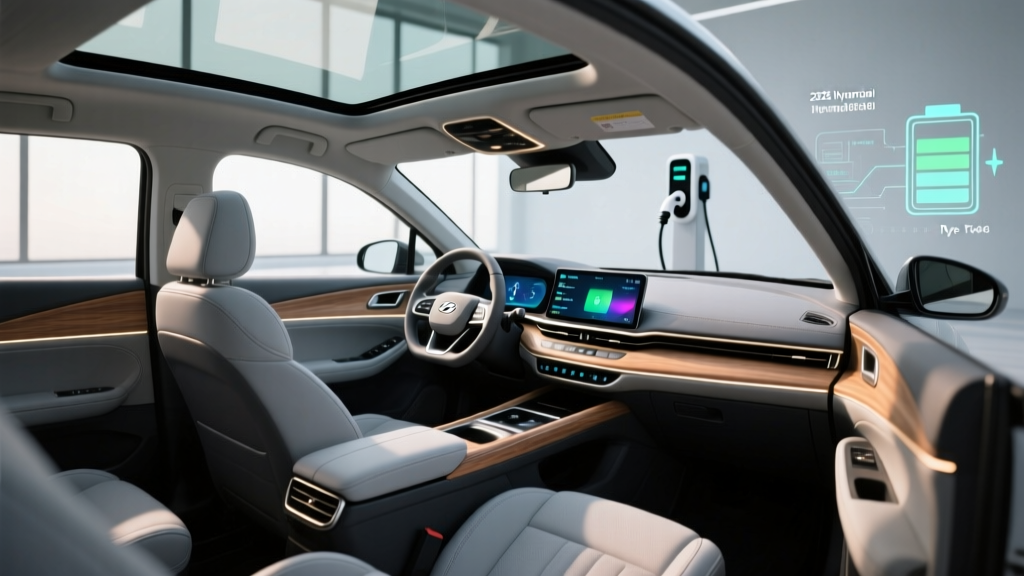
The Hyundai Ioniq 5 has been one of the most compelling electric crossovers since its launch, but the 2026 model year brings a meaningful refresh: a slightly larger battery, the addition of the Tesla NACS charging port from the factory, and an interior that now includes a standard rear windshield wiper, a redesigned center console with physical HVAC controls, and expanded storage. For buyers researching the Hyundai Ioniq 5 interior, the headline is practicality — this cabin was designed around a flat floor and a sliding center console ("Universal Island") that gives it a lounge-like feel while preserving serious cargo volume.
This review covers everything a real buyer needs: exact range, charging speeds, interior dimensions, pricing with tax-credit math, and the ownership trade-offs versus the Tesla Model Y, Ford Mustang Mach-E, and Kia EV6.
2026 Hyundai Ioniq 5 Quick Specs
| Spec | SE / SEL RWD | SEL AWD | Limited AWD | Ioniq 5 N |
|---|---|---|---|---|
| EPA Range | 318 mi | 290 mi | 274 mi | 221 mi |
| Battery (usable) | 84.0 kWh (NMC) | 84.0 kWh (NMC) | 84.0 kWh (NMC) | 84.0 kWh (NMC) |
| Horsepower | 168 hp | 320 hp | 320 hp | 641 hp (N Grin Boost) |
| 0–60 mph | 7.4 sec | 4.5 sec | 4.5 sec | 3.25 sec |
| Drivetrain | RWD single-motor | AWD dual-motor | AWD dual-motor | AWD dual-motor |
| Peak DC Fast Charge | ~240 kW | ~240 kW | ~240 kW | ~240 kW |
| 10–80% DC Time | ~18 min | ~18 min | ~18 min | ~18 min |
| MPGe (combined) | 132 MPGe | 111 MPGe | 106 MPGe | 85 MPGe |
| Base MSRP | $42,600 | $47,100 | $53,700 | $66,400 |
Sources: fueleconomy.gov, Hyundai USA. Pricing excludes destination.
Hyundai Ioniq 5 Interior: Space, Layout, and Materials
The Ioniq 5 rides on Hyundai's E-GMP platform, which pushes the wheels to the corners and eliminates the transmission tunnel. The result is a wheelbase of 118.1 inches — longer than many midsize SUVs — and a cabin that feels a full class larger than its compact-crossover footprint suggests.
Passenger and Cargo Dimensions
| Dimension | Measurement |
|---|---|
| Front headroom | 39.6 in |
| Front legroom | 41.7 in |
| Rear headroom | 38.0 in |
| Rear legroom | 39.4 in |
| Cargo behind rear seats | 27.2 cu ft |
| Cargo (rear seats folded) | 59.3 cu ft |
| Front trunk (frunk) | 0.85 cu ft (AWD) / 2.0 cu ft (RWD) |
The 2026 interior update adds several quality-of-life improvements buyers have requested since launch:
- Physical HVAC controls: The previous touchscreen-only climate strip is replaced by a dedicated row of buttons and knobs below the main display — a major usability win while driving.
- Redesigned Universal Island console: The sliding armrest/console now has deeper storage, a wireless charging pad with active cooling, and USB-C ports (front and rear) capable of 27W PD charging for laptops.
- Rear windshield wiper and washer: Finally standard, addressing one of the most persistent complaints about the original design.
- Updated infotainment: A 12.3-inch cluster and 12.3-inch center touchscreen running Hyundai's latest ccNC software with native wireless Apple CarPlay and Android Auto, plus over-the-air updates.
- Relaxation seats (front): Available on SEL and standard on Limited, the driver and passenger seats recline into a zero-gravity "relaxation" position with leg rests — useful during DC fast-charging stops.
Material quality is strong for the segment: soft-touch surfaces on the dash and door uppers, recycled PET fabric on the seats (SEL/Limited), and eco-processed leather on Limited trims. The Ioniq 5 N adds Alcantara and N-specific sport bucket seats with heavier bolstering.
Real-World Range vs. EPA Estimates
The 2026 Ioniq 5 uses an updated 84.0 kWh usable (approximately 87 kWh gross) lithium-ion battery pack with NMC (nickel-manganese-cobalt) chemistry supplied by SK On. Hyundai has not adopted LFP for this model — the energy density of NMC is required to hit the 318-mile EPA target in a package this size.
Efficiency on the RWD Long Range is rated at 132 MPGe combined, which translates to roughly 25 kWh per 100 miles. That's competitive with the Tesla Model Y Long Range RWD and meaningfully better than the Ford Mustang Mach-E Extended Range RWD (111 MPGe combined). The AWD trims drop to 106–111 MPGe due to the second motor's weight and drag.
For the Ioniq 5 N, range is a clear trade-off: 221 miles EPA, with real-world track or aggressive driving easily dropping below 150 miles. This is a performance vehicle first, and buyers should treat it as such.
Charging Speed: 800V Architecture Still Pays Off
One of the Ioniq 5's biggest engineering advantages remains its 800-volt electrical architecture, which enables faster DC charging than the 400V systems used by most competitors outside of Porsche, Kia (EV6/EV9), and Lucid.
| Charging Level | Power / Rate | Time / Miles Added |
|---|---|---|
| Level 1 (120V household) | ~1.4 kW | ~4 mi/hr |
| Level 2 (240V home, 48A) | 10.9 kW | ~32 mi/hr; full charge in ~8.5 hr |
| DC Fast Charge (350 kW station) | Peak ~240 kW | 10–80% in ~18 min |
| DC Fast Charge (150 kW station) | ~135 kW sustained | 10–80% in ~28 min |
Charging curve reality: The Ioniq 5 peaks near 240 kW between roughly 10–35% state of charge, then tapers progressively. From 80–100%, charging slows dramatically — expect the final 20% to take nearly as long as the 10–80% session. For road trips, plan stops from 10–80% and move on; topping off to 100% at a DC fast charger wastes time and increases battery wear over the long term.
For 2026, the Ioniq 5 ships with the NACS (Tesla-style) charge port natively, meaning direct access to Tesla Supercharger V3 and V4 stalls without an adapter. Hyundai also includes a CCS1 adapter in the box for compatibility with Electrify America, EVgo, and other legacy networks during the infrastructure transition. Home Level 2 charging uses the same NACS connector.
Home charging note: To achieve the full 10.9 kW Level 2 rate, you need a 48-amp hardwired EVSE on a 60-amp dedicated circuit. A NEMA 14-50 outlet on a 50-amp circuit will deliver ~9.6 kW (40A continuous), adding ~28 miles per hour. Budget $800–$2,000 for a quality Level 2 home install depending on panel proximity; older homes may require a $2,000–$4,000 panel upgrade to 200A service.
Pricing, Trims, and Federal Tax Credit Eligibility
| Trim | MSRP | Est. After §30D Credit* |
|---|---|---|
| SE Standard Range RWD | $42,600 | $35,100 |
| SE RWD Long Range | $46,100 | $38,600 |
| SEL AWD | $47,100 | $39,600 |
| Limited AWD | $53,700 | $46,200 |
| Ioniq 5 N | $66,400 | $58,900 |
*Federal tax credit estimate assumes buyer and vehicle qualify. See eligibility details below.
The 2026 Ioniq 5 is assembled at Hyundai's Metaplant in Ellabell, Georgia, which makes it eligible for the IRS §30D federal EV tax credit — up to $7,500 — provided the buyer meets income requirements and the vehicle's battery sourcing complies with critical-mineral and battery-component rules that tighten annually. As of the 2026 tax year, the credit can be transferred to the dealer at point of sale as an immediate purchase-price reduction, which is how most buyers will experience it.
§30D Eligibility Checklist
- MSRP cap: SUVs must be under $80,000 — all Ioniq 5 trims qualify.
- Buyer income cap: AGI must not exceed $150,000 (single), $225,000 (head of household), or $300,000 (joint).
- Battery sourcing: Critical minerals and battery components must meet escalating domestic/free-trade-partner thresholds. Hyundai has been actively reshoring battery supply with SK On's U.S. plants, but exact compliance varies by build month — verify the VIN on the fueleconomy.gov tax credit tool before purchase.
- Point-of-sale transfer: Available for 2026 — the $7,500 can reduce your out-of-pocket cost at the dealer rather than waiting for a tax refund.
Important: Tax credit rules under IRS §30D are subject to legislative and regulatory change. Consult a tax professional and verify your specific VIN's eligibility before committing to a purchase.
Performance and Driving Impressions
The RWD Long Range is the efficiency sweet spot: 168 hp from a single rear motor is adequate for commuting (0–60 in 7.4 seconds), and the rear-biased weight distribution gives it a planted, slightly sporty feel unusual for a crossover. Regen braking is well-calibrated with adjustable levels via steering-wheel paddles, including an i-Pedal one-pedal mode that brings the car to a complete stop.
The AWD dual-motor trims (320 hp, 4.5 seconds to 60 mph) offer confident highway merging and all-weather traction. Torque delivery is instant, as expected from an EV, and the Ioniq 5's ride quality — tuned on the softer side — absorbs road imperfections better than the stiffer Kia EV6.
The Ioniq 5 N is a different animal entirely: 641 hp with N Grin Boost engaged, simulated 8-speed dual-clutch shifts (complete with "rev matching" and jolts), and an N e-Shift mode that makes it feel like a hot hatch. It's thrilling but comes with a steep range penalty and a $66,400 price tag.
Driver Assistance (ADAS)
The 2026 Ioniq 5 includes HDA 2 standard on all trims, along with forward collision-avoidance assist, blind-spot collision-avoidance, rear cross-traffic avoidance, and safe exit assist. The Limited trim adds Hyundai's Digital Key 2 (phone-as-key via NFC/UWB), a head-up display with augmented-reality navigation, and Remote Smart Parking Assist (the car can park itself in tight spaces while you stand outside).
Ownership: Warranty, Costs, and Who It's For
Hyundai backs the Ioniq 5 with one of the strongest warranties in the segment:
- Battery: 10 years / 100,000 miles (capacity retention above 70%)
- Powertrain: 10 years / 100,000 miles
- New vehicle limited: 5 years / 60,000 miles
- Roadside assistance: 5 years / unlimited miles
- Complimentary maintenance: 3 years / 36,000 miles
The 10-year battery warranty exceeds the federal minimum of 8 years/100,000 miles and provides meaningful long-term reassurance. Hyundai's battery degradation data from earlier model years suggests roughly 8–12% capacity loss over 100,000 miles under normal use, which keeps most packs well within warranty thresholds.
Who Should Buy the Ioniq 5?
- You want the most spacious interior in the compact EV crossover segment
- You prioritize ultra-fast DC charging for road trips (800V architecture)
- You value a comfortable, soft-riding daily driver over sporty handling
- You need NACS Supercharger access without an adapter
- You need maximum range — the Tesla Model Y Long Range AWD offers ~320 mi with AWD
- You want a sportier drive — the Kia EV6 GT-Line AWD is sharper in corners
- You need three rows — consider the Kia EV9 or Hyundai Ioniq 9
- Frunk space is critical — the Ioniq 5's AWD frunk is tiny (0.85 cu ft)
Pros and Cons
Pros
- Class-leading interior space and rear legroom
- 800V charging: 10–80% in ~18 minutes at 350 kW stations
- Native NACS port for 2026 — direct Supercharger access
- 10-year/100,000-mile battery and powertrain warranty
- Physical HVAC controls return for 2026
- Strong value after $7,500 federal credit
Cons
- AWD frunk is nearly useless (0.85 cu ft)
- AWD range drops noticeably vs. RWD (274 vs. 318 mi EPA)
- No front trunk storage on AWD models to speak of
- Rear wiper was missing pre-2026 (now fixed)
- Infotainment learning curve with Hyundai's ccNC system
- Ioniq 5 N range is impractical for road trips (221 mi EPA)
Frequently Asked Questions
What is the real-world range of the 2026 Hyundai Ioniq 5?
The RWD Long Range is EPA-rated at 318 miles. In real-world highway driving at 70 mph in moderate weather, expect 260–285 miles. In cold weather (below freezing), plan for 210–230 miles. AWD trims lose 8–12% range in equivalent conditions.
How fast does the Ioniq 5 charge at home and on the road?
At home on a 48-amp Level 2 charger, the Ioniq 5 charges at 10.9 kW, adding about 32 miles per hour — a full charge takes roughly 8.5 hours. On a 350 kW DC fast charger, it peaks at ~240 kW and charges from 10–80% in about 18 minutes, thanks to its 800-volt architecture.
Does the 2026 Ioniq 5 qualify for the $7,500 federal tax credit?
Yes, the Ioniq 5 is U.S.-assembled (Georgia) and qualifies for up to $7,500 under IRS §30D, subject to buyer income caps ($150K single / $300K joint), MSRP caps (under $80K for SUVs — all trims qualify), and battery-sourcing requirements. The credit can be transferred at point of sale for an immediate price reduction. Verify your specific VIN on fueleconomy.gov before purchasing.
Is the Hyundai Ioniq 5 worth buying over the Tesla Model Y or Kia EV6?
The Ioniq 5 wins on interior space, ride comfort, and charging speed (800V vs. Tesla's 250 kW peak). The Model Y Long Range AWD offers slightly more range and access to Tesla's proprietary Supercharger network (though the Ioniq 5 now has native NACS access). The Kia EV6 shares the same platform but has a sportier driving character and a more coupe-like interior with slightly less rear headroom. For most families prioritizing comfort and practicality, the Ioniq 5 is the strongest all-around choice in this segment.
What is the Hyundai Ioniq 5 battery warranty?
Hyundai provides a 10-year / 100,000-mile battery warranty guaranteeing capacity retention above 70%. The powertrain is also covered for 10 years / 100,000 miles, and the new-vehicle limited warranty runs 5 years / 60,000 miles.
Does the Ioniq 5 have a front trunk (frunk)?
Yes, but it's small. The RWD model offers about 2.0 cubic feet — enough for a charging cable bag. The AWD model's frunk shrinks to just 0.85 cubic feet due to the front motor, making it nearly impractical for storage.