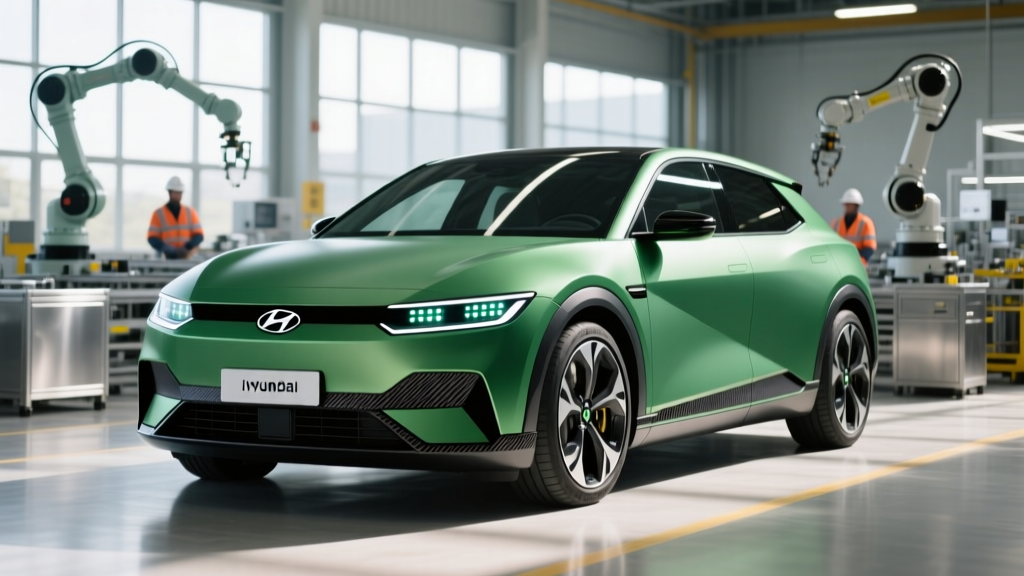
The Hyundai Ioniq 5 has been a benchmark compact electric crossover since its U.S. debut, but the story shifted dramatically in late 2024 when Hyundai launched stateside production at its Metaplant America facility in Ellabell, Georgia. That Hyundai Ioniq 5 production start date in Georgia (October 2024) wasn't just a manufacturing milestone — it fundamentally changed the vehicle's tax-credit eligibility, pricing competitiveness, and delivery timelines for American buyers. Now in its 2025/2026 model-year cycle, the Georgia-built Ioniq 5 is one of the most compelling EVs in the $40,000–$55,000 segment. This review covers every number that matters.
Quick Verdict: Is the Georgia-Built Ioniq 5 Worth It?
The Ioniq 5 remains one of the best all-around electric crossovers on the market, and domestic production has only strengthened its value proposition. The 800-volt E-GMP architecture delivers class-leading DC fast-charging speeds, the interior is genuinely spacious, and Hyundai's warranty coverage is among the best in the industry. The Georgia-built models qualify for the full federal tax credit under current IRS §30D rules — a significant advantage over imported competitors that may not clear battery-sourcing requirements. If you need a daily-driver EV with road-trip capability and don't require three rows of seats, the Ioniq 5 should be on your shortlist.
Range, Efficiency & Real-World Expectations
The Ioniq 5 is offered with two battery configurations across its trim lineup. The Standard Range models use a smaller pack, while the Long Range variants carry the larger battery that most buyers will want.
| Trim / Drivetrain | Battery (kWh usable) | EPA Range (mi) | MPGe (city/hwy/combined) | kWh/100 mi |
|---|---|---|---|---|
| SE Standard Range RWD | 58.0 (LFP) | 245 | 129 / 108 / 119 | 29 |
| SE / SEL / Limited RWD (Long Range) | 77.4 (NMC) | 303 | 134 / 109 / 122 | 28 |
| SE / SEL / Limited AWD (Long Range) | 77.4 (NMC) | 270–290 | 119 / 99 / 110 | 31 |
The EPA estimates 303 miles for the Long Range RWD, but real-world results depend heavily on conditions. Expect approximately 250–270 miles on sustained highway driving at 70–75 mph. In cold weather (below 32°F), range drops 15–30% depending on cabin heating demand — plan for 210–250 miles in winter conditions. The Ioniq 5's standard heat pump (on Long Range trims) helps mitigate this loss compared to EVs without thermal management. City driving with frequent regenerative braking can push you close to or even slightly above the EPA number.
Charging Speed: 800V Architecture Pays Off
Hyundai's E-GMP platform supports 800-volt DC fast charging — a feature still uncommon in this price class. This allows the Ioniq 5 to accept significantly higher charge rates than 400V competitors, provided you're plugged into a capable charger (350 kW units from Electrify America, EVgo, or similar networks).
| Charging Level | Power / Rate | Time / Miles Added |
|---|---|---|
| Level 1 (120V household) | ~1.4 kW | ~4 mi/hr — full charge in 50+ hours |
| Level 2 (240V home/public) | 10.9 kW (48A) | ~34 mi/hr — 10–100% in ~8 hrs |
| DC Fast Charge (peak) | 240 kW (Long Range) | 10–80% in ~18 min |
| DC Fast Charge (Standard Range) | 150 kW | 10–80% in ~24 min |
Charging-curve reality check: The 240 kW peak rate is only sustained between roughly 10–40% State of Charge. Above 60%, the curve tapers significantly — expect 80–100 kW in the 60–80% band, and a slow trickle above 90%. The 10–80% time of 18 minutes is genuinely achievable at a 350 kW charger with battery preconditioning active. Without preconditioning (or in cold weather), add 5–10 minutes.
For home charging, the Ioniq 5 accepts 10.9 kW on a Level 2 circuit (48-amp, requiring a 60-amp breaker). A typical overnight session from 20–80% takes about 4.5 hours — more than sufficient for daily driving needs. Installation of a Level 2 home charger typically costs $800–$2,000 depending on panel capacity and wiring distance, per fueleconomy.gov guidance on home charging.
Performance & Drivetrain
The Ioniq 5 isn't positioned as a performance EV, but it's far from slow. The rear-wheel-drive Long Range model delivers 168 kW (225 hp) and 258 lb-ft of torque from its single rear motor, yielding a 0–60 mph time of approximately 7.0 seconds. The dual-motor AWD variant bumps output to 239 kW (320 hp) and 446 lb-ft, cutting the 0–60 time to 4.5 seconds.
| Variant | Horsepower | Torque (lb-ft) | 0–60 mph | Drivetrain |
|---|---|---|---|---|
| Standard Range RWD | 168 hp (125 kW) | 258 | ~7.4 sec | RWD (single motor) |
| Long Range RWD | 225 hp (168 kW) | 258 | ~7.0 sec | RWD (single motor) |
| Long Range AWD | 320 hp (239 kW) | 446 | ~4.5 sec | AWD (dual motor) |
The AWD model's 4.5-second sprint is genuinely quick for a family crossover, and the instant electric torque makes highway merging effortless. Regenerative braking is adjustable through four levels (including a strong one-pedal mode) via steering-wheel paddles. Ride quality is compliant — Hyundai tuned the Ioniq 5 for comfort over sportiness, which suits most buyers in this segment.
Battery Chemistry: LFP vs. NMC by Trim
Hyundai uses two different battery chemistries across the Ioniq 5 lineup, each with distinct trade-offs:
| Factor | LFP (Standard Range) | NMC (Long Range) |
|---|---|---|
| Usable capacity | 58.0 kWh | 77.4 kWh |
| Energy density | Lower (heavier per kWh) | Higher (lighter per kWh) |
| Cycle life | 3,000+ cycles (excellent) | 1,500–2,000 cycles (good) |
| Recommended daily charge | Can charge to 100% daily | Better at 80–90% daily |
| Cold-weather performance | More range loss in cold | Better cold-weather retention |
| Cost | Lower | Higher |
Practical takeaway: If your daily commute is under 60 miles round-trip and you rarely road-trip, the Standard Range LFP model offers superior long-term battery longevity and the convenience of daily 100% charging. For road-trippers and those with longer commutes, the Long Range NMC battery's extra 58 miles of EPA range and better cold-weather behavior justify the trade-off.
Interior Space, Cargo & Technology
The Ioniq 5's E-GMP skateboard platform yields a flat floor and a long 118.1-inch wheelbase, translating to genuinely generous interior volume:
- Front legroom: 41.7 inches
- Rear legroom: 39.4 inches — more than most midsize SUVs
- Cargo behind rear seats: 27.2 cu ft
- Cargo with rear seats folded: 59.3 cu ft
- Front trunk (frunk): 0.85 cu ft (RWD) / 0.43 cu ft (AWD) — small, fits a charging cable bag
The dual 12.3-inch displays (digital cluster and infotainment) run Hyundai's latest software with wireless Apple CarPlay and Android Auto. Physical buttons for climate control are a welcome practicality choice. The center console slides fore and aft by up to 5.5 inches — a unique feature that eases front-seat cross-overs in tight parking spaces.
Driver assistance: Hyundai's Highway Driving Assist 2 (HDA2) is a competent SAE Level 2 system offering adaptive cruise with stop-and-go, lane-centering, and lane-change assist. It is not a hands-off autonomous system — the driver must remain engaged at all times. The Ioniq 5 also includes standard forward collision-avoidance, blind-spot monitoring, rear cross-traffic alert, and safe-exit assist.
Unique feature: Vehicle-to-Load (V2L) capability allows the Ioniq 5 to power external devices — camping equipment, power tools, or home appliances during outages — at up to 3.6 kW through an interior outlet or external adapter. This is a genuinely useful feature competitors like the Tesla Model Y lack.
Pricing, Trims & Federal Tax Credit
Georgia production was the key to unlocking the full $7,500 federal EV tax credit under IRS §30D for qualifying buyers. Here's the current pricing landscape:
| Trim | Base MSRP | After $7,500 Credit* | Key Features |
|---|---|---|---|
| SE Standard Range | $42,600 | $35,100 | 18" alloys, HDA2, heated front seats |
| SE Long Range | $46,100 | $38,600 | 303-mi range, power liftgate |
| SEL Long Range | $49,100 | $41,600 | Leatherette, panoramic roof, HDA2+ |
| Limited AWD | $57,100 | $49,600 | Nappa leather, HUD, premium audio, ventilated seats |
The $7,500 credit is available at point-of-sale (as a direct price reduction) for buyers meeting all of the following criteria per IRS guidelines:
- Income caps: Modified AGI ≤ $150,000 (single) / $300,000 (joint)
- MSRP cap: Vehicle MSRP must not exceed $55,000 (SUVs/crossovers — the Ioniq 5 qualifies)
- Battery sourcing: Critical minerals and battery components must meet escalating domestic/free-trade sourcing thresholds
- Assembly: Final assembly must be in North America (Georgia-built Ioniq 5 qualifies)
Not all trims qualify — the Limited AWD at $57,100 exceeds the $55,000 MSRP cap. Verify eligibility with your tax professional before purchase. Rules are subject to change; consult irs.gov for the latest.
Pros & Cons
✓ Pros
- Class-leading 240 kW DC fast charging (10–80% in ~18 min)
- Spacious rear seat (39.4" legroom) and flat floor
- Full $7,500 tax credit eligibility on most trims
- Industry-leading 10-yr/100,000-mi powertrain warranty
- V2L capability for off-grid power
- Standard heat pump on Long Range trims
- Physical climate controls — no screen-diving
✗ Cons
- No front wiper on rear window (visibility issue in rain)
- Small frunk — barely fits a charging cable
- AWD Limited trim exceeds tax-credit MSRP cap
- Rear wiper was not standard on early production (check model year)
- Infotainment learning curve for first-time EV owners
- No third row — families needing 7 seats must look elsewhere
- Insurance premiums 10–20% higher than gas Tucson equivalent
Warranty Coverage
Hyundai's warranty remains one of the strongest in the EV market:
- Battery: 10 years / 100,000 miles (capacity retention threshold: 70% of original capacity)
- Powertrain: 10 years / 100,000 miles
- New vehicle limited: 5 years / 60,000 miles
- Anti-perforation: 7 years / unlimited miles
- Roadside assistance: 5 years / unlimited miles
The 70% battery capacity retention threshold is standard for the industry. Real-world data from early Ioniq 5 owners (2022–2024 models) suggests degradation of approximately 3–5% after 30,000 miles — well within the warranty safety margin. Hyundai's 10-year coverage provides long-term peace of mind that most competitors match only at 8 years.
Who Should Buy the Ioniq 5?
Decision Framework
Choose the Ioniq 5 if:
- You want a daily commuter with 250+ real-world miles of range and road-trip fast-charging capability
- You value interior space and rear-seat comfort over sporty handling
- You qualify for the §30D tax credit and want the full $7,500 point-of-sale reduction
- You need V2L for camping, job-site tools, or emergency home backup power
- You plan to own the vehicle 8+ years and want warranty coverage to match
Look elsewhere if:
- You need three rows / 7-passenger seating (consider the Kia EV9 or Hyundai Ioniq 9)
- You want the Tesla Supercharger network without an adapter (Ioniq 5 uses NACS port on 2025+ models, granting access, but Tesla's native integration is smoother)
- You prioritize sporty handling — the Ford Mustang Mach-E GT or BMW iX are more engaging to drive
- You regularly tow more than 2,300 lbs (Ioniq 5 max towing: 2,300 lbs with AWD)
Frequently Asked Questions
When did Hyundai Ioniq 5 production start in Georgia?
Hyundai began U.S. production of the Ioniq 5 at its Metaplant America facility in Ellabell, Georgia in October 2024. This was the first vehicle produced at the plant, which is part of Hyundai's $7.6 billion U.S. manufacturing investment. Georgia-built Ioniq 5 vehicles began arriving at dealerships in late 2024 and early 2025.
What is the real-world range of the Ioniq 5?
The EPA rates the Long Range RWD at 303 miles, but expect 250–270 miles on highway trips at typical speeds. In winter conditions, plan for 210–250 miles. The AWD variant's real-world highway range is approximately 230–250 miles. City driving with regenerative braking can approach or slightly exceed the EPA figure.
How fast does the Ioniq 5 charge at home and on the road?
On a 240V Level 2 home charger, the Ioniq 5 accepts 10.9 kW, adding about 34 miles per hour — a full charge takes roughly 8 hours. On a 350 kW DC fast charger, the Long Range model peaks at 240 kW and charges from 10–80% in approximately 18 minutes with battery preconditioning active.
Does the Ioniq 5 qualify for the $7,500 federal EV tax credit?
Yes — most trims qualify under current IRS §30D rules thanks to Georgia assembly and compliant battery sourcing. However, buyers must meet income caps ($150K single / $300K joint) and the vehicle MSRP must not exceed $55,000. The Limited AWD trim ($57,100 MSRP) does not qualify. The credit is available as a point-of-sale price reduction. Always confirm eligibility with a tax professional before purchase.
How does the Ioniq 5 compare to the Tesla Model Y?
The Ioniq 5 offers comparable range (303 vs. ~320 miles EPA), faster DC charging (240 kW vs. ~250 kW peak, but the Ioniq 5 sustains higher rates longer), and a more comfortable ride. The Model Y wins on cargo space, Supercharger network convenience, and over-the-air update frequency. The Ioniq 5 wins on rear-seat comfort, V2L capability, and warranty length (10 years vs. Tesla's 8 years/120,000 miles for battery).
Is the Ioniq 5 good for road trips?
Yes. The 800V fast-charging system means you can add ~180 miles of range in 15 minutes at a capable DC charger. Combined with comfortable seats, a quiet cabin, and HDA2 for highway fatigue reduction, it's one of the better road-trip EVs in its class. Plan charging stops around Electrify America or EVgo 350 kW stations for best results.
Sources: EPA range and efficiency data via fueleconomy.gov; IRS §30D tax credit rules via irs.gov; Hyundai Ioniq 5 specifications via Hyundai USA.